Executive Overview
In a major development for the modern web and artificial intelligence engineering ecosystems, Vercel and Amazon Web Services (AWS) have announced a powerful architectural integration. Developers building and scaling web applications, microservices, and AI models on Vercel can now provision and manage Amazon Simple Storage Service (Amazon S3)—including Amazon S3 Tables and Amazon S3 Vectors—directly within the Vercel Marketplace and through v0 by Vercel.
Historically, marrying the high-performance frontend orchestration of platforms like Vercel with the deep, scalable object-storage capabilities of AWS required a fragmented and tedious workflow. Engineers had to context-switch out of their deployment pipelines, log into the AWS Management Console, manually configure cross-account access policies, generate static security credentials, and handle environment variables by hand.
This new native integration fundamentally changes that paradigm. By blending the durability, enterprise-grade scalability, and cost efficiency of Amazon S3 with Vercel’s frictionless provisioning workflow, developers can now deploy a complete, end-to-end application stack entirely within the Vercel ecosystem. This includes seamless interoperability with previously integrated AWS primitives such as Amazon Aurora, Amazon DynamoDB, and Amazon OpenSearch Serverless. All of this is executed under a unified billing umbrella and secured via modern OpenID Connect (OIDC) authentication, eliminating static keys and reducing administrative overhead.
Detailed Chronology & Technical Architecture
The Evolution of Cloud Toolchain Consolidation
The journey toward a unified developer experience between frontend-as-a-service platforms and hyperscale cloud providers has been iterative. Over the past several years, Vercel established robust integrations with serverless databases and data stores like Amazon Aurora, DynamoDB, and OpenSearch Serverless. However, a glaring gap remained: object storage, analytics-grade tabular data, and vector embeddings—the lifeblood of modern AI applications—were still bound to traditional, separate configuration pipelines.
With this announcement, Amazon S3 bridges that gap across three specialized workloads:
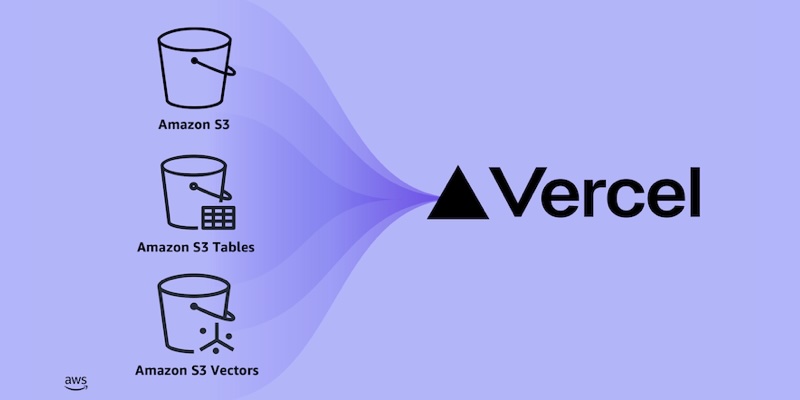
- Everyday General-Purpose Object Storage: For handling traditional web assets, media uploads, and document repositories.
- Analytics via Amazon S3 Tables: For managing massive datasets with fully managed Apache Iceberg tables that automatically optimize query performance.
- AI Workloads via Amazon S3 Vectors: For native, cost-optimized vector storage powering semantic search and Retrieval-Augmented Generation (RAG) pipelines without requiring a standalone, dedicated vector database engine.
Provisioning and Zero-Static-Key Security
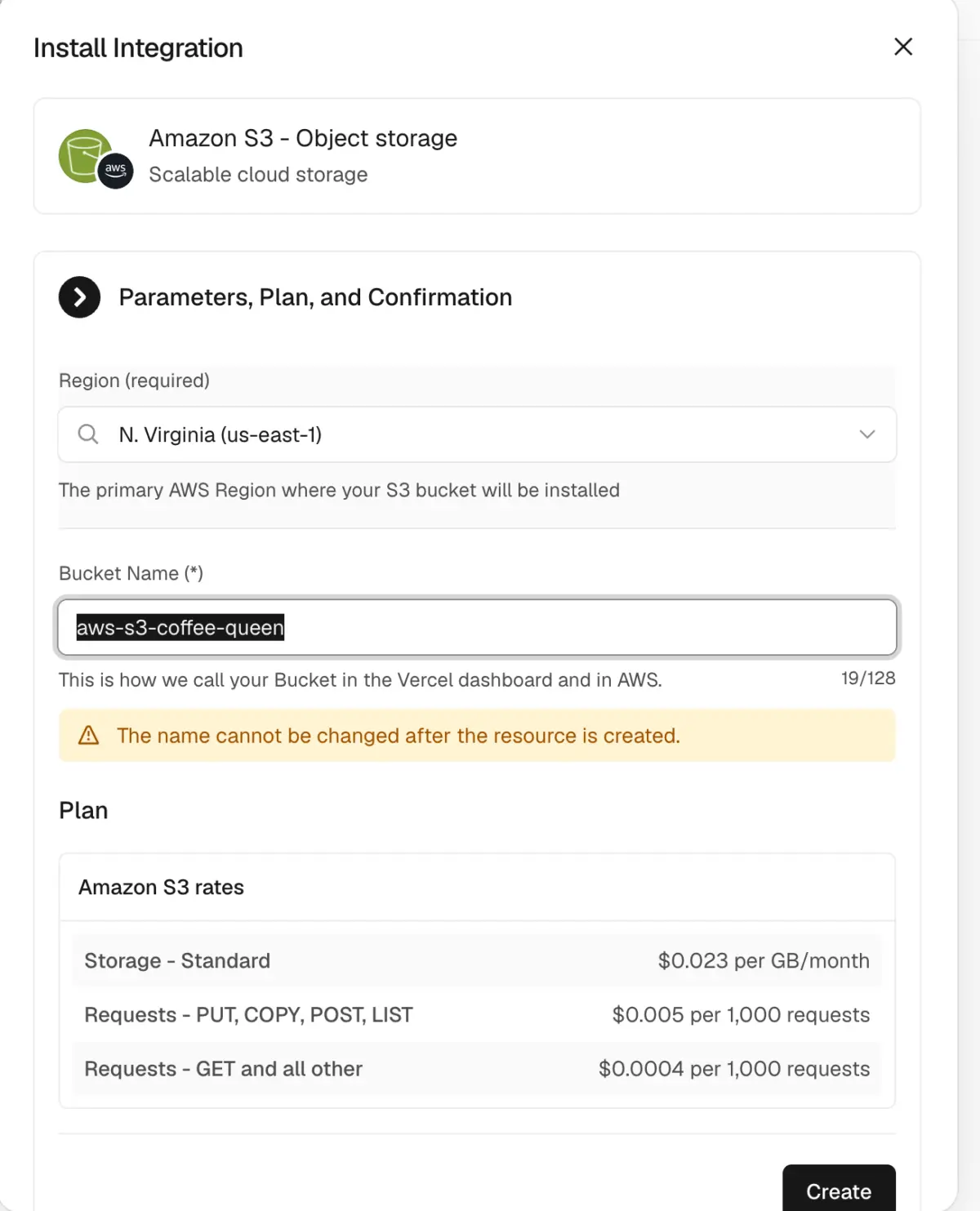
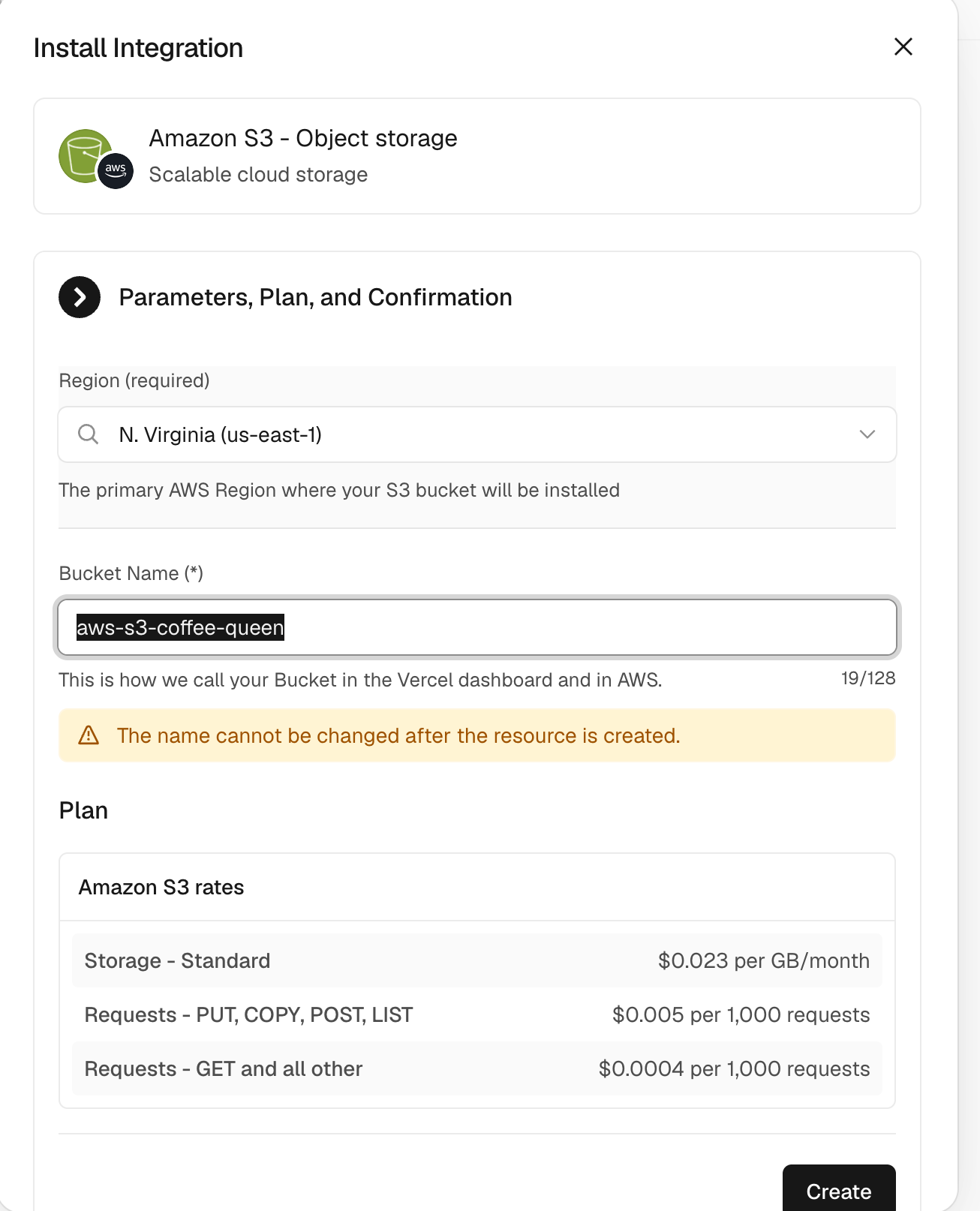
Getting started with the integration has been designed for maximum velocity. From the Vercel dashboard, engineering teams navigate to the Storage tab, select AWS, choose their desired S3 bucket type, specify a target AWS Region, and instantiate the bucket in seconds.
Once connected to a project, developers pull environment variables locally using the Vercel CLI:
vercel link
vercel env pull .env.local
Crucially, the system abandons risky long-lived IAM keys. Instead, the integration injects essential environment variables such as AWS_REGION, AWS_ROLE_ARN, AWS_RESOURCE_ARN, and bucket-specific identifiers. At runtime, the awsCredentialsProvider function from @vercel/functions/oidc seamlessly exchanges a short-lived OIDC token with the AWS Security Token Service (AWS STS) for temporary, highly scoped credentials.
Practical Implementations Across Workloads
1. General-Purpose Object Storage with Next.js
Handling file uploads in a Next.js API route is streamlined using the standard @aws-sdk/client-s3 coupled with Vercel’s OIDC credential provider:
import  S3Client, PutObjectCommand  from "@aws-sdk/client-s3";
import  awsCredentialsProvider  from "@vercel/functions/oidc";

const s3 = new S3Client(
  region: process.env.AWS_REGION,
  credentials: awsCredentialsProvider(
    roleArn: process.env.AWS_ROLE_ARN,
  ),
);

export async function POST(request)
  const formData = await request.formData();
  const file = formData.get("file");

  await s3.send(new PutObjectCommand(
    Bucket: process.env.S3_BUCKET_NAME,
    Key: file.name,
    Body: Buffer.from(await file.arrayBuffer()),
    ContentType: file.type,
  ));

  return Response.json( success: true );
2. High-Performance Analytics with S3 Tables and DuckDB
Amazon S3 Tables introduce purpose-built storage for analytics workloads, featuring automated table maintenance and compaction for Apache Iceberg tables. Developers can leverage DuckDB directly inside a Vercel Serverless Function to execute high-speed analytical queries against their S3 data lakehouses:

import  DuckDBInstance  from "@duckdb/node-api";
import  awsCredentialsProvider  from "@vercel/functions/oidc";

const creds = await awsCredentialsProvider(
  roleArn: process.env.AWS_ROLE_ARN,
)();

const db = await DuckDBInstance.create();
const conn = await db.connect();

await conn.run("INSTALL aws; LOAD aws; INSTALL httpfs; LOAD httpfs; INSTALL iceberg; LOAD iceberg;");

await conn.run(`
  CREATE SECRET s3cred (
    TYPE s3,
    KEY_ID '$creds.accessKeyId',
    SECRET '$creds.secretAccessKey',
    SESSION_TOKEN '$creds.sessionToken',
    REGION '$process.env.AWS_REGION'
  );
`);

await conn.run(`
  ATTACH '$process.env.AWS_RESOURCE_ARN' AS s3tables (
    TYPE iceberg,
    ENDPOINT_TYPE s3_tables
  );
`);

const rows = await (await conn.run(`
  SELECT town_city, AVG(median_price) AS avg_price
  FROM s3tables."$process.env.S3_TABLES_NAMESPACE".town_monthly
  GROUP BY town_city
  ORDER BY avg_price DESC
  LIMIT 10
`)).getRowObjects();
(Note: When bundling DuckDB within Next.js routes, developers must declare @duckdb/node-api under serverExternalPackages in next.config.mjs to prevent bundling errors with native C++ bindings).
3. Native Vector Search for AI Agents
With S3 Vectors, applications can perform semantic searches and power AI agents directly over data stored in S3, bypassing the complexity of managing separate vector databases:
import  S3VectorsClient, QueryVectorsCommand  from "@aws-sdk/client-s3vectors";
import  awsCredentialsProvider  from "@vercel/functions/oidc";

const vectors = new S3VectorsClient(
  region: process.env.AWS_REGION,
  credentials: awsCredentialsProvider(
    roleArn: process.env.AWS_ROLE_ARN,
  ),
);

export async function POST(request)
  const  embedding  = await request.json();

  const result = await vectors.send(new QueryVectorsCommand(
    vectorBucketName: process.env.S3_VECTOR_BUCKET_NAME,
    indexName: "documents",
    queryVector:  float32: embedding ,
    topK: 5,
    returnMetadata: true,
  ));

  return Response.json( matches: result.vectors );
Conversational Provisioning via v0 by Vercel
The integration extends deeply into generative development via v0 by Vercel. Developers can use natural language prompts to describe application architectures, and v0 will autonomously provision the underlying cloud resources, wire up the connection strings, and generate functional code.
- Prompting "a photo gallery where users upload images using AWS" provisions a general-purpose S3 bucket.
- Asking for "a support bot that answers questions from my PDFs" automatically spins up S3 Vectors.
- Requesting "an analytics dashboard for my clickstream data" deploys S3 Tables.
Supporting Context & Operational Metrics
Consolidation of Enterprise Billing and Architecture
Managing modern cloud infrastructure often results in operational sprawl, where development teams lose track of shadow IT, disconnected data silos, and fragmented billing portals. The Vercel-AWS collaboration addresses this by offering flexible account management models:
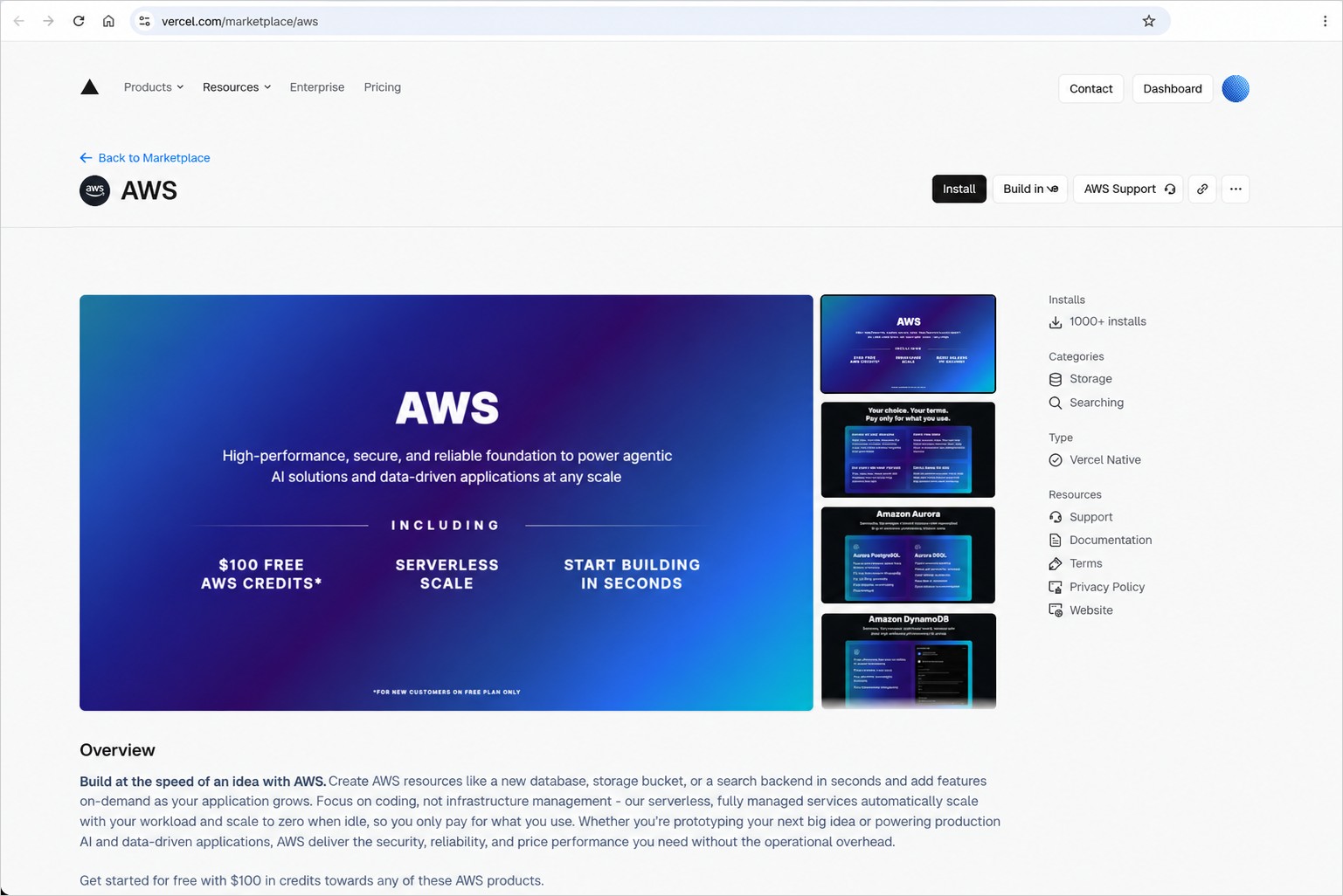
- New AWS Accounts: Developers can spin up a pristine AWS account directly through the Vercel interface, instantly unlocking a specialized tier that includes $100 in AWS credits valid for six months.
- Existing Enterprise Accounts: Organizations can link their pre-existing AWS billing accounts to Vercel. While Vercel maintains governance over the specific storage resources provisioned via its marketplace, all resource usage rolls directly into the organization’s overarching AWS enterprise discount programs (EDPs) and consolidated billing statements.
Security and Compliance Advantages
Security professionals have long criticized the practice of hardcoding static IAM user credentials into application environment variables. By standardizing on AWS IAM Roles for Service Accounts (IRSA) and OIDC token exchange, this integration meets rigorous enterprise compliance frameworks. Tokens are ephemeral, scoped precisely to the individual resource ARN, and expire automatically after fulfilling their runtime lifecycle. Furthermore, because the underlying buckets reside entirely within the customer’s chosen AWS account, organizations retain full custody of their data, encryption keys (via AWS KMS), and audit logs (via AWS CloudTrail).
Official Statements and Industry Impact
While specific executive quotes reflect the ongoing evolution of hyperscale partnerships, industry analysts view this move as a defining milestone in the maturation of full-stack developer platforms.
By abstracting away the boilerplate infrastructure code traditionally required to hook up cloud storage, Vercel and AWS are lowering the barrier to entry for sophisticated enterprise engineering. Teams no longer need dedicated DevOps specialists merely to bootstrap object storage or vector indices for an AI prototype. Instead, frontend and full-stack engineers can leverage enterprise-grade AWS primitives with the same agility traditionally reserved for lightweight, developer-centric database startups.
Future Outlook
The unification of AWS storage infrastructure with Vercel’s deployment and generation engine signals a broader industry trend: the boundaries between infrastructure-as-a-service (IaaS), platform-as-a-service (PaaS), and frontend tooling are rapidly dissolving.
As AI agents and multimodal models demand increasingly tight integration between raw data lakes, vector indices, and real-time user interfaces, architectures that minimize data movement and administrative friction will win the market. The inclusion of S3 Tables and S3 Vectors positions developers to build advanced analytical engines and RAG applications at unprecedented speeds.
For engineering leaders, the directive is clear. The days of managing disparate, brittle cloud configuration scripts are giving way to unified, intent-driven provisioning. As tools like v0 continue to mature alongside deep cloud integrations, the velocity of software delivery will accelerate, allowing product teams to focus relentlessly on business logic rather than cloud plumbing.
Getting Started and Community Resources
Developers can begin experimenting immediately by visiting v0.app or navigating to the AWS section of the Vercel Marketplace.
For technical troubleshooting, API reference checks, and regional availability matrices, AWS has also made available the AWS MCP Server and associated plugins for integration with advanced AI developer toolkits. Feedback and architectural discussions can be directed to the active community channels on AWS re:Post for Amazon S3.