Executive Overview
The B2B software ecosystem has crossed a psychological and economic Rubicon. For over a decade, the prevailing dogma of scaling a tech company mirrored standard industrial growth: top-line revenue expansion required a proportional, often linear, expansion of headcount. More sales development reps (SDRs), more back-office administrators, and vastly expanded engineering departments were viewed as the immutable cost of doing business at scale.
Today, that playbook is obsolete.
Driven by the maturation of generative AI, agentic workflows, and a shifting macroeconomic landscape, boardrooms across Silicon Valley, Europe, and global tech hubs are aggressively asking a singular, existential question: How lean can we get and still perform as well—or better—than before?
The catalyst for this renewed wave of radical efficiency is a structural shift championed by efficiency-first operators. Most recently, Bending Spoons sent shockwaves through the tech community by announcing massive layoffs across the newly acquired Airtable team. The rationale? A conviction that smaller, hyper-focused teams consistently ship faster and achieve superior product outcomes. Bending Spoons pointed to its newly established Core, Performance, and Infrastructure teams—groups that successfully delivered over 30 top customer-requested features in a mere three weeks.
This is not an isolated corporate restructuring; it is part of a broader, systemic trend. Almost every B2B Chief Executive Officer and board of directors is now re-evaluating workforce sizing. By examining deep cuts executed by major players like Cloudflare and Atlassian, alongside extreme operational models like Bending Spoons and AI-native outliers like SaaStr, a new economic reality emerges. Revenue per employee is skyrocketing, traditional departmental boundaries are dissolving under the weight of autonomous AI agents, and the metrics defining enterprise health are being rewritten in real time.
Detailed Chronology: The 2026 Restructuring Wave
The trend toward hyper-lean corporate structures accelerated significantly in early 2026. Three major enterprise entities—Cloudflare, Atlassian, and Bending Spoons—executed substantial structural reductions, each targeting different organizational layers, at different corporate stages, and for distinct strategic motivations. The outcomes of these actions now provide the broader market with concrete, public-facing data on the post-layoff realities of modern tech enterprises.
1. Cloudflare: Trimming G&A to Accelerate an Agentic Future
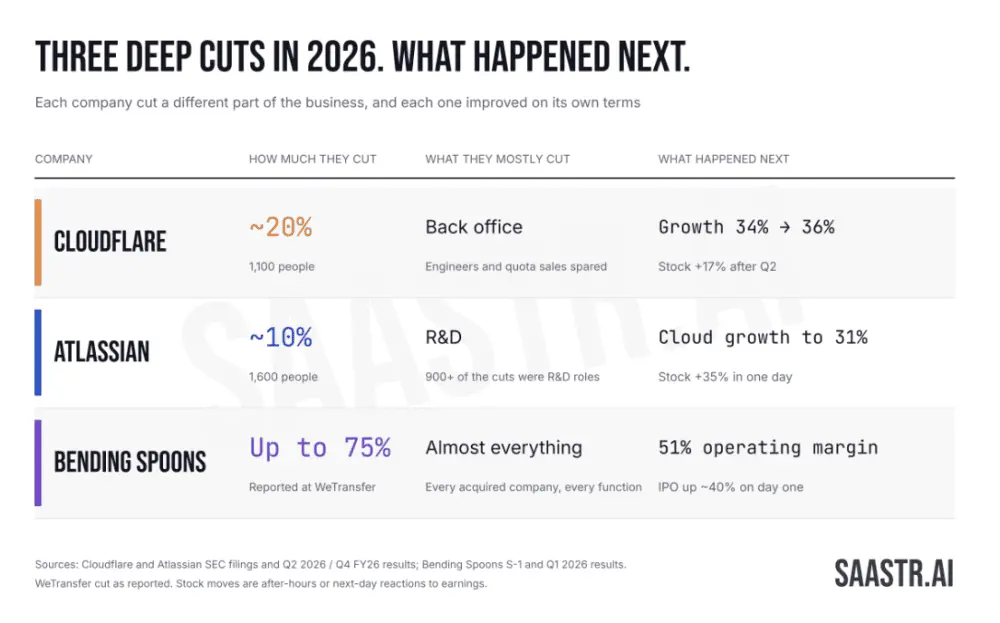
On May 7, Cloudflare announced a comprehensive strategic pivot toward an agentic AI-first operating model. This transition involved reducing its workforce by approximately 20%, resulting in restructuring charges ranging between $140 million and $150 million. At the close of 2025, Cloudflare maintained 5,156 full-time employees.
Crucially, Cloudflare executed these cuts from a position of commercial strength. On the exact day of the announcement, the company reported its strongest financial quarter on record, posting $639.8 million in revenue—a 30%+ year-over-year increase. Despite the impressive beat, the market reacted with apprehension; Cloudflare’s stock dropped more than 20% in after-hours trading.
The post-cut reality, however, told a dramatically different story. In the subsequent quarter, Cloudflare’s revenue climbed to $696.1 million (representing 36% year-over-year growth), driving a 17% surge in its stock price after hours. Management subsequently raised full-year guidance to a range of $2.86 billion to $2.87 billion, comfortably ahead of the consensus $2.81 billion, while maintaining a stellar net dollar retention rate of 120%.
Where the cuts landed: Cloudflare intentionally preserved its engineering talent and customer-facing revenue generators. Chief Executive Officer Matthew Prince structured the cuts to target back-office and administrative roles that had been streamlined by automation and AI. Quota-carrying sales positions were explicitly spared across every geographical region and department.
The growth was largely fueled by organic market demand, specifically enterprise adoption of Cloudflare Workers and agentic workloads. By positioning itself squarely in the center of the machine-to-machine traffic boom—and by streamlining General and Administrative (G&A) overhead—the company captured this surge at a radically lower operational cost structure. Prince has also indicated that Cloudflare’s total headcount is expected to rebound by 2027, albeit for entirely different, AI-enabled skill sets.
2. Atlassian: R&D Realignment and Cloud Acceleration
In March, Atlassian parted ways with roughly 10% of its global workforce—equating to approximately 1,600 positions—with a primary focus on restructuring its Research and Development (R&D) divisions. Over 900 of the eliminated roles were engineering and product development positions.
Market sentiment leading up to the announcement was bearish. Atlassian had shed more than half its market value since the beginning of 2026, driven by investor anxieties surrounding the rise of AI-native software competitors. The initial announcement prompted a modest 2% after-hours stock bump.
Yet, by the close of its June quarter, the operational impact of the restructure defied conventional expectations:

- Cloud revenue growth accelerated to 31% year-over-year.
- Enterprise adoption indicators surged, with usage metrics for the company’s MCP server and Teamwork Graph CLI exceeding one million monthly active users—more than doubling in a single quarter.
Concurrently, Atlassian restructured its upper technical leadership, splitting the traditional Chief Technology Officer role into two distinct, AI-focused engineering divisions. By pairing headcount reduction with a radical reimagining of how software is built, Atlassian proved that slashing R&D size does not inherently impair product velocity. In fact, it can often eliminate bureaucratic drag.
3. Bending Spoons: The Extreme Margin Model
Operating at the opposite end of the spectrum, Bending Spoons has institutionalized an aggressive, private-equity-style playbook for mature software acquisitions. When Bending Spoons acquires a tech asset, deep restructuring is practically guaranteed: Eventbrite announced sweeping workforce reductions weeks after a deal closed, WeTransfer saw approximately 75% of its staff cut post-acquisition, and video platform Vimeo underwent two major waves of downsizing following a $1.38 billion acquisition.
The financial profile of this model is stark: Bending Spoons routinely achieves extraordinary revenue-per-employee metrics and staggering operating margins. While the company’s net revenue retention hovers around 95%—indicating that acquired user bases naturally contract slightly over time—its overarching growth engine relies on serial acquisitions and ruthless operational efficiency.
Vimeo offers a clear case study in the trade-offs inherent in this approach. Prior to its acquisition, Vimeo boasted an ambitious product roadmap featuring a rebuilt review platform with Adobe Premiere Pro integration and natural-language search capabilities. The subsequent workforce cuts heavily impacted product innovation teams. Bending Spoons does not optimize for aggressive, hyper-growth product expansion; it optimizes for durable, high-margin cash flow. For a hyper-growth startup scaling at 60% annually, this model would prove fatal. For a mature product generating modest growth with bloated legacy headcounts, however, it represents a compelling, highly profitable blueprint.
Supporting Context & Metrics: The Rise of the Agentic Enterprise
To understand why these structural changes are succeeding, one must look beyond traditional labor models and examine the deployment of autonomous AI agents. SaaStr serves as an extreme, real-world case study in this operational shift. Operating within the $15 million to $20 million ARR bracket, the organization runs entirely on a foundation of 3 human operators backed by roughly 20 production-grade AI agents (with peak experimentation reaching 30 agents, later consolidated down to the core 6 that drive the majority of daily output).
This operational architecture yields an astonishing $6 million in revenue per human employee.
What Autonomous Agents Manage Entirely:
- Routine data processing, CRM hygiene, and pipeline reporting.
- Automated customer onboarding sequences and Tier-1 ticket triage.
- Initial content drafting, social distribution scheduling, and media monitoring.
- Internal workflow routing and administrative scheduling tasks.
What Human Judgment Retains:
- High-stakes relationship management and executive negotiations.
- Final editorial, strategic, and creative decision-making.
- Comprehensive review, auditing, and re-ranking of agent-generated outputs.
As operational experiments demonstrate, cutting headcount by 50% under the assumption that AI agents will run entirely unsupervised is a recipe for failure. Human oversight remains mandatory. Enterprises must transition from spending time executing tasks to spending time reviewing and curating automated execution.
Official Statements and Industry Commentary
The philosophical shift driving these changes is best summarized by leadership teams across the sector. Announcing the restructuring of the Airtable team under Bending Spoons’ operating thesis, executive Federico Simionato articulated the core principle on social media:
"Today we’re laying off a large part of the Airtable team. This is not a reflection of their work but a reflection of our deep belief that small teams ship more and better. For Airtable, better is about to look like a new Core team shipping your top requests monthly…"
This sentiment echoes across boardrooms globally. Leaders are recognizing that bloated organizational charts often introduce communication overhead, slowing down product iteration cycles rather than accelerating them.
Future Outlook: Departmental Breakdown and Benchmarks
As organizations plan their operational structures for the years ahead, enterprise leaders must evaluate efficiency gains on a department-by-department basis.
Function-by-Function Cut Feasibility:
- Back Office, G&A, and Operations: Prime candidates for 50% or greater reduction. As demonstrated by Cloudflare and agent-first companies, standard administrative workflows are ideally suited for automation.
- Marketing Operations and Demand Generation: 30% to 50% reduction potential. While core brand strategy and creative vision remain human-led, campaign assembly, list hygiene, and multi-variant copywriting are now reliably handled by AI agents.
- Engineering (Mature vs. Growth Organizations): Large, mature engineering organizations that expanded aggressively through the early 2020s typically harbor 10% to 20% (or greater) redundancy. Conversely, early-stage, high-growth startups should protect and even expand core engineering talent, as AI-augmented developers multiply baseline output.
- Quota-Carrying Sales: Protect and preserve. When pipelines are validated, revenue-generating reps are the final asset a healthy company should touch.
- Customer Success: Highly dependent on Average Contract Value (ACV). Low-ACV models can be largely automated via agentic support, whereas enterprise accounts carrying $100K+ ACVs continue to demand high-touch human relationship management.
Revenue-per-Employee Benchmarks
Historical metrics are rapidly shifting. According to foundational market data from ICONIQ, the median B2B software company historically hovered around $237,000 in revenue per employee. However, ICONIQ’s Pacesetter Index reveals a new baseline for elite performers: fastest-growing companies above $100M ARR now post a median of $655,000 in revenue per employee.
Cloudflare’s targeted restructuring vaulted its individual output metrics from roughly double the industry norm to a position exceeding the Pacesetter median within a single quarter. Bending Spoons pushes this extreme to its logical limit at over $2.5 million per employee.
For any B2B organization operating below $300,000 in revenue per employee while growing at less than 30% annually, the message from modern financial markets is unequivocal: prepare for rigorous board scrutiny, or let autonomous agentic workflows and lean operating structures transform your business before market pressures force your hand.