Executive Overview
The B2B software ecosystem has reached a definitive inflection point. Across boardrooms from Silicon Valley to European tech hubs, a singular, high-stakes question is dominating leadership discussions: How lean can an organization become while maintaining—or even accelerating—its performance?
This paradigm shift was thrust into the spotlight following Bending Spoons’ abrupt announcement regarding the mass layoff of the Airtable team. Defending the move, leadership doubled down on a core philosophy: small, hyper-focused teams consistently ship better, faster products. Highlighting the success of a newly formed "Core" team—which pushed out over 30 top customer-requested features in a mere three weeks, alongside newly structured Performance and Infrastructure divisions—the company underscored a broader market reality. Lean execution is no longer just a defensive play for capital preservation; it is rapidly becoming an aggressive, operational strategy for high-performance software delivery.
This mindset is trickling down to nearly every B2B Chief Executive Officer and board of directors. Armed with advanced automation, agentic AI workflows, and structural re-engineering, major technology players are proving that massive headcount is not a prerequisite for massive revenue.
To understand the mechanics of this transformation, we must examine three distinct case studies from major enterprise organizations that implemented deep operational cuts, alongside an extreme case study in high-margin private equity consolidation and an experimental blueprint for the ultra-lean, AI-native firm. Together, these stories reveal how strategic, surgical reductions in specific business units can dramatically alter a company’s trajectory.
Detailed Chronology: Case Studies in Strategic Restructuring
1. Cloudflare: Trimming the Back Office to Accelerate Growth
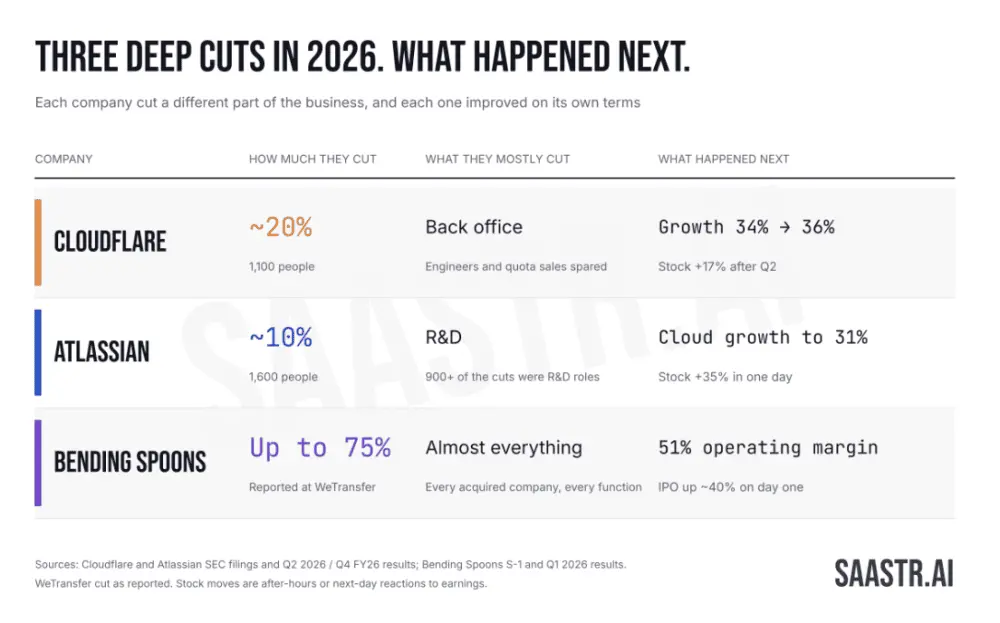
On May 7, Cloudflare announced a sweeping strategic transition toward an agentic, AI-first operating model. This shift necessitated a reduction of roughly 20% of its workforce—affecting over 1,000 employees out of a 5,156-person full-time roster—and incurred restructuring charges between $140 million and $150 million.
Crucially, Cloudflare executed these cuts from a position of financial strength. Just prior to the announcement, the company reported record-breaking quarterly results, pulling in $639.8M in revenue (a 34% year-over-year increase). Despite the beat, the market reacted with skepticism, sending the stock tumbling more than 20% in after-hours trading.
However, the operational turnaround materialized swiftly. In the subsequent quarter, Cloudflare posted revenue of $696.1M—accelerating growth to 36%—and watched its stock surge 17% after hours. Management upgraded its full-year guidance to a range of $2.86B to $2.87B, comfortably outpacing the $2.81B consensus, while maintaining a robust Net Dollar Retention (NDR) rate of 120%.
Where the cuts landed: Cloudflare exercised extreme surgical precision. Leadership explicitly spared quota-carrying sales personnel across every geographical region and department. Instead, the reductions targeted back-office and General & Administrative (G&A) functions that had been largely streamlined by automation and AI tools.
Driving this top-line acceleration was surging organic demand, particularly for Workers and agentic workloads. Positioned at the center of the machine-to-machine traffic boom, Cloudflare proved that a leaner administrative backbone could successfully support surging infrastructure demand at a significantly lower operational cost.
2. Atlassian: R&D Reductions and the Pivot to Enterprise AI
In March, collaboration software giant Atlassian parted ways with roughly 1,600 employees—accounting for approximately 10% of its workforce—with the express intent of reallocating capital toward AI development and enterprise sales expansion. Notably, more than 900 of the eliminated positions were concentrated within software Research & Development (R&D).
Market sentiment leading up to the announcement had been subdued. Atlassian had shed more than half of its market value since the beginning of the year, weighed down by rising anxiety over the emergence of nimble, AI-native competitors. The immediate market response to the restructuring was muted yet positive, with shares edging up roughly 2% after hours.
The financial and operational results following the pivot painted a compelling picture of heightened efficiency:
- Cloud revenue growth stabilized at an impressive 31% year-over-year.
- Despite shedding over 900 engineering and product roles, the company’s product velocity noticeably increased.
- Monthly active users for key developer-facing initiatives, such as the MCP server and Teamwork Graph CLI, surpassed one million—more than doubling within a single quarter.
Concurrently, Atlassian split its Chief Technology Officer role into two distinct, AI-focused engineering leadership positions, demonstrating that operational transformation requires a simultaneous evolution of organizational architecture alongside headcount adjustments.

3. Bending Spoons: The Extreme Margin Play
Operating at the opposite end of the spectrum, Bending Spoons represents the most aggressive case study in modern corporate restructuring. Known for deep operational overhauls following acquisitions—such as downsizing Eventbrite’s team weeks after a deal, slashing an estimated 75% of WeTransfer’s staff, and executing multiple rounds of cuts following a $1.38B acquisition of Vimeo—Bending Spoons prioritizes operating margin above all else.
The financial profile of this model is staggering:
- Generates an immense $2.57M in revenue per employee.
- Operates at a staggering 51% operating margin.
However, this model comes with clear strategic trade-offs. Bending Spoons reported a Net Revenue Retention (NRR) rate of 95%, indicating that its acquired customer bases naturally contract slightly over time. The firm expands primarily through aggressive M&A rather than organic enterprise hyper-growth.
While this model is exceptionally lucrative for mature, slow-growing software products with high margins, it illustrates what must be sacrificed along the way. Prior to its acquisition and subsequent restructuring, Vimeo boasted an ambitious roadmap featuring a rebuilt review suite with Premiere Pro integration and natural-language search. Under Bending Spoons, feature velocity often takes a back seat to extreme operational efficiency. For a high-growth startup expanding at 60% with $20M in ARR, this model would prove fatal; for a mature, cash-flowing asset growing at 5% with an bloated headcount, it is a masterclass in cost discipline.
Supporting Context & Metrics: The Mechanics of Lean Scaling
Comparative Breakdown: Where Different Functions Can Cut
Analyzing the actions of Cloudflare, Atlassian, and Bending Spoons reveals distinct playbooks for different organizational departments:
- Back Office, G&A, and Operations (50% or more reduction potential): This category formed the vast majority of Cloudflare’s layoffs. With modern AI agents capable of handling invoicing, compliance tracking, and internal routing, administrative bloat is the primary target for early-stage and enterprise cuts alike.
- Marketing Operations and Demand Generation Execution (30% to 50% reduction potential): Generative tools and specialized AI agents now seamlessly manage campaign builds, list hygiene, creative variant generation, and performance reporting. Human labor is increasingly reserved for high-level brand strategy and creative vision.
- Engineering in Mature Organizations (10% to 20% reduction potential): Once considered untouchable, R&D departments that expanded rapidly through the hyper-growth era of 2021 frequently harbor structural inefficiencies. With AI-assisted pull requests and automated testing, mature engineering orgs can achieve higher output with smaller teams.
- Engineering in Early-Stage, High-Growth Companies (Protect at all costs): For a lean, 25-person team scaling rapidly at $20M ARR, individual engineers are seeing their productivity double or triple via developer tooling. These teams should be protected and selectively expanded.
- Quota-Carrying Sales (Protect in growth phases): As demonstrated by Cloudflare and Atlassian, if a reliable, predictable pipeline exists, revenue-generating sales representatives are the last to be touched.
- Customer Success (Contingent on ACV): For low Average Contract Value (ACV) models, automated systems and AI agents can manage the vast majority of customer interactions. For enterprise contracts exceeding $100K in ACV, high-touch human relationships remain paramount.
The Rise of the AI-Native Micro-Enterprise: The SaaStr Blueprint
Taking the lean thesis to its absolute limit, organizations like SaaStr are rewriting the rules of organizational scale. Operating at a scale of $15M to $20M in annual revenue, SaaStr runs its entire operation with just 3 human beings alongside roughly 20 specialized AI agents in active production (peaking near 30 before operational consolidation). Among these, approximately 6 core agents handle the vast majority of daily workloads.
- Fully Automated by Agents: Content distribution, basic data hygiene, initial customer correspondence triage, and analytics aggregation.
- Retained by Humans: Complex judgment calls, high-stakes relationship management, strategic partnerships, and rigorous oversight of agent-generated outputs.
As highlighted by leadership, running an agentic workforce does not eliminate labor; it shifts the nature of work from creation to review. Oversight of autonomous systems requires intense human concentration, proving that while human headcount can decrease exponentially, executive judgment cannot be automated.
Official Statements and Industry Insights
Reflecting on the widespread industry trend, tech leaders have taken to public platforms to defend and explain their structural philosophies. Announcing the Airtable restructuring, Bending Spoons leadership noted:
"Today we’re laying off a large part of the Airtable team. This is not a reflection of their work but a reflection of our deep belief that small teams ship more and better. For Airtable, better is about to look like a new Core team shipping your top requests monthly…"
This sentiment is echoed across institutional market benchmarks. According to ICONIQ’s Pacesetter Index, the median revenue per employee for top-performing B2B companies exceeding $100M ARR has climbed to an impressive $655K, a stark contrast to historical industry averages hovering around $237K. Cloudflare’s aggressive restructuring successfully vaulted its own metrics from roughly double the traditional average to well above this new Pacesetter median in the span of a single quarter.
Future Outlook: Boardroom Benchmarks for 2027 and Beyond
As software companies prepare for upcoming board meetings and fiscal planning cycles, revenue-per-employee metrics will serve as the primary litmus test for operational health.
- The Traditional Baseline: Historically, a benchmark below $300K in revenue per employee was considered acceptable for venture-backed growth companies.
- The New Reality: In the current economic landscape, powered by agentic AI workflows and leaner operational models, companies generating under $300K per employee while growing at less than 30% year-over-year will face immediate, pointed inquiries from their boards.
The trajectory of the B2B tech sector is clear. The era of unchecked headcount expansion has given way to the age of architectural leverage. Whether through the surgical back-office trims executed by Cloudflare, the R&D reallocations led by Atlassian, the aggressive margin consolidation of Bending Spoons, or the extreme agentic automation pioneered by micro-enterprises, the message to modern leadership is unequivocal: efficiency, velocity, and lean execution are the ultimate competitive advantages of the modern software economy.