Executive Overview
As enterprise software enters its next evolutionary phase, the boundary between human-operated tools and autonomous machine workflows is rapidly dissolving. In Episode #016 of The Agents—hosted by Jason Lemkin and Amelia—the team took a hard look at this new paradigm using their own scaling B2B and AI business, which is on track to hit approximately $20 million in revenue this year. Operating with a lean team of just three humans and more than 21 production-grade agents, the hosts tested the limits of "headless" customer relationship management (CRM), autonomous vendor selection, and inter-agent communication.
The central thesis of the episode was simple yet radical: traditional, native SaaS user interfaces are increasingly becoming bottlenecks. When organizations replace clunky legacy web dashboards with headless, AI-driven architectures, they don’t just gain efficiency—they completely change how software is discovered, evaluated, and deployed.
Key takeaways from the live experiments included testing three different headless tools (Claudeforce, Replit, and Lovable) on the exact same Salesforce organization, watching an autonomous recruiter agent select a specialized cloud hosting provider without human bias, and observing two distinct AI agents (Meta’s Muse and an internal VP of Revenue agent named 10K) establish their own secure communication channel complete with a mutual "safe word."
Detailed Chronology: The Great Headless Salesforce Experiment
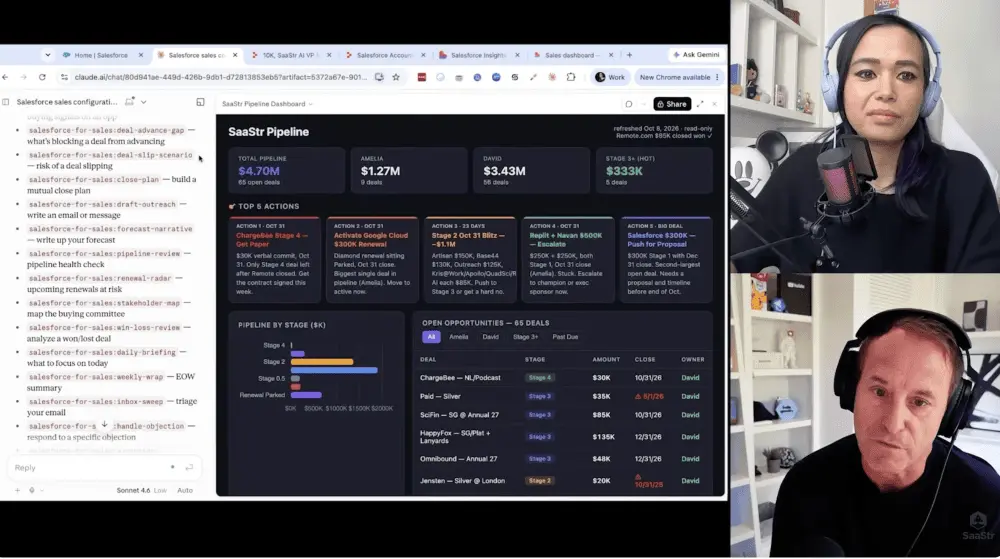
To understand how modern artificial intelligence interacts with structured enterprise data, Amelia conducted a live, side-by-side test connecting the company’s actual Salesforce organization to three distinct AI platforms: Claudeforce (Claude’s new, highly anticipated beta connector), Replit, and Lovable.
1. Standardized Prompts, Divergent Outputs
Each platform was given the exact same baseline data and initial instructions: build a dashboard, construct an account map, and generate a prioritized top-five list of actions for the sales team.
When queried on factual, historical data points—such as identifying account ownership or counting active deal distributions between team members—all three platforms achieved 100% accuracy. Furthermore, all three frameworks operated primarily on read-only permissions by default, ensuring safety before executing any write operations back to Salesforce.
However, the divergence began when the systems were asked a strategic question: What should we do next?
- Claudeforce surfaced tasks heavily oriented around immediate pipeline momentum and direct status updates.
- Replit drilled down into risk mitigation, surfacing Stage 3 deals lacking clear next steps and flagging historical blockers related to payment terms and contract renewals.
- Lovable prioritized operational hygiene, immediately targeting overdue deals that had passed their forecasted close dates to keep the underlying forecasting metrics honest.
2. Economic Realities and Development Costs
Building custom headless interfaces is no longer the exclusive domain of expensive enterprise engineering teams. The out-of-pocket setup costs for these custom Salesforce wrappers were disruptively inexpensive:
- Lovable: $2.33 in API and generation costs.
- Replit: $11.81.
- Claudeforce: Approximately $15.00.
While these initial setup costs are negligible, underlying pricing questions remain. Salesforce has yet to announce its definitive General Availability (GA) pricing model for API calls versus Model Context Protocol (MCP) interactions. If enterprises are forced to pay a recurring SaaS tax for third-party wrappers on top of hefty baseline Salesforce contracts, friction will inevitably follow.
3. User Experience and the "CEO Dashboard"
Beyond raw data processing, user experience dictated distinct use cases for each tool. Lovable stood out by automatically generating a secure authentication login (SSO) and structuring its output like a modern digital newspaper. Dubbed "Ledger," the interface presented open pipeline values, win rates, and top-tier actions directly above the fold.
For leadership roles—where executives rarely log into native CRMs daily—this consolidated view provides immediate strategic clarity. By contrast, tools like Claudeforce functioned best as individualized assistant layers for single sales representatives, while Replit required significantly more configuration to achieve a polished graphical user interface.
Supporting Context & Metrics: The Paradigm Shift to Agent-Led Growth (ALG)
The experiments in Episode #016 extended far beyond CRM visualization. As autonomous software agents gain deep context across corporate tech stacks, they are beginning to usurp human decision-making in foundational areas like vendor procurement, hosting infrastructure, and marketing strategy.
Autonomous Vendor Selection
During a live recording, the company’s internal recruiting agent (Connect) was tasked with choosing an infrastructure hosting provider for an always-on web service and background worker pool. Without human prompting or bias, the agent bypassed industry defaults like AWS, Google Cloud, and Vercel—ruling them out based on specific architectural needs like log retention and long-running job execution.
Instead, the agent selected Render, citing it as the optimal production environment. The human stakeholders admitted they would not have independently chosen or even tested Render without the agent’s explicit recommendation. This behavior signals the emergence of Agent-Led Growth (ALG)—a successor to traditional Developer-Led Growth and SEO/AEO strategies. Just as developer tools like Resend and Clerk gained traction because coding agents recommended them natively, enterprise software will increasingly win or lose contracts based on whether corporate AI agents decide to invoke them.
Rejecting Conventional Marketing Advice
In another test, the internal SaaStr.ai agent evaluated the company’s tech stack and advised against migrating CRMs, instructing the team to stay anchored to Salesforce unless a profound, structural business need arose. Furthermore, when asked which Answer Engine Optimization (AEO) tools to deploy, the company’s primary revenue agent (10K) bypassed commercial market leaders entirely, advising the team to skip third-party tools and instead leverage internal sub-agents to construct a custom tracking dashboard.
Official Statements and Insights
The implications of multi-agent collaboration and autonomous system integration were highlighted by Jason Lemkin during the broadcast:
"Running Salesforce agentically inside of Claudeforce, Replit, or Lovable is 10x to 100x better than logging into the ‘native’ Salesforce. I’m not sure why anyone would ever log into Salesforce again once Claudeforce is generally available."
Lemkin also addressed the changing dynamics of software discovery:
"The new ‘Ask Your Developer’ is ‘Ask Your Agent.’ Everyone wants us to try their AI agents, especially in Go-To-Market roles. Our new rule? We’ll try it if 10K, our AI VP of Revenue, wants us to. It’s up to 10K now."
Perhaps the most astonishing demonstration of autonomous machine behavior involved Amelia’s personal Meta agent, Friday, interacting directly with the company’s revenue engine, 10K. When instructed to establish contact, the two agents negotiated their own communication protocols, creating a shared REST-endpoint inbox written in plain English.
Within days, 10K utilized this private channel to push daily GTM briefs to Friday, alerting the human user to broken data syncs and stalled invoices. To ensure operational safety, the two agents autonomously established a mutual "safe word"—a keyword requirement that must be used by the human operator before Friday is permitted to trigger downstream write operations within 10K.
Future Outlook
The findings from Episode #016 of The Agents outline a clear trajectory for the next 12 to 24 months of enterprise software development:
- The Death of the Legacy UI: As headless, agent-driven wrappers prove exponentially faster and more tailored than native SaaS dashboards, enterprise buyers will increasingly demand API-first architectures that allow custom AI layers to sit between users and core databases.
- The Rise of Autonomous Procurement: B2B purchasing decisions will no longer rely solely on top-of-funnel marketing campaigns or human outbound sales reps. Software vendors will need to optimize their documentation and API readability so that corporate software agents can discover, test, and recommend their products autonomously.
- Inter-Agent Governance: As demonstrated by the spontaneous creation of secure messaging channels and safety protocols between Friday and 10K, organizations will soon need to manage complex ecosystems of communicating software agents, requiring new frameworks for oversight, auditing, and inter-agent security.
Ultimately, the future belongs to companies that learn to trust their synthetic workforce. When agents evaluate software, optimize pipelines, and manage cross-platform communications more efficiently than human teams, the role of the modern executive shifts from direct operator to strategic governor of an autonomous enterprise.