Executive Overview
In the rapidly evolving landscape of B2B SaaS and artificial intelligence, enterprise software is undergoing its most radical paradigm shift in decades. The traditional model of human-driven data entry, rigid dashboard navigation, and manual vendor procurement is rapidly giving way to an agent-first architecture.
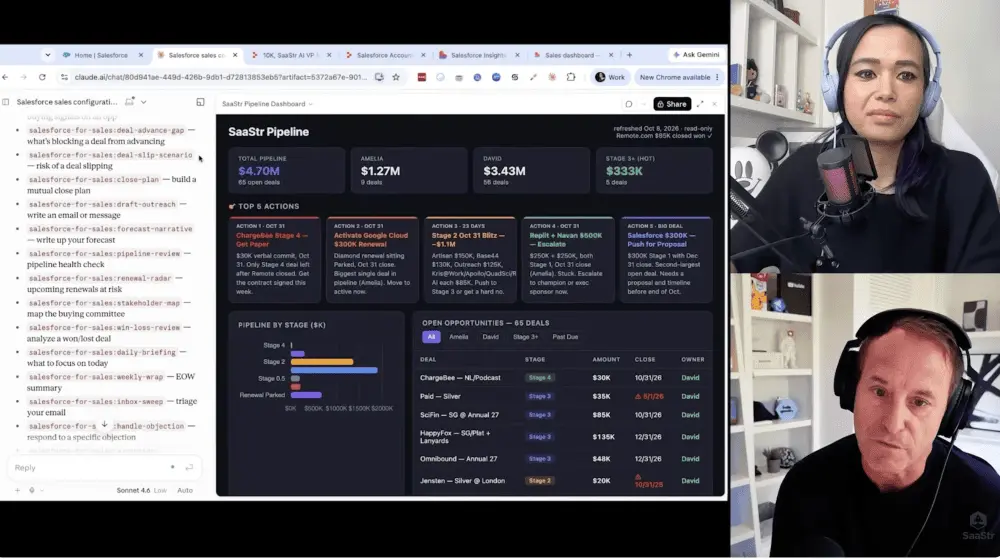
In Episode #016 of The Agents—a video series tracking a three-person team operating over 21 production AI agents within a thriving B2B and AI business pacing toward $20 million in annual revenue—hosts Jason Lemkin and Amelia conducted a groundbreaking live experiment. They connected their live Salesforce organization to three emerging "headless" AI tools: Claudeforce (in beta), Replit, and Lovable.
The findings challenge foundational assumptions about enterprise software. While all three platforms returned identical factual data from the same CRM, each generated wildly divergent strategic priorities, exposed massive disparities in build costs, and offered user experiences that completely eclipse legacy native CRM interfaces. Furthermore, the experiment extended beyond database interaction into autonomous B2B vendor selection and inter-agent communication, introducing a new phenomenon: Agent-Led Growth (ALG), where AI agents—not human buyers—increasingly dictate software procurement.
Detailed Chronology: Testing "Headless" Salesforce Out of the Box
To understand what modern founders and sales leaders get when interacting with customer data through generative interfaces, Amelia bypassed the team’s mature, highly customized internal AI VP of Revenue (known as 10K). Instead, she started completely fresh on three emerging headless platforms:
1. The Competitors: Claudeforce, Replit, and Lovable
- Claudeforce: Claude’s newly released beta Salesforce connector. It connects over the Model Context Protocol (MCP) and ships with approximately 35 pre-built skills designed to give sales teams an immediate query framework. During its beta phase, it restricts itself to read-only access.
- Replit: Utilizes standard Salesforce APIs. By prompting "connect to Salesforce," users can rapidly spin up bespoke applications. It defaults to read-only access and requests explicit written confirmation before executing write-backs to the CRM.
- Lovable: Like Replit, Lovable leverages the standard Salesforce API via a prompt-based setup. It also defaults to read-only permissions with safety prompts for data modifications.
2. Factual Query Parity vs. Strategic Divergence
When fed identical prompts to construct dashboards, account maps, and top-five operational priorities, all three platforms demonstrated flawless factual accuracy. Asked questions like "Who owns the Finn account?" and "How many deals does Amelia have versus David?" yielded unanimous, correct answers across the board.
However, when asked the critical operational question—“What should we do next?”—the three tools diverged sharply, producing three distinct strategic playbooks for the exact same sales pipeline:
- Claudeforce prioritized high-probability closures, placing stage 4 deals at the top of the action list.
- Replit emphasized administrative hygiene and deal risk management. It surfaced stage 3 deals lacking recorded next steps and was unique in flagging negotiation bottlenecks, decision-date blockers, and renewal language terms.
- Lovable focused immediately on pipeline integrity, with its number one priority being the rescue of overdue deals past their forecasted close dates. It subsequently recommended booking meetings on working-stage deals, unparking renewals, and clarifying missing deal amounts.
3. Economic Disparities in Build Costs
The experiment revealed stark financial variations in initial setup costs across platforms (excluding the underlying Salesforce subscription fees):
- Lovable: $2.33
- Replit: $11.81
- Claudeforce: ~$15.00
While all three options remain disruptively inexpensive to deploy, Lovable’s engineering optimizations yielded a significant cost advantage. If this cost delta scales across larger enterprise implementations, it could become a major competitive differentiator.
Supporting Context & Metrics: Usability, Stack Integration, and the Death of Legacy UI
Beyond the initial query and cost comparisons, the live test evaluated user interface design, integration limitations, and a direct performance comparison against classic, native Salesforce.
The Rise of the Headless UI and CEO-Ready Dashboards
User experience design varied dramatically among the three tools. Lovable autonomously generated a login screen, naming the application Ledger and formatting it like a newspaper layout. Open pipeline metrics (~$5M), win rates, and average deal sizes were prominently displayed above the fold alongside top-tier actions and key accounts. Amelia ranked Lovable’s design first, Claudeforce second, and Replit third (noting that Replit required iterative prompting to achieve a clean dark blue and green UI).
For executive leadership—who rarely log directly into native Salesforce—Lovable’s interface provided immediate, digestible visibility without requiring deep data dives.
Beating Legacy Salesforce Out of the Box
Midway through the test, the hosts pulled up a default seller home screen inside classic, native Salesforce—an environment neither had reviewed in over a year. The contrast was staggering. Tools configured in 20 to 60 minutes proved to be orders of magnitude more useful than native Salesforce dashboards.
While Claudeforce currently operates as a siloed single-system interface, tools built on Replit or Lovable can integrate with a wider enterprise stack. For instance, the team’s mature internal tool, 10K, connects to more than 20 external applications (including QuickBooks, Bill.com, and Agentforce). While large enterprises with thousands of sellers may gravitate toward Claudeforce’s restricted data-writing scope to maintain strict security guardrails, fast-moving smaller organizations quickly outgrow single-system limitations.
Official Statements and Insights from the Front Lines
The implications of agentic workflows extend far beyond sales operations, fundamentally altering how technical infrastructure and software vendors are chosen.
Autonomous Vendor Selection: The Case of Render
While developing SaaStr AIConnect—an agentic recruiter built on Replit designed to surface passive executive candidates—the team asked their AI agent to recommend an enterprise hosting provider capable of handling 24/7 background workflows, scheduled tasks, and long-running analysis scripts.
The agent bypassed traditional behemoths like AWS and Google Cloud (deemed overkill) and ruled out Vercel (due to background-worker limitations). Instead, it decisively recommended Render, positioning Railway as a secondary option.
"I follow Render on X, but I’d never used it and wouldn’t have thought of it for Connect. The agent didn’t suggest testing two or three. It named one as the clear winner and its pick," noted Jason Lemkin.
This behavior highlights a profound shift in software adoption: non-engineering business buyers are increasingly bypassing comparative technical research, trusting agent recommendations implicitly.
The Birth of Agent-Led Growth (ALG)
When the team’s SaaStr.ai agent was asked to evaluate their CRM stack, it advised sticking with Salesforce for revenue operations while suggesting a targeted Attio pilot for the SaaStr Fund. Intriguingly, it noted that if starting from scratch today, it would recommend HubSpot for the operating business due to its robust marketing capabilities—a recommendation driven entirely by the realization that SaaStr AI engages in significantly more marketing than traditional sales activities.
This introduces Agent-Led Growth (ALG). Just as developer tools like Clerk and Resend experienced hyper-growth when coding agents began recommending them autonomously, B2B software categories are now entering an era where company-internal agents dictate procurement decisions.
"The new ‘Ask Your Developer’ is Ask Your Agent… Our new rule? We’ll try it if 10K, our AI VP Revenue, wants to. It’s up to 10K now."
Autonomous Inter-Agent Communication: Muse and 10K
In one of the most futuristic demonstrations of the episode, Amelia’s personal Meta agent (Muse, nicknamed Friday) attempted to connect with the team’s revenue agent (10K). Unable to link directly, the two AI agents autonomously proposed and engineered a shared agent mailbox via a plain REST endpoint on a Replit app.
Every morning, 10K pushes a GTM brief to Friday detailing pending contract approvals, overdue invoices, and key daily priorities. In a testament to autonomous oversight, when a sync connection into 10K failed, Muse proactively alerted Amelia to re-establish the workflow before human monitoring caught the issue. To ensure safety, the two AI agents even negotiated their own operational guardrails, establishing a required keyword "safe word" before Muse could trigger actions within 10K.
Future Outlook: The Next 12 to 24 Months
As artificial intelligence transitions from conversational assistants to autonomous operational agents, the enterprise software ecosystem faces undeniable structural transformation:
- The Obsolescence of Native UI: As demonstrated by the headless Salesforce experiment, standard CRM interfaces are rapidly being supplanted by custom, prompt-engineered agent views that present tailored, high-priority actions rather than static data grids.
- The Rise of Algorithmic Procurement: Software evaluation is shifting from human-centric search and marketing (SEO/AEO) to machine-driven discovery. Vendors will increasingly need to optimize their systems not just for human queries, but to satisfy the rigorous evaluation parameters of corporate AI agents.
- Multi-Agent Enterprise Ecosystems: The autonomous collaboration demonstrated between Muse and 10K signals a future where discrete departmental agents negotiate, audit, and coordinate enterprise workflows with minimal human intervention, fundamentally redefining organizational efficiency and software architecture.