Date: October 19, 2026
Location: InterContinental London, The O2
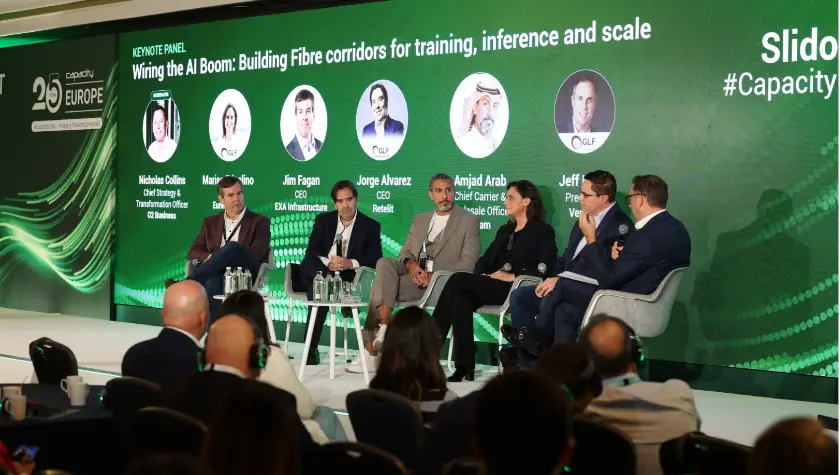
Event: 25th Capacity Europe
Executive Overview
At the milestone 25th edition of Capacity Europe, held from October 13 to 15, 2026, the digital infrastructure sector confronted a stark reality. For years, the industry’s narrative has been dominated by the sheer velocity of artificial intelligence demand. However, three days of intensive dialogue among more than 3,500 global decision-makers, executives, and investors at the InterContinental London made it clear that the AI boom has entered a new, more sober phase.
Demand is no longer the primary variable guiding the market; instead, physical, regulatory, and supply-chain constraints now dictate the agenda.
With global data centre spending surging past the $800 billion mark and hurtling toward a trillion-dollar threshold, the industry is grappling with acute friction points. From two-year queues for backup generators and multi-year grid connection delays to fierce public debates over UK fibre consolidation and community opposition, growth is being choked not by a lack of capital or visionary algorithms, but by the physical limits of our electrical grids, supply chains, and long-haul networks.
This report outlines the ten pivotal takeaways from Capacity Europe 2026, charting how operators, carriers, and investors are adapting to a landscape where infrastructure scarcity defines value.
Detailed Chronology & thematic Shifts
1. Machines Out-Request Humans Online: The Dawn of Agentic Traffic
The conference opened with a paradigm-shifting milestone presented by Colt’s Chief Strategy Officer, Avijit Singh. Citing data from Cloudflare, Singh revealed that in June 2026, machine-generated web page requests officially overtook human-generated traffic for the first time, registering at 57.4% compared to 42.6%. Projections indicate that within five years, machine traffic could outpace human interaction by a factor of 100.
This fundamental transformation alters data architecture. Traditional web traffic relies heavily on a north-south flow—routing data from centralised clouds down to end-user devices. The surge in autonomous AI agents, however, triggers massive east-west traffic patterns characterized by intense data exchanges between data centres and autonomous agents.
Consequently, operators must elevate standards for latency, resilience, automation, and observability. Security paradigms are also shifting from verifying human users to authenticating machine identities. As Singh noted, "Now we have crossed the threshold." Speakers predicted this shift will soon influence commercial channels, with AI agents negotiating contracts on behalf of enterprise customers, necessitating a transition from search engine optimisation (SEO) to "machine optimisation."
2. Inference Pulls Compute Beyond FLAP-D
While training dominated early AI infrastructure spending, industry leaders at Capacity Europe pointed uniformly to inference as the primary driver of the next wave. Verizon’s Jeff Hulse highlighted McKinsey research indicating that 2026 marks the crossover point where investment in inference matches training. Valerie Cussac of Orange Wholesale confirmed that AI workloads are already actively saturating networks, particularly across inter-data-centre links.
This evolution is breathing new life into edge computing, albeit with a fresh geographic focus. Dimitrios Rizoulis of T Wholesale reported exceptionally high demand for edge locations across Europe to support low-latency inference. DE-CIX CEO Ivo Ivanov emphasized that every millisecond of latency equates to roughly 80 kilometres of distance, requiring agentic and physical AI applications to sit within 100km to 150km of the end-user inference point.
Meta noted that the industry’s earlier retreat from edge computing was "a major missed opportunity," noting that edge capacity is now severely constrained. Illustrating this geographic diversification, Ivanov pointed to Lisbon, Madrid, and Barcelona as components of a new "distributed digital capital," signalling that Europe’s data centre footprint is expanding far beyond the traditional FLAP-D markets (Frankfurt, London, Amsterdam, Paris, and Dublin).
3. Connectivity as a Core Foundation, Not an Afterthought
Digital Realty’s Paula Cogan delivered a blunt warning regarding network integration: "A data centre is simply a large fridge without a deep connectivity ecosystem." Panellists concurred that network planning historically lags behind physical construction. While new fibre routes routinely require 12 to 18 months to deploy, Equinix noted it began planning connectivity for a single North London campus with Colt five years ahead of its launch.
Exa Infrastructure CEO Jim Fagan described a "fundamental shift" in demand, while Salam’s Amjad Arab revealed that advanced AI workloads can demand up to 36 times more fibre than legacy applications. This surge is bleeding out of primary hubs into regional markets, enterprise sites, and local exchanges. "The whole network will be required," stated euNetworks CEO Marisa Trisolino, though experts simultaneously cautioned against overbuilding metro markets where long-term demand visibility remains clouded.
4. Long-Haul and Subsea Routes as the Overlooked Bottleneck
Compute investment is rapidly outpacing the underlying transport networks. FLAG’s Paul Abfalter pointed to "really significant underinvestment" in long-haul capacity between data centres, warning of tightening constraints on major international routes. Sparkle CEO Enrico Bagnasco added that geopolitical complexities are severely hampering the construction of necessary subsea capacity, particularly along corridors connecting the United States and the Middle East.
Despite these hurdles, critical new projects are emerging. Orange announced a joint venture with Equitix and MDM to deploy Pisces, a 3,125-kilometre, 16-fibre-pair system linking Ireland, France, Spain, and Portugal while intentionally bypassing the UK. Concurrently, Exa completed newly commissioned Milan-Zurich and Paris-Vienna long-haul corridors during the conference week.
5. Digital Sovereignty Demands Physical Infrastructure
Michael Trabbia, CEO of Orange Wholesale, used his Day Two keynote to argue that the geopolitical and technological AI race has shifted decisively from software models to physical infrastructure. With global data centre expenditure eclipsing $800 billion and marching toward $1 trillion, underlying connectivity has emerged as a matter of national security.
"You cannot talk about sovereignty without talking about physical infrastructure," Trabbia asserted, warning against the vulnerabilities of foreign dependencies where foreign governments could theoretically disrupt vital services. Orange is backing this strategic stance with a 400MW data centre joint venture in France and an ambitious roadmap targeting 2.5 million kilometres of proprietary fibre by 2028.

6. Supply Chain Security Outweighs Cost Considerations
Procurement strategies have undergone a radical transformation. Telehouse’s Ozgur Duzgunoglu noted that backup diesel generators now carry two-year lead times, while high-voltage transformers require 12 to 18 months. Consequently, operators are forced to commit to suppliers long before architectural blueprints are finalised. "We should be worried about capacity," warned Greenscale’s Miriam van Kooperen.
Firms like Start Campus have adopted "procure first, design around it" as an operational mantra, measuring supply chain success in days saved rather than euros. Furthermore, operators are shifting from strict product specifications to performance-based benchmarks to maintain flexibility when preferred vendors face delivery delays.
Labour shortages compound these supply challenges. Nelson Pinto de Magalhaes of Start Campus emphasized that orchestrating equipment deliveries, specialized installers, and commissioning teams simultaneously has become more difficult than acquiring the hardware itself. Van Kooperen predicted that mechanical, electrical, and plumbing (MEP) trades will face severe deficits by 2029, particularly in emerging markets lacking established data centre talent pools.
Supporting Context & Metrics
| Metric / Indicator | Value / Timeline | Source / Context |
|---|---|---|
| Machine vs. Human Web Requests | 57.4% vs. 42.6% (June 2026) | Cloudflare data, cited by Colt |
| Global Data Centre Spend | Exceeding $800B, heading past $1T | Industry consensus at Capacity Europe 2026 |
| Backup Generator Wait Times | Up to 2 Years | Telehouse procurement data |
| High-Voltage Transformer Lead Times | 12 to 18 Months | Telehouse supply chain analysis |
| AI vs. Traditional Fibre Demand | Up to 36x increase | Salam network metrics |
| Pisces Subsea Cable System | ~3,125 km, 16 fibre pairs | Orange, Equitix, and MDM joint venture |
| UK Netomnia Acquisition Value | £2 Billion | nexfibre / CMA regulatory review |
Official Statements & Key Industry Voices
"A data centre is simply a large fridge without a deep connectivity ecosystem."
— Paula Cogan, Digital Realty"You cannot talk about sovereignty without talking about physical infrastructure."
— Michael Trabbia, CEO, Orange Wholesale"Having more networks does not make stronger challengers."
— Rajiv Datta, CEO, nexfibre (criticising the CMA’s provisional findings on the Netomnia merger)"Value will accrue around bottlenecks—power, strategic sites, scarce routes, and trusted interconnection."
— Jeroen Kleinjan, Managing Director, ING
Regulatory Friction and Market Controversies
Grid Certainty Overshadows Incentives
Power scarcity remains the industry’s ultimate governor, but opacity in grid connection timelines creates acute financial risk. An anonymous infrastructure investor noted that while capital is readily available, grid operators routinely miss connection windows—promising a 36-month hookup and delivering at 48 months—leaving developers to shoulder a full year of stranded capital costs.
National Grid Strategic Demand Director David Atkins reported that the UK transmission network is currently building three times more infrastructure in this five-year cycle than in the previous one. He noted that securing just 1% to 2% flexibility from data centres could unlock substantial spare capacity, characterizing the coming months as pivotal for grid connections reform.
In continental Europe, timelines remain extended. Duzgunoglu stated that securing power in Frankfurt can span five to seven years. In contrast, securing a new facility anchor in the US takes roughly 18 months compared to three to five years in Europe. This disparity is accelerating the adoption of behind-the-meter generation, with hydrogen power providers like GeoPura gaining traction as alternative energy sources.
The Social License to Operate
Community opposition emerged as a persistent hurdle across nearly all panel discussions. Digital Realty’s Cogan admitted she occasionally hesitates to disclose her profession in social settings, advocating for a European equivalent of the US Infrastructure for America campaign to educate the public on the societal value of data centres. Telehouse’s Mark Pestridge identified a "massive gap between what we call digital dependence and digital understanding."
Proactive engagement, however, yields results. Simon Allen of Nomad Futurist highlighted a CyrusOne project in Milan where local community sentiment swung from 70% opposition to over 70% approval following transparent dialogue addressing resident concerns regarding noise, water usage, and local benefits.
The UK Fibre Consolidation Showdown
Public policy and market competition collided on the Fibre Investment Stage, where nexfibre CEO Rajiv Datta launched a blistering critique of the Competition and Markets Authority’s (CMA) provisional findings regarding its £2 billion acquisition of Netomnia. Datta labeled the regulator’s stance "completely divorced from financial reality," arguing that the UK market cannot economically sustain three physical fibre networks in every postcode. "Having more networks does not make stronger challengers," he asserted.
Datta also questioned the financial health of rival bidder CityFibre—a characterisation swiftly rejected by CityFibre, which pointed to robust organic growth and a £900 million equity injection from shareholders. With the CMA’s final determination scheduled for December 15, 2026, both entities agree that market consolidation is inevitable; the central dispute rests on who will steer it.
Future Outlook: Navigating the Scarcity Economy
As Capacity Europe 2026 drew to a close, financial institutions and operators painted a clear picture of how capital will be deployed moving forward. ING Managing Director Jeroen Kleinjan emphasized that lenders are prioritizing contracted cash flows, guaranteed power allocations, and seasoned corporate sponsors. "Value will accrue around bottlenecks," Kleinjan reiterated, pointing directly to power access, prime real estate, scarce long-haul corridors, and high-integrity interconnection points.
The economics of connectivity are likewise undergoing structural stress. Mobile UK CEO Hamish MacLeod reported that domestic mobile revenues have fallen by roughly 30% while network traffic volumes have surged 40-fold, prompting internet exchanges like LINX, represented by CEO Jennifer Holmes, to warn that traffic volume no longer correlates directly with revenue growth.
Ultimately, the silver lining of the 2026 infrastructure crunch is discipline. By forcing operators to move away from speculative overbuilding and toward hyper-focused, secure, and resource-efficient engineering, the digital infrastructure sector is maturing. As the industry looks toward the remainder of the decade, success will belong not to those with the boldest growth projections, but to those who successfully navigate the physical, energetic, and regulatory bottlenecks of a resource-constrained world.