Executive Overview
Managing containerized applications at cloud scale has long presented platform teams with a delicate balancing act. While orchestration engines like Amazon Elastic Container Service (Amazon ECS) have simplified the deployment and scaling of microservices, configuring the surrounding ingress networking remains a notoriously tedious and error-prone operational hurdle.
For every single microservice deployed, infrastructure teams historically had to manually provision, wire together, and continuously lifecycle-manage a complex matrix of resources: Application Load Balancers (ALBs), AWS Certificate Manager (ACM) SSL/TLS certificates, AWS WAF web access control lists (web ACLs), target groups, and intricate security group rules. As organizations scale from a handful of services to hundreds or thousands, this per-service operational friction translates directly into deployment bottlenecks, administrative fatigue, and a severe risk of configuration drift.
To fundamentally redefine how container ingress is handled, Amazon Web Services (AWS) has announced the official launch of Amazon ECS Gateway. Operating as a powerful new account-level resource, ECS Gateway abstracts and automates the heavy lifting of ingress provisioning. By dynamically orchestrating infrastructure directly within the customer’s AWS account on an as-needed basis, ECS Gateway acts as a bridge between the structural needs of platform engineering teams and the rapid-deployment requirements of application developers.
This release promises profound structural benefits: dramatically reduced time-to-market for new microservices, lower overall infrastructure costs through intelligent resource sharing (such as packing up to 25 services onto a single ALB), and airtight security governance. Available immediately across all commercial AWS regions where ECS operates—at no additional software licensing charge beyond the standard underlying AWS resources—ECS Gateway marks a major evolutionary leap forward in cloud-native application delivery.
Detailed Chronology: The Evolution of ECS Ingress Management
To understand the transformative significance of Amazon ECS Gateway, it is crucial to examine the historical trajectory of ingress networking within container ecosystems and the mounting pressures that forced a paradigm shift.

The Era of Manual Provisioning and Custom Automation
In the early days of container orchestration, platform teams relied entirely on imperative scripts or rigid Infrastructure as Code (IaC) templates (such as AWS CloudFormation or Terraform) to manage ingress. Every time an application team requested a new microservice endpoint, platform engineers were forced to:
- Provision a dedicated ALB (or manually adjust listener rules on an existing shared proxy).
- Generate, validate, and attach ACM certificates for custom DNS domains.
- Configure target groups, health check parameters, and deregistration delays.
- Establish tightly scoped security group rules permitting traffic solely from the load balancer to the specific container ports.
As enterprise portfolios expanded, this model collapsed under its own weight. Teams resorted to building complex internal developer platforms (IDPs) wrapped around custom CI/CD pipelines just to automate these steps. However, maintaining custom automation frameworks introduced significant technical debt. Whenever AWS released new security features or load-balancing capabilities, internal automation code frequently broke, requiring ongoing engineering maintenance.
The Rise of Shared Infrastructure and Configuration Drift
Recognizing that provisioning a dedicated Application Load Balancer for every single microservice was financially unsustainable and operationally inefficient, organizations began shifting toward shared load-balancing models. Reverse proxies, API gateways, and ingress controllers (such as AWS Gateway Controller paradigms or third-party service meshes) gained traction.
Yet, these solutions often shifted the burden back onto platform teams, who had to manually orchestrate listener rules, route mapping, and DNS registrations across disparate systems. Configuration drift—where the actual state of production networking diverges from the intended declarative state—became a persistent operational menace. Orphaned target groups, expired certificates, and misconfigured WAF web ACLs routinely sparked intermittent outages and security audit vulnerabilities.
The Birth of Amazon ECS Gateway
Responding to persistent customer feedback from enterprise platform engineers, AWS architects set out to design a native, platform-level solution embedded directly into the core Amazon ECS control plane.

Rather than treating ingress as an afterthought or forcing developers to interact directly with Elastic Load Balancing (ELB) APIs, the engineering team conceived ECS Gateway as an intelligent, intent-based intermediary. Announced today, the feature introduces an account-level construct that observes container service deployments in real time, automatically provisions the necessary foundational networking elements when services connect, and seamlessly scales those resources up or down based on actual aggregate traffic and capacity constraints.
Supporting Context & Metrics: Architecture, Economics, and Mechanics
Amazon ECS Gateway introduces a clean, elegant separation of responsibilities between platform teams (who govern overall network topologies, security baselines, and shared infrastructure roles) and application teams (who simply attach declarative gateway connectors to their service definitions).
Many-to-Many Architectural Topography
The architectural flexibility of ECS Gateway is anchored in its support for a robust many-to-many relationship model between gateways and ECS clusters:
- A single ECS Gateway can be associated with up to 10,000 distinct ECS clusters.
- A single ECS cluster can support up to 5 simultaneous gateway associations.
This granular flexibility allows platform architects to segment traffic flows logically. For instance, an enterprise can instantiate a public-facing gateway for internet traffic alongside a separate, internal VPC-internal gateway for backend microservice-to-microservice communication, applying both to the exact same cluster depending on business requirements.
Cost Optimization via High-Density Service Packing
One of the most compelling economic advantages of ECS Gateway is its intelligent resource sharing. Traditional deployments often waste capital on underutilized, single-tenant load balancers. ECS Gateway optimizes infrastructure spend by utilizing host-based routing via Application Load Balancers, enabling up to 25 distinct containerized services to securely share a single ALB.
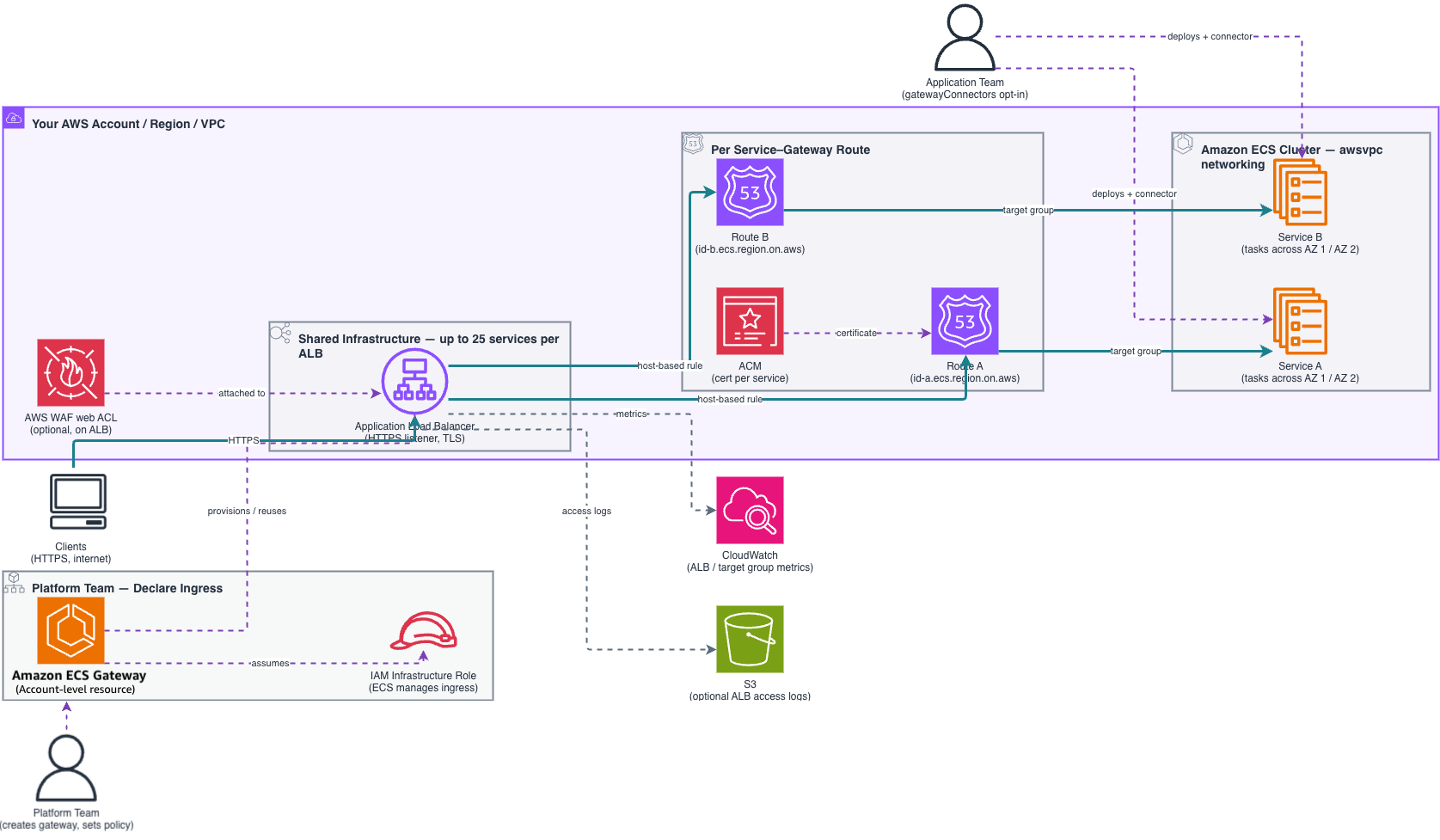
ECS manages this lifecycle dynamically:
- When the very first service connects to a gateway, ECS automatically provisions the initial ALB, configures the necessary listeners, and establishes the foundational security groups within the user’s account.
- As additional services attach, ECS packs them efficiently onto the existing ALB utilizing unique hostnames and path-based or host-based routing rules.
- Once the 25-service threshold per ALB is reached, ECS automatically provisions an additional ALB to absorb incoming capacity without administrative intervention.
- Conversely, when services are decommissioned and capacity requirements drop, ECS gracefully scales down and removes unneeded load balancers to minimize idle cloud expenditure.
Step-by-Step Implementation Mechanics
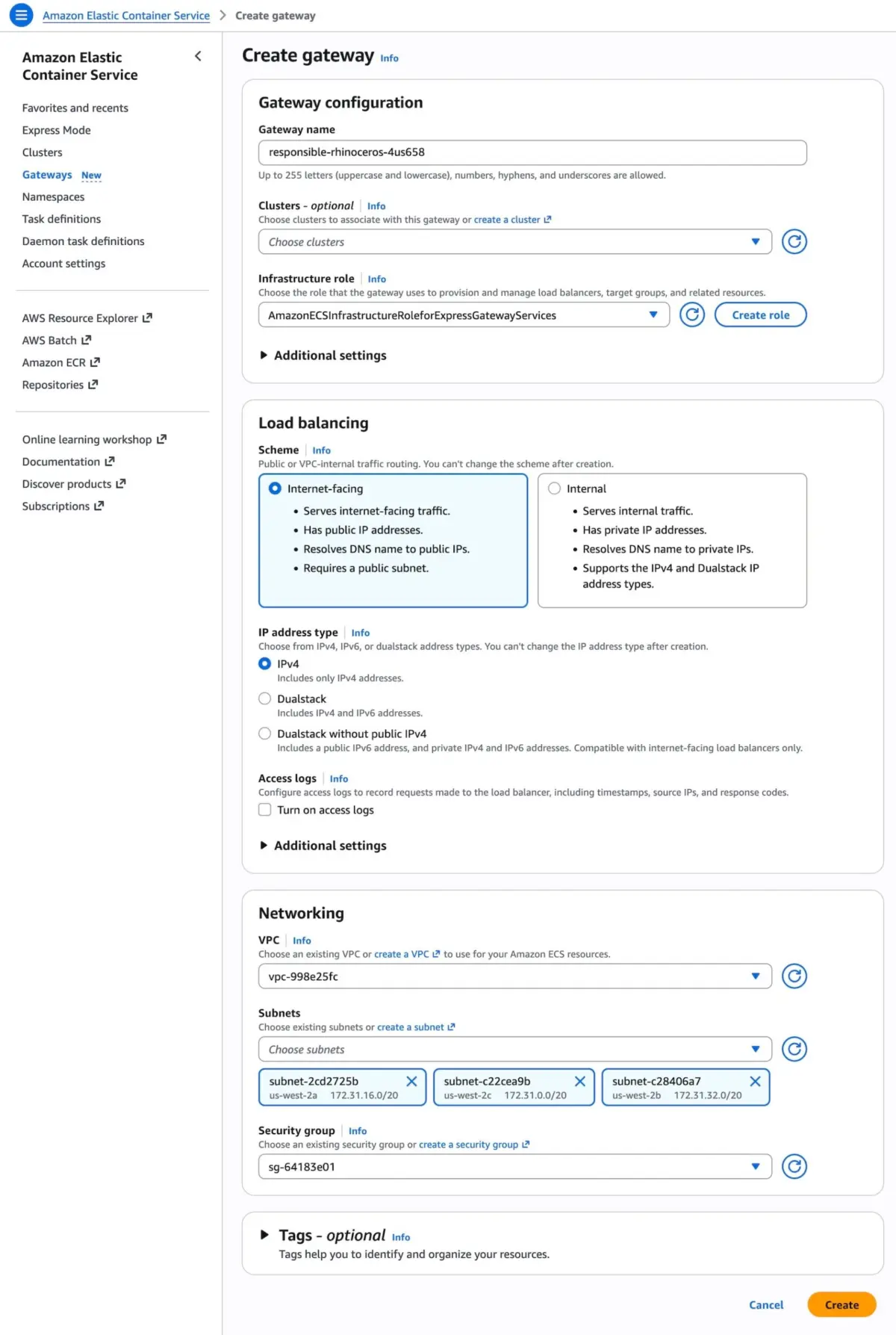
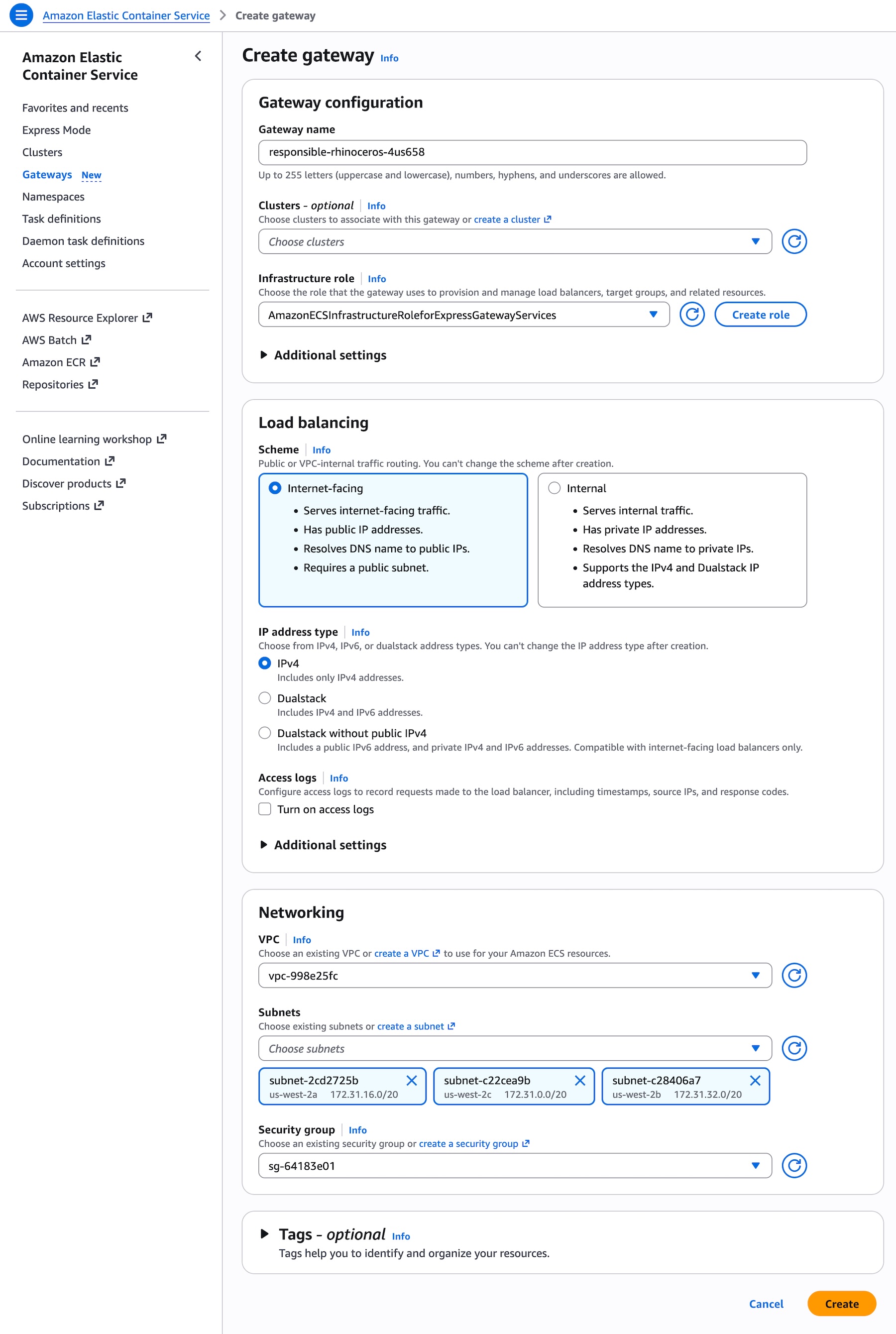
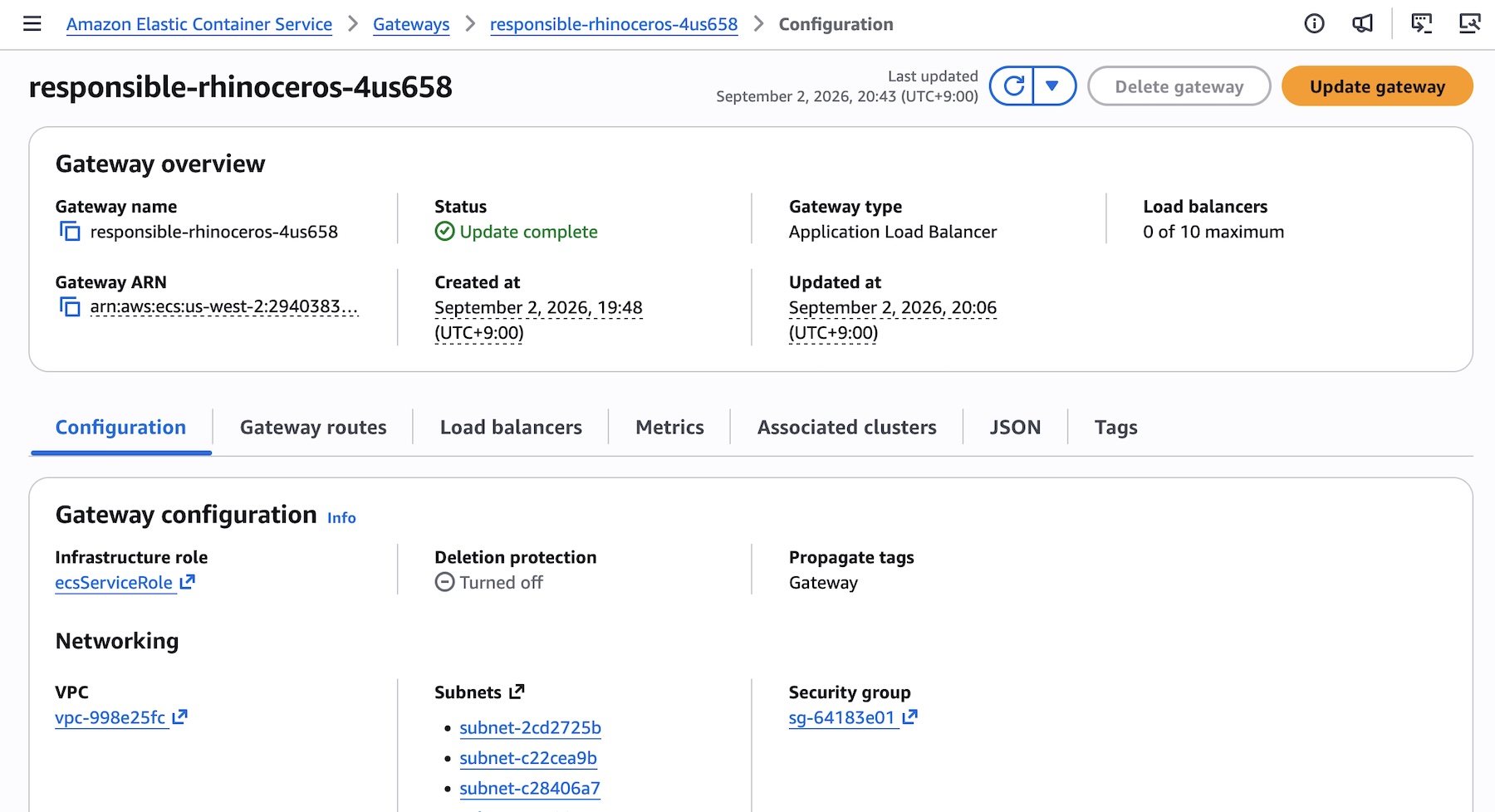
Platform teams can establish and configure gateways using either the AWS Management Console or the AWS Command Line Interface (AWS CLI).
First, a platform administrator defines a gateway using an IAM infrastructure role that permits ECS to manage underlying resources (ALBs, security groups, ACM certificates) within the account:
aws ecs create-gateway
  --name enterprise-production-gateway
  --infrastructure-role-arn arn:aws:iam::123456789012:role/ECSGatewayRole
  --configuration '
    "HostSharedAlb":
      "networkConfiguration":
        "subnets": [
          "subnet-080779f9bd887757a",
          "subnet-03d5b2fead6bc6258",
          "subnet-0861210a397d31252",
          "subnet-06539e194023cb77a"
        ],
        "ipAddressType": "ipv4"
      ,
      "scheme": "internet-facing"

  '
Once established, the gateway is linked to specific application clusters using the AssociateGatewayWithCluster API call:
aws ecs associate-gateway-with-cluster
--gateway enterprise-production-gateway
--cluster arn:aws:ecs:us-east-1:123456789012:cluster/production-cluster
Application teams then adopt the gateway incrementally by updating their service definitions. Both legacy ingress methods and ECS Gateway can run concurrently during migration periods, allowing teams to validate connectivity before deprecating older architectures:
aws ecs create-service
  --cluster production-cluster
  --service payment-processing-service
  --task-definition payment-processing-service:1
  --gateway-connectors '[ "portName": "api", "filters": "accessTypes": ["PUBLIC"], "healthCheck": ... ]'
Upon deployment, Amazon ECS evaluates compatibility based on access types, VPC boundaries, and Availability Zone coverage, instantly provisioning a unique DNS hostname, ACM certificate, listener rule, and isolated security group for the service.
Official Statements & Expert Perspectives
In briefing materials accompanying the release, AWS engineering leadership underscored the strategic imperative of abstracting undifferentiated infrastructure management away from software developers.
"For years, our enterprise customers have built remarkable containerized architectures on Amazon ECS, yet the friction of tying microservices to external load balancers and certificates has remained a persistent bottleneck," noted a senior product management lead for Amazon ECS. "With ECS Gateway, we are shifting the burden of ingress orchestration entirely onto the platform control plane. Platform teams define the guardrails and security baselines once, and application developers can securely publish production-ready endpoints instantly with a single declarative flag. It combines the rigorous security governance enterprises demand with the frictionless developer velocity of modern cloud-native design."
Early enterprise design partners who tested ECS Gateway during its private preview phase reported dramatic improvements in deployment velocity.
“In our previous operating model, spinning up a new customer-facing microservice required a multi-day ticket queue involving our network engineering, security, and DevOps squads,” shared the Principal Cloud Architect of a global financial technology enterprise. “By implementing Amazon ECS Gateway, we have cut our service onboarding time from days to literal seconds. Our developers declare their connection requirements in their task definitions, and the platform automatically handles the underlying ALB and certificate provisioning without human intervention. It has completely eliminated configuration drift across our AWS accounts.”
Furthermore, industry analysts have lauded the integration of AI-assisted management tools alongside the launch. AWS has officially integrated support for Amazon ECS Gateway into the AWS MCP Server and associated developer plugins, allowing engineering teams to create, search, and manage gateways programmatically using natural language commands within modern AI coding assistants.
Future Outlook: The Next Horizon for Cloud-Native Ingress
The introduction of Amazon ECS Gateway signals a broader, industry-wide evolution toward intent-based cloud architecture. As organizations grapple with increasingly complex, multi-region container deployments, the traditional boundaries separating compute orchestration, network routing, and security policy enforcement continue to blur.
Looking ahead, industry experts anticipate that features like ECS Gateway will serve as foundational building blocks for more advanced autonomous cloud operations. By centralizing ingress telemetry, security auditing, and traffic management at the account and cluster levels, AWS has laid the groundwork for sophisticated machine learning-driven traffic optimization, automated threat mitigation via tighter AWS WAF integration, and zero-trust service-to-service mesh unification.
For platform engineers and DevOps professionals, the message is clear: the era of manual, script-driven ingress provisioning is drawing to a close. By embracing declarative constructs like Amazon ECS Gateway, organizations can reclaim hundreds of hours of engineering bandwidth, fortify their security posture against human error, and empower development teams to deliver resilient, scalable applications faster than ever before.
Getting Started
Amazon ECS Gateway is available today across all commercial AWS regions where Amazon ECS is supported. There is no additional service fee for using ECS Gateway; customers pay solely for the underlying AWS resources provisioned within their accounts (such as Application Load Balancers, CloudWatch metrics, ACM certificates, and data transfer fees). To begin streamlining your container ingress architecture today, access the Amazon ECS Console or review the official Amazon ECS Gateway Developer Guide.