Executive Overview
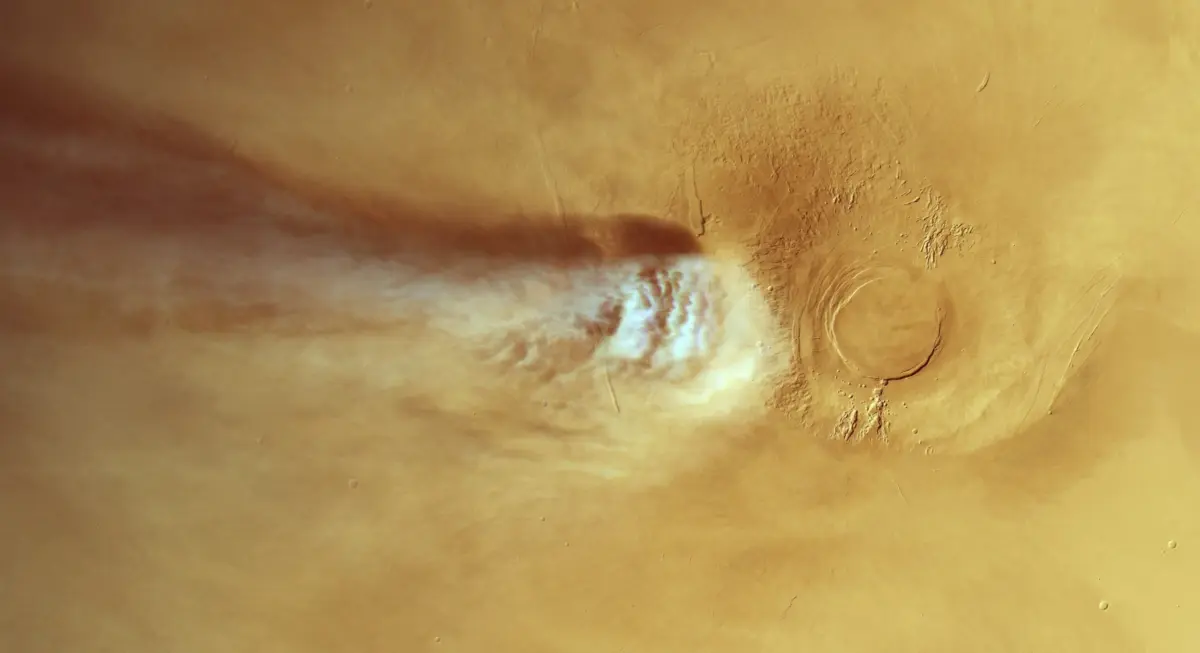
Every Martian spring and summer, a bizarre atmospheric phenomenon awakens on the Red Planet. Near the slopes of Arsia Mons—a colossal shield volcano towering roughly 65,000 feet above the Martian surface—a wispy, exceptionally long cloud materializes each morning. Over the course of several hours, this slender formation stretches across the Martian sky until it reaches an astonishing length of over 1,000 miles, roughly equivalent to the distance from New York City to Kansas City. By midday, as solar radiation heats the thin atmosphere, the giant structure completely dissipates, only to repeat the cycle the following morning for months on end.
First recorded in striking detail by orbiting space probes in 2018, the Arsia Mons Elongated Cloud (AMEC) has long baffled planetary scientists. For years, standard meteorological models failed to provide a plausible explanation for how such a massive, ephemeral structure could consistently form in the thin, dry air of Mars.
Now, an international team of researchers has successfully modeled the cloud’s formation for the first time. Published in Nature Geoscience, their findings suggest that the AMEC is driven by a radical physical process never before directly observed in the atmosphere of any planet in our solar system. According to the study, the cloud’s birth relies on "exotic physics"—textbook theoretical mechanics that atmospheric scientists previously assumed rarely, if ever, occurred spontaneously in nature. This breakthrough not only solves a Martian meteorological mystery but also provides a tantalizing glimpse into uncharted atmospheric dynamics that may span across distant worlds.
Detailed Chronology: From Discovery to Breakthrough
The 2018 Discovery and the Enigma of AMEC
While amateur astronomers and space probes had previously captured fleeting, localized hazes near Mars’ great volcanoes, it was not until 2018 that the scale of the Arsia Mons Elongated Cloud was fully realized. Equipped with advanced wide-angle imaging systems, spacecraft orbiting Mars captured the systematic, repeatable evolution of the AMEC during the planet’s southern spring and summer seasons.
Day after day, as the sun rose over the towering peak of Arsia Mons, the cloud would begin as a small, localized plume downwind from the summit. Instead of dispersing harmlessly into the upper atmosphere, the plume would elongate, stretching at speeds rivaling terrestrial jet streams. Within hours, it reached its maximum length of over 1,000 miles before vanishing entirely under the midday sun.
For years, planetary scientists attempted to replicate this cycle using established meteorological computer models adapted from Earth and Mars weather databases. Every attempt fell flat. Standard cloud-formation mechanisms—which rely on wind patterns, topography, and the presence of microscopic condensation nuclei like dust or ice particles—could not account for a structure of such immense proportions forming and evaporating with such clockwork precision. The AMEC remained an outlier, a persistent puzzle in planetary science.
The Modeling Breakthrough
The turning point came when a research team led by Jorge Hernández-Bernal, a planetary scientist at Paris Sorbonne Université, decided to rethink the foundational physics governing the simulation. Rather than relying solely on standard atmospheric mechanics, the team incorporated theoretical phase-change physics into their computational models.
"We found that we needed to include some exotic physics—physics that, while included in textbooks, is treated as theoretical and usually thought not to happen in nature," Hernández-Bernal noted in a press release. "It certainly hasn’t been seen in action before. Once we included this physics in our simulations, the AMEC emerged just as we hoped."
By adjusting the simulation parameters to account for rapid thermodynamic shifts and unassisted molecular bonding, the computer models finally reproduced the exact life cycle, growth rate, and dissipation timeline of the Arsia Mons Elongated Cloud. The long-standing mystery was finally yielding to advanced atmospheric simulation.
Supporting Context & Metrics: The Science of Homogeneous Nucleation
To understand why the AMEC is so revolutionary, one must examine how clouds form on Earth versus the extreme environment of Mars.
Earthly Clouds vs. Martian Extremes
On Earth, clouds are rarely solitary actors; they require microscopic impurities to take shape. Water vapor in our atmosphere needs tiny airborne particles—known as cloud condensation nuclei or ice nuclei, such as dust, sea salt, pollen, or soot—to act as a scaffolding upon which liquid droplets or ice crystals can condense and freeze.
The new study on the AMEC suggests that Mars is operating under an entirely different set of rules. The researchers concluded that the Arsia Mons cloud forms through homogeneous nucleation. In this rare process, water vapor transitions directly into ice crystals completely on its own, bypassing the need for dust, aerosols, or other solid debris to seed the formation.
"It’s akin to droplets of condensation appearing in the middle of a room, rather than on a window," Hernández-Bernal explained, illustrating the counterintuitive nature of homogeneous nucleation. "It’s wholly unexpected."
The Extreme Atmospheric Recipe
For homogeneous nucleation to occur on the scale required to build a 1,000-mile cloud, nature must orchestrate a convergence of extreme environmental triggers:
- Severe Temperature Drops: The atmosphere must undergo a dramatic temperature plummet of approximately 30 degrees Celsius within a frantic 10-minute window.
- Intense Relative Humidity: The local air mass must achieve hyper-saturation levels of water vapor.
- Topographic Amplification: The 65,000-foot-tall Arsia Mons shield volcano acts as an enormous physical wedge. When prevailing wind currents slam into this gargantuan obstacle, they are forcefully deflected upward, generating powerful atmospheric waves that launch moist air high into the thin Martian sky in a matter of minutes.
These conditions create a transient environment featuring air humidity levels more than 100,000 times greater than any atmospheric humidity value ever reliably measured on Earth. Prior to this successful modeling effort, planetary scientists had no empirical evidence that such extreme pockets of humidity could even exist in the Martian atmosphere.
Official Statements and Expert Analysis
The implications of the study, published in Nature Geoscience, stretch far beyond the red dust of Mars, challenging fundamental assumptions about how planetary atmospheres behave across the solar system.
"We don’t have nearly as much information about Mars’ atmosphere as we do about Earth’s, so reproducing the AMEC to this degree is a big success," stated Jorge Hernández-Bernal, emphasizing the computational hurdle the research team overcame. "The result is remarkable."
Independent planetary scientists and meteorologists have hailed the study as a masterclass in bridging theoretical physics with observational astronomy. By successfully simulating a phenomenon driven by unobserved physical pathways, the research team has opened a new door for how scientists analyze weather systems on other celestial bodies.
Atmospheric physicists point out that while theoretical models have long suggested homogeneous nucleation could occur under extreme laboratory settings or in the upper reaches of gas giants, capturing its footprint in a planetary atmosphere—let alone verifying it through predictive modeling—is a monumental milestone. It proves that nature frequently utilizes physical pathways that human scientists dismiss as too extreme or improbable for active planetary environments.
Future Outlook: Implications for Mars Exploration and Beyond
As the scientific community digests the implications of the Nature Geoscience study, researchers are already looking toward the future. The discovery that Mars can host hyper-humid microclimates and execute exotic phase changes forces a reassessment of the planet’s atmospheric dynamics, past and present.
Redefining Planetary Meteorology
With the AMEC mystery largely solved, researchers are turning their computational models toward other enigmatic atmospheric formations across the solar system. Similar rapid-formation cloud structures have been hypothesized to exist in the upper atmospheres of Venus and even within specialized storm cells on Earth, yet they have consistently eluded direct observation.
The discovery that Mars can support extreme homogeneous nucleation suggests that similar hidden physical processes may be active on other worlds, quietly operating outside the boundaries of classical textbook meteorology. Future planetary missions equipped with high-cadence atmospheric sensors will undoubtedly search for the thermal and hygrometric signatures of homogeneous nucleation on Venus, the gas giants, and icy moons.
Preparing for Human Exploration
For near-term Mars exploration, understanding localized atmospheric phenomena like the AMEC is more than an academic exercise. As space agencies and private aerospace companies lay the groundwork for human missions to the Red Planet, accurate weather forecasting and atmospheric modeling are critical for safe spacecraft entry, descent, and landing (EDD), as well as long-term surface operations.
Arsia Mons and its surrounding region are prime targets for future scientific exploration due to their complex volcanic geology and potential subsurface volatile deposits. Understanding how massive moisture plumes form, travel, and dissipate provides vital data on the global water cycle of Mars—a key element in the search for ancient habitability and resources to support future astronauts.
Ultimately, the 1,000-mile cloud of Arsia Mons has proven to be much more than a transient Martian curiosity. It stands as a testament to the vast, undiscovered complexities of the cosmos, reminding us that even our closest planetary neighbors still harbor secrets capable of rewriting our understanding of physics itself.