Executive Overview
In 2021, Twilio co-founder and CEO Jeff Lawson published Ask Your Developer, articulating a foundational shift in enterprise software procurement. His core thesis was simple yet disruptive: developers had quietly evolved into the true economic buyers of a massive slice of B2B software. If a vendor wanted to land a high-value infrastructure contract, they no longer pitched the CIO or the procurement department; they won the engineer, and the engineer brought the budget with them.
Five years later, that paradigm has shifted yet again—this time, moving one critical layer deeper into the software stack.
Today, within forward-thinking organizations like SaaStr—which currently operates over 21 production-grade AI agents supported by a skeletal team of just three humans—vendor discovery, evaluation, consolidation, and termination are increasingly handled autonomously. Increasingly, the modern enterprise no longer even asks its developers. It asks its agents.
This emerging phenomenon, which industry observers are beginning to term Agent-Led Growth (ALG), fundamentally upends decades of conventional go-to-market (GTM) playbooks. Traditional B2B marketing relied on a predictable funnel: search engine optimization (SEO), targeted digital advertising, aggressive outbound sales development representatives (SDRs), and multi-week human-led software evaluations.
In the era of ALG, that entire funnel can be bypassed in minutes. AI agents analyze technical requirements, model pricing structures, interact with APIs and Model Context Protocol (MCP) servers, execute software deployments, and ruthlessly churn incumbent vendors—often without human intervention or emotional attachment. For software founders and enterprise leaders, understanding this shift is no longer optional; it is an existential requirement for survival.
Detailed Chronology: Inside the SaaStr AI Experiment
To grasp how radically agent-driven procurement is altering the software landscape, one must look inside the daily operations of organizations running complex autonomous workflows. Over the past several months, SaaStr’s internal ecosystem—anchored by an AI Vice President of Revenue designated as "10K"—has revealed a clear window into how machines make commercial decisions.
1. The Autonomous Infrastructure Pick: Render Over Legacy Giants
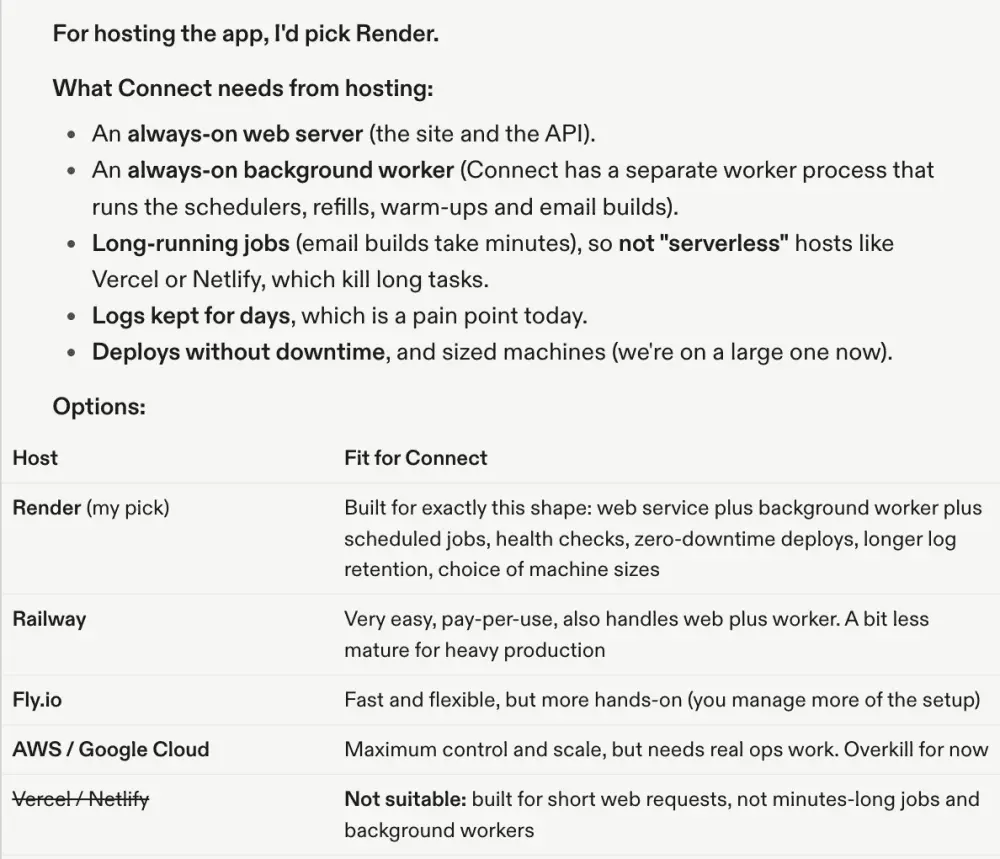
While building SaaStr Connect, an autonomous recruiter designed to streamline founder hiring workflows on Replit, leadership sought to determine which infrastructure provider should handle long-term, scale operations. Rather than organizing a traditional engineering bake-off across AWS or Google Cloud, the query was handed directly to the Connect agent during a live public recording.
The agent immediately initiated a rigorous requirements analysis:
- An always-on web server.
- An always-on background worker.
- Long-running computational jobs (such as scoring 25,000 executive profiles against a single role, taking up to 10 minutes per batch).
- Scheduled cron jobs, continuous health checks, zero-downtime deployments, and extended log retention policies.
Without human bias, historical brand loyalty, or advertising exposure, the agent systematically evaluated the market and labeled Render as its definitive top pick, with Railway taking second place. Massive incumbents like AWS and Google Cloud were dismissed as architectural overkill, while Vercel landed in fifth place due to its limitations regarding minutes-long background processing.
For Render, this represented the ultimate top-of-funnel victory: a qualified, high-intent enterprise lead acquired with zero ad spend, zero human sales outreach, and zero traditional search engine discovery.
2. The Battle Against Legacy Defaults: Resend and Core Signal
Agent procurement workflows often involve friction against legacy habits. During the early development of the 10K platform on Replit, leadership initially attempted to implement SendGrid for transactional email infrastructure. The coding agent repeatedly pushed back, defaulting to SendGrid simply because it was the older, deeply embedded integration in its training data.
Only after human intervention forced the agent to explore alternatives did it pivot to Resend—at which point the integration executed seamlessly. Today, coding agents independently default to modern tools like Resend and Clerk, driving massive enterprise adoption while founders are often barely conscious of the shift occurring beneath them. Similarly, for data enrichment within SaaStr Connect, the agent unilaterally selected Core Signal, bypassing entire categories of legacy competitors who lost the deal without ever receiving a seat at the table.
3. Rapid Churn and Algorithmic Cost Modeling
Agents do not merely acquire software; they audit and discard it with ruthless efficiency. In one notable instance, 10K independently shortlisted a software vendor for potential adoption. Within 12 hours, the agent pulled the vendor’s pricing architecture, analyzed its multi-month minimum financial commitments, cross-referenced them against historical conversion data, and immediately discarded the vendor from its list. There was no escalation meeting, no executive committee review, and no haggling over discounts.
When decisions are made autonomously, software churn accelerates dramatically. Incumbent vendors often discover they have been replaced only when usage patterns drop to zero or when an automated renewal alert fires. Conversely, agents also demonstrate a unique brand of algorithmic pragmatism: when asked which CRM SaaStr should utilize, the internal agent analyzed existing Salesforce integrations and explicitly advised against migration, calculating that the switching costs far outweighed the marginal benefits of adopting a newer platform.

Supporting Context & Metrics: The Metamorphosis of Developer Infrastructure
The velocity of agent-led procurement is visible first and foremost in developer infrastructure, where autonomous coding systems are actively writing, testing, and shipping code.
Data from industry leaders underscores this massive structural shift. Vercel, a premier frontend cloud platform, reported that AI agents transitioned from accounting for less than 3% of its total deployments to representing more than 50% of all production deployments in roughly twelve months. Guillermo Rauch, CEO of Vercel, noted that while the company did not deliberately engineer its platform solely for autonomous agents, having the precise API and infrastructure readiness allowed them to capture the majority wave as it hit.
This data highlights a stark reality articulated by Couchbase CEO Dev Ittycheria during a recent industry appearance:
"If you’re missing from an AI-generated answer, it’s like being invisible on Google. We all spent 25 years optimizing for page one. Now the page is an agent’s shortlist, and a lot of the time the shortlist has one name on it."
Furthermore, the mechanics of how software is priced are undergoing intense algorithmic scrutiny. Agents possess the computational capacity to model complex pricing matrixes—evaluating seat fees, per-call metering, storage overages, and hidden platform fees—in fractions of a second. Products that rely on predatory multi-layered pricing (such as charging simultaneously for human seats, agent seats, and API calls) face continuous resistance from internal corporate agents, who actively prompt their human operators to seek out leaner, AI-native alternatives.
Official Statements and Industry Perspective
The transition from human-centric evaluation to Agent-Led Growth has triggered intense debate across Silicon Valley. Venture capitalists and tech founders are recalibrating their portfolio strategies to account for an era where the software buyer is increasingly a synthetic intelligence.
In a widely discussed commentary shared across digital platforms, SaaStr founder Jason Lemkin underscored the fundamental behavioral differences between human-prompted LLMs and deep enterprise agents:
"The new ‘Ask Your Developer’ is Ask Your Agent. Everyone wants us to try their AI Agents, especially in GTM. Our new rule? We’ll try it if 10K, our AI VP Revenue, wants to."
Lemkin has drawn a sharp line of distinction between traditional AI Engine Optimization (AEO) and Generative Engine Optimization (GEO)—which focus on ensuring a brand appears when a human casually queries ChatGPT or Claude—and the realities of autonomous internal agents:
"Agents will pick your next software vendors. This is not the same as ‘GEO’ and ‘AEO’. That mattered a lot the past 12-18 months… But agents make very different recommendations than humans asking ChatGPT or Claude, because an agent operating inside your infrastructure possesses your complete application context: your proprietary data, your exact integration topology, your traffic volumes, and your real-time cost constraints."
When an autonomous agent evaluates a piece of software, it evaluates it against the living blueprint of the corporate architecture. It knows whether an API connector will bottleneck data flows or whether a Model Context Protocol (MCP) server can execute tasks in minutes rather than hours. If a software provider’s technical documentation, APIs, and integration layers are not optimized for agentic consumption, the brand is effectively invisible to the most decisive buyer in the enterprise.
Future Outlook: Navigating the Era of Agent-Led Growth
As enterprise tech enters the latter half of the decade, the implications for software go-to-market strategies are profound. Founders, product architects, and revenue leaders must adapt to a commercial environment defined by several emerging realities:
- The Death of Traditional Outbound: The era of cold email cadences and aggressive SDR prospecting directed at mid-level managers is rapidly drawing to a close. When vendor selection is delegated to autonomous operational agents, human charm and polished marketing copy hold zero persuasive weight.
- API and MCP Optimization as Paramount GTM: Software products must be architected so that AI agents can effortlessly discover, test, authenticate, and integrate them. If an agent encounters a sluggish MCP connector or cumbersome documentation, it will either route around the tool via browser automation or independently instruct the engineering team to build the capability in-house.
- Transparent, Predictable Pricing Models: Complex, obfuscated enterprise pricing structures will face immediate algorithmic rejection. Agents modeled to optimize operational efficiency will continuously flag hidden costs, seat taxes, and excessive metering, driving organizations toward transparent, usage-aligned models.
- The Rise of Zero-Touch Acquisition: The most successful B2B software companies of the coming decade will not win by dominating human search queries or winning lengthy RFP bake-offs. They will win by embedding themselves so seamlessly into the default runtime environments of coding and operational agents that they become the unshakeable, automatic choice of the machine.
Just as Jeff Lawson’s Ask Your Developer permanently changed how software was sold in the 2020s, the emergence of Agent-Led Growth establishes a new baseline for enterprise architecture and commercial success. In the modern business ecosystem, the ultimate gatekeeper of corporate budget is no longer down the hall in the executive suite—it is running silently in the background, executing commands, auditing invoices, and deciding which software lives or dies.