Executive Overview
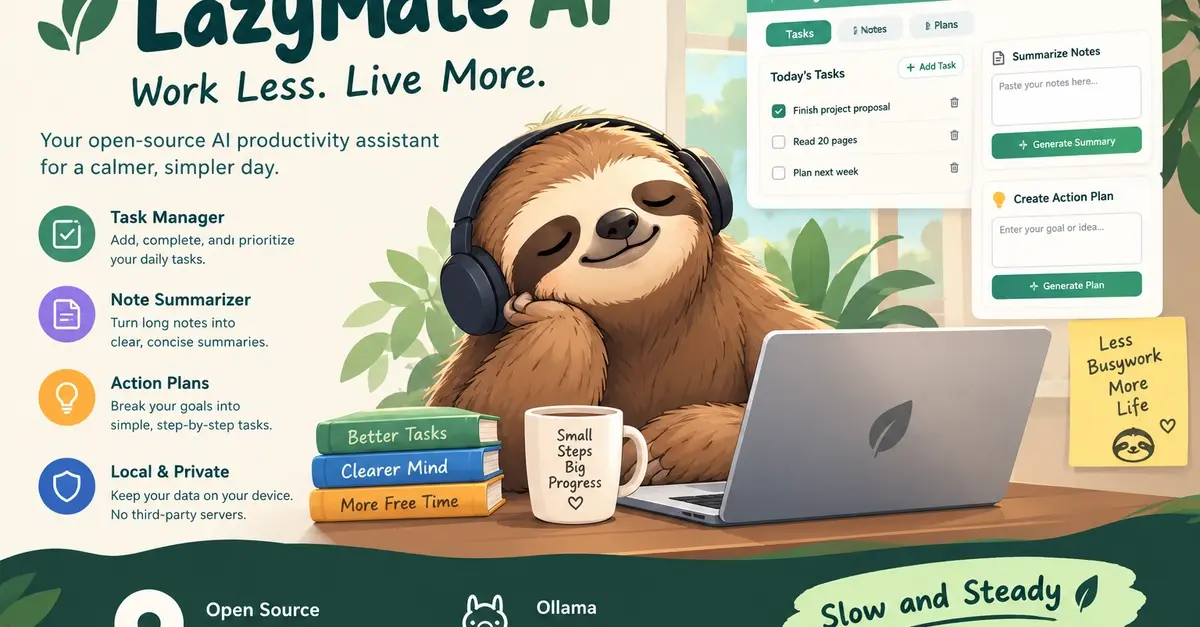
In an era dominated by cloud-based software-as-a-service (SaaS) platforms that demand uninterrupted data streams and costly recurring subscriptions, a quiet counter-movement is taking shape. Enter LazyMate AI, a lightweight, open-source productivity assistant developed for the Hacktoberfest Open-Source AI Challenge Week 3: Slow and Steady.
Operating under the philosophy of "Work Less, Live More," LazyMate AI is designed to solve a modern cognitive dilemma: how to leverage the organizing power of artificial intelligence to manage chaotic notes and daunting tasks without sacrificing personal data privacy or falling into the trap of paid, proprietary AI ecosystems.
Built using foundational web technologies—HTML, CSS, and JavaScript—LazyMate AI bridges the gap between simple client-side utility and advanced local machine learning. By utilizing optional local inference runtimes like Ollama, the application allows users to process sensitive notes, school assignments, and daily schedules entirely on their own hardware. This architecture eliminates the need to route private data through third-party cloud servers.
This article explores the motivations, technical architecture, and broader implications of LazyMate AI. We will examine how this minimalist tool addresses modern digital fatigue, its dual-mode operating system, the importance of open-source innovation, and what the future holds for privacy-centric productivity software.
Detailed Chronology: The Making of LazyMate AI
The genesis of LazyMate AI is rooted in the practical challenges faced by students and multi-tasking professionals drowning in disorganized information. The project’s development progressed through a deliberate, iterative cycle designed to keep the application accessible, modular, and lightweight.
Phase 1: Conceptualization and the Frontend Foundation
The project began as an exploration of friction points in daily workflows. When confronted with pages of messy lecture notes or unstructured brain dumps, users often experience decision paralysis—the gap between having a task and knowing how to begin it.
The developer chose to build the user interface using standard web technologies:
index.html: The structural markup providing a clean, distraction-free layout.style.css: A minimalist design system tailored to reduce visual clutter and cognitive overload.script.js: The behavioral engine handling user interactions, task parsing, and local storage.
By avoiding heavy frontend frameworks (such as React, Angular, or Vue), the creator ensured that the codebase remains approachable. Beginners can easily inspect, modify, and contribute to the repository without navigating complex build pipelines or node module dependencies.
Phase 2: Implementing the Dual-Mode Architecture
A major engineering hurdle for local AI tools is accessibility: forcing users to run heavy models can alienate casual users who just want a quick task manager. To solve this, LazyMate AI was engineered with two distinct operational modes:
- Demo Mode (Rule-Based Fallback):
Operating entirely within the browser, the core task manager utilizes native JavaScript logic. Even without a local model server running, the application can execute basic text processing, organize bullet points, and generate rudimentary action plans using algorithmic rules. This ensures the app is immediately useful out-of-the-box. - Local AI Mode (Ollama Integration):
For users seeking more advanced cognitive assistance, LazyMate AI connects seamlessly with Ollama, a lightweight framework for running open-weight large language models locally. When configured, the web app routes prompts directly to the local model instance, delivering nuanced summaries, intelligent task breakdowns, and customized schedules without sending a single byte of data to an external API.
Phase 3: Open-Source Distribution and Hacktoberfest Participation
With the core architecture stabilized, the project was published to GitHub as part of the Hacktoberfest initiative. The repository structure was kept intentionally flat to maximize transparency and ease of contribution:
LazyMate-AI/
├── index.html
├── style.css
├── script.js
└── README.md
By releasing the code under an open-source license, the creator invited the global developer community to audit the code, suggest improvements, and experiment with local AI integrations—aligning directly with the ethos of community-driven software development.
Supporting Context & Metrics: The Shift Toward Local AI
To fully understand the significance of LazyMate AI, one must examine the broader technological landscape of productivity software and user privacy.
The Problem with Cloud-Centric Productivity
Modern knowledge workers and students rely heavily on digital assistants embedded within proprietary suites. While powerful, these tools introduce several systemic friction points:
- Data Privacy Risks: Personal journals, study notes, strategic plans, and unfinished thoughts are routinely uploaded to cloud servers, where they may be logged, analyzed, or used for model training.
- Subscription Fatigue: Essential AI features are increasingly locked behind expensive monthly paywalls, pricing out students and independent creators.
- Connectivity Dependency: Cloud-based AI tools fail the moment an internet connection drops or a service provider experiences an outage.
The Rise of Open-Weight Models and Local Inference
The release of high-performing, open-weight models (such as Llama, Mistral, and Gemma) has democratized artificial intelligence. Tools like Ollama allow everyday computers—even those without enterprise-grade GPUs—to run quantized language models locally.
| Feature | Cloud-Based AI Assistants | LazyMate AI (Local Mode via Ollama) |
|---|---|---|
| Data Destination | Third-party cloud servers | Local machine (RAM/Storage) |
| Privacy Level | Dependent on Terms of Service | Absolute control by the user |
| Internet Requirement | Mandatory | Optional (after initial model download) |
| Cost Structure | Subscription fees / Pay-per-token | Free and open-source |
| Customizability | Restricted by provider guardrails | Fully adaptable by the developer |
While local AI setups require initial technical configuration and internet access for downloading model weights, the long-term payoff is unmatched sovereignty over one’s personal workflow data.
Official Insights & Developer Philosophy
Open innovation is more than just a software distribution model; it is a philosophy centered on user empowerment. In discussing the core motivations behind LazyMate AI, the developer emphasized the importance of returning control to the end-user.
"For me, open innovation is about giving people more control over the tools they use. A productivity assistant may handle personal notes, study plans, assignments, and unfinished tasks. I wanted to explore an approach where users can choose to process that information on their own computer."
This perspective highlights a critical blind spot in contemporary software design: productivity tools should serve the user’s peace of mind, not extract value from their cognitive output. By designing an application that functions offline and respects local boundaries, the project tackles digital surveillance head-on.
Furthermore, the developer maintains a pragmatic stance on performance metrics. Rather than inflating claims of miraculous productivity boosts, the project embraces scientific rigor:
"I have not measured a verified time saving yet, so I won’t claim a specific number. The next step is to test the app with real study notes and everyday tasks, then measure how much time it saves. Sometimes, being productive doesn’t mean working harder. It means making the next step easier."
This honest approach is refreshing in an industry often saturated by exaggerated marketing claims and unverified performance metrics.
Future Outlook: The Road Ahead for LazyMate AI
As LazyMate AI evolves beyond its initial Hacktoberfest submission, the roadmap focuses on practical enhancements, user testing, and community expansion.
1. Empirical Validation
The immediate next phase involves rigorous user testing. By deploying LazyMate AI among students and professionals handling diverse workloads—ranging from academic research to software development sprints—the project will gather quantitative data on task completion rates and perceived cognitive load reduction.
2. Expanded Local Capabilities
Future updates aim to refine the fallback rules and deepen integration with various open-weight models supported by Ollama. Enhancements will likely include:
- Context-aware prompt templates for specific scenarios (e.g., meeting transcript summarization, syllabus breakdown, and daily journal organization).
- Enhanced offline storage protocols utilizing IndexedDB for robust local data persistence.
- Streamlined configuration wizards to help non-technical users connect their local AI runtimes with minimal friction.
3. Cultivating the Open-Source Community
As part of the BuildInPublic movement, the developer encourages ongoing contributions from designers, frontend engineers, and AI enthusiasts. Whether through refining the CSS design system, optimizing JavaScript execution loops, or writing documentation, the community will play a pivotal role in shaping the tool’s evolution.
Conclusion
LazyMate AI stands as a compelling testament to what can be achieved when minimalist web design meets the power of local artificial intelligence. By stripping away bloated cloud infrastructure, expensive subscriptions, and privacy intrusive data-harvesting practices, the project offers a refreshing alternative for anyone looking to organize their digital life responsibly.
In an age that constantly pushes humanity to work faster, burn brighter, and produce more, LazyMate AI offers a necessary counter-narrative. It reminds us that technology should adapt to human rhythms—not the other way around.
Work less. Live more. Stay a little slothful. 🌍🦥
Tags: #Hacktoberfest #OpenSource #JavaScript #AI #Ollama #BuildInPublic