In an explosive convergence of cybercrime, corporate espionage, and international law enforcement action, U.S. federal investigators have trained their sights on the upper echelons of the cybersecurity consulting sector. The probe, centered on the notorious ShinyHunters hacking syndicate—the group responsible for the high-profile breach of the Federal Bureau of Investigation’s recruitment portal—has uncovered an illicit ecosystem of collusion. According to sources close to the investigation, executives at two distinct ransomware negotiation firms maintained unusually close, cooperative relations with the extortion collective. Most damningly, a U.S.-based executive is alleged to have actively assisted the hackers in operating a victim-shaming and pressure website.
The unfolding scandal exposes a dark underbelly in the multi-million-dollar cyber-incident response and negotiation industry. As ransomware cartels rake in tens of millions of dollars annually, investigators reveal that certain professionals tasked with guiding terrified corporate victims through crisis management may have been playing a double game. By bleeding insider information to threat actors, helping operate extortion platforms, and harboring prior knowledge of critical national security breaches—including the compromise of FBI personnel data—these individuals have transformed from corporate defenders into alleged co-conspirators.
Detailed Chronology: From Dutch Raids to the Fall of Cyber Executives
The web of arrests and revelations began to unravel in mid-September 2026, catalyzed by aggressive international police work and high-stakes digital forensics.
The Capture of Pepijn van der Stap
On the evening of September 15, 2026, Dutch law enforcement executed a dramatic raid in the Netherlands, deploying flash-bang grenades to stun and apprehend Pepijn van der Stap, a convicted hacker and senior suspect tied to ShinyHunters. Police successfully compromised Van der Stap while he was actively logged into his Signal instant messaging account. This tactical precision allowed authorities to harvest real-time chat histories, unmasking a network of frequent contacts that included ransomware negotiators stationed in Canada and the United States.
According to sources close to the investigation, Van der Stap’s decrypted communications contained explosive evidence. Beyond routine extortion coordination, investigators uncovered discussions pointing to a murder-for-hire plot targeting individuals abroad. While Dutch media outlet RTL reported that the murder orders were never ultimately carried out, the discovery underscored the violent and volatile nature of the ShinyHunters operation.
The Ascent of "Rey" and the FBI Breach
With Van der Stap neutralized, control over the ShinyHunters brand shifted to its current administrator, a teenage hacker from Amman, Jordan known online as "Rey." (Identified in late 2025 as the head of the "Scattered Lapsus Hunters" overlap). Under Rey’s leadership, the group intensified its aggressive shaming tactics, culminating in a devastating strike in late September 2026: the compromise of the FBI recruitment website, fbijobs.gov.
The breach mocked federal law enforcement, exposing sensitive internal files containing employee Social Security numbers, home addresses, medical and psychological evaluations, and unit specializations.
The audacity of the FBI jobs site hack prompted an unprecedented response. Moving with uncommon velocity, the bureau tracked, detained, and interrogated anyone communicating with Rey. On October 3, Reuters reported that Rey had been detained by Jordanian authorities and was actively cooperating with the FBI.
The Arrest of Edward Dubrovsky
The decrypted Signal chats seized from Van der Stap’s device served as a Rosetta Stone for federal agents, directly implicating prominent figures in the cybersecurity consulting community. On October 9, the FBI arrested Edward Dubrovsky, a 54-year-old Canadian cybersecurity executive and co-founder of CyberSteward. Dubrovsky—who had recently authored a book on handling cyber extortion that advised victims to always engage with hackers—was charged with threatening to disclose stolen data and interfering with interstate commerce through extortion.
Prosecutors subsequently requested that Dubrovsky remain in custody pending trial, with court dockets heavily sealed. Investigators revealed that Dubrovsky’s chats with Van der Stap showed he was intimately aware that ShinyHunters had exfiltrated sensitive FBI server data long before the group publicly threatened to publish the personnel files on social media, yet he never notified the bureau.
Supporting Context & Metrics: The Mechanics of Extortion
The Rise and Fall of "Shinywire"
Federal investigators believe that at least one executive at a prestigious U.S.-based consulting firm—employing more than 1,000 associates—played an active role in operating shinywire[.]com, a now-defunct victim extortion website linked to ShinyHunters. Operating from May 3 until October 16, 2026, the platform hosted profiles of nearly 100 corporate victims.
Shinywire functioned as a digital pressure cooker. Each entry displayed samples of stolen data and demanded that organizations engage with the cybercriminals to negotiate payment terms. If victims failed to comply within seven days, their files were dumped onto the ShinyHunters Tor-based leak blog. Among the victims listed on the platform was Intuitive Surgical, a major American medical technology company breached via targeted phishing in March 2026.
The Ghostbyte Connections
The investigation has also cast a shadow over historical ransomware incidents. Former colleagues of Daniel Tobok, former CEO of the Toronto-based cybersecurity firm Cypfer, revealed that as far back as 2018, Tobok was known to affiliates of the Dharma ransomware program by the moniker "Ghostbyte."
An email unearthed from a 2018 Dharma ransomware negotiation reveals the threat actors explicitly instructing a desperate Canadian victim to seek guarantees from an IT firm contact associated with the email address [email protected]. Intelligence services noted that Tobok’s personal email, [email protected], ties back to online accounts utilizing the username "ghostbyte." Furthermore, blockchain analysis of the Dharma affiliate wallet associated with the referral linked it to dozens of transactions totaling roughly $3.5 million.
Tobok and Dubrovsky had previously experienced a bitter falling out. Dubrovsky filed a lawsuit in Ontario alleging Tobok systematically squeezed him out of Cypfer following its acquisition by Aon Cyber Solutions Group and subsequent rebranding under the Apros Group. Tobok denied the allegations, filing counterclaims accusing Dubrovsky of misappropriating confidential information.
Financial Metrics and the Toll of Extortion
According to FBI estimates, the ShinyHunters collective has successfully extorted over $70 million from corporate victims in 2026 alone. Their operations have targeted massive entities, including education technology giant PowerSchool, which reportedly paid a $2.85 million ransom in late 2024 after 62 million student and 9.5 million teacher records were compromised.
Despite such payouts, security researchers emphasize that paying ransoms is a false economy. Prominent incident response firms like Coveware and Unit 221B have consistently warned victims that threat actors routinely retain, resell, or re-extort stolen datasets.
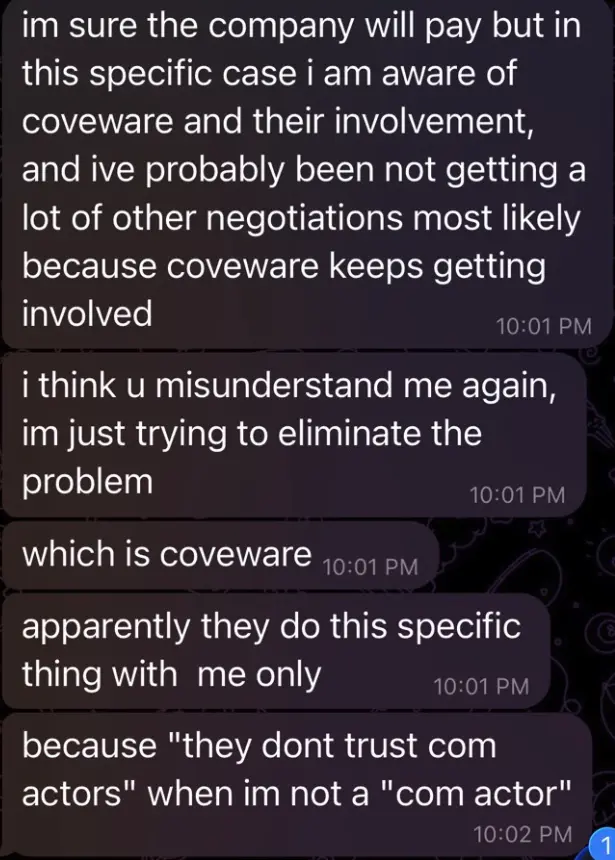
Internal ShinyHunters Telegram chats captured by investigators highlight the group’s fury toward firms like Coveware for interfering with their revenue streams. In an April and May 2026 chat logs, ShinyHunters leadership complained that Coveware’s anti-payment advisories were devastating their payment conversion rates, prompting the hackers to discuss ways to "eliminate the problem."
Official Statements and Industry Fallout
The unfolding scandal has sent shockwaves through the cyber insurance and incident response sectors, bringing issues of professional ethics and structural conflicts of interest to the forefront.
The Cypfer Response
In a statement issued on October 14, Cypfer distanced itself entirely from the criminal proceedings facing its former executive:
"We had no prior knowledge of Mr. Dubrovsky’s arrest. CYPFER has not received any outreach from law enforcement and, to our knowledge, is not the target of any law enforcement investigation."
The firm emphasized that CyberSteward and Cypfer operate as entirely separate entities with no shared leadership, and noted its recent acquisition by the Apros Group, led by former FBI special agent Jason Hogg.
Conflicts of Interest in Ransomware Negotiations
Industry leaders argue that the economic model governing ransomware negotiation is fundamentally broken. Mark Camillo, Chief Executive of CyberAcuView—an industry group founded by major cyber insurers—pointed out the glaring conflict of interest inherent in contingency-fee negotiation models:
"It has come to the industry’s attention that many of the ransomware payers charge a percentage of the final payment which may or may not be disclosed… This makes no sense if they are also the negotiator. There needs to be more transparency in the process as no one in the ecosystem should be profiting purely on the size of the ransomware transaction."
Camillo’s concerns are validated by recent Department of Justice crackdowns. On October 7, the DOJ charged MonsterCloud CEO Zohar Pinhasi with wire fraud and conspiracy for allegedly charging clients $19 million for ransomware remediation while secretly cutting back-alley deals to pay hackers only $8 million. Similarly, in July, negotiator Angelo Martino was sentenced to 70 months in prison for leaking his clients’ negotiation strategies directly to the BlackCat/ALPHV ransomware gang to maximize ransom payouts.
Future Outlook: A Turning Point for Incident Response
The arrest of high-profile executives like Edward Dubrovsky and the unmasking of deep corruption within negotiation intermediaries mark a watershed moment in the global fight against cyber extortion.
Stricter Regulatory Oversight: Law enforcement agencies, led by the U.S. Department of Justice and the FBI, are signaling that the traditional "don’t ask, don’t tell" approach to ransom payouts is coming under intense legal scrutiny. Negotiators and incident response firms can no longer operate in a regulatory vacuum.
Erosion of Trust: Corporate victims and cyber insurance underwriters will likely demand radical transparency regarding how negotiation firms operate, how fees are structured, and what guarantees exist that intermediaries are acting solely in the client’s best interest.
The Crackdown on Syndicates: With key figures like Rey in Jordanian custody, Pepijn van der Stap facing trial in the Netherlands, and domestic co-conspirators being unmasked from within corporate boardrooms, the operational anonymity that once shielded groups like ShinyHunters is rapidly evaporating.
As federal investigators sift through terabytes of decrypted chat logs, financial ledgers, and seized servers, the message to the cyber-consulting underground is clear: the shield of professional legitimacy can no longer protect those who choose to sit on both sides of the extortion table.