Executive Overview
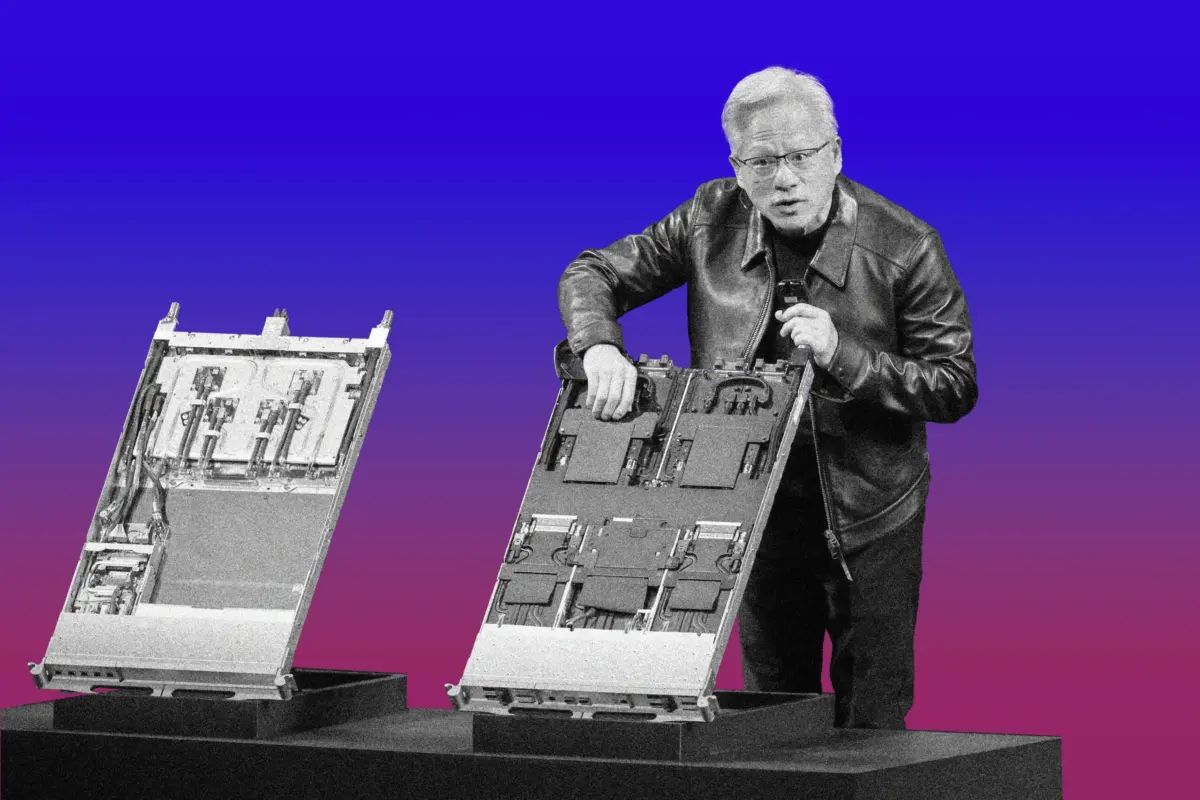
For the better part of a decade, the architecture of the modern artificial intelligence boom rested upon a single, indispensable pillar: Jensen Huang. As the co-founder and Chief Executive Officer of Nvidia, Huang was not merely the leader of the world’s most dominant semiconductor manufacturer; he was the primary architect of the hardware ecosystem that powered the generative AI revolution. From Silicon Valley startups to the sprawling server farms of hyperscale cloud providers, virtually every major leap in large language models and machine learning trace back to Nvidia’s graphics processing units (GPUs).
However, the tech landscape is notoriously unforgiving of permanence. As the industry careens past the peak of the initial hardware gold rush, signs of structural and strategic vulnerability are emerging at Nvidia, and by extension, within the empire Huang built. Industry analysts, macroeconomic forecasters, and international policymakers are increasingly speaking of a "post-Huang era"—a transition phase characterized not by unrivaled dominance, but by fierce competition, supply chain diversification, regulatory crackdowns, and a fundamental reassessment of how artificial intelligence will be scaled, monetized, and governed.
This shift extends far beyond corporate balance sheets. Because Nvidia sat at the literal and figurative intersection of national security, economic policy, and technological supremacy, the recalibration of Huang’s influence is actively redrawing the geopolitical map. Governments from Washington to Beijing, Brussels to Taipei, are waking up to the reality of semiconductor dependency. As the United States navigates political transitions and shifting administrations—where Huang once operated as a uniquely effective bridge-builder and "Trump whisperer"—the erosion of Nvidia’s absolute market immunity threatens to destabilize delicate international trade alignments.
This comprehensive report examines the multifaceted implications of Nvidia’s shifting trajectory, the geopolitical fallout of the post-Huang transition, and what industry insiders and journalists like The Atlantic’s Charlie Warzel are identifying as a pivotal turning point for the future of global technology.
Detailed Chronology: The Rise, Peak, and Reckoning of the Nvidia Empire
To understand the gravity of the current transition, one must trace the deliberate trajectory that positioned Nvidia at the center of the geopolitical universe.
Phase 1: The Incubation of Accelerated Computing (1993–2015)
Founded in 1993, Nvidia initially carved out its identity as a pioneer in 3D graphics for personal computers and video games. For years, the company was viewed primarily as a high-end hardware supplier for gamers. However, a watershed moment arrived in the late 2000s when Huang and his engineering teams recognized that the parallel processing architecture of GPUs could be repurposed to solve complex mathematical problems far more efficiently than traditional Central Processing Units (CPUs). This realization led to the creation of CUDA (Compute Unified Device Architecture) in 2006, a proprietary software platform that allowed developers to program GPUs for general-purpose computing. While Wall Street initially viewed CUDA as an expensive, niche gamble, it quietly laid the foundational software highway upon which the entire modern deep learning revolution would eventually travel.
Phase 2: The Generative AI Gold Rush and the Monopoly of Silicon (2016–2023)
When OpenAI released early iterations of its transformative models, and subsequent breakthroughs in generative AI captured the global imagination, the tech world encountered an immediate bottleneck: the world did not have enough computing power. Nvidia was uniquely positioned to answer the call. Its H100 and subsequent chips became the undisputed gold standard for training frontier AI models. During this period, Jensen Huang’s status ascended from tech executive to geopolitical powerbroker. Clad in his signature leather jacket, Huang became a fixture at international summits, commanding the attention of heads of state. Nvidia’s valuation soared past historic milestones, briefly making it the most valuable publicly traded company in the world as Big Tech firms engaged in an indiscriminate buying frenzy to hoard AI silicon.
Phase 3: The Geopolitical Crosshairs and Trade Realities (2022–2024)
As Nvidia’s hardware became synonymous with national security and technological superiority, geopolitical tensions caught up with the company. The United States government, seeking to maintain its strategic edge over rival superpowers—most notably China—began implementing sweeping export controls on advanced semiconductors. Nvidia found itself navigating a diplomatic and economic tightrope. Huang engaged in intense high-level lobbying and diplomacy, attempting to satisfy U.S. national security objectives while retaining access to the critical Chinese market through compliant, downgraded chips. It was during this high-stakes balancing act that Huang earned his reputation as a master diplomat and "Trump whisperer," capable of navigating unpredictable political winds in Washington while managing a sprawling, Taiwan-centric manufacturing supply chain.
Phase 4: The Post-Huang Inflection Point (Present Day)
Today, Nvidia faces a complex matrix of headwinds that signal the twilight of its unchallenged monopoly. Competitors—including major tech giants designing their own custom Application-Specific Integrated Circuits (ASICs)—are eating into Nvidia’s margins. Furthermore, regulatory scrutiny is intensifying globally, antitrust investigations are looming, and the sheer capital expenditure of AI infrastructure is forcing buyers to demand immediate profitability over raw computational power. As the industry pivots toward cost-efficiency, software optimization, and localized sovereign AI solutions, the absolute centralization of power around Jensen Huang and Nvidia is dissolving, marking the dawn of a decentralized, highly contested post-Huang geopolitical reality.
Supporting Context & Metrics: The Anatomy of the Transition
The conversation surrounding the post-Huang era is not merely speculative; it is anchored in shifting market dynamics, supply chain vulnerabilities, and hard economic metrics.
Market Share and Competitor Erosion
For years, Nvidia commanded upwards of 80% to 90% of the AI accelerator market. However, market research indicates that this monolithic dominance is facing sustained erosion.
- The Hyperscaler In-House Movement: Major cloud providers—including Alphabet (Google), Amazon (AWS), and Microsoft—are accelerating the deployment of their own custom silicon (such as Google’s TPUs and Amazon’s Trainium/Inferentia chips). By designing hardware tailored precisely to their internal workloads, these trillion-dollar entities are systematically reducing their long-term reliance on Nvidia.
- Rival Silicon Giants: Advanced Micro Devices (AMD) and Intel are aggressively carving out market share with competitive offerings like AMD’s MI300 series, presenting enterprise buyers with viable alternatives to mitigate supply chain risks and cost pressures.
Geopolitical Supply Chain Vulnerabilities
Nvidia’s historical success has been inextricably bound to the geopolitical stability of Taiwan. The company’s chips are physically manufactured by the Taiwan Semiconductor Manufacturing Company (TSMC), placing the heartbeat of the global AI revolution directly within one of the world’s most sensitive geopolitical flashpoints.
- Any disruption in the Taiwan Strait threatens not just corporate earnings, but the entire technological infrastructure of the Western world.
- Recognizing this vulnerability, the U.S. CHIPS Act and similar European legislative frameworks have spurred billions of dollars in domestic semiconductor manufacturing subsidies. However, building out redundant fabrication plants outside of Taiwan is a multi-year, capital-intensive endeavor, leaving a precarious window of vulnerability during this transition phase.
The Shift Toward Sovereign AI
Beyond corporate boardrooms, nation-states are increasingly viewing domestic AI capacity as a matter of national sovereignty. Countries across Europe, the Middle East, and Asia are refusing to rely indefinitely on American hardware monopolies or U.S.-centric cloud architectures. This has sparked a demand for "sovereign AI"—locally hosted, culturally contextualized models powered by diversified hardware supply chains. This localized approach decentralizes the global AI market, diminishing the singular influence that any one corporation—or any one executive—can wield over international standards and regulatory frameworks.
Expert Perspectives and Analytical Insights
To contextualize these monumental shifts, industry observers and media commentators have begun interrogating what the end of the hyper-concentrated Nvidia era means for the future.
In a recent episode of the podcast What Next: TBD, tech journalist and The Atlantic staff writer Charlie Warzel—host of the Galaxy Brain podcast—joined the discussion to analyze the profound implications of this transition. Warzel highlighted the unique role that Jensen Huang played as both a corporate visionary and a political operator capable of navigating the turbulent waters of Washington politics.
"As the founder-CEO of Nvidia, and famous Trump whisperer, Jensen Huang was uniquely positioned to influence where the A.I. industry was going and how it would be regulated," Warzel noted during the broadcast. "As we enter the post-Huang era, Nvidia isn’t the only company—and America isn’t the only country—wondering where we’re headed now."
This observation cuts to the heart of the matter. Huang was not just selling chips; he was acting as a stabilizing anchor for an industry experiencing exponential, often chaotic growth. His ability to maintain amicable, pragmatic relationships across political aisles and international borders provided a degree of predictability to an otherwise volatile regulatory environment.
As that singular figurehead sees his absolute leverage challenged by market realities and geopolitical friction, the regulatory vacuum is beginning to fill with competing interests. Antitrust regulators, trade hawks, and international competitors are stepping into the fray, eager to establish new rules of engagement for the next generation of artificial intelligence development.
Future Outlook: Navigating the Decentralized AI Landscape
As the technological ecosystem moves deeper into the post-Huang era, several critical trends will dictate the trajectory of global geopolitics and artificial intelligence development over the next decade:
1. Fragmentation of the AI Hardware Market
The days of a single hardware provider dictating the terms of engagement for every major tech enterprise are drawing to a close. The future will be characterized by a heterogeneous computing environment. Enterprises will mix and match GPUs, custom ASICs, and specialized neuromorphic chips depending on cost, energy efficiency, and specific workload requirements. This diversification will lower barriers to entry for smaller players but will increase software complexity for developers.
2. The Weaponization of Tech Regulation and Export Controls
Geopolitical competition between the United States and China will continue to center heavily on semiconductor access. Even as Nvidia and its peers attempt to thread the needle of compliance, regulatory frameworks are bound to tighten. Future export controls are likely to expand beyond raw computing power to encompass software ecosystems, talent mobility, and cloud computing access, forcing multinational technology companies to adopt rigidly localized compliance strategies.
3. The Energy and Infrastructure Bottleneck
As the pure hardware race matures, the next geopolitical battlefield will be energy. Training and operating frontier AI models demand astronomical amounts of electricity. The post-Huang era will see tech giants increasingly tied to national energy policies, investing heavily in nuclear, geothermal, and advanced renewable energy grids to power their data centers. Consequently, geographic regions with abundant, cheap energy and stable regulatory climates will emerge as the new hubs of AI supremacy.
4. Redefining Corporate Leadership and Diplomacy
Jensen Huang set a high benchmark for the modern tech CEO—one part visionary engineer, one part master salesperson, and one part geopolitical diplomat. As leadership transitions occur across the tech sector, incoming executives will find themselves operating in a far more hostile, heavily scrutinized regulatory environment. The era of unchecked technological exceptionalism is over; tech leaders will need to master statecraft, compliance, and international diplomacy just as fluently as code and silicon architecture.
Conclusion
The narrative of Nvidia under Jensen Huang is one of the defining business and technological epics of the twenty-first century. By anticipating the computational demands of the artificial intelligence revolution before the rest of the world understood its magnitude, Huang secured a temporary monopoly that reshaped global commerce, national security, and daily life.
Yet, history demonstrates that technological revolutions inevitably outgrow their initial catalysts. As the industry transitions into the post-Huang paradigm, the challenges confronting Nvidia reflect the broader maturation of the artificial intelligence sector itself. No single company can permanently insulate itself from market competition, supply chain gravity, and the relentless currents of geopolitics.
As America, international allies, and global competitors grapple with this new reality, the fundamental question remains: Who—or what systems—will step into the void left by Nvidia’s shifting dominance? The answers formulated in corporate boardrooms, government ministries, and research laboratories today will determine not only the economic winners of tomorrow, but the geopolitical architecture of the entire digital age.