Executive Overview
The landscape of workplace productivity is undergoing a fundamental structural shift, transitioning from isolated point-solution applications to interconnected, agentic ecosystems. As software vendors race to embed artificial intelligence into every user interface, the primary bottleneck has shifted from raw model capability to contextual awareness. In a bid to capture this unified context layer, Superhuman (the enterprise productivity suite formerly known as Grammarly) has announced a comprehensive rollout of features centered around its flagship AI assistant, Go.
This major update expands the scope of the Go assistant beyond simple text generation and proofreading, transforming it into an autonomous, cross-application orchestrator. The strategy relies on three main initiatives: deepening contextual intelligence across desktop workflows, opening the system to third-party developers via a dedicated Go Software Development Kit (SDK), and integrating the agent directly into core productivity spaces like Docs, Mail, and real-time meeting environments.
By leveraging data from newly connected platforms such as Databricks, Amplitude, and DeepL, alongside deep context harvested from its recent acquisition of meeting intelligence platform Fathom, Superhuman aims to establish Go as an essential digital co-pilot. As tech giants like OpenAI and Anthropic push rival agent frameworks, Superhuman’s latest suite update signals an aggressive move to control the user’s inline writing, task execution, and enterprise data retrieval.
Detailed Chronology
Understanding Superhuman’s current strategic direction requires analyzing the company’s pivot from single-purpose writing utilities to a comprehensive agent platform over the past eighteen months.
+-------------------------------------------------------------------------------+
|                       EVOLUTION OF THE GO AGENT PLATFORM                      |
+-------------------------------------------------------------------------------+
|                                                                               |
|  [Late 2025]        Superhuman (Formerly Grammarly) Rebrand                   |
|                     * Shifts identity from syntax checker to platform.        |
|                     * Launches initial iteration of 'Go' AI assistant.        |
|                                                                               |
|  [Early 2026]       Product Refinement & Market Friction                      |
|                     * Faces backlash over controversial features like the     |
|                       "Expert Review" tool (criticized for AI-human opacity). |
|                     * Refines model alignment and user trust frameworks.      |
|                                                                               |
|  [September 2026]   Strategic Acquisition of Fathom                           |
|                     * Acquires YC-backed AI notetaker Fathom.                 |
|                     * Lays foundation for real-time meeting intelligence and  |
|                       automated post-meeting workflow triggers.               |
|                                                                               |
|  [Current Phase]    Full Agentic Ecosystem Rollout                            |
|                     * Deploys connected Go agents natively in Docs and Mail.  |
|                     * Launches Go SDK with 20 enterprise launch partners.     |
|                     * Achieves 1 Million+ active user benchmark.              |
+-------------------------------------------------------------------------------+
1. The Rebrand and Initial Rollout (Late 2025)
In late 2025, Grammarly executed one of the tech industry’s most ambitious rebrands, renaming the entity Superhuman to reflect a scope far broader than spelling corrections and tone checks. Alongside the rebrand came the debut of the Go assistant, an initial attempt to bring generative AI features directly to the user’s desktop cursor.
2. Product Friction and Feature Pivots (Early 2026)
The transition was not without early setbacks. Early iterations of Superhuman’s expanded AI suite faced scrutiny from power users and technology journalists alike. Most notably, features like the platform’s "Expert Review" capability drew sharp criticism when industry observers pointed out that the service lacked human subject-matter experts in its feedback loop, relying instead on algorithmic evaluations wrapped in high-touch marketing. In response, Superhuman shifted its engineering focus toward programmatic transparency and verifiable system integrations.
3. The Contextual Pillar: Acquiring Fathom (September 2026)
Recognizing that textual context alone was insufficient for autonomous task execution, Superhuman acquired Y Combinator-backed automated notetaker Fathom in September 2026. The acquisition was designed to solve a fundamental problem in enterprise workflow automation: capturing unstructured audio and conversational data from internal meetings to feed downstream execution loops.
4. The Agentic Matrix Expansion (Current Rollout)
The latest platform update represents the convergence of these strategic milestones. Superhuman is now activating deep Fathom integrations, exposing native background agents in Docs, replacing legacy AI models in its Mail client with Go, and opening its APIs to third-party enterprise tools.

Supporting Context & Metrics
Superhuman’s platform updates address a core frustration in enterprise software: context switching. Rather than requiring users to manually copy and paste prompts between distinct web apps, the updated Go assistant operates directly within existing typing environments while pulling data from an expanded network of software tools.
                  +-----------------------------------+
                  |      SUPERHUMAN 'GO' ENGINE       |
                  +-----------------+-----------------+
                                    |
        +---------------------------+---------------------------+
        |                           |                           |
        v                           v                           v
+---------------+           +---------------+           +---------------+
| IN-LINE UI    |           | DOCS & MAIL   |           | THIRD-PARTY   |
| ENGINE        |           | ORCHESTRATION |           | GO SDK        |
+---------------+           +---------------+           +---------------+
| * Cursor sync |           | * Background  |           | * Databricks  |
| * Style match |           |   routines    |           | * Amplitude   |
| * Proactive   |           | * Multi-acct  |           | * DeepL       |
|   calendar &  |           |   search      |           | * Legora      |
|   inbox monitoring        | * Live notes  |           | * Blackboard  |
+---------------+           +---------------+           +---------------+
The Architectural Shift: Deep Contextual Ingestion
The core of this release is a revamped onboarding experience designed to gather data on user preferences and enterprise knowledge bases from day one. Rather than relying on generic prompt engineering, Go dynamically adjusts its underlying system instructions based on:
- User Persona & Style Matching: The assistant analyzes historical communication across email and document stores to mimic the user’s exact writing style, sentence structure, and vocabulary choices when auto-generating drafts.
- Unified Enterprise Search: Go indexes unstructured data across connected cloud repositories, allowing users to query company internal knowledge bases directly from their drafting window.
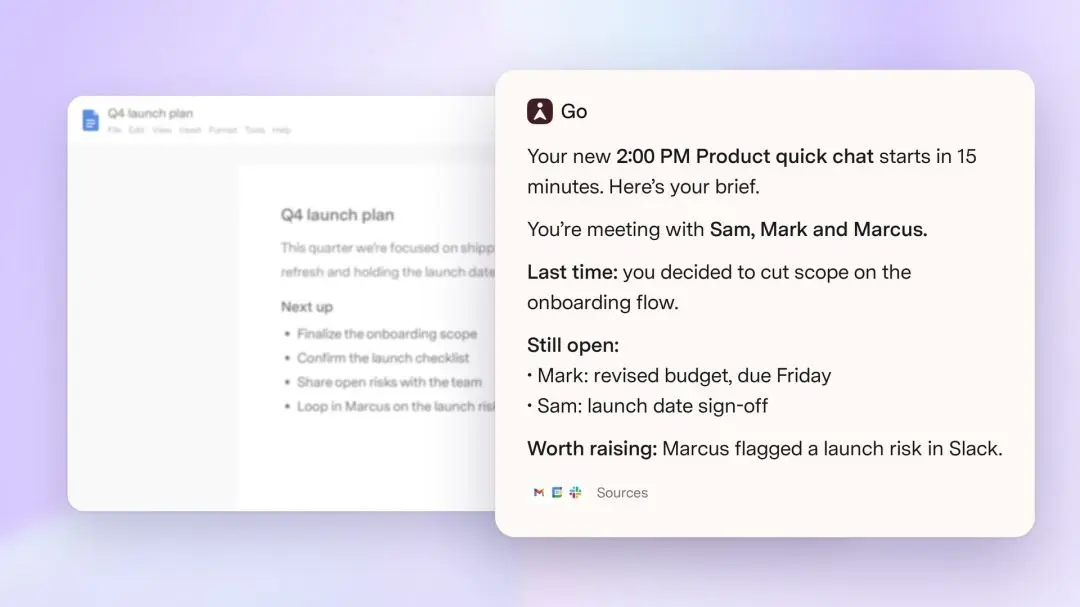
- Background Proactivity: The assistant operates continuously in the background—monitoring incoming calendar invitations, tracking unread email threads, and preemptively generating context-aware reply drafts before the user even opens an email.
Native Agent Deployment in Docs and Mail
Superhuman is embedding native Go agents across its primary workspaces, fundamentally altering how content is created and processed:
Superhuman Docs
Go agents operate natively alongside human writers. Users can assign background tasks to autonomous agents—such as researching background data or restructuring sections—while continuing to draft text. Furthermore, the platform introduces event-driven routines, allowing teams to trigger automated workflows based on specific document updates or status changes.
Superhuman Mail
Superhuman is phasing out its legacy, single-purpose AI tools in favor of unified Go orchestration. The assistant orchestrates inbox management across both Google Workspace and Microsoft Outlook environments. It uses cross-platform enterprise context to categorize messages, prioritize urgent tasks, and automatically compose contextually accurate responses.
Live Collaborative Note-Taking
Capitalizing on the Fathom acquisition, Superhuman is rolling out live, collaborative note-taking across teams. Beyond real-time transcription, Go can translate post-meeting summaries directly into operational workflows, such as automatically drafting a client proposal or updating a project tracking doc immediately after a call finishes.
The Go SDK and Third-Party Connectors
To prevent Go from operating in an isolated silo, Superhuman has launched the Go SDK, releasing 20 new connected agents at launch. This integration framework allows third-party platforms to expose their data stores and workflows directly to the Go assistant interface.
| Partner Platform | Primary Integration Functionality |
|---|---|
| Databricks | Pulls complex enterprise data queries directly into executive briefs and strategic docs. |
| Amplitude | Integrates real-time product analytics metrics into status updates and strategy reports. |
| DeepL | Enables real-time, contextually accurate multi-language translation within inline drafts. |
| Legora | Brings specialized legal compliance context and contract analysis directly into Docs. |
| Blackboard | Connects academic course frameworks, syllabi, and student records to academic workflows. |
Official Statements
The shift toward proactive, agentic workflows reflects a broader debate within the technology industry regarding the boundary between personal utility and enterprise automation.

Addressing the target market for the updated Go assistant, Shishir Mehrotra, CEO of Superhuman, emphasized that the platform is engineered to navigate the blur between professional responsibilities and personal administrative tasks.
"One of the reasons why these assistants have been popular is that they treat you as a whole person and recognize that we need to cover both extremes," Mehrotra stated during an interview. "Go is definitely more work-focused than some of the tools coming out of the pure consumer ecosystem. It doesn’t mean we draw the boundary at helping you with your personal tasks or helping you with your calendar or all of your email."
+-------------------------------------------------------------------------+
|                  THE PRODUCTIVITY AGENT COMPETITIVE LANDSCAPE           |
+-------------------------------------------------------------------------+
|                                                                         |
|  CONSUMER-FIRST AGENTS                 ENTERPRISE WORK-FOCUSED AGENTS   |
|  * OpenAI 'Dots'                       * Superhuman 'Go'                |
|  * Anthropic 'Claude Duet'             * Specialized Vertical Agents    |
|  * Consumer AI Ecosystems                (Instinct, Muse, Fo)           |
|                                                                         |
|  <------------------------------------------------------------------->  |
|                         Target Market Spectrum                          |
+-------------------------------------------------------------------------+
Mehrotra disclosed that Go has surpassed 1 million active users, a milestone that underlines its growing footprint amidst intense competition. While specialized productivity tools such as Instinct, Muse, and Fo target hyper-niche workflows, Superhuman is positioning Go to compete directly for the core desktop interface against general-purpose assistants like OpenAI’s Dots and Anthropic’s Claude Duet.
By embedding Go directly into the inline cursor and connecting it to enterprise platforms via its new SDK, Superhuman aims to establish a defensible moat based on proprietary user context—an area where broader foundational model providers often struggle.
Future Outlook
Superhuman’s broad rollout of agentic features highlights the next battleground for software platforms: owning the user’s primary desktop interface.
+-------------------------------------------------------------------------------+
|                       FUTURE PLATFORM TRAJECTORY & CHALLENGES                 |
+-------------------------------------------------------------------------------+
|                                                                               |
|  1. THE DATA PRIVACY IMPERATIVE                                               |
|     Connecting Databricks & Amplitude to inline AI requires strict enterprise |
|     governance, zero-data-retention guarantees, and granular access controls.  |
|                                                                               |
|  2. FROM PASSIVE SUGGESTIONS TO FULL AUTONOMY                                 |
|     Moving from inline text auto-complete to unsupervised background execution |
|     requires high model accuracy to prevent costly, automated hallucinations. |
|                                                                               |
|  3. PLATFORM CONSOLIDATION VS. POINT SOLUTIONS                                |
|     Superhuman's attempt to unify email, docs, notes, and search will force   |
|     enterprises to choose between specialized tools or unified agent suites.  |
+-------------------------------------------------------------------------------+
Enterprise Security and Governance Challenges
As Superhuman expands the Go SDK to ingest sensitive data from analytics and data warehouse tools like Databricks and Amplitude, the company will face increased enterprise scrutiny around data governance. Securing third-party context pipelines, ensuring strict role-based access control (RBAC), and preventing unintended data leaks through generative model responses will be vital as the platform pushes further into corporate IT environments.
The Shift to Asynchronous Background Execution
The introduction of event-driven routines in Superhuman Docs signals a shift away from human-triggered prompts toward completely asynchronous background work. As AI agents gain authority to draft proposals, respond to client emails, and update internal documentation independently, user trust will hinge entirely on the system’s reliability and error rate. Managing hallucination risks while maintaining an authentic user tone remains a critical challenge.
The Battle for Desktop Real Estate
Superhuman’s transformation from a simple grammar utility into an agentic ecosystem illustrates the consolidation taking place across enterprise productivity software. As foundational model developers launch their own desktop-level agent frameworks, Superhuman’s long-term success will depend on its ability to leverage deep cross-app integrations, proprietary workflows from acquisitions like Fathom, and an expanding ecosystem of third-party SDK partners to remain the premier operational layer for modern knowledge workers.