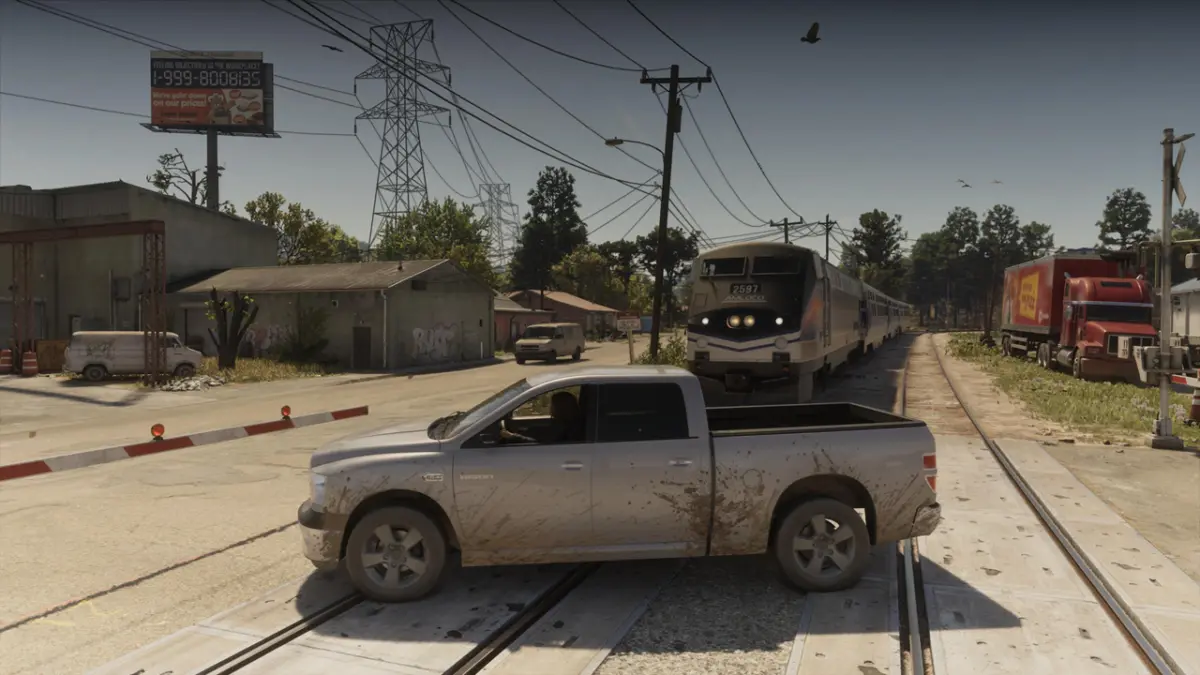
of an Icon: How GTA 6 Shattered a Decade-Old Gaming Legend by Making Its Train Vulnerable
Executive Overview
For over thirteen years, the ubiquitous black, yellow, and white locomotive of Grand Theft Auto V reigned supreme as the undisputed heavyweight champion of open-world gaming physics. Operating as an immovable object in a world where players could reshape cityscapes with explosives, flatten pedestrians, and launch fighter jets into skyscrapers, GTA 5’s train remained completely unfazed. It absorbed rows of dump trucks, brushed off stacks of C4 detonators, and shrugged off barricades of commercial semi-trucks with arrogant indifference. This mechanical monolith quickly evolved into a cultural touchstone—a decade-long meme that spawned millions of social media challenge videos, viral experiments, and communal bonding over the sheer futility of stopping Los Santos’ premier rail line.
When Grand Theft Auto VI finally roared onto the PlayStation 5 and Xbox Series X/S, breaking global entertainment revenue records with a staggering $379 billion day-one launch and securing universal critical acclaim, fans instinctively returned to their time-honored traditions. Within hours of dropping into the sun-drenched, swamp-and-neon landscapes of Leonida, players tracked down the state’s newly minted railway system. Their mission was singular, nostalgic, and entirely predictable: test the mettle of the new engine to see if Rockstar Games had preserved the mythological status of its predecessor.
To the collective shock, amusement, and mild disappointment of the community, the results were definitive. GTA 6’s train lacks the supernatural aura of its Los Santos ancestor. Far from being an unstoppable force of nature, the new locomotive is bound by the rigid, unflinching laws of modern simulation physics. Park an excavator in its path? It halts. Ram it head-on with a fully loaded dump truck? It stops dead in its tracks. Even worse for meme culture, Rockstar’s advanced, hyper-realistic artificial intelligence features NPCs smart enough to actively apply the emergency brakes when a pedestrian merely steps onto the tracks.
The immediate realization that the new train could be stopped with minimal effort has ignited a sprawling debate within the gaming community: Has Rockstar Games gone too far in its pursuit of hyper-realism, inadvertently neutering the absurd, chaotic sandbox magic that defined the franchise for generations?
Detailed Chronology: From Los Santos Immutability to Leonida Reality
The Reign of the Los Santos Juggernaut (2013–2026)
To understand the gravity of the community’s reaction to GTA 6, one must examine the legacy established by Grand Theft Auto V following its initial September 2013 launch. Throughout the PlayStation 3, Xbox 360, PlayStation 4, Xbox One, PC, and ninth-generation console cycles, Los Santos stood as a masterclass in satirical open-world design. Yet, amidst the satirical billboards, radio commercials, and chaotic heists, the suburban railway system assumed a mythic status.
Michael, Franklin, and Trevor—the game’s trio of protagonists—discovered early on that no amount of firepower could alter the train’s trajectory. Gamers spent countless collective hours attempting to derail or halt the commute. YouTube channels, Twitch streams, and TikTok feeds were flooded with ambitious engineering projects:
- Stacking dozens of transit buses across the tracks.
- Parking fully loaded freight trucks and tanker trailers in tight chokepoints.
- Saturating the rails with remote-detonated sticky bombs and heavy weaponry.
Every single attempt ended in the same deterministic fashion: the train plowed effortlessly through the barricades, maintaining its speed as if operating in an alternate dimension of physics. Over the course of thirteen years, this immutable object achieved meme deification. It was the "final boss" of GTA 5’s physics engine, a running joke that united millions of players across generational hardware divides.
The Leonida Expedition: Day One Disillusionment
When GTA 6 launched on November 19, 2026, earning a coveted 10/10 review from outlets like IGN and cementing itself as the joint highest-rated game of all time, millions of players flooded the servers to explore the fictionalized rendition of Florida known as Leonida.
True to gaming tradition, a vocal faction of the community bypassed introductory missions, steering protagonist Jason toward the southern stretches of the map explicitly to find the tracks. Footage quickly began circulating across social media platforms like X (formerly Twitter) and Instagram, capturing the moment players first intercepted the new Vice City transit line.
Content creators and curious fans lined up commercial vehicles, heavy industrial machinery, and standard sedans across the pristine tracks. Expecting the familiar, catastrophic explosion of a futile crash followed by the unstoppable locomotive crushing everything in its path, players watched in stunned silence as the simulation played out with clinical, sobering accuracy.
Rather than demolishing the obstacles with mythological authority, the train applied its brakes, slowed to a crawl, or ground to a complete halt upon impact with heavy objects. Social media users immediately began lamenting the mechanical downgrade. "They nerfed the boss," posted user Satyajit on X, echoing the sentiments of thousands who felt the franchise had lost a slice of its whimsical soul in exchange for simulation purity.
Supporting Context & Metrics: The Realism vs. Sandbox Debate
The debate over the GTA 6 train encapsulates a broader philosophical schism that has haunted Rockstar Games internally and externally for years: At what point does a video game become too realistic?

The Physics of Modern Open-World Engines
Rockstar’s proprietary RAGE (Rockstar Advanced Game Engine) has long set industry standards for environmental interaction, vehicle deformation, and pedestrian behavioral algorithms. In Grand Theft Auto V, performance trade-offs meant that certain world elements—like the train—were hardcoded as immovable environmental hazards to prevent physics calculations from breaking or crashing the game hardware.
By the time Red Dead Redemption 2 launched in 2018, Rockstar signaled a definitive pivot toward granular, uncompromising realism. Snow deformation, horse testicle physics shrinkage in cold weather, dynamic mud accretion, and realistic train stopping distances became the studio’s new calling cards.
In GTA 6, this design philosophy reached its zenith. The game’s staggering commercial success—pulling in $379 billion on day one to shatter every entertainment launch record in history—proves that the vast majority of consumers embrace this hyper-detailed direction. The simulated ecosystems of Leonida feature smarter, context-aware NPCs who react organically to traffic obstructions, bridges that articulate with mechanical precision, and vehicle handling models that demand respect rather than pure arcade-style recklessness.
Community Backlash and the Deification of the 2013 Engine
Despite the universal acclaim and record-shattering player counts, a passionate sub-community views these simulation advancements as a net negative for sandbox freedom. To these players, the charm of Grand Theft Auto has always rested in its delightful friction between grounded criminal storytelling and manic, physics-breaking sandbox chaos.
The vulnerability of the GTA 6 train has sparked a wave of nostalgic revisionism. Fans have begun creating ironic tribute edits on Instagram and TikTok, placing the 2013 Los Santos locomotive side-by-side with its modern Leonida counterpart in mock "power-scaling" battles.
As one prominent X user summarized: "Yeah, this and the ‘No first-person mode’ are the biggest downsides for me."
The sentiment highlights a niche yet vocal constituency that fears Rockstar is trading the eccentric, unpredictable cartoon physics of early franchise iterations for the sterile predictability of real-world physics engines.
Official Statements and Industry Reception
While Rockstar Games has not issued a formal press release addressing the community’s fixation on the vulnerability of the Leonida railway system, development insiders have frequently spoken in past retrospectives about the studio’s dedication to systemic immersion.
Industry analysts point out that the decision to allow trains to interact realistically with obstacles is a direct byproduct of modern procedural animation and advanced AI routing. In an environment where players expect every vehicle, pedestrian, and environmental asset to respond dynamically to input, hardcoding an invincible, physics-defying train would clash with the overarching design ethos of Leonida.
Critical reception to GTA 6 has overwhelmingly sidelined minor physics grievances in favor of praising the game’s monumental scale, narrative depth, and technical wizardry. Reviewers have highlighted the Leonida interactive map as a triumph of modern level design, urging players to immerse themselves fully in the intricate ecosystems crafted by the developers rather than mourning the loss of a decade-old programming limitation.
Future Outlook: Can the Legend Be Restored?
As millions of players continue to comb through the vast expanses of Leonida—utilizing comprehensive resources like the Official Grand Theft Auto 6 Guide, the Beginner’s Guide with 67 Tips and Tricks, and chapter-by-chapter breakdowns—the discourse surrounding the train serves as a fascinating case study in player psychology.
Nostalgia is a powerful, often stubborn force in gaming. The unstoppable Los Santos train was never an intentional design masterpiece; it was an artifact of older hardware constraints that accidentally birthed a generational meme. By correcting this technical quirk in GTA 6, Rockstar delivered a more believable world, but inadvertently retired an unwitting folk hero.
Whether future title updates, PC modding communities post-launch, or future DLC expansions will introduce a secret, truly indestructible "Boss Train" to satisfy the demands of chaotic sandbox traditionalists remains to be seen. Until then, players across PlayStation 5 and Xbox Series X/S must come to terms with a sobering reality: in the sun-soaked wetlands and neon avenues of Leonida, even the trains have to follow the rules.