Executive Overview
In the high-stakes world of software engineering—particularly within the rapidly evolving domain of artificial intelligence and security—metrics are often treated as marketing assets. A "green" test suite is the universal currency of progress, signaling to stakeholders, users, and automated continuous integration (CI) pipelines that a system is ready for prime time. Yet, the pursuit of unblemished metrics frequently incentivizes a quiet, insidious compromise: sweeping inconvenient limitations under the rug, silently skipping unrunnable tests, or "faking" passing states just to clear a blocker.
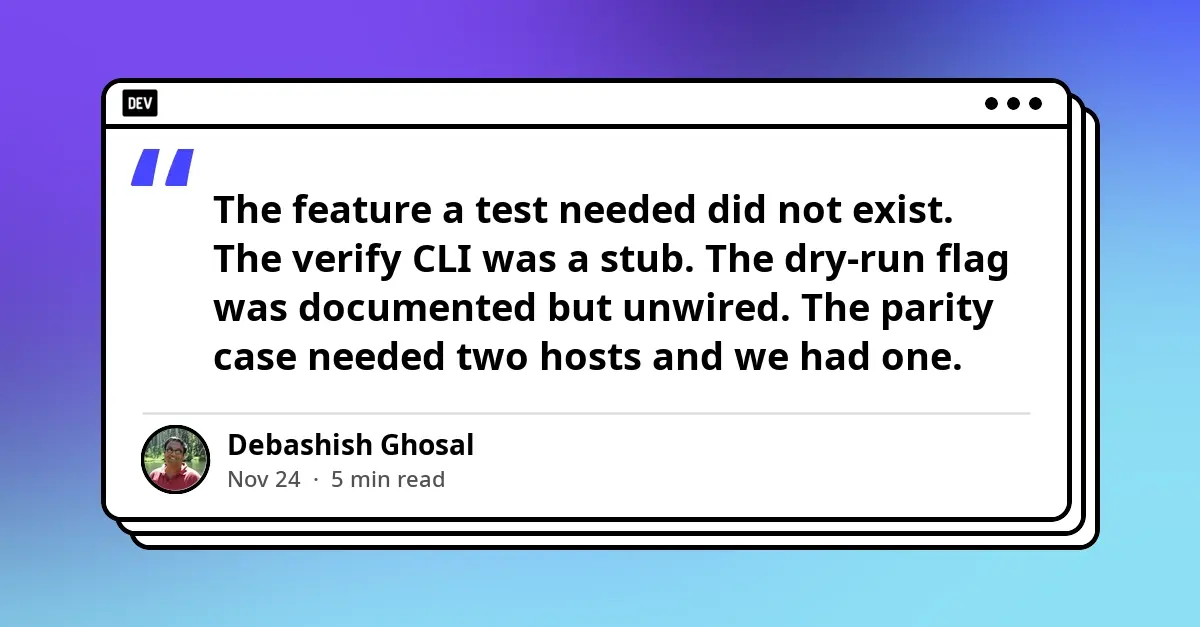
When the open-source engineering team behind agentic-suite prepared to launch agentdrill v0.1.0—their harness-agnostic adversarial testing engine for AI-agent defenses—they encountered a stark reality check. Out of their initial test battery, four critical evaluation units could not be executed. The required features simply did not exist yet: the verification command-line interface (CLI) was a dead stub, the documented dry-run flag was completely unwired, and a multi-host parity case lacked the necessary infrastructure to run.
Faced with this bottleneck, the team rejected the industry-standard paths of quiet omission or fabricated success. Instead, they pioneered a radical approach to transparency: they formally "declared" the failures in the shipped public report, complete with exact reasons, names, and explicit accountability. This decision transformed an uncomfortable honesty tax into an actionable build queue, ultimately culminating in a pristine final state of 73 PASS, 0 FAIL, and 0 DECLARED—every single conversion earned through genuine code implementation and rigorous re-execution rather than editorial sleight-of-hand.
This report examines the philosophy, chronology, and broader industry implications of the agentdrill v0.1.0 field test, highlighting how uncompromising transparency can redefine software quality assurance for AI security tooling.
Detailed Chronology: From Unrunnable Stubs to Earned Passes
The journey of agentdrill v0.1.0 offers a masterclass in treating test gaps as engineering requirements rather than bureaucratic annoyances. To understand how the project achieved its final state, it is essential to trace the chronology of the development cycle, the identification of blockers, the governance of the "declared" state, and the subsequent engineering sprint.
Phase 1: Confronting the Unrunnable Stubs
During the final pre-release hardening of agentdrill v0.1.0, the core testing harness confronted a series of architectural gaps. Modern AI-agent deployments require robust, multi-layered security verification. However, building the verification frameworks concurrently with the testing harnesses often leads to dead ends where test specifications outpace implementation details.
Specifically, the team mapped out four distinct units that hit hard walls:
- The Verify CLI Stub: The command-line interface designed to validate signed security bundles was little more than a placeholder stub, lacking any functional backing engine.
- The Unwired Dry-Run Flag: While the documentation proudly highlighted a
--dry-runcapability for previewing execution plans, the underlying flag had not been connected to the planning engine. - The Multi-Host Parity Case: A vital security check requiring synchronized execution across two distinct operating systems/hosts, which could not be completed due to environment provisioning limits (constrained temporarily to a single host).
Phase 2: Choosing the Third Door
When an engineering team confronts tests that cannot be executed, standard institutional habits typically present three distinct pathways:
- Door One: Skip Quietly. The test is commented out or ignored in the test runner configuration, with the unspoken hope that code reviewers and auditors will not count the missing items.
- Door Two: Fake the Green. The test logic is mocked or altered to return a false-positive exit code, allowing the CI pipeline to flash green so the team can move on with their lives.
- Door Three: Write It Down. Explicitly document the failure in writing, within the officially shipped public report, attaching a specific name, a clear technical reason, and a direct line of accountability.
The agentic-suite maintainers bypassed doors one and two entirely. They stepped through Door Three. By anchoring their methodology in absolute transparency, they integrated a novel status into their testing matrix: Declared.
Phase 3: The Governance of "Declared" States
In the agentdrill harness architecture, classification is strictly enforced. Units are categorized under explicit governance rules:
P/F(Pass/Fail): These units must definitively pass or fail; no intermediate or escape exits are permitted.P/F|D(Pass/Fail/Declare): These units permit a third verdict—declared—but under stringent, unyielding rules.
A "declared" status is not a casual shrug or an excuse; it is a formal verdict. To declare a test unrunnable, the engineering team had to adhere to strict criteria:
- Name the exact technical limitation preventing execution.
- Name the specific plan item or architectural roadmap ticket that formally permits the declaration.
- Incorporate both pieces of metadata permanently into the report’s official "not-tested" list.
Crucially, within this harness design, a simple unmanaged skip is automatically treated as a hard failure. There is no quiet omission. For multiple release batches, the official field test report carried those four declared units plainly on its face. As the maintainers noted, declaring is uncomfortable in the specific way that proves useful: the "not-tested" list stares down the engineering team every single time they open the documentation.
Phase 4: The Build Queue Transformation
Rather than leaving these declarations as permanent caveats, the team weaponized transparency. The "not-tested" list transformed organically into an prioritized, unyielding build queue.
- Wiring the Verify Engine: The team tackled
cli/verify.py, connecting the CLI to the real verifier engine. They engineered the test to construct a cryptographic signed bundle, verify it offline, and rigorously confirm that any tampered copy would immediately trigger a strict exit code 3. Valid bundles passed smoothly; tampered bundles were caught instantly; and seven distinct CLI regression tests turned green. - Wiring the Dry-Run Flag: Next, the dry-run flags were systematically wired into the core planning engine. Assertions were written to ensure the execution plan prints cleanly with
executions: 0, accurately lists all test cases, and utilizes--explainannotations to document why each individual case exists. A dry-run that accidentally executes a single live action is designed to fail its own validation test. - Resolving Multi-Host Parity: Finally, the parity case was expanded beyond its single-host constraint, provisioned across two distinct operating systems to run a comprehensive validation battery.
Throughout this phase, the rule of discipline was absolute: the report never moved first. Code was written, features were built, cases were re-run, and grounded assertions were satisfied. Only after the disk and the compiler confirmed success was the report row updated.
Supporting Context, Metrics, and Architecture
The agentdrill framework does not exist in a vacuum; it is a foundational pillar of the broader agentic-suite ecosystem. Designed specifically to address the unique vulnerabilities of autonomous AI agents—such as prompt injection, unauthorized tool usage, and privilege escalation—agentdrill executes versioned adversarial attack packs directly against deployed stacks within CI/CD pipelines.
Key Metrics from the v0.1.0 Field Test
| Metric Category | Initial State | Final State | Resolution Mechanism |
|---|---|---|---|
| Total Test Units | 73 | 73 | Complete test surface coverage |
Passing Units (PASS) |
69 | 73 | Earned via feature implementation and re-run |
Failing Units (FAIL) |
0 | 0 | Maintained zero regressions |
Declared Units (DECLARED) |
4 | 0 | Cleared exclusively via code delivery |
| Verification Regressions | Unwired | 7 Green | Built |
offline signed bundle verification |
The Philosophy of the "Honesty Tax"
Many engineering organizations fear that transparency regarding technical debt or missing features will erode stakeholder confidence. However, the agentdrill experiment demonstrates that embracing the "honesty tax" yields immense project management dividends:
- Inadvertent Roadmaps: A well-maintained not-tested list acts as an immediate, un-ignorable backlog. It prevents forgotten edge cases from lingering indefinitely in private issue trackers.
- Integrity Validation: When metrics are earned rather than edited, the integrity of the entire verification pipeline is reinforced. Stakeholders know that a "green" indicator actually means the code has been exercised against reality.
Official Statements and Insights from the Maintainers
Reflecting on the release cycle, the core developers behind agentic-suite emphasized the psychological and technical barriers of maintaining rigorous honesty in software reporting.
"A declared case is one honest sentence away from a fake pass," notes the project documentation. "The temptation is always to write a softer limitation—one that sounds more like an environment problem than a missing feature. The guard we landed on was simple: every declaration must name the plan item that permits it, so the claim is checkable against the plan. A declaration for a hard-gate case is invalid outright, and the harness rejects it."
The maintainers issued a direct challenge to the broader software engineering community:
"Can you name what your last test report did not test, without opening it? If the answer is no, the report is telling you a greener story than the one that happened. Ours did, for four cases, for weeks. The fix was not talent or tooling; it was being willing to write the sentence ‘this one we could not run, and here is why’ in a document we knew people would read."
Future Outlook: The Next Wave of AI-Agent Defenses
As autonomous AI agents transition from experimental toys to mission-critical enterprise systems, the attack surface expands exponentially. Traditional application security tools are fundamentally ill-equipped to handle the probabilistic, dynamic nature of agentic workflows. Frameworks like agentdrill and its companion evidence-recording tool, agentwatch, represent the future of proactive AI security.
With the successful deployment of v0.1.0—achieving a verified 73/73 passing unit metric with zero unaddressed declarations—the agentic-suite project has established a new benchmark for open-source security engineering.
Developers looking to audit their own AI deployments can immediately integrate the tool via Python’s package manager:
pip install agentsec-agentdrill   # v0.1.0 is live on PyPI
agentdrill quickstart             # first honest result in ~15 minutes, bundled demo
Looking ahead, the roadmap for subsequent releases will continue to expand adversarial attack packs, deepen cross-platform parity testing, and refine the automated verification harnesses. By refusing to compromise on reporting integrity, the agentdrill team has proven that true security tooling must begin with brutal, unvarnished honesty about what the software can—and cannot—yet do.