Executive Overview
In the fast-paced ecosystem of generative artificial intelligence, rumors can spread across social media channels faster than official press releases. On November 24, 2026, a wave of speculation hit platforms like X (formerly Twitter), claiming that AI safety and research powerhouse Anthropic had quietly initiated live, under-the-radar testing for a prospective new flagship model: Claude Opus 5.6.
According to these viral posts, a select subset of users utilizing Claude Code and the standard web interface (claude.ai) were being covertly routed to this unannounced architecture. The claims were accompanied by eye-catching visual evidence, including sophisticated 3D scenes, side-by-side benchmarking comparisons, and a deceptively simple "litmus test" prompt designed to confirm whether a user had been granted early access to the phantom model.
However, a rigorous journalistic investigation into official channels, cloud partner catalogs, historical system cards, and foundational APIs reveals a starkly different reality. Claude Opus 5.6 does not exist in any official capacity. The viral claims rely on misinterpreted legacy documentation, recycled trivia that is already native to current models, and subjective visual outputs that conflate model capability with model identification.
This comprehensive deep-dive explores how the rumor originated, dissects the specific proofs offered by internet sleuths, examines what Anthropic has actually shipped, and provides a blueprint for verifying future artificial intelligence leaks.
Detailed Chronology: How the "Opus 5.6" Myth Unfolded
The genesis of the Claude Opus 5.6 rumor trace back to a well-known phenomenon in tech communities: the anticipation of sequential software updates. However, the narrative crystallized rapidly on November 24, 2026, through a coordinated cascade of anecdotal reports.
The Spark on Social Media
Throughout the morning of November 24, multiple high-visibility accounts posted screenshots and code snippets claiming that Anthropic was replicating its pre-launch testing playbook. Users suggested that traffic patterns on claude.ai and Claude Code mirrored the quiet rollouts preceding earlier iterations like Opus 5.5.
One widely shared post framed the speculation definitively:
"Claude Opus 5.6 is likely now being tested for a subset of Claude users (some in Claude Code, some in Chat, and some without it anywhere), in a similar fashion to how Opus 5.5 was tested."
These posts promised sweeping generational improvements, specifically highlighting dramatic leaps in real-time 3D rendering, WebGL performance, and complex programmatic visual logic. To back up these claims, creators shared intricate, interactive animations that they attributed exclusively to the processing power of the rumored Opus 5.6 model.
The "Karpathy Test" and Misinterpreted Proofs
To allow everyday users to check if they had been selected for the clandestine trial, viral threads promulgated a specific test prompt. The instructions were simple: disable web search and memory tools, and ask the chatbot where prominent AI researcher Andrej Karpathy went in May 2026.

According to the rumor runners, if the model correctly identified "Anthropic" as his destination, it served as definitive proof that the user’s session was operating on Opus 5.6.
Simultaneously, "evidence" was bolstered by screenshots of internal documents described as standard Anthropic compliance or routing protocols. These documents purportedly detailed how the company dynamically assigns incoming developer and consumer queries to unreleased model checkpoints during final staging phases.
By late afternoon, however, prominent AI commentators and independent analysts—such as Matthew Berman—began pushing back against the narrative. Berman bluntly noted on X: "Everyone talking about Opus 5.6 are liars. They do not have access to the model and those are not real demos."
Despite the pushback, specialized crypto and tech news aggregators in regions like South Korea and Europe picked up the claims, running stories that amplified the unverified rumors before any editorial fact-checking could be completed.
Supporting Context & Metrics: Deconstructing the Evidence
To separate verifiable facts from community-driven folklore, every piece of circulating evidence was cross-referenced against authoritative sources, system logs, and official platform documentation.
1. The Karpathy Prompt Fallacy
The core diagnostic tool offered to users—asking about Andrej Karpathy’s career moves in May 2026—rests on a fundamental misunderstanding of how modern LLM knowledge cutoffs work.
It is a matter of public record that Andrej Karpathy joined Anthropic’s pre-training team on May 19, 2026, a move heavily covered by major journalistic outlets including TechCrunch and Reuters. Because this event occurred months ago, it is already embedded within the training corpora of Anthropic’s current stable of models.
The official Anthropic Models overview establishes that reliable knowledge cutoffs for the current generation—including Claude Opus 5.5, Claude Sonnet 5.5, Claude Haiku 5.5, and Claude Fable 5.2—extend well past May 2026 (with standard baseline knowledge reaching June 2026 and beyond via dynamic tool integration).
Consequently, asking a current Claude Sonnet 5.5 or Opus 5.5 instance about Karpathy will yield the correct answer ("Anthropic") even with web search turned off. Outlets such as TokenPost quickly pointed out this glaring logical flaw: a prompt that successfully executes on an existing, publicly available model cannot logically be used to authenticate a secretive, unreleased successor.
2. Misattributed System Cards
Another pillar of the rumor was a thread sharing pages from what were described as leaked internal Anthropic routing documents.
Upon closer inspection, the shared images—specifically pages numbered 98, 112, and 169—were identified as excerpts from older, historical system cards.

- Pages 98 and 112 discussed pre-deployment A/B testing protocols utilized during the development of Claude Sonnet 5.
- Page 169 detailed similar staging procedures used during the validation phase of Claude Opus 4.7, involving controlled batches of 10,000 conversations per surface.
While these documents confirm that Anthropic systematically employs A/B testing before launching major models, they make zero mention of Opus 5.6. They represent standard corporate engineering methodology, not proof of an active, unannounced deployment.
3. Subjective Visual Outputs vs. Model IDs
The stunning 3D scenes and WebGL2 animations shared by proponents of the rumor proved only one thing: that modern generative AI models are exceptionally capable visual coders.
Later on November 24, one of the primary accounts publishing these high-end demos shared a complex WebGL2 animation of a singing pelican, this time explicitly attributing it to the current Claude Opus 5.5 model. This admission undermined the premise that such output quality required a generational leap to version 5.6.
Furthermore, community feedback was fragmented; other developers reported that their complex coding queries executed noticeably slower or yielded inferior results when routed through purported "experimental channels," pointing more toward standard load-balancing latency or prompt variance rather than a uniform architectural upgrade.
Official Statements & The Anthropic Ecosystem
A definitive audit of Anthropic’s official communication channels confirms the total absence of "Opus 5.6." A systematic review conducted on November 25 across the following repositories yielded zero references to the rumored model:
- Anthropic Newsroom & Product Pages: The official product page for Claude Opus lists only
claude-opus-5-5as the current flagship. - Platform Release Notes: The latest release notes (dating through November 23, 2026) focus on enterprise features, zero-data retention betas, and the upcoming deprecation of Claude Opus 4.5 (slated for retirement on January 22, 2027). They contain no entries for Opus 5.6.
- Open-Source SDKs & Cloud Catalogs: The official Python SDK (
anthropics/anthropic-sdk-python), the Claude Code changelog, and enterprise partner catalogs across Amazon Bedrock, Google Cloud Vertex AI, and Microsoft Foundry contain no string identifiers forclaude-opus-5-6.
What Anthropic Has Actually Shipped
To understand where the AI community stands, it is helpful to look at Anthropic’s genuine, verified release schedule for late 2026:
- Claude Opus 5.5: Released on September 22, 2026. Priced at $4 per million input tokens and $20 per million output tokens, featuring a robust 1-million-token context window. This remains the reigning apex model for heavyweight reasoning tasks.
- Claude Fable 5.2 & Claude Mythos 5.2: Announced on November 9, 2026. Fable 5.2 is positioned as an alternative recommendation when Opus 5.5 requires supplementary compute effort, priced at $8 per million input tokens and $40 per million output tokens. Mythos 5.2 was rolled out with highly restricted availability via specialized verification tracks.
- Claude Ship: Launched on November 23, 2026, as a dedicated workflow tool for reviewing and approving GitHub pull requests.
- Siren Evaluation: Published on November 24, 2026, serving as a safety benchmark designed to test whether autonomous agents attempt to compromise weakened sandboxes.
At no point in this sequence has Anthropic teased, previewed, or registered an Opus 5.6 model.
Future Outlook: How to Verify Future AI Leaks
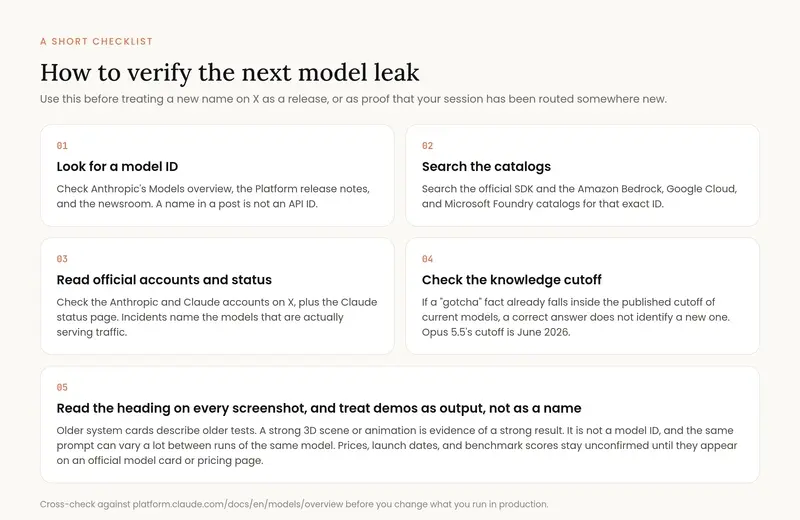
The cycle of artificial intelligence hype will inevitably continue, with new rumors swirling around every major platform update. To protect against misinformation, developers, enterprise buyers, and enthusiasts should utilize a rigorous verification checklist before accepting social media leaks as gospel:
- Demand an Official Model ID: True leaks or soft-launches almost always leave a footprint in underlying software development kits (SDKs), API parameter files, or cloud provider catalog schemas (such as AWS Bedrock or Google Cloud). If the string cannot be found programmatically, treat it with extreme skepticism.
- Interrogate the "Test Prompts": Be wary of prompts designed to prove model identity. If a historical fact or capability falls well within the known knowledge cutoff of existing models, any LLM can answer it correctly regardless of its underlying version number.
- Scrutinize Documentation Provenance: Always check the headers, version numbers, and metadata of leaked screenshots. Anthropic, OpenAI, and other major labs routinely update their system cards; repurposing documentation from older model deployments (such as version 4.7 or Sonnet 5) is a common tactic used to manufacture false credibility.
- Separate Output Quality from Architecture: A brilliant piece of code, a stunning 3D rendering, or a clever poem is a reflection of prompt engineering and baseline model capability. Exceptional outputs do not constitute a cryptographic model identifier.
- Monitor Official Status Pages: Real-time infrastructure shifts, canary tests, and silent rollouts typically cause ripples in official status logs, developer changelogs, or repository commits long before they achieve viral status on consumer-facing social networks.
Conclusion
As of late November 2026, Claude Opus 5.6 remains a phantom product born of community speculation, misinterpreted historical documentation, and clever prompt-engineering demos. While Anthropic’s relentless pace of innovation ensures that new model checkpoints are continuously evaluated behind closed doors, public certainty must rest on verifiable code, official model IDs, and authenticated release notes—not viral threads on X.
Until Anthropic publishes an official model card for its next major iteration, the public frontier of the Claude ecosystem officially concludes with Opus 5.5 and Fable 5.2.