Executive Overview
The landscape of modern web development has long been characterized by a persistent friction point: the operational divide between frontend deployment environments and backend cloud infrastructure. For millions of developers utilizing Vercel to build, deploy, and scale web and artificial intelligence applications, orchestrating robust data storage has traditionally required a context-switching leap into the AWS Management Console. Navigating Identity and Access Management (IAM) policies, configuring cross-origin resource sharing, and manually generating static API keys have added unnecessary cognitive overhead to an otherwise streamlined developer experience.
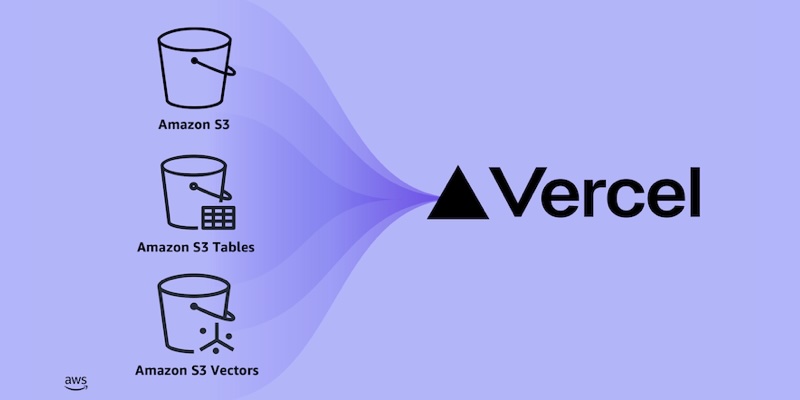
That operational paradigm shifted fundamentally today with the official rollout of native Amazon Simple Storage Service (Amazon S3) integration across the Vercel Marketplace and v0 by Vercel. Developers can now provision, configure, and manage enterprise-grade S3 storage resources directly from their Vercel dashboard. This powerful integration spans three distinct, high-demand workloads: everyday general-purpose object storage, high-performance analytics via Amazon S3 Tables, and purpose-built vector storage via Amazon S3 Vectors.
By weaving Amazon S3 directly into Vercel’s automated provisioning workflow, the partnership eliminates the need for manual credential management. It introduces a secure, ephemeral authentication model leveraging OpenID Connect (OIDC) and AWS Security Token Service (AWS STS). Furthermore, this release complements existing Vercel Marketplace integrations for Amazon Aurora, Amazon DynamoDB, and Amazon OpenSearch Serverless. It delivers a complete, unified application stack—bridging relational databases, NoSQL, open analytical tables, vector embeddings, and object storage—all managed within a single AWS account under a consolidated billing structure.
Detailed Chronology: Bridging the Edge-Cloud Divide
The journey toward a unified application stack on Vercel has evolved through a deliberate series of infrastructure milestones, culminating in this comprehensive S3 integration.
Phase 1: The Relational and NoSQL Foundation
Historically, Vercel revolutionized how frontend architectures were delivered to the edge, but connecting those dynamic edge functions to persistent, scalable databases often required bespoke environment variable management. Recognizing this, AWS and Vercel established early foundational integrations for managed relational and NoSQL databases. Developers gained the ability to spin up instances of Amazon Aurora and Amazon DynamoDB directly from the Vercel ecosystem. While this successfully bridged the database layer, applications requiring unstructured file storage, heavy analytical processing, or semantic AI search capabilities still forced teams to step outside the Vercel interface to configure external S3 buckets.
Phase 2: Expanding the Serverless Data Tier
As enterprise applications increasingly adopted search-driven and serverless patterns, the demand for integrated open search and vector capabilities grew. The integration of Amazon OpenSearch Serverless into the Vercel Marketplace addressed real-time search use cases. However, the core asset repository—the millions of files, logs, analytical data lakes, and AI embeddings underpinning these systems—remained decoupled from the deployment workflow. Developers were left stitching together disparate services using custom scripts and long-lived static keys, introducing potential security vulnerabilities and maintenance overhead.
Phase 3: The Natural Language and Marketplace Synthesis
The introduction of v0 by Vercel, an AI-powered code generation tool, created an urgent need for intelligent, context-aware resource provisioning. If v0 could generate complex React components and Next.js routes from natural language prompts, it logically needed the ability to provision the underlying data layers automatically.
The integration launched today solves this exact challenge. By bridging Amazon S3, S3 Tables, and S3 Vectors directly into both the Vercel Marketplace dashboard and the v0 conversational interface, the collaboration completes the modern cloud stack. Developers can now type a natural language prompt into v0—such as "Build a support bot that answers questions from my PDFs"—and watch as the system provisions an S3 Vector bucket, establishes secure IAM trust relationships, and generates fully functional runtime code.
Supporting Context & Metrics: Architecture and Security at Scale
To understand the engineering significance of this release, one must examine the underlying mechanics of how Vercel and AWS handle resource provisioning, authentication, and workload execution.
Streamlined Provisioning Workflow
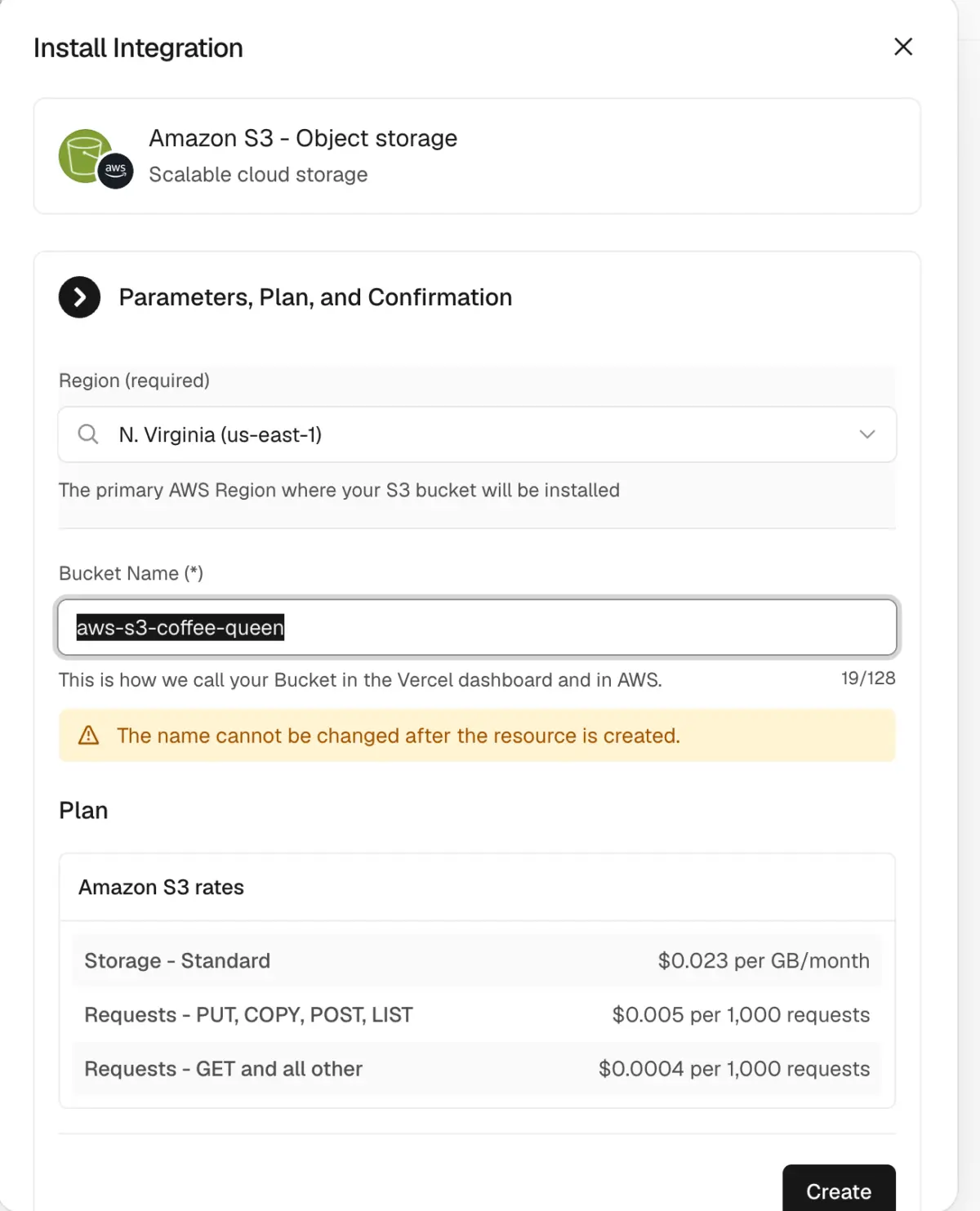
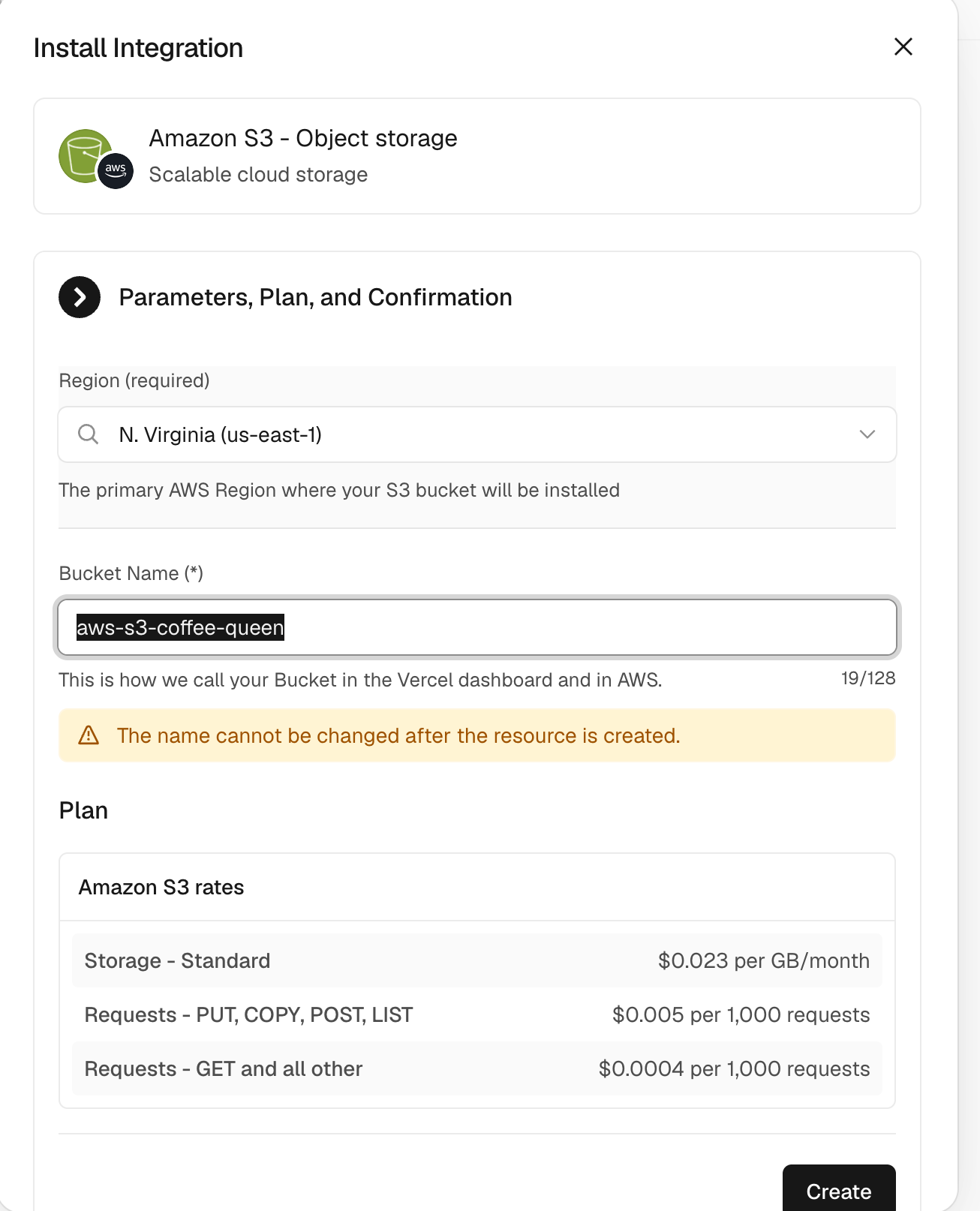
Provisioning an S3 resource no longer requires manual configuration in the AWS console. Within the Vercel dashboard, developers navigate to the Storage tab, select Create, choose AWS, and specify the desired bucket type (General Purpose, Tables, or Vectors) alongside their target AWS Region. The entire provisioning lifecycle takes mere seconds.

Once created, linking the bucket to a project and executing standard Vercel CLI commands:
vercel link
vercel env pull .env.local
automatically injects critical configuration variables, including:
AWS_REGIONAWS_ROLE_ARNAWS_RESOURCE_ARN- Resource-specific identifiers such as
S3_BUCKET_NAME,S3_TABLE_BUCKET_NAME, orS3_VECTOR_BUCKET_NAME.
Zero Static Credentials via OIDC and AWS STS
Security is a cornerstone of this integration. Rather than storing static AWS access keys and secret keys—which run the risk of exposure in source control or environment file leaks—the integration relies on runtime token exchange.
Utilizing the awsCredentialsProvider function from @vercel/functions/oidc, Vercel exchanges a short-lived OpenID Connect (OIDC) token with the AWS Security Token Service (AWS STS). This generates highly scoped, temporary credentials valid only for the duration of the execution context.
The Three Pillars of S3 Workloads on Vercel
-
General Purpose Object Storage: Ideal for traditional media handling, user-generated content uploads, and static asset management. Leveraging the official
@aws-sdk/client-s3, developers can execute upload, list, and read operations directly inside Next.js server actions or API routes: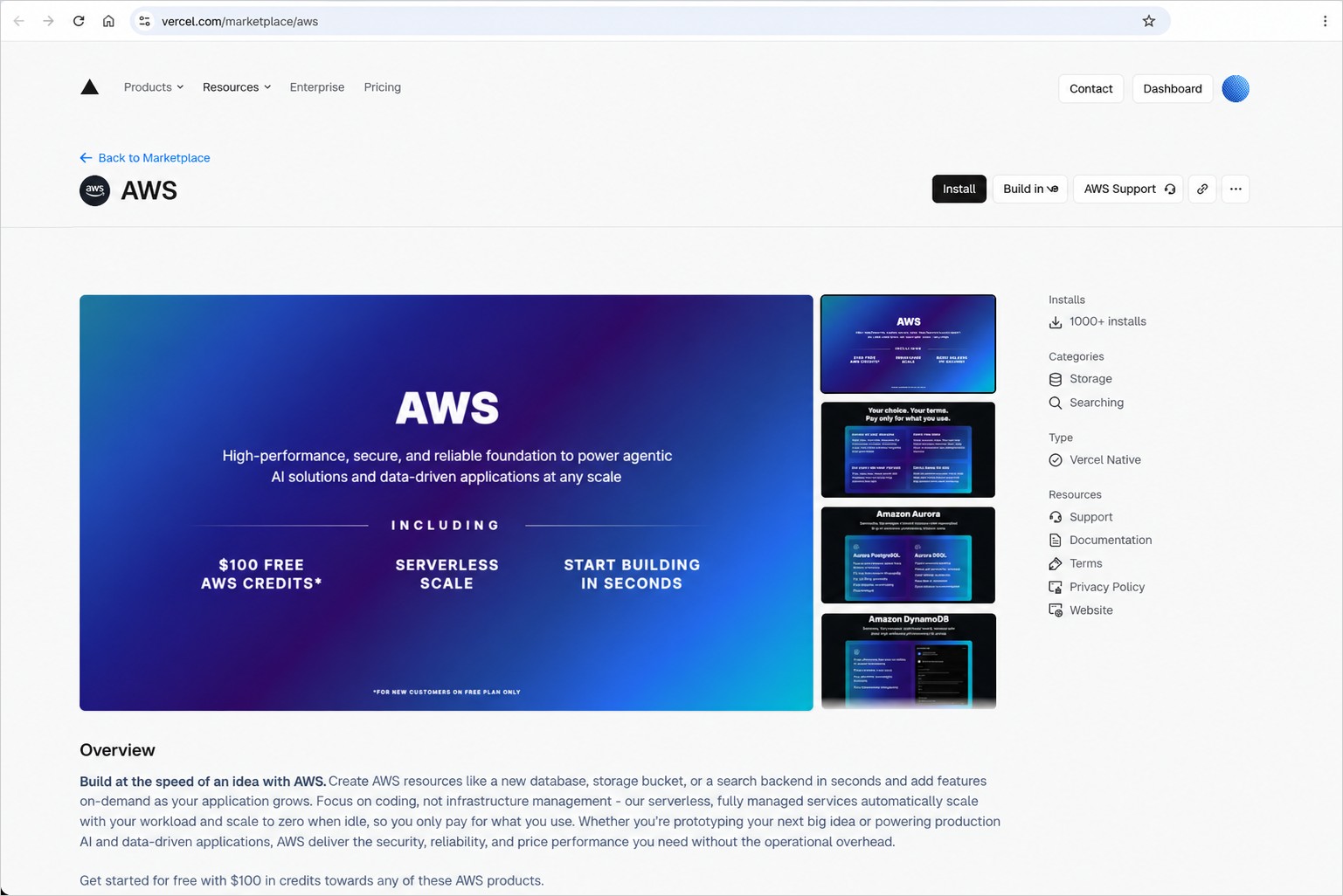
import S3Client, PutObjectCommand from "@aws-sdk/client-s3"; import awsCredentialsProvider from "@vercel/functions/oidc"; const s3 = new S3Client( region: process.env.AWS_REGION, credentials: awsCredentialsProvider( roleArn: process.env.AWS_ROLE_ARN, ), ); export async function POST(request) const formData = await request.formData(); const file = formData.get("file"); await s3.send(new PutObjectCommand( Bucket: process.env.S3_BUCKET_NAME, Key: file.name, Body: Buffer.from(await file.arrayBuffer()), ContentType: file.type, )); return Response.json( success: true ); -
Analytics with S3 Tables: Designed for data lakes and high-volume analytical workloads, S3 Tables provide fully managed Apache Iceberg tables featuring automated table maintenance and compaction. Developers can embed query engines like DuckDB directly inside Vercel Functions to execute lightning-fast analytical queries over massive datasets without managing external cluster infrastructure.
-
Vector Search with S3 Vectors: Built specifically to support AI agents, semantic search, and retrieval-augmented generation (RAG) architectures, S3 Vectors allow teams to store and query high-dimensional embeddings natively within S3. By bypassing the need to spin up and manage a separate standalone vector database, development teams drastically simplify their AI infrastructure stack.
Official Statements and Industry Impact
Industry analysts and engineering leaders have praised the collaboration for lowering the barrier to entry for enterprise-grade cloud architecture.
"By bringing Amazon S3, S3 Tables, and S3 Vectors natively into the Vercel Marketplace and v0, we are removing the traditional boundaries between frontend deployment and deep cloud infrastructure," noted engineering representatives close to the launch. "Developers no longer have to choose between the unmatched speed of Vercel’s deployment workflow and the industrial-grade durability and scalability of AWS. They get both, secured by modern OIDC standards and unified under a single billing pane."
Cloud architects have highlighted the economic and operational advantages of maintaining a single AWS account for storage, compute, and database needs. Because all S3 resources reside directly within the customer’s own AWS account, organizations retain complete ownership of their data governance policies, compliance frameworks, and AWS-native security tooling. Furthermore, new AWS accounts created through the Vercel integration are backed by $100 in AWS credits valid for six months, offering a risk-free environment for teams prototyping modern web applications and AI agents.
Future Outlook: The Next Generation of Full-Stack AI Apps
The integration of Amazon S3 into Vercel signals a broader industry trend toward unified, intent-driven software development. As tools like v0 continue to mature, the distinction between writing infrastructure code and writing application logic will continue to blur.
Looking ahead, we can expect to see deeper synergies between Vercel’s edge computing network and AWS’s sprawling storage and AI ecosystems. With zero-configuration object storage, automated analytical data lakes via S3 Tables, and native vector search capabilities for RAG architectures now accessible via simple natural language prompts, development velocity is poised to accelerate exponentially.
For engineering teams looking to modernize their tech stacks, the path forward is clear: a seamless fusion of the edge and the cloud, where performance, security, and developer ergonomics coexist without compromise.