Executive Overview
In a milestone announcement for cloud database engineering and artificial intelligence infrastructure, Amazon Web Services (AWS) has officially launched general availability (GA) for native vector search capabilities within Amazon DynamoDB. This major release transforms the industry-standard NoSQL operational database into a unified data store capable of simultaneously managing transactional operational records and high-dimensional vector embeddings.
Previously, engineering teams constructing generative AI applications—ranging from Retrieval-Augmented Generation (RAG) pipelines and sophisticated recommendation engines to agentic memory frameworks and anomaly detection systems—faced a complex architectural hurdle. Implementing semantic search meant maintaining hybrid architectures: storing primary application data in DynamoDB while duplicating, syncing, and managing vector embeddings in a separate, dedicated vector store.
This dual-database pattern introduced steep operational overhead, data synchronization pipelines, increased latency risks, and escalated licensing and infrastructure costs. By embedding native vector search directly into DynamoDB’s serverless framework, AWS eliminates these silos. Developers can now run high-performance similarity searches directly against existing operational tables with single-digit millisecond latency, 99%+ recall accuracy, and effortless horizontal scalability. The capability is available immediately across all commercial AWS regions, including AWS GovCloud (US), running on the same pay-per-request pricing model familiar to current DynamoDB users.
Detailed Chronology: The Evolution of DynamoDB Toward Native Vector Operations
The integration of vector search into DynamoDB represents the culmination of a broader industry shift toward embedding machine learning primitives directly into foundational data stores. For years, Amazon DynamoDB stood as the premier choice for predictable, low-latency, hyperscale NoSQL workloads. However, the generative AI explosion radically altered developer requirements. Modern applications demand the ability to interpret natural language, deduce semantic context, and retrieve data based on meaning rather than exact-match keys.
The Architectural Friction of Hybrid Stores
As organizations rushed to adopt Large Language Models (LLMs) and vector-based semantic retrieval, they quickly encountered the friction of multi-database topologies. To equip an application with semantic capabilities using DynamoDB, developers had to implement complex change-data-capture (CDC) pipelines using tools like AWS Lambda and DynamoDB Streams. These pipelines continuously copied data transformations over to specialized vector databases.

This approach brought notable engineering liabilities:
- Synchronization Latency: Ensuring consistency between the operational table and the vector index often introduced race conditions and stale reads.
- Operational Complexity: Teams had to provision, patch, monitor, and scale two completely different database engines with disparate operational paradigms.
- Cost Inefficiencies: Maintaining duplicated datasets across multiple infrastructures inflated storage costs, egress fees, and engineering maintenance hours.
The Engineering Breakthrough
Recognizing these pain points, AWS engineers designed a native vector index type capable of living alongside operational attributes without requiring schema migrations or data duplication. By leveraging DynamoDB’s native List data type, tables can seamlessly store floating-point arrays representing embeddings generated by models such as Amazon Bedrock Titan Text Embeddings, Cohere Embed, or OpenAI models.
The implementation of dedicated vector indexing algorithms within DynamoDB’s serverless fabric ensures that users can index trillions of vectors without pre-provisioning capacity, managing servers, or enduring maintenance windows. The system handles indexing and horizontal scaling dynamically behind the scenes, upholding the strict SLA expectations historically associated with DynamoDB operational tables.
Technical Architecture & Implementation Deep-Dive
To understand how native vector search operates within DynamoDB, it is helpful to examine the mechanics of index creation, data structuring, and query execution. The system is architected to handle up to 4,096 dimensions per vector, utilizing industry-standard distance metrics and supporting granular metadata filtering.
1. Preparing the Operational Table
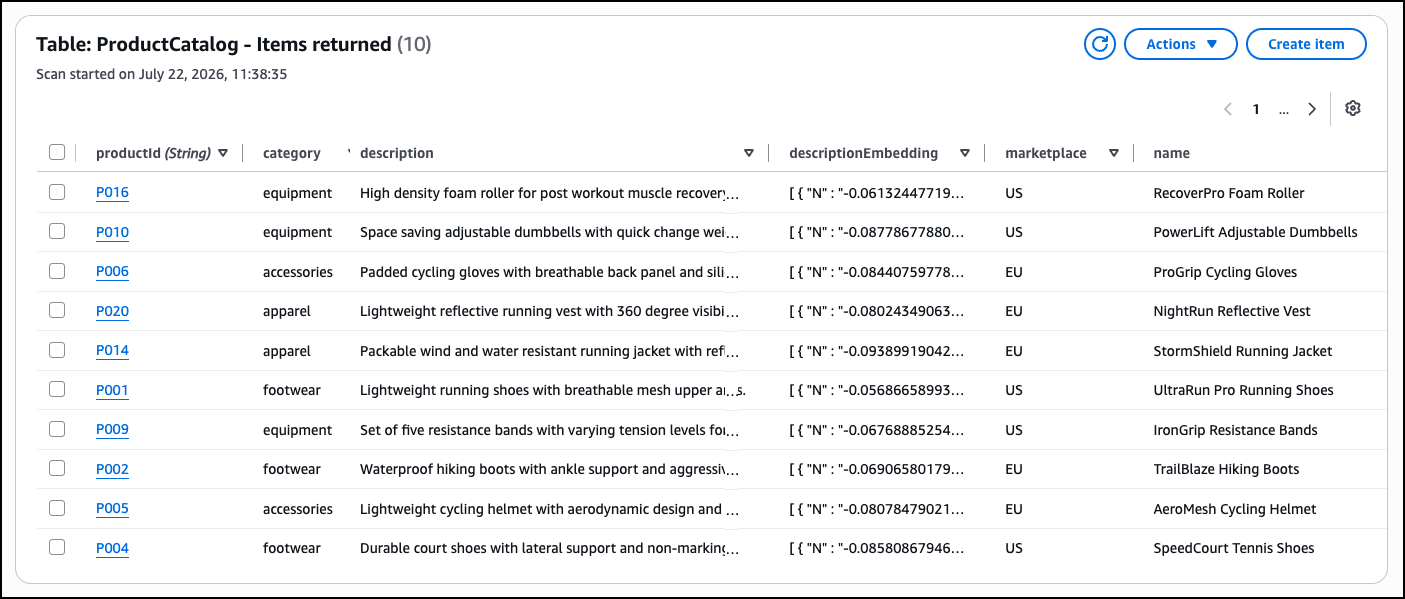
In a typical scenario—such as an online sporting goods catalog—items are characterized by standard operational attributes like productId, category, description, marketplace, and price.

To transition this catalog to support semantic queries, developers generate vector embeddings from the descriptive text using a machine learning model of choice. Because text embeddings are mathematical representations capturing semantic meaning, products sharing conceptual traits cluster closely together in high-dimensional vector space.
  "productId": "SP-8842-US",
  "category": "footwear",
  "marketplace": "US",
  "name": "Trailblazer All-Weather Running Shoe",
  "price": 129.99,
  "descriptionEmbedding": [0.0124, -0.0431, 0.1192, "...", 0.0051]
These vectors are injected into the table via standard PutItem or UpdateItem API calls, stored as standard list structures containing numeric float elements. This avoids any breaking changes to existing data schemas or application logic.
2. Creating the Vector Index
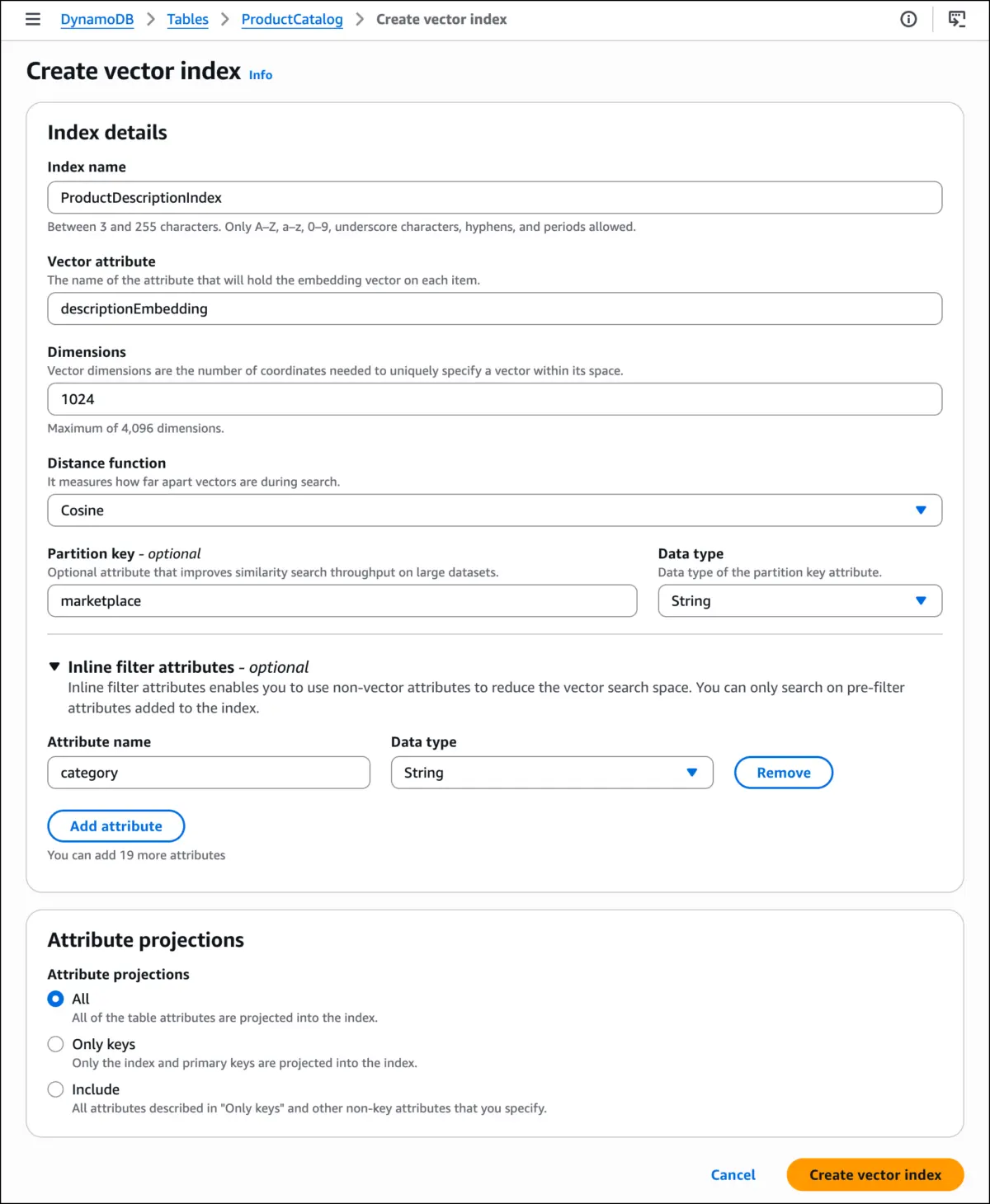
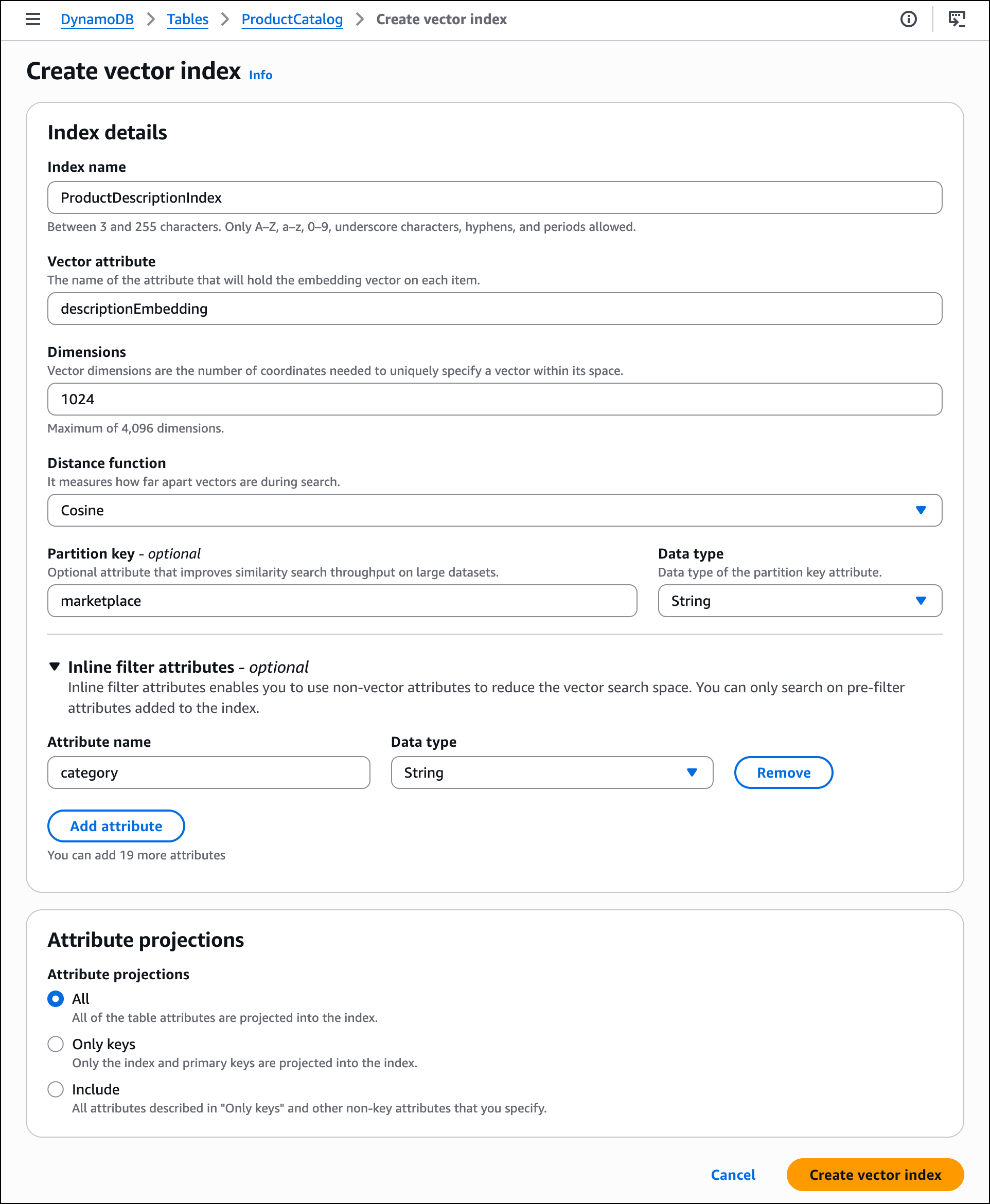
Once the embeddings reside within the table items, engineers configure a vector index through the AWS Management Console, AWS CLI, AWS SDKs, or Infrastructure-as-Code (IaC) tools like AWS CloudFormation.
The configuration process requires defining several key parameters:
- Index Name: A unique identifier for the index (e.g.,
ProductDescriptionIndex). - Vector Attribute: The specific table attribute housing the embedding array (e.g.,
descriptionEmbedding). - Dimensions: The exact dimensionality matching the output of the embedding generation model (up to 4,096 dimensions).
- Distance Function: The mathematical algorithm utilized to compute vector proximity:
- Cosine: Measures the angle between vectors, ideal for text semantics where magnitude variations are irrelevant.
- Euclidean: Measures straight-line distance in vector space.
- Dot Product: Measures directional alignment and magnitude, frequently utilized in specialized recommendation systems.
- Partition Key: An optional, highly recommended attribute (such as
marketplace) that helps distribute vectors across storage partitions, optimizing query performance and scoping searches to specific subsets of data. - Inline Filter Attributes: Non-vector attributes designated for precise, exact-match filtering (such as
category = "footwear") to refine search boundaries at runtime.
3. Executing Semantic Queries via SearchVectors API
Querying the vector index involves translating a natural language user prompt—for example, "lightweight running shoes for summer"—into a query vector using the same underlying embedding model.
The application then invokes the newly introduced SearchVectors API. This call passes the query vector, the desired top-$K$ result count (up to 100), partition key scopes, and inline filter conditions. DynamoDB processes the query, evaluates the high-dimensional space with 99%+ recall accuracy, and returns the most semantically relevant items ranked by similarity score alongside their associated operational attributes in a single, unified response.
Supporting Context & Metrics: Performance at Scale
The value proposition of DynamoDB’s vector search centers on performance metrics that bridge the gap between traditional NoSQL execution speeds and advanced artificial intelligence workloads.
- Latency and Recall: DynamoDB maintains single-digit millisecond query latencies while achieving a recall rate of 99%+ across massive datasets. This ensures that real-time user-facing applications, such as e-commerce recommendations or interactive chat assistants, suffer no perceptible lag when incorporating semantic retrieval.
- Scale Without Limits: Vector indexes in DynamoDB have no predefined storage limits. As datasets expand from millions to trillions of vectors, the architecture scales horizontally without manual intervention.
- Serverless Cost Efficiency: Inheriting DynamoDB’s serverless DNA means organizations pay strictly for what they use through the familiar pay-per-request pricing model. There are no idle server costs, no cluster sizing guesswork, and zero overhead associated with provisioning or patching search nodes.
- Unified Governance: Security, backup, restore, and global replication features natively apply to vector indexes, ensuring that enterprise security baselines and compliance mandates are seamlessly extended to AI workloads.
Official Statements and Industry Impact
The release has drawn significant attention from enterprise architects, database administrators, and AI developers navigating the complexities of modern software development.
Industry analysts note that eliminating the barrier between transactional databases and vector stores marks a pivotal maturation phase in cloud architecture. For years, database fragmentation forced engineering teams into defensive technical postures—building elaborate orchestration layers simply to keep distributed data stores in sync. By collapsing operational data and vector embeddings into a single managed surface area, AWS has drastically simplified the architectural blueprint for generative AI applications.
Early adopters testing the preview builds have highlighted the dramatic reduction in operational toil. Maintenance windows, cluster re-sharding procedures, and synchronization monitoring scripts have largely evaporated for teams migrating their semantic workloads directly onto DynamoDB’s serverless foundation. Furthermore, the integration of developer tools—such as the AWS MCP Server and AI coding plugins—allows engineers to query vector search documentation and build APIs using natural language workflows directly within their preferred integrated development environments (IDEs).
Future Outlook: The Next Generation of Serverless AI
As enterprises transition proof-of-concept AI applications into robust, mission-critical production systems, the demand for streamlined, low-latency, and cost-effective infrastructure will only intensify. The launch of native vector search in Amazon DynamoDB sets a new benchmark for how operational databases must evolve to support intelligent, context-aware software.
Looking forward, we can expect further harmonization between operational databases and machine learning workflows. As embedding models become more nuanced and agentic systems grow increasingly autonomous, the ability to store memories, logs, transactional records, and high-dimensional semantic vectors within a unified, auto-scaling serverless database will become a core architectural standard.
Organizations ready to modernize their application catalogs are encouraged to explore the Amazon DynamoDB Developer Guide, test vector index configurations in non-production environments, and provide feedback directly to the engineering teams via AWS re:Post or standard support channels. The era of the fragmented vector database is giving way to unified, intelligent, and effortlessly scalable cloud data platforms.