For decades, the daily newspaper comic strip has fought an uphill battle against cultural trivialization. Often dismissed as the "funny papers"—a disposable morning ritual designed to offer a quick chuckle alongside the heavy, grim realities of world news—the medium is inherently restrictive. Artists are typically given a tight grid of three or four panels, and occasionally just a single one, to establish a premise, deliver a punchline, and resonate with a diverse readership. Despite these rigid structural limitations, cartoonists have repeatedly defied expectations, weaving characters like Charles Schulz’s Snoopy and Jim Davis’s Garfield into the very tapestry of modern global culture.
Yet, defining "greatness" in the realm of cartooning remains a slippery endeavor. While strips like Peanuts and Bill Watterson’s Calvin and Hobbes frequently ventured outside straightforward comedy to offer profound, existential philosophies about the human condition, other masterworks achieved greatness through entirely different vectors. Garfield relied on universally relatable, razor-sharp gags of laziness and gluttony, while Prince Valiant captivated audiences through immaculate, picturesque, and highly detailed historical illustrations.
Then, there is Gary Larson’s The Far Side.
Larson’s legendary single-panel cartoon never sought to deliver life-affirming philosophical epiphanies, nor did it win praise for conventional artistic beauty—in fact, Larson purposefully employed grotesque, bug-eyed characters to heighten his bizarre comedic timing. While one of his famous Stegosaurus cartoons inadvertently birthed a brand-new anatomical term in scientific literature (coining the thagomizer), Larson never set out to rewrite paleontology textbooks. Instead, his singular ambition was remarkably pure: to craft the absolute funniest, most inventive single-panel joke possible each day. By deliberately avoiding recurring characters, Larson liberated himself from continuity, focusing entirely on the velocity and cleverness of the gag.
To measure the true greatness of The Far Side, one must evaluate it not by its high-minded cultural impact, but by the sheer precision of its wit. What follows is an exhaustive examination and ranking of ten quintessential The Far Side masterworks, chosen not for grand headlines or solemn truths, but because they represent the pinnacle of clever, beautifully absurd cartooning.
Detailed Chronology and Evolution of a Masterpiece
To understand the genius of The Far Side, one must trace the evolution of Gary Larson’s unique comedic sensibilities from his early syndicated days in the late 1970s and 1980s to its retirement and enduring cultural footprint. Larson debuted The Far Side (originally titled Nature’s Way) in The Seattle Times in 1979 before it was picked up by Chronicle Features and syndicated nationally.
Unlike serial strips that required readers to follow evolving character arcs, Larson’s single-panel format functioned as an unpredictable daily trapdoor. Readers opened the newspaper never knowing if they would encounter hyper-intelligent cows plotting behind human backs, medieval knights interacting with modern suburban absurdities, or anthropomorphic insects navigating surreal domestic spaces.
10. Find Peter
One of Larson’s greatest strengths was his absolute trust in his audience’s intelligence. While some punchlines were wonderfully broad and slapstick, others functioned as comedic scavenger hunts. "Find Peter" is a textbook example of a gag that yields zero amusement until the reader actively participates, scanning a chaotic corporate office cubicle layout to locate the subtle, contextual punchline hiding in plain sight.
9. A Deconstructionist Masterpiece
Though rare, Larson occasionally broke the fourth wall to deconstruct the medium of cartooning itself. In this meta-masterpiece, the cartoon playfully addresses the concept of "sketchy" characters by populating the panel with figures drawn with the absolute minimum, crudely rendered lines imaginable. It requires a discerning eye, rewarding readers who pause to appreciate the self-aware mechanics of comic illustration.
8. And the Complete Opposite Kind of Masterpiece
Conversely, The Far Side did not require high-concept subtlety to achieve greatness. Here, the humor is derived entirely from unapologetic overkill. A murder victim is sprawled across a floor, and despite being surrounded by hundreds of unmistakable bowling pins, an inept pair of detectives scratch their heads, utterly baffled by the nature of the homicide weapon. The absurdity lies in the glaringly obvious staring the characters directly in the face.
7. A Clever Twist
Larson routinely excelled at injecting fresh, warped perspectives into ancient cultural tropes. While fairy tale subversions were a staple of his work, his handling of Pinocchio stands as a masterclass in lateral thinking. Pinocchio’s eternal quest is to become a "real boy"—prompting Larson to imagine the one exact, miserable scenario where a wooden puppet would desperately wish he were made of pine again.
6. More Deconstruction (The Appliances)
Newspapers of the era frequently supplemented their comic pages with visual puzzle activities like "spot the differences" and "hidden images." Larson gleefully mocked this journalistic trope by scattering a series of wildly out-of-place household appliances across a dense forest landscape. The crowning glory of the panel is the caption claiming there are precisely 127 appliances hidden within the trees—a brazen statistical lie that elevates the joke.
5. Find the Punchline (The Artist and the Fly)
This composition serves as another brilliant visual scavenger hunt. The viewer’s eye is immediately drawn to the central giant fly-woman, then drifts to the human artist painting her canvas, before finally rewarding the observant reader with the punchline reflected quietly in the artist’s spectacles.
4. Reconstruct the Punchline (The Window Washer)
Taking the visual riddle a step further, this panel relies on retroactive comprehension. It takes the viewer a few delayed seconds to process the environmental clues and realize the true punchline: a window washer was actively suspended outside the pane just milliseconds before the oblivious homeowner flung the window open.
3. Snakes
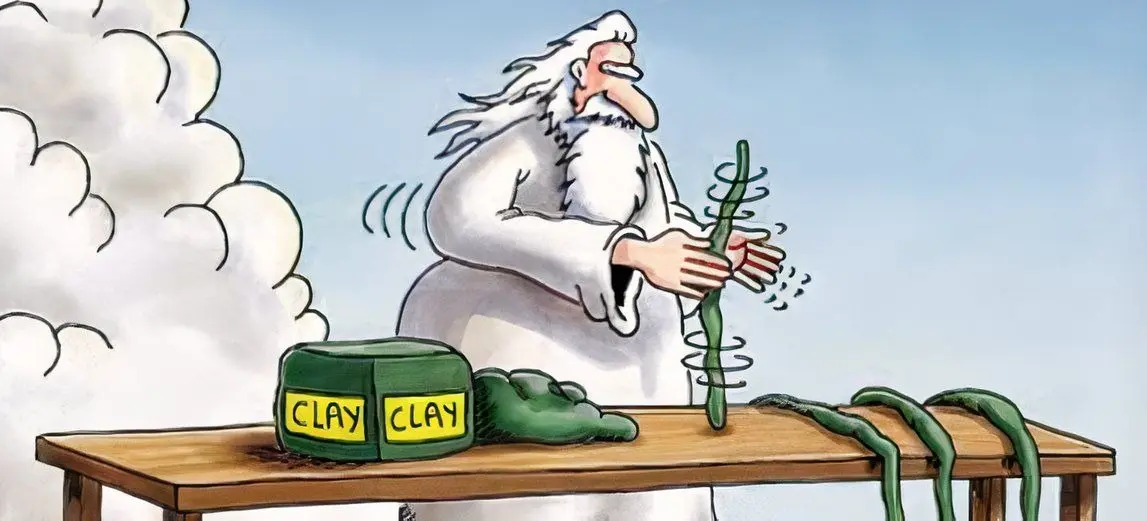
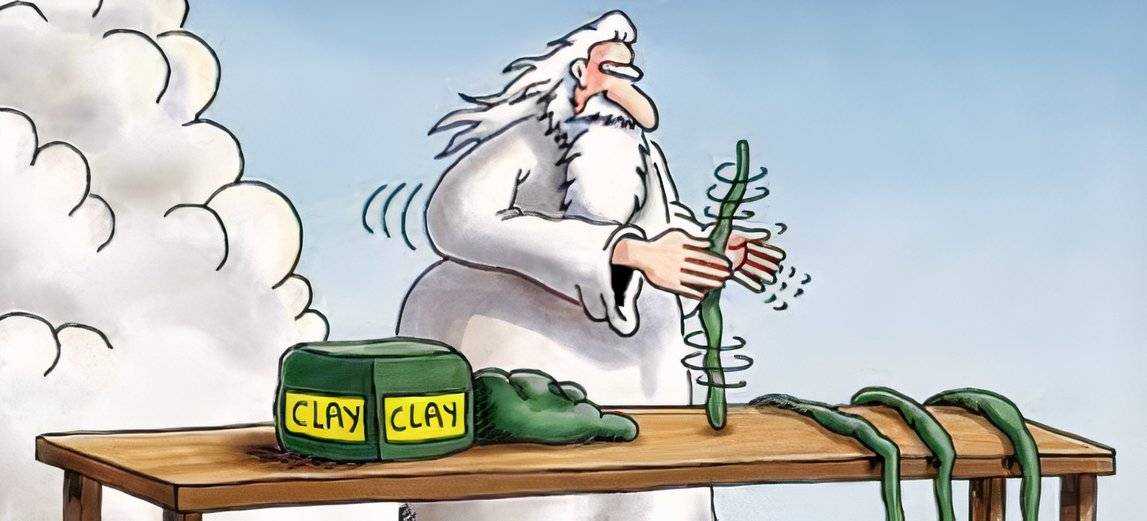
While Larson avoided heavy existentialism, he frequently tackled the fundamental silliness of creation itself. The mental image of God sculpting snakes out of Play-Doh—essentially rolling long green cylinders and casually tossing them into a bin—brilliantly trivializes the grandeur of biological design with divine apathy.
2. Love Triangle (The Desert Island)
Mirroring the comedic mechanics of the bowling pin homicide, this island-stranded love triangle derives its humor entirely from the staggering, unmitigated density of the characters involved. The relational dynamics among the cast members highlight Larson’s unique talent for illustrating profound human (and non-human) stupidity.
1. Smoking Dinosaurs
Standing proudly at the summit of The Far Side pantheon is arguably Larson’s most famous single panel: dinosaurs casually huddled together smoking cigarettes, with the caption attributing their extinction not to a catastrophic asteroid strike, but to lung cancer and tobacco addiction.
This panel encapsulates every hallmark of Larson’s genius in a single rectangle. He adored dinosaurs, he adored dark and morbid humor, and he effortlessly bridged the gap between lowbrow visual gags and high-concept satirical cleverness. On the surface, smoking reptiles are hilariously silly; beneath that veneer lies an impeccably structured piece of comedic engineering. It remains the ultimate expression of Gary Larson’s singular, twisted artistic vision.
Supporting Context & Metrics
To fully grasp the cultural footprint of The Far Side, one must examine its unprecedented reach during its golden era of syndication. At its peak, The Far Side appeared in over 1,900 daily newspapers worldwide, translated into 17 different languages.
Total Cartoons Produced: Gary Larson drew upward of 4,000 individual panels over a 15-year syndicated career (1980–1995).
Book Sales: Collected editions of The Far Side, such as The PreHistory of The Far Side and The Complete Far Side, have sold tens of millions of copies globally, becoming permanent fixtures on coffee tables and in academic offices alike.
Scientific Recognition: Beyond the famous Stegosaurus incident—where scientists formally adopted the term "thagomizer" to describe the spikes on the tail of the dinosaur, directly inspired by a 1982 Larson cartoon—numerous species of insects, chewing lice (Strigiphilus garylarsoni), and even a butterfly have been named in honor of the cartoonist’s contributions to public ecological awareness.
Official Statements and Archival Reflections
Reflecting on his creative process and the eventual retirement of the strip in 1994, Gary Larson frequently noted the exhausting physical and mental toll required to maintain daily inspiration without repeating oneself. In various retrospective interviews and introductions to his collected works, Larson articulated his philosophy on cartooning:
"I never set out to change the world, nor did I ever think of myself as an educator. Cartooning, for me, was an exercise in navigating the strange corners of my own imagination and dragging whatever absurdities I found back into the light. If people laughed, or felt a flicker of shared recognition at the sheer weirdness of existence, then the job was done."
Media analysts and literary critics have similarly lauded Larson’s ability to bypass traditional narrative structures. Cultural historian and comic theorist Robert C. Harvey noted:
"Larson revolutionized the single-panel cartoon by injecting an intellectual surrealism that had previously been foreign to the daily comics page. He proved that an audience didn’t need recurring characters to build an emotional connection; they only needed a shared appreciation for the delightfully absurd."
Future Outlook
Decades after Gary Larson dropped his ink pen in 1995—interrupted only by sporadic, highly anticipated online returns via The Far Side official website in recent years—the cultural relevance of his work shows no sign of diminishing. In an era dominated by rapid digital consumption, algorithmic meme culture, and fragmented media, the single-panel absurdist humor pioneered by The Far Side feels remarkably prescient.
Modern webcomics and digital meme creators owe an immense stylistic debt to Larson’s template: a flat, unassuming image paired with a deadpan caption that completely reframes reality. As physical newspapers continue to decline, the archival preservation of Larson’s work ensures that future generations will continue to stumble upon his surreal ecosystems, corporate animal meetings, and prehistoric misadventures. The Far Side remains a timeless testament to the power of a well-crafted punchline—proving that while humanity may take itself very seriously, the universe is infinitely funnier when viewed through Gary Larson’s wonderfully skewed lens.