Executive Overview
In the fast-paced ecosystem of modern cloud engineering, speed is the ultimate currency. Whether iterating on microservices architecture or leveraging generative AI tools to rapidly prototype cloud infrastructure, development velocity is frequently bottlenecked by the mechanisms designed to keep systems safe. Today, Amazon Web Services (AWS) is fundamentally shifting that paradigm with the launch of AWS CloudFormation Express mode.
Designed to dramatically accelerate infrastructure provisioning cycles, Express mode cuts deployment times by up to four times. It achieves this by redefining a core tenet of infrastructure-as-code (IaC) deployment lifecycles: stabilization checks. Traditionally, CloudFormation has required a meticulous, step-by-step verification process—waiting for every resource to fully initialize, pass health checks, and confirm its operational status before marking a stack deployment as complete. While essential for mission-critical production traffic routing, this mandatory waiting period introduces friction during rapid prototyping and iterative development.
Express mode optimizes this process by completing deployments the moment resource configurations are successfully applied by the control plane, leaving the underlying resources to stabilize asynchronously in the background. By eliminating these artificial wait times, routine operations that once took minutes—or even up to half an hour—now resolve in seconds.
Available immediately across all AWS commercial regions at no additional cost, this new deployment mode is uniquely optimized for human developers, continuous integration pipelines, and the rising tide of AI-driven infrastructure generators.
Detailed Chronology: The Mechanics of CloudFormation Express
To understand the profound impact of Express mode, one must first examine how traditional AWS CloudFormation operations function under the hood.
The Standard Mode Bottleneck
Historically, every AWS CloudFormation deployment executes in two primary phases:
- Configuration Application: The service calls underlying AWS resource APIs to create, update, or delete requested infrastructure components.
- Stabilization Checks: CloudFormation actively polls the state of these resources, verifying that they have transitioned from a provisioning state to a fully active, fully responsive operational state capable of handling real-world traffic.
For instance, deploying an Amazon Simple Queue Service (SQS) queue paired with a dead letter queue (DLQ) in Standard mode typically commands a stabilization window lasting upwards of 64 seconds. More drastically, operations involving complex resource deletions—such as removing an AWS Lambda function with entrenched network interface attachments—frequently subject engineers to an agonizing 20- to 30-minute wait while VPC network clean-up routines execute behind the scenes.
How Express Mode Streamlines the Lifecycle
Express mode does not alter how resources are provisioned or how AWS APIs interact with your account; rather, it fundamentally re-architects when the CloudFormation stack operation concludes.
Under Express mode:
- Early Completion: The deployment signal returns success as soon as the configuration payload is successfully accepted and applied by the target service APIs.
- Asynchronous Stabilization: Resources continue their stabilization sequence in the background without holding up the deployment pipeline.
- Intelligent Auto-Retries: Recognizing that asynchronous provisioning can occasionally introduce race conditions or transient dependency failures, CloudFormation features built-in resilience. It automatically retries dependent resources that encounter transient provisioning errors within the same stack, entirely eliminating the need for manual developer intervention.
Real-world benchmarking illustrates the stark difference. Creating an SQS queue with a DLQ under Express mode drops execution time down to a brisk 10 seconds. Similarly, the notoriously time-consuming deletion of a network-attached Lambda function is compressed from nearly half an hour down to a mere 10 seconds.
Supporting Context & Metrics: Powering Iterative Development and AI Workflows
The introduction of Express mode arrives at a critical juncture in software engineering. As development teams adopt agile methodologies and automated tooling, the feedback loop for application code has shrunk from hours to seconds. Infrastructure code, however, has traditionally lagged behind, forcing engineers to wait extended periods just to test a single configuration tweak.
CloudFormation Express mode addresses two distinct operational pillars:
1. Human-Driven Iterative Workflows
When architects and developers build infrastructure incrementally—such as isolating a microservice stack by starting with an IAM role, adding a Lambda function in the next iteration, and binding an SQS event source mapping in the third—waiting for full stack stabilization at every step severely disrupts cognitive flow. Express mode converts these workflows into sub-minute feedback loops, allowing engineers to build and test infrastructure with the same fluidity as writing application code.
2. AI-Assisted Infrastructure Development
The rise of AI-driven coding assistants and specialized developer tooling (such as Kiro and the AWS MCP Server) has accelerated the generation of infrastructure templates. However, AI agents rely on rapid trial-and-error cycles to validate and refine generated code. Traditional deployment latencies impede this process. By integrating Express mode into AI agent workflows, developers can achieve near-instantaneous validation of AI-generated CloudFormation templates, significantly improving the efficacy and speed of autonomous infrastructure generation.
Practical Implementation and Code Architecture
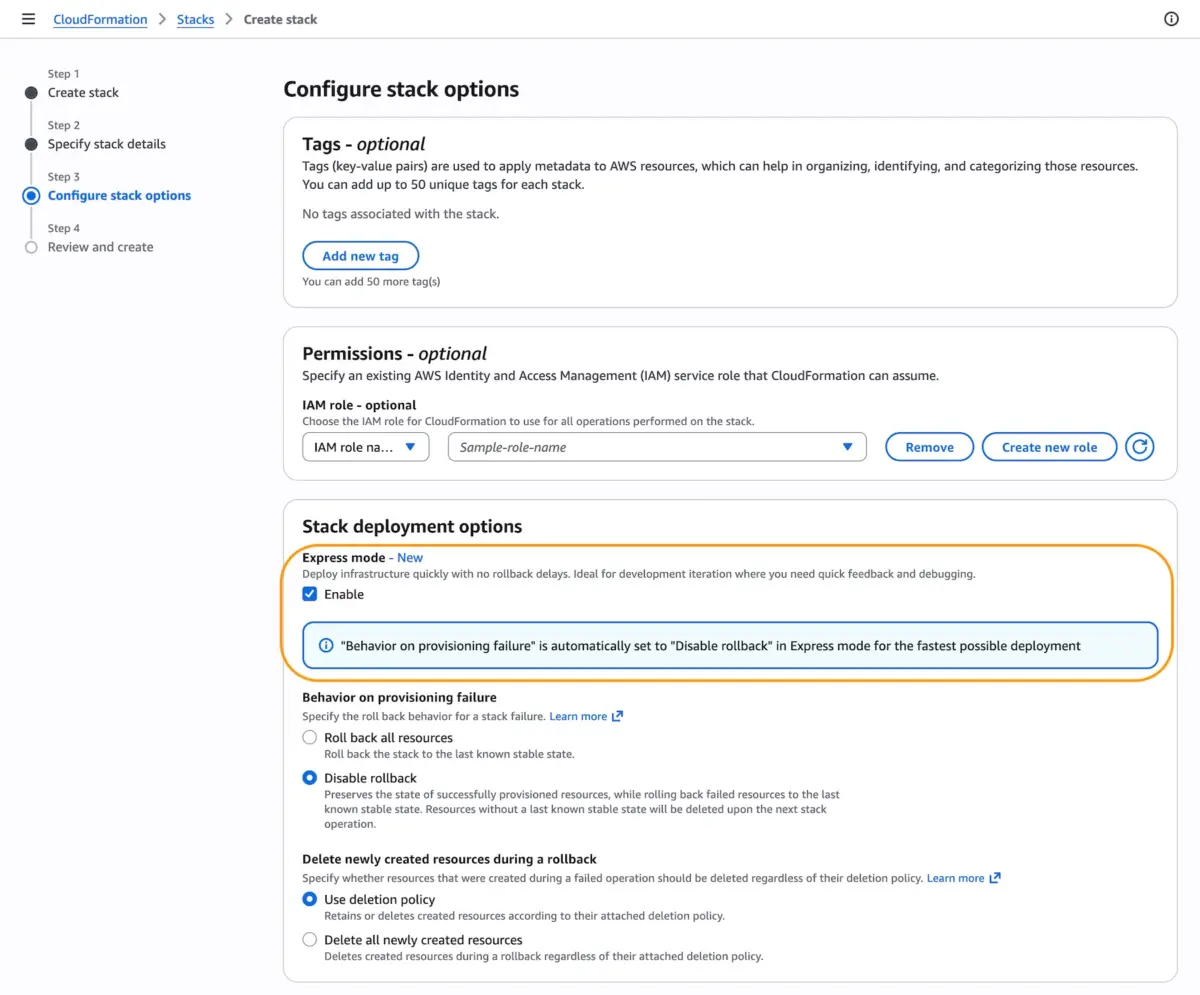
Activating Express mode requires no structural alterations to existing CloudFormation templates. Developers can deploy via the AWS Management Console by simply navigating to Stack deployment options and toggling Enable under Express mode.
For command-line enthusiasts and automation pipelines, the AWS CLI, AWS SDKs, and infrastructure frameworks like the AWS Cloud Development Kit (CDK) fully support the feature out of the box.
Using the AWS CLI, developers invoke Express mode by passing the --deployment-config parameter. Notably, to maximize iteration speed, Express mode disables stack rollbacks by default. For production workflows, teams can explicitly re-enable rollbacks by defining configuration parameters.
# Example: Creating a stack with Express mode and disabled rollback for speed
aws cloudformation create-stack
   --stack-name my-app
   --template-body file://template.yaml
   --deployment-config '"mode": "EXPRESS", "disableRollback": true'
For incremental microservice development, developers can maintain security best practices—such as adhering to the principle of least privilege for IAM roles—while rapidly layering resources:

# Iteration 1: Deploy IAM role
aws cloudformation create-stack
--stack-name my-microservice
--template-body file://iteration1-iam.yaml
--deployment-config '"mode": "EXPRESS"'
--capabilities CAPABILITY_IAM
--role-arn arn:aws:iam::123456789012:role/CloudFormationDeployRole

# Iteration 2: Add Lambda function
aws cloudformation update-stack
--stack-name my-microservice
--template-body file://iteration2-lambda.yaml
--deployment-config '"mode": "EXPRESS"'
--capabilities CAPABILITY_IAM
--role-arn arn:aws:iam::123456789012:role/CloudFormationDeployRole

# Iteration 3: Add SQS queue and event source mapping
aws cloudformation update-stack
--stack-name my-microservice
--template-body file://iteration3-sqs.yaml
--deployment-config '"mode": "EXPRESS"'
--capabilities CAPABILITY_IAM
--role-arn arn:aws:iam::123456789012:role/CloudFormationDeployRole
Teams utilizing the AWS Cloud Development Kit (CDK) can invoke the feature via a straightforward command-line flag:
cdk deploy --expressThis command parses the synthesized CloudFormation template and routes it through the Express deployment channel, ensuring seamless execution across existing template features, change sets, and nested stacks. When Express mode is enabled on a parent stack, all nested stacks inherit the behavior automatically.
Official Statements and Industry Perspective
While AWS engineering teams have positioned Express mode as a developer-centric quality-of-life enhancement, industry analysts are already evaluating its broader implications for enterprise cloud operations.
In technical announcements authored by prominent AWS evangelists such as Channy, the core design philosophy is clear: optimization should not require template rewriting. By ensuring backward compatibility with every existing CloudFormation template, AWS has removed the adoption barrier that typically plagues new infrastructure features.
Early adopters within the developer community have praised the removal of artificial delays, particularly when managing complex, tear-down-and-rebuild pipelines in ephemeral testing environments. However, enterprise platform teams maintain a cautious note regarding production usage. Because Express mode bypasses immediate stabilization verification, AWS explicitly advises that where absolute confirmation of resource readiness is mandatory prior to traffic shifting, teams should continue utilizing the default Standard deployment mode.
Future Outlook: The Next Wave of Cloud Agility
The launch of AWS CloudFormation Express mode signals a broader industry trend: the relentless compression of the software development lifecycle from code commit to production validation. As infrastructure definitions increasingly become the domain of dynamic software architectures and autonomous AI agents, static, hyper-conservative validation models are giving way to intelligent, asynchronous, and resilient deployment paradigms.
Looking ahead, we can anticipate deeper integrations between Express mode and automated testing suites, where asynchronous stabilization metrics feed directly into continuous monitoring platforms. For now, developers working across all AWS commercial regions can leverage this capability immediately at no additional cost.
Engineers looking to explore Regional roadmaps, consult API documentation, or integrate the feature into AI-assisted development tools can utilize the AWS MCP Server and associated plugins. Feedback and community discussion can be directed to the AWS re:Post for AWS CloudFormation forums, marking a major milestone in how cloud infrastructure is conceptualized, tested, and deployed.