Executive Overview
As artificial intelligence models scale exponentially, global data center infrastructure is accelerating toward an unprecedented capital expenditure threshold. Industry analysts project that developers and hyperscalers will spend as much as $4 trillion on data center construction and hardware by the end of the decade.
However, this massive expansion faces severe physical constraints. Traditional tech hubs are running out of available land and, more critically, hitting power grid capacity limits. To survive, the world’s largest compute clusters must expand across vast multi-campus footprints. Yet, expanding physical distance introduces severe network latency that threatens synchronous AI training workloads.
Relativity Networks, an optical interconnect startup, offers a compelling solution: altering the physical speed at which data travels between facilities. The company announced $22 million in seed-stage funding via a Simple Agreement for Future Equity (SAFE) note, supported by high-profile deep-tech investors including Rhapsody Venture Partners, Bell Ventures Inc., and Faster Than Glass LLC. Concurrently, Relativity Networks revealed a major commercial milestone: a $40 million follow-on order from an undisclosed, leading hyperscaler.
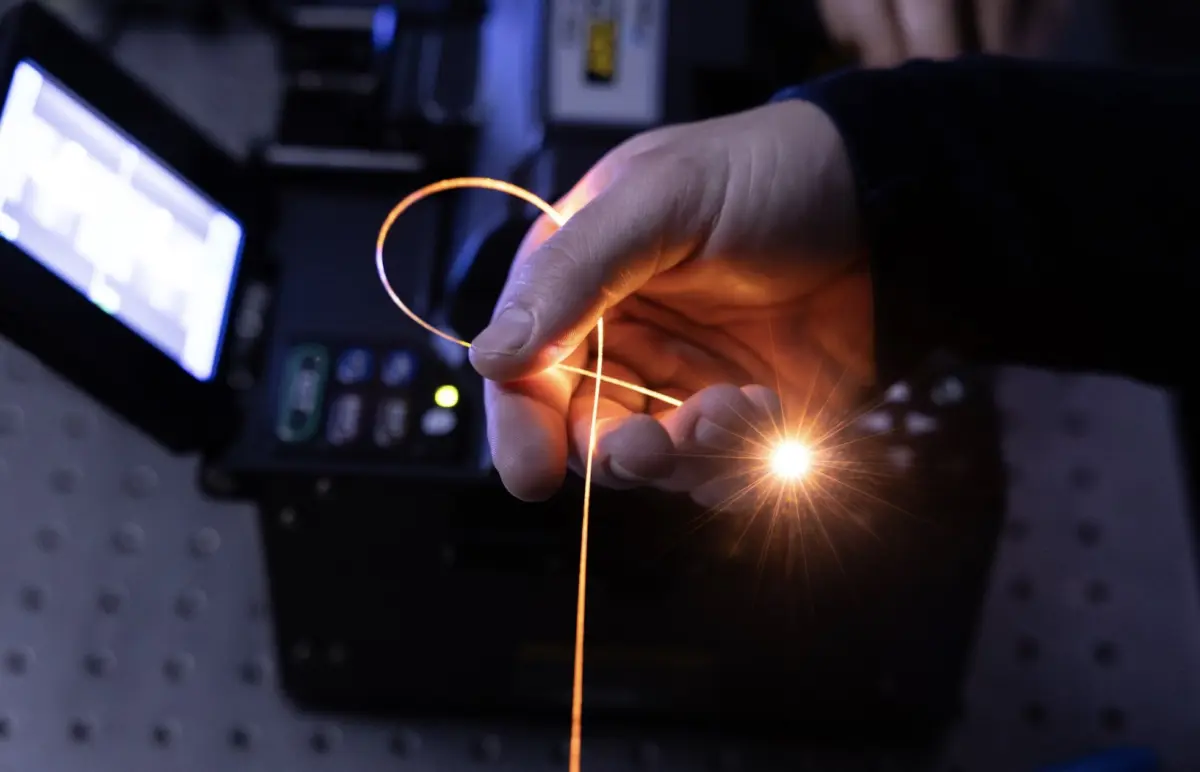
By commercializing hollow-core fiber optic technology—which replaces solid glass cores with vacuum channels—Relativity Networks increases optical transmission speeds by approximately 30%. In an industry where speed is constrained by the physics of glass, this reduction in latency allows hyperscalers to distribute massive AI clusters across much larger geographical areas. This breakthrough enables data center operators to bypass localized grid bottlenecks without degrading compute performance.
Detailed Chronology
+-------------------------------------------------------------------------------+
|                        RELATIVITY NETWORKS TRANSACTION                        |
+-------------------------------------------------------------------------------+
|  Funding Structure  | $22M SAFE Note (Pre-seed / Seed financing round)        |
|  Key Investors      | Rhapsody Venture Partners, Bell Ventures Inc.,          |
|                     | Faster Than Glass LLC, among others                     |
+---------------------+---------------------------------------------------------+
|  Commercial Order   | $40M Follow-On Deployment Order                         |
|  Customer Profile   | Undisclosed Tier-1 Hyperscaler                          |
+---------------------+---------------------------------------------------------+
|  Core Innovation    | Hollow-Core Fiber (Vacuum channel optical transmission)  |
|  Performance Impact | 30% Latency Reduction (~5.0 µs/km down to ~3.5 µs/km)   |
+-------------------------------------------------------------------------------+
The emergence of hollow-core fiber as a viable commercial solution follows years of specialized research. Historically confined to academic laboratories and niche, ultra-low-latency financial trading networks, hollow-core fiber was long considered too complex and expensive to manufacture at scale.
Relativity Networks’ latest announcement represents a crucial milestone in shifting this technology into mainstream cloud and AI infrastructure:
- Early Validation and Pilot Testing: Prior to securing its latest financing, Relativity Networks conducted field trials with major hyperscalers, testing hollow-core fiber across multi-building campuses and metropolitan-area interconnects.
- SAFE Financing Round: The company finalized a $22 million SAFE note financing round. Structurally designed to convert into equity upon the closing of a future priced Series A round, the capital injection was led by prominent early-stage deep-tech investors, including Rhapsody Venture Partners, Bell Ventures Inc., and Faster Than Glass LLC.
- Commercial Scale-Up: Alongside the capital injection, Relativity Networks secured a $40 million follow-on purchase order from a major hyperscaler. This follow-on order confirms that the technology has moved beyond testbeds into active, large-scale deployment within high-density production environments.
This commercial progress highlights a shifting priority among hyperscalers: networking speed is no longer just an internal data center metric, but a critical tool for overcoming real estate and power constraints.
Supporting Context & Metrics
The Physics of Photonics: Glass vs. Vacuum
To understand the strategic value of Relativity Networks’ technology, one must look at the fundamentals of fiber optic physics. Standard single-mode optical fiber (SMF-28) transmits data by firing laser pulses through a solid core of synthetic silica glass.
CONVENTIONAL FIBER OPTIC CABLE
[ Solid Silica Glass Core ]  ---> Light slowed down by glass density
• Refractive Index (n): ~1.468
• Signal Velocity: ~204,000 km/s
• Latency: ~5.0 microseconds per kilometer

HOLLOW-CORE FIBER OPTIC CABLE
[ Central Vacuum Chamber ]   ---> Light travels near vacuum speed (c)
• Refractive Index (n): ~1.0003
• Signal Velocity: ~299,700 km/s
• Latency: ~3.5 microseconds per kilometer (30% Faster)
While light in a vacuum travels at approximately $299,792 text kilometers per second$ ($c$), its speed decreases when traveling through a physical medium. The refractive index ($n$) of silica glass is roughly $1.468$. This means light traveling through conventional fiber optics drops to roughly $68%$ of its theoretical maximum speed.
$$textVelocity in Glass = fraccn = frac299,792 text km/s1.468 approx 204,218 text km/s$$
Relativity Networks replaces the solid glass core with a microstructured vacuum chamber surrounded by delicate glass membranes. Because the refractive index of air or vacuum is approximately $1.0003$, light travels through hollow-core fiber at nearly full speed ($c$).
- Conventional Fiber Latency: $approx 4.9 text to 5.0 text microseconds per kilometer (mutexts/km)$.
- Hollow-Core Fiber Latency: $approx 3.5 text microseconds per kilometer (mutexts/km)$.
This $1.5 text mutexts/km$ difference provides a 30% reduction in propagation latency, bringing data transfer speeds as close as possible to the physical limits of light.
The Macro Crisis: Power Bottlenecks and $4 Trillion in CapEx
This 30% speed increase addresses a major structural bottleneck in global technology infrastructure. Hyperscalers—including Microsoft, Meta, Google, and Amazon—are investing heavily in processing power, pushing expected infrastructure spending to $4 trillion by 2030.
       Global Data Center Bottlenecks & Grid Lockout
       +-------------------------------------------------------+
       | Projected CapEx spend by 2030: $4 Trillion            |
       +-------------------------------------------------------+
                                  |
                                  v
       +-------------------------------------------------------+
       | Primary Grid Failures / Bottlenecks:                 |
       | • Northern Virginia (Ashburn "Data Center Alley")     |
       | • Frankfurt, Dublin, London, Amsterdam (FLAP-A)       |
       | • Phoenix, Silicon Valley, Pacific Northwest          |
       +-------------------------------------------------------+
                                  |
                                  v
       +-------------------------------------------------------+
       | The Latency Radius Barrier:                           |
       | Traditional fiber forces GPUs into tight physical     |
       | clusters to prevent distributed compute timeouts.     |
       +-------------------------------------------------------+
                                  |
                                  v
       +-------------------------------------------------------+
       | The Solution: Hollow-Core Interconnects                |
       | 30% Latency Reduction = 30% Broader Geographic Area   |
       | Enables synchronous training across multi-campuses    |
       +-------------------------------------------------------+
However, data center developers face severe external headwinds:
- Power Grid Starvation: Tier-1 data center hubs—such as Northern Virginia, Santa Clara, Frankfurt, and Dublin—are experiencing severe power shortages. Utilities are routinely telling developers that new high-megawatt grid connections will take five to eight years to deliver.
- Geographical Fragmentation: Developers can no longer build massive gigawatt-scale data centers on a single parcel of land. Instead, they must distribute facilities across multiple smaller sites where localized power is available.
- The AI Compute Limit: Modern Large Language Model (LLM) training requires tens of thousands of GPUs working in precise synchronization. High-bandwidth communication algorithms (such as AllReduce) require near-instantaneous data exchanges between every GPU in the cluster. If latency between sites grows too high, expensive GPUs spend valuable time idling, waiting for data packets to cross the network.
By cutting propagation latency by 30%, hollow-core fiber lets developers expand the physical distance between facilities by 30% without exceeding critical latency limits. A multi-campus layout spread across 30 kilometers can now perform with the low latency of a conventional 20-kilometer layout.
Official Statements & Strategic Analysis
Speaking on the paradigm shift in artificial intelligence infrastructure, Jason Eisenholz, Chief Executive Officer of Relativity Networks, outlined the industry’s historical progression and future trajectory:
"The largest systems are distributing the compute across multiple campuses to reach the power that exists. They’re moving to where the warm shell is, but they still need to operate as one synchronized machine."
Eisenholz emphasized that the infrastructure strategy governing high-performance computing has evolved through three distinct phases:
+-----------------------------------------------------------------------------------+
|                        THE THREE ERAS OF AI INFRASTRUCTURE                        |
+-----------------------------------------------------------------------------------+
|  ERA 1: Compute Optimization     | Focus on maximizing GPU/silicon density within |
|                                  | individual server racks and chassis.           |
+----------------------------------+------------------------------------------------+
|  ERA 2: Intra-Data Center Fabrics| Focus on internal network fabrics (InfiniBand, |
|                                  | Ultra Ethernet) to connect campus GPUs.        |
+----------------------------------+------------------------------------------------+
|  ERA 3: Geographic Optimization  | Focus on using ultra-low-latency optics to     |
|                                  | bridge physically separated data campuses.     |
+-----------------------------------------------------------------------------------+
"The first era of AI optimized for compute," Eisenholz explained. "It was GPU, GPU, GPU. The second era optimized the networking inside the data center to take advantage of that compute. The third era that we see coming is optimizing the geography."
This insight highlights a key shift in cloud real estate strategy. Previously, hyperscalers prioritized building hyper-dense facilities on adjacent land plots. Now, as power grid delays force facilities farther apart, optical physics—specifically the medium through which light travels—is becoming a vital tool for cluster design.
Strategic Industry Outlook
The transition to hollow-core fiber represents a major technical advancement in optical communications, but widespread adoption faces both significant opportunities and clear challenges.
Manufacturing and Engineering Challenges
While standard single-mode glass fiber is cheap and easy to mass-produce, hollow-core fiber requires precise manufacturing to maintain its hollow geometry over long distances:
- Microstructural Consistency: The interior vacuum core is maintained by delicate glass structures running the entire length of the cable. These delicate structures must remain uniform during high-speed manufacturing to prevent signal loss.
- Splicing and Field Logistics: Joining two hollow-core fibers in the field requires specialized fusion splicers to prevent the hollow center from collapsing under heat.
- Attenuation Curves: Historical hollow-core fibers suffered from high signal attenuation (db/km) compared to standard fiber. However, recent advances in hollow-core design have dramatically reduced signal loss, making it practical for campus interconnects and regional metro networks.
+-----------------------------------------------------------------------------------+
|                   HOLLOW-CORE FIBER: ADVANTAGES VS. CHALLENGES                    |
+-----------------------------------------------------------------------------------+
|  ADVANTAGES                               |  CHALLENGES                           |
|  • 30% latency reduction (~3.5 µs/km)     |  • Higher per-meter manufacturing cost|
|  • Higher power handling thresholds       |  • Complex field splicing procedures  |
|  • Minimal non-linear signal distortion   |  • Scaled factory production capacity |
|  • Expands viable geographic campus footprint| • specialized testing equipment      |
+-------------------------------------------+---------------------------------------+
Strategic Implications for Cloud Real Estate and Energy Networks
Relativity Networks’ initial funding and customer validation suggest that top-tier hyperscalers are willing to pay a premium for high-performance optics to solve critical infrastructure problems.
As AI models grow and require gigawatts of power, data center geography will depend heavily on advanced optical networks:
- Repurposing Legacy Sites: Hyperscalers can tie older, smaller facilities into newer developments miles away, combining their power capacity to form a single, unified cluster.
- Rural and Remote Expansion: Developers can place data center buildings closer to renewable energy sources—such as hydroelectric dams, solar farms, or nuclear power plants—without suffering the latency penalties that previously limited remote locations.
- Competitive Pressure on Fiber Manufacturers: Established fiber optic manufacturers will face pressure to accelerate their own hollow-core production, turning what was once a specialized technology into a key standard for data center connectivity.
Conclusion
Relativity Networks’ $22 million funding round and $40 million hyperscale deal signal a broader shift in AI infrastructure. As power grid constraints and physical space limits challenge traditional data center expansion, the industry can no longer rely solely on physical proximity.
By replacing solid glass optical cores with vacuum channels, Relativity Networks provides a way to circumvent geographical limits. By pushing light transmission closer to its physical speed limit, the company is helping hyperscalers expand compute clusters across larger regions—proving that as AI expansion tests the limits of localized grid power, physics and photonics will play a crucial role in shaping the future of global computing.