Executive Overview
In the modern digital landscape, professional networks have evolved far beyond digital resumes. They are now dynamic ecosystems where industry leaders build multi-million dollar brands, recruit top-tier talent, and generate compounding inbound leads. Yet, a staggering paradox defines platforms like LinkedIn: while the demand for authoritative professional insights has never been higher, only 1% of the platform’s active user base actually creates content.
This severe supply-and-demand imbalance presents an extraordinary window of opportunity for executives, founders, consultants, and B2B marketers. However, simply maintaining a consistent publishing schedule is no longer a competitive advantage. Amidst an ocean of generic posts and AI-generated copy, audiences have developed an acute radar for inauthenticity. The content that successfully stops the scroll, commands attention, and drives measurable business growth requires a deliberate, human-centric strategy.
Co-created by digital strategist Kasey Brown and industry analyst Michael Stelzner, a proven framework has emerged to solve this exact challenge. Known as the Triple S Framework, this methodology bypasses automated shortcuts to focus on three core dimensions of user psychology: Stop, Stay, and Share. By anchoring content in precise audience profiling and executing tactical psychological triggers, creators can transform their LinkedIn presence from a passive broadcast channel into an active engine for business development—entirely without the aid of artificial intelligence.
Detailed Chronology: Foundations of the Triple S Methodology
Before deploying advanced tactical execution, creators must establish the foundational architecture of their messaging. According to Brown, achieving traction on LinkedIn requires solving three upstream strategy prerequisites. Without these foundational elements, even the most cleverly written hooks and polished visuals will fail to convert casual scrollers into loyal business prospects.
1. Pinpointing the Ideal Client Profile (ICP)
The first critical misstep most creators make is defining their target audience with vague demographic sketches. Phrases like "people who want to build a brand online" are far too broad to inform effective copywriting.
Instead, a high-converting ICP must be hyper-specific—so precise that a virtual assistant could plug the exact keywords into LinkedIn’s search engine and instantly populate a list of viable prospects. Brown offers a benchmark example: shifting from a generic audience description to “speakers, coaches, and consultants earning at least $20K per month who need systems for organic content so they can scale their impact and their business.” This granular level of detail ensures that every subsequent piece of content directly addresses a real operational pain point.
2. Defining the 30-Day Transformation
Every piece of content must exist within a larger narrative arc. Creators must explicitly answer a foundational question: What tangible transformation will a reader experience after following this account for 30 days? By establishing a clear trajectory of value, individual posts cease to be random thoughts and instead become chapters in a cohesive authority-building narrative.
3. Shifting from Self-Centric to Reader-Centric Publishing
The psychological anchor of successful digital publishing is the pivot away from ego-driven metrics. Most creators publish while subconsciously asking internal questions: Did I sound smart? Did I share enough client wins? Will this directly drive a sale?
When the paradigm shifts to evaluate content exclusively through the lens of the reader—asking “What exact value, insight, or operational relief does the ideal reader walk away with?”—the tone of the content shifts. This audience-first orientation builds the kind of deep, compounding trust that accelerates business growth.
The Triple S Framework in Action
With foundational clarity established, creators can implement the Triple S Framework, a tactical blueprint designed to manage user engagement across every stage of consumption.
[THE TRIPLE S FRAMEWORK]
  │
  ├── 1. STOP  ──► Pause the Scroll (Unpolished Visuals + 5 Cs Hooks)
  │
  ├── 2. STAY  ──► Maintain Attention (Re-Hooks + Scannable Rhythm + Mobile Optimization)
  │
  └── 3. SHARE ──► Drive Amplification (The "Goodie Bag" Transformational Takeaway)
Dimension #1: STOP – Pause a Viewer’s Scroll With Images and Hooks
The absolute first objective of any LinkedIn post is pattern interruption. According to engagement analytics, roughly 80% of a post’s impressions are determined by just two elements: the attached visual asset and the first two lines of text.
Disrupting Visual Uniformity
Most professionals default to polished speaking headshots or highly stylized corporate graphics. Because feeds are saturated with this visual sameness, it creates a massive opportunity to stand out by doing something different.
Brown tested this hypothesis empirically. Following a live speaking engagement, she captured a wide-angle stage selfie using her smartphone’s back camera at 0.5x zoom. The resulting image was casual and unpolished, revealing the entire audience in the background. When paired with an offer for presentation slides, this unvarnished post generated 3,000 inbound leads. Conversely, when she subsequently published the same offer accompanied by a professionally lit, high-resolution photo from the event, conversions plummeted to just 200 leads.
The tactical lesson is clear: "We don’t have to be better; we have to be different." Furthermore, vertical images consume more valuable screen real estate on mobile devices and resist unwanted cropping, naturally forcing the user’s eye to pause.
Deploying the Five Cs of High-Impact Hooks
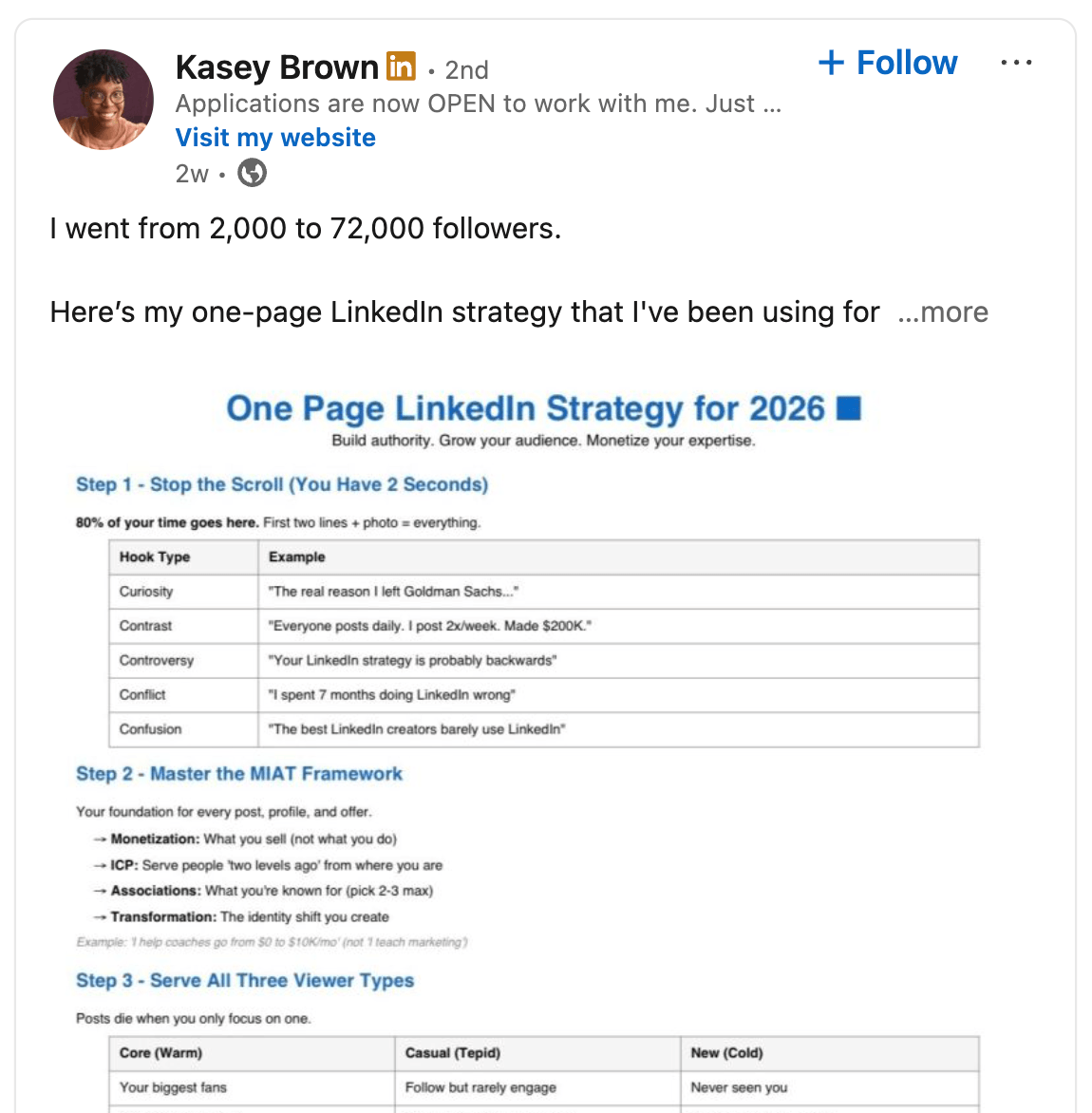
Once visual curiosity is sparked, the opening lines of text must compel the reader to click the "see more" expansion button. To evaluate the potency of an opening line, Brown applies a mental model adapted from short-form video strategy known as the Five Cs:
- Curiosity: Leaving an open loop that demands closure.
- Contrast: Highlighting a stark difference between two realities.
- Contradiction: Presenting ideas that appear to conflict with conventional wisdom.
- Controversy: Touching on polarizing industry debates safely and constructively.
- Confusion: Introducing an anomalous detail that defies immediate logic.
A weak hook—such as a vacation photo captioned, "On vacation in Bali, having a great summer"—triggers none of the Five Cs. It offers zero tension or intrigue. Redesigned utilizing the framework, the same concept opens with a powerful juxtaposition:
"I was at a job I hated. 2021." / "2026. I just spent $30K to come here…"
Instantly, the reader is hooked by confusion, contrast, and intense curiosity.
Dimension #2: STAY – Keep Readers Engaged From Hook to Finish
Getting a user to click "see more" is only half the battle. The second challenge is earning and holding their attention through the body of the post.
Mastering the Post-Click Re-Hook
When a reader expands a post, the immediate lines following the break must validate their decision to click. Crucially, this is not the place to resolve the narrative. The amateur mistake is delivering the punchline or resolution too early.
Following the Bali narrative, a flawed execution immediately relieves tension: "I’m here in Bali with the family. I took five weeks off, and my business is thriving." The story is effectively over, and the reader departs.
The professional execution continues building tension:
"It was a wild dream I had last February. I never thought I could actually leave my business and spend this kind of money, especially with so many fires burning in the company and everything feeling like it was about to fall apart. But somehow I made it."
This sustains narrative tension, compelling the user to read deeper for the resolution.

Structuring for Optimal Rhythm and Readability
Textual formatting directly impacts completion rates. Creators should optimize for rhythm by alternating between short, punchy one-sentence lines and brief multi-sentence narrative blocks.
- Short lines: Land high-impact takeaways and create visual white space.
- Dense blocks: Develop complex operational ideas.
Additionally, readability metrics matter profoundly. Top-performing educational posts typically score at a fourth-to-seventh-grade reading level to ensure maximum accessibility. Tools like the Hemingway App assist creators in stripping away jargon and overly complex sentence structures. Because nearly 70% of professional networking occurs on mobile devices, previewing drafts in mobile environments—via native application drafts or dedicated workflow tools like Authored Up—ensures text blocks do not collapse into unreadable walls of text on smaller screens.
Dimension #3: SHARE – Drive Amplification Through Concrete Value
The ultimate litmus test for content quality is the share (or repost). While vanity metrics like raw views and basic comments are relatively easy to acquire, a share represents the highest form of digital endorsement: a user attaching their personal professional reputation to your insights and broadcasting them to their own network.
Tracking the Share-to-Impression Ratio
Creators should monitor their shares-per-impression ratio as a primary health metric for their content strategy:
- 0.3 Ratio: Solid performance indicating targeted resonance.
- 0.5+ Ratio: Exceptional performance indicating high utility.
Any post that crosses the 0.5 threshold should be systematically indexed and rotated back into the publishing schedule every 60 to 90 days using identical creative assets and copy. Conversely, posts that underperform serve as diagnostic tools, signaling that the core message lacked actionable utility or a definitive conclusion.
The "Goodie Bag" Transformational Ending
To consistently inspire shares, content must conclude with tangible utility—what Brown describes as handing the reader a "goodie bag" at the end of a presentation. Following an engaging story or conceptual breakdown, the closing section must provide a step-by-step framework, an actionable checklist, or a repeatable system.
When a post delivers this level of concrete transformation, explicit calls-to-action (CTAs)—such as "tag a colleague who needs to see this" or "share with your network if this was valuable"—feel natural and earned rather than manipulative.
Supporting Context & Metrics: The Modern AI and Content Landscape
To fully understand the urgency of adopting a human-first, strategy-driven approach to LinkedIn publishing, one must examine the broader macro environment of digital marketing and content creation.
The rapid democratization of generative artificial intelligence has flooded professional channels with an unprecedented volume of homogenized, synthetic copy. Industry data highlights a profound operational challenge: while marketers scramble to harness AI tools, 85% of professionals are forced to learn AI applications entirely through self-directed experimentation, with only 7% receiving formal corporate training, and more than half financing their own software investments.
This rush toward automated output has created a severe backlash among digital audiences. When every feed is populated by predictable, AI-generated structures utilizing identical phrasing and hollow thought-leadership tropes, authenticity becomes the ultimate differentiator.
The Triple S Framework succeeds precisely because it rejects algorithmic homogenization. By prioritizing unpolished, real-world visual assets (such as wide-angle stage selfies and raw office TV infographics), authentic personal narratives, and rigorous structural pacing, creators reclaim the human element that automated tools fundamentally cannot replicate.
Future Outlook: The Next Era of Professional Personal Branding
As algorithms continue to evolve and user tolerance for synthetic noise diminishes, the future of professional publishing on LinkedIn will belong entirely to authentic, high-utility practitioners.
Several key trends are poised to shape the content landscape over the coming years:
- The Premium on Raw Authenticity: As deepfakes and flawless synthetic media become ubiquitous, audiences will place an increasingly high value on imperfect, real-world documentation. Raw phone photography, behind-the-scenes operational breakdowns, and unfiltered founder journeys will significantly outperform hyper-polished corporate branding.
- Shift From Broadcasting to Community Building: Content will no longer serve merely as a top-of-funnel broadcast mechanism. The most successful founders and executives will use frameworks like the Triple S methodology to build dedicated, engaged communities where prospects actively participate in peer-to-peer knowledge exchange.
- The Death of Generic Thought Leadership: Vague platitudes and surface-level motivational quotes will be aggressively filtered out—both by increasingly sophisticated platform algorithms and by fatigued audiences. Success will require deep domain expertise packaged into rigorous, highly actionable, step-by-step frameworks.
By abandoning automated shortcuts, defining laser-focused ideal client profiles, and committing to the discipline of the Triple S Framework, professionals can cut through the noise. In a digital world increasingly saturated by artificial intelligence, the most powerful competitive advantage a creator can possess remains entirely human.