Executive Overview
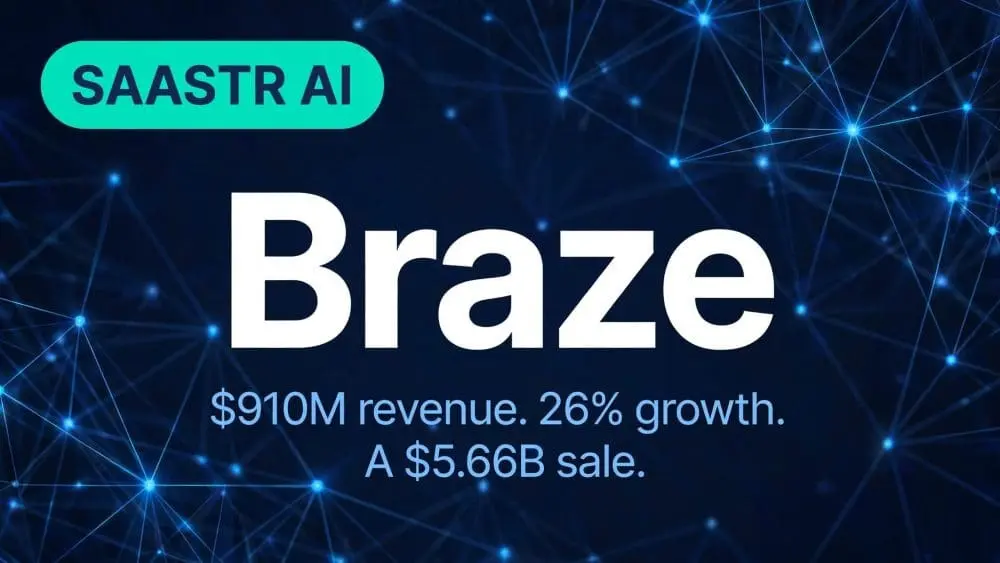
In a landmark transaction that underscores the shifting valuations of the modern software economy, enterprise software titan Salesforce announced its acquisition of customer engagement platform Braze for an enterprise value of approximately $5.66 billion. Under the terms of the agreement, Braze Class A shareholders will receive $47.50 per share in cash. This figure represents a staggering 58% premium over the company’s closing price of $30.04 just prior to the announcement, instantly rewriting the narrative for mid-market and enterprise B2B software companies navigating the turbulent post-zero-interest-rate era.
For Salesforce, the acquisition is far more than a routine bolt-on; it is a calculated, strategic consolidation meant to fortify its Customer 360 ecosystem. Specifically, the deal targets Marketing Cloud, a legacy powerhouse within the Salesforce portfolio that has long excelled in traditional channels like email but historically lagged behind in real-time mobile push notifications and in-app engagement. By absorbing Braze—whose elite client roster includes digital-native giants such as Canva, Instacart, Venmo, Equinox, Urban Outfitters, and Dairy Queen—Salesforce instantly bridges a critical functional gap.
However, looking at the headline valuation of $5.66 billion captures only half the story. The true intrigue of this multi-billion-dollar deal lies in the dramatic sequence of events that preceded it. Just six weeks prior to the acquisition announcement, Braze reported an earnings beat and raised its full-year guidance, only to watch its public stock price plunge 25% in a single week. Wall Street punished the company for moderating growth rates and early-stage AI monetization metrics, failing to recognize the underlying operational discipline that made Braze an irresistible target for a strategic acquirer.
This article deconstructs the anatomy of the Salesforce-Braze deal, examining the macroeconomic pressures on public B2B software, Braze’s masterclass in operational leverage, the strategic shift toward high-value upmarket accounts, and the broader implications for founders navigating the 2026 SaaS landscape.
Detailed Chronology: From Market Whiplash to Acquisition
To understand how a high-growth software company can suffer a massive market sell-off only to be acquired at a 58% premium a month and a half later, one must examine the stark disconnect between public market sentiment and strategic corporate valuation in 2026.
The September Earnings Shock and Market Overreaction
On September 8, Braze delivered a strong quarterly earnings report. The company posted $227.2 million in quarterly revenue, representing a robust 2j6% year-over-year increase. Not only did this performance beat consensus estimates by roughly $6.9 million, but Braze also surpassed expectations on earnings per share (EPS) and raised its guidance for the full fiscal year.
Yet, the market’s reaction was swift and punishing. By the end of the week, Braze’s stock had cratered by 25.1%.
Public market investors had developed tunnel vision. In an economic climate obsessed with hyper-growth and immediate, revolutionary artificial intelligence transformation, a growth rate in the mid-20s was viewed through a lens of skepticism. Investors fixated on the fact that Braze’s AI revenue was not yet material to its top-line financial performance, entirely discounting the company’s rapidly expanding margins and record-breaking cash flow generation. To public market analysts, Braze was categorized as a legacy pre-AI application vulnerable to disruption.
The Strategic Buyer’s Perspective
While public market algorithmic traders and short-term institutional investors saw a slowing asset, a strategic behemoth like Salesforce saw an engine of immense structural value.
Strategic buyers do not value software companies purely on quarterly growth multiples or short-term sentiment shifts. Instead, they price assets on irreplaceable distribution channels, deeply embedded proprietary data loops, and thousands of enterprise-grade customer relationships that would take a competitor years and hundreds of millions of dollars to replicate organically.
Braze had spent over a decade building deep, mission-critical integration points inside the tech stacks of the world’s most sophisticated consumer applications. For Salesforce, buying those relationships and integrating them into Customer 360 bypassed years of internal product development and sales friction. The board of directors at Braze recognized the wide valuation gap between public market skepticism and private strategic value—a delta of 58%. When Salesforce stepped forward with an all-cash offer at $47.50 per share, the path forward was clear.
Supporting Context & Metrics: Unpacking Braze’s Financial Engine
Beneath the drama of the stock market fluctuations and the ultimate buyout lies a masterclass in financial engineering and operational discipline. Braze’s final quarters as an independent public company offer vital lessons for software founders scaling toward profitability in 2026.
1. The Power of Opex Discipline
While maintaining a 26% top-line revenue growth rate, Braze executed a remarkable pivot in cost management. Operating expenses rose by a mere 6% year-over-year to $170 million. This deliberate divergence between revenue growth and operating expense growth created significant leverage.
Non-GAAP operating margins improved by more than 600 basis points year-over-year, and management’s forward guidance pointed toward at least another 400 basis points of expansion. Furthermore, this discipline culminated in a record-breaking quarterly free cash flow of $21.7 million, leaving the company with a formidable balance sheet featuring $431.9 million in cash.
Achieving a 20-point gap between revenue growth and opex growth requires immense organizational restraint. It is a transition made possible by leadership exercising hiring discipline and augmented by early deployments of artificial intelligence to handle internal operational workloads that were previously managed manually. Crucially, this financial transformation made Braze an ideal acquisition target. An acquirer deploying over $5.66 billion in cash wants a target that immediately contributes to cash flow, rather than one that burns capital to chase unbridled top-line expansion.
2. Net Retention Rates and the Upmarket Pivot
Dollar-based net retention (NRR) for Braze settled at 110% overall, with large customers ticking up slightly to 112% (a 100-basis-point improvement over the prior quarter). With NRR resting at 110%, existing customers alone could no longer serve as the primary engine for compounding hyper-growth.
Faced with this plateau, Braze executed a strategic shift upmarket. Rather than chasing a massive volume of mid-market logos, the company concentrated its best sales and customer success resources on high-value enterprise accounts.
The results speak for themselves. Customers paying upwards of $500,000 annually grew from 282 to 361—a remarkable 28% increase in large enterprise accounts within a single fiscal period. Total customer count grew by roughly 15%, moving from 2,422 to 2,789. These 361 massive accounts represent precisely the tier of enterprise clients that Salesforce intends to target with its advanced Data 360 and Agentforce initiatives.
3. The Monetization of Professional Services
Another fascinating metric buried in Braze’s financial disclosures was the explosive growth of its professional services and other revenue, which more than doubled to $19.6 million, up from $8.3 million a year earlier. While subscription revenue grew by a healthy 21% (reaching $207.7 million), professional services surged by roughly 136%, expanding from 5% of total revenue to approximately 9%.
In the broader B2B software ecosystem, this trend highlights a fundamental reality of the artificial intelligence era: advanced AI decisioning engines and autonomous agent deployments require hands-on implementation. Connecting disparate enterprise data silos, configuring workflows, and tuning results demand human engineering talent.
While many AI-native startups choose to absorb these costs under the guise of "onboarding" to protect subscription gross margins, Braze proved that enterprise customers are willing to pay for implementation services as a distinct line item. If a customer requires specialized engineering time to extract maximum value from a complex platform, Braze’s model demonstrates that the market will bear the cost.
4. Early-Stage AI Adoption and Packaging Dilemmas
By the time of its acquisition, paid adoption of Braze’s AI product suite had reached approximately one-third of its large enterprise customer base—an impressive acceleration of roughly 900 basis points since the first quarter. Innovations like AI Operator, which allows marketers to construct complex multi-channel journey steps through natural language conversational prompts and deploy pre-built autonomous agents, clearly resonated with users.
Yet, despite one-third of major clients paying for AI, this metric failed to move the needle with public market investors. Why? Because the attach rate did not radically alter the company’s macro top-line growth rate.
In the current financial climate, institutional investors evaluate AI through the prism of net-new budgetary expansion. If AI is bundled invisibly into the core platform, its direct financial impact is obscured. Conversely, packaging AI as a distinct SKU allows companies to clearly report attach rates, average deal size uplifts, and direct contributions to growth. Braze possessed the former—strong feature adoption—without yet being able to cleanly prove the latter to public analysts.
Official Statements and Industry Context
The transaction is part of an aggressive, multi-pronged acquisition spree by Salesforce throughout 2026. In addition to Braze, Salesforce has announced or closed deals for Contentful, m3ter, Fin, Listen Labs, and Loops, culminating in the closure of Fin in September. Marc Benioff’s organization is systematically acquiring best-of-breed developer, automation, and customer interaction tools to solidify its dominance against fierce competition from Microsoft, Google, and Adobe.
Bill Magnuson, co-founder and CEO of Braze, emphasized that despite the integration into Salesforce’s expansive ecosystem, the brand and its engineering culture will persist.
"Braze will keep building as Braze," Magnuson noted, signaling that the platform’s core architectural autonomy will be preserved to maintain the high velocity of product innovation that attracted Salesforce in the first place.
Industry observers and operators have taken notice. Writing from the perspective of an enterprise software user, commentators within the SaaS community—such as the leadership team at SaaStr, which utilizes Marketing Cloud—have noted that the acquisition raises intriguing operational questions. Organizations currently evaluating enterprise marketing automation stacks will be watching closely to determine how much of Braze’s advanced, real-time messaging architecture is absorbed natively into Marketing Cloud versus remaining an independent, specialized product suite.
Future Outlook: Lessons for Founders in 2026
The $5.66 billion acquisition of Braze is more than a corporate milestone for Salesforce; it is a textbook case study for founders, venture capitalists, and executives navigating the modern software economy.
1. The Strategic Exit Over Public Markets
For private founders whose companies are experiencing decelerating growth in the 20s and whose AI innovations have yet to materialize visibly in top-largest revenue figures, Braze’s trajectory offers a clear roadmap. The public markets can be brutally myopic, penalizing mature software assets that are quietly generating immense cash flow and operational efficiency. When public valuations disconnect from fundamental enterprise value, strategic acquirers—armed with massive balance sheets and the desire to buy rather than build distribution—represent the most viable path to liquidity.
2. The Mandate for Operational Efficiency
The era of reckless, growth-at-all-costs software spending is long gone. Braze proved that a company can achieve mid-20s revenue growth while holding operating expense growth to single digits, translating directly into record-breaking free cash flow. Founders at the $20 million, $50 million, or $100 million ARR milestones must look to Braze as the benchmark for disciplined scaling. Acquirers in 2026 do not want cash-burning promises; they want self-sustaining financial engines.
3. Upmarket Focus and Ecosystem Integration
As net retention rates normalize across the SaaS landscape, software leaders must consciously choose between horizontal volume expansion and vertical enterprise depth. Braze chose the latter, dedicating its top resources to accounts capable of scaling past $500,000 in annual recurring revenue. Those enterprise relationships became the primary catalyst that drove Salesforce to execute a multi-billion-dollar buyout.
Ultimately, the Salesforce-Braze union heralds a new chapter in enterprise software consolidation. It demonstrates that exceptional product architecture, relentless operational discipline, and deep customer stickiness will always find a premiun valuation—even when the public markets momentarily lose their way.