Executive Overview
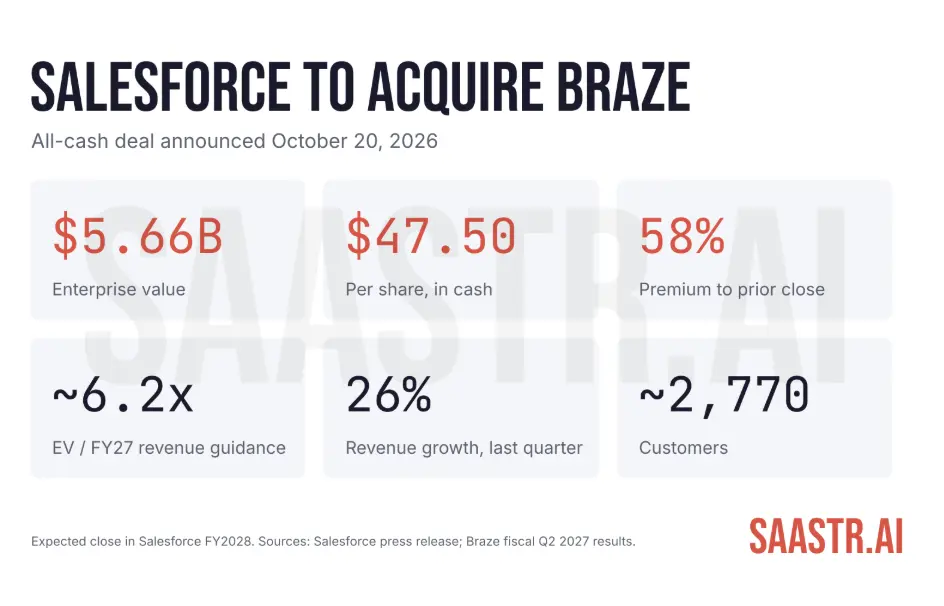
In a landmark transaction that underscores the growing gulf between public market valuations and strategic private-equity or corporate acquirer appraisals, Salesforce announced a definitive agreement to acquire customer engagement platform Braze for an enterprise value of approximately $5.66 billion. Under the terms of the agreement, Braze Class A stockholders will receive $47.50 per share in cash. This represents a staggering 58% premium over the company’s closing price of $30.04 just prior to the announcement.
For Salesforce, the acquisition is designed to aggressively patch a historic blind spot in its flagship Marketing Cloud: real-time mobile and in-app customer engagement. While Salesforce has long reigned supreme in enterprise email and CRM architecture, consumer-facing brands have increasingly gravitated toward specialized platforms to manage high-frequency, cross-channel messaging. By absorbing Braze and its roster of nearly 2,770 premier consumer brands—including Canva, Instacart, Venmo, Equinox, Urban Outfitters, and Dairy Queen—Salesforce is positioning its Customer 360 ecosystem to capture the entire lifecycle of consumer interactions.
Yet, beyond the immediate strategic rationale of product integration, the deal lays bare a profound market dislocation. Salesforce acquired Braze at roughly 6.8x trailing twelve-month (TTM) revenue. Just days before the deal was struck, Braze was trading publicly at a mere 3.7x revenue. This transaction highlights a broader existential crisis facing public software-as-a-service (SaaS) companies in 2026: public market investors are heavily discounting marketing technology, fearing that generative artificial intelligence agents will compress seat counts and undermine consumption-based pricing models.
Strategic buyers, by contrast, view these platforms through an entirely different lens. They see sticky enterprise distribution, proprietary customer data, and high-margin cash flows that can immediately supercharge broader product suites like Agentforce and Data 360. For B2B founders and boards navigating an increasingly complex exit landscape, the Braze buyout serves as a watershed moment, illustrating the dramatic divergence between public market multiples and the true strategic value of category-defining software.
Detailed Chronology: From Earnings Beat to Billion-Dollar Buyout
To fully appreciate the velocity of the Salesforce-Braze deal, one must examine the dramatic six-week window that preceded it. The narrative arc from public skepticism to strategic validation offers critical lessons in market psychology and corporate timing.
The September Earnings Shock
On September 8, Braze delivered a strong quarterly earnings report that would typically have been celebrated by Wall Street. The company posted $227.2 million in quarterly revenue, representing a robust 26% year-over-year increase. It beat consensus revenue estimates by approximately $6.9 million, topped expectations on earnings per share (EPS), and raised its full-year guidance.
Yet, the market’s reaction was swift and punishing. By the end of the week, Braze’s stock had plummeted 25.1%.
Public equity investors looked past the top-line beat and operational improvements, focusing instead on moderating growth rates and the reality that artificial intelligence-driven revenue was not yet material enough to alter the company’s trajectory. Wall Street was caught in a risk-off mindset, pricing B2B software companies as legacy applications vulnerable to imminent AI disruption.
The Quick Pivot to Acquisition
Rather than languishing in the public penalty box, Braze’s board and executive team—led by CEO Bill Magnuson—found themselves sitting on an enterprise asset with exceptional fundamentals. While public investors were obsessed with future disruption risks, strategic acquirers were focused on immediate execution capabilities: positive free cash flow, disciplined cost controls, and deep enterprise penetration.
Barely six weeks after the post-earnings sell-off, Salesforce swooped in with an all-cash offer valuing the company at $47.50 per share. The 58% premium effectively erased the public market discount, rewarding patient shareholders and validating the underlying enterprise value that public algorithms had ignored.
Supporting Context & Metrics: Decoding the GTM Valuation Disconnect
The transaction crystallizes a broader valuation compression across the Go-To-Market (GTM) software sector. Public markets are currently applying historically low valuation multiples to software companies, creating a fertile environment for strategic consolidation.
Public Multiples vs. Strategic Reality
Prior to the announcement, Braze was trading at 3.7x TTM revenue. Following the deal, it was acquired at 6.8x TTM revenue. This disparity highlights a stark valuation gap when compared against other GTM software peers:
- HubSpot: Trading at roughly 3.1x TTM revenue (growing at 20%).
- Klaviyo: Trading at roughly 3.1x TTM revenue (growing at 26%).
- Monday.com: Trading at roughly 2.3x TTM revenue (growing at 22%).
- Adobe: Trading at roughly 3.8x TTM revenue.
- Salesforce (standalone): Trading at roughly 5.3x revenue, against a broader public B2B median of 4.5x forward revenue.
The core reason for this compression lies in business model fears. Many modern marketing and GTM applications monetize via consumption metrics—charging per contact, per message, or per seat. Public investors harbor deep anxieties that AI agents will dramatically reduce the human labor required to run campaigns, thereby eroding seat counts and suppressing message volume. Rather than waiting for that risk to materialize in financial statements, public markets have aggressively priced it in today.
Strategic Buyers See Synergy, Not Disruption
Strategic acquirers like Salesforce operate under a fundamentally different financial calculus. For Salesforce, paying 6.8x revenue for Braze makes complete sense because Braze’s 2,770 enterprise customers represent fertile ground for cross-selling data infrastructure and agentic AI tools.
If Salesforce can successfully upsell Data 360 and Agentforce into Braze’s existing customer base—which features digital-native giants like Canva and Instacart—the effective multiple paid on a combined-synergy basis drops rapidly. Public investors, constrained by quarterly earnings cycles and siloed asset views, are structurally incapable of pricing this cross-selling optionality into a standalone public stock.
Inside Braze’s Financial Engine: Five Key Takeaways for Founders
A microscopic look at Braze’s final financial reports as an independent public company reveals the precise operational levers that made it an irresistible acquisition target.
1. Decoupling Opex Growth from Top-Line Growth
One of the most impressive feats in Braze’s final quarters was its ability to scale revenue while exercising stringent financial discipline. Operating expenses rose by just 6% year-over-year to $170 million, while revenue surged by 26%.

This created a massive 20-point positive delta between top-line growth and expense expansion. By intentionally slowing headcount growth—partially aided by internal AI tools absorbing administrative and operational workloads—Braze drove non-GAAP operating margins up by more than 600 basis points year-over-year. This disciplined cost management culminated in a record quarterly free cash flow of $21.7 million and a fortress balance sheet holding $413.9 million in cash. Acquirers like all-cash buyers prioritize immediate cash generation, and Braze delivered this precisely when it mattered most.
2. Moving Upmarket While Maintaining Net Retention
Braze’s dollar-based net retention rate (NDR) settled at a solid 110 overall, and 112% for its large enterprise customer segment (representing a 100-basis-point sequential improvement). While an 110% NDR alone is not enough to fuel hyper-growth entirely from the existing install base, Braze compensated by aggressively expanding upmarket.
The company focused its go-to-market muscle on whale-sized accounts. Customers generating over $500,000 in annual recurring revenue (ARR) grew from 282 to 361—a remarkable 28% year-over-year increase—while total customer count expanded by 15% to reach 2,789.
3. The Services Boom: The Hidden Cost of AI Deployment
An intriguing anomaly in Braze’s financials was the explosive growth of its professional services and other revenue, which more than doubled to $19.6 million in the quarter, up from $8.3 million a year prior.
While subscription revenue grew at a healthy 21% (reaching $207.7 million), professional services skyrocketed by roughly 136%, expanding from 5% to nearly 9% of total revenue. This trend reflects a broader reality across the B2B SaaS landscape: as enterprises deploy complex, AI-driven decisioning engines and autonomous agents, they require intensive, hands-on professional services to integrate disparate customer data stores and fine-tune machine learning models. Customers are increasingly willing to pay premium rates for implementation expertise.
4. Early AI Monetization Without Wall Street Recognition
Paid adoption of Braze’s proprietary AI suite reached roughly one-third of its large enterprise customer base, representing a 900-basis-point jump from Q1. During the quarter, the company expanded AI Operator, a tool enabling marketers to orchestrate complex customer journeys through natural language prompts and deploy pre-built autonomous agents.
Despite this robust attach rate, Wall Street remained unimpressed. In 2026, public investors demand that AI generate entirely new budgetary lines that accelerate headline growth rates. Because Braze’s AI features were initially integrated to enhance core stickiness rather than command an immediate, standalone enterprise price tag, the market failed to award the company a valuation premium.
For early-stage founders, this presents a strategic packaging dilemma: bundle AI into the core product for rapid adoption (at the expense of clear revenue attribution), or spin it out as a discrete SKU with separate pricing to prove direct financial contribution.
Official Statements and Industry Reactions
The acquisition announcement has ignited widespread debate across the enterprise software ecosystem.
Salesforce leadership emphasized that Braze will serve as a foundational pillar for modernizing Marketing Cloud. By integrating Braze’s real-time mobile, push, and in-app messaging capabilities into Customer 360, Salesforce aims to deliver seamless cross-channel orchestration that rivals native digital-native architectures.
Addressing customer and market concerns regarding product continuity, Braze CEO Bill Magnuson confirmed that Braze will continue to build and operate as Braze, maintaining its distinct brand identity and product roadmap while leveraging Salesforce’s immense global distribution network.
Industry analysts have been quick to point out the defensive and offensive symmetry of the deal. Marc Benioff’s Salesforce has been on an aggressive acquisition tear throughout 2026—announcing deals for Contentful, m3ter, Fin, Listen Labs, and Loops, while closing Fin in September. However, Braze represents by far the crown jewel of the sequence, instantly giving Salesforce a dominant foothold in mobile-first consumer engagement apps that it previously struggled to penetrate organically.
Future Outlook: What the Braze Buyout Means for SaaS Founders
The acquisition of Braze for $5.7 billion is far more than a routine corporate tie-up; it is a bellwether for the next era of enterprise software M&A.
1. The Redefinition of Public vs. Private Valuations
As long as public markets continue to heavily discount GTM and marketing software out of fear of AI disruption, the valuation arbitrage between public stocks and strategic corporate buyers will remain wide. Founders and boards must recalibrate their long-term planning. For companies with strong enterprise moats, proprietary data assets, and robust cash flows, an initial public offering (IPO) may no longer be the default gold standard. Instead, positioning the company for a lucrative strategic buyout by an industry titan looking to plug product gaps may yield a significantly higher return for shareholders.
2. The Imperative of Operational Efficiency
Braze’s playbook—slowing opex growth, expanding operating margins, and generating record free cash flow while maintaining a healthy 26% top-line growth rate—serves as the ultimate blueprint for modern SaaS success. In an environment where capital is no longer free, acquirers are unwilling to subsidize cash-burning growth engines. Companies that achieve the rare trifecta of growth, efficiency, and cash generation will command massive strategic premiums.
3. The Rise of Agentic Ecosystems
Standalone point solutions in marketing technology face an uphill battle if they remain isolated. The future belongs to integrated ecosystems where customer data (Data 360), workflow automation (Customer 360), and autonomous decision-making (Agentforce/AI Operator) operate as a unified fabric. Salesforce’s acquisition of Braze proves that platform giants are willing to pay top dollar to absorb best-of-breed mobile engagement engines rather than building them from scratch.
Ultimately, the Braze transaction demonstrates that while Wall Street may be myopic regarding the near-term headwinds facing marketing technology, strategic visionaries recognize the enduring value of deep enterprise customer relationships. For the broader SaaS ecosystem, the message is unmistakable: build an indispensable product, master your unit economics, and prepare for a market where strategic acquirers are ready to capitalize on public market mispricing.