Executive Overview
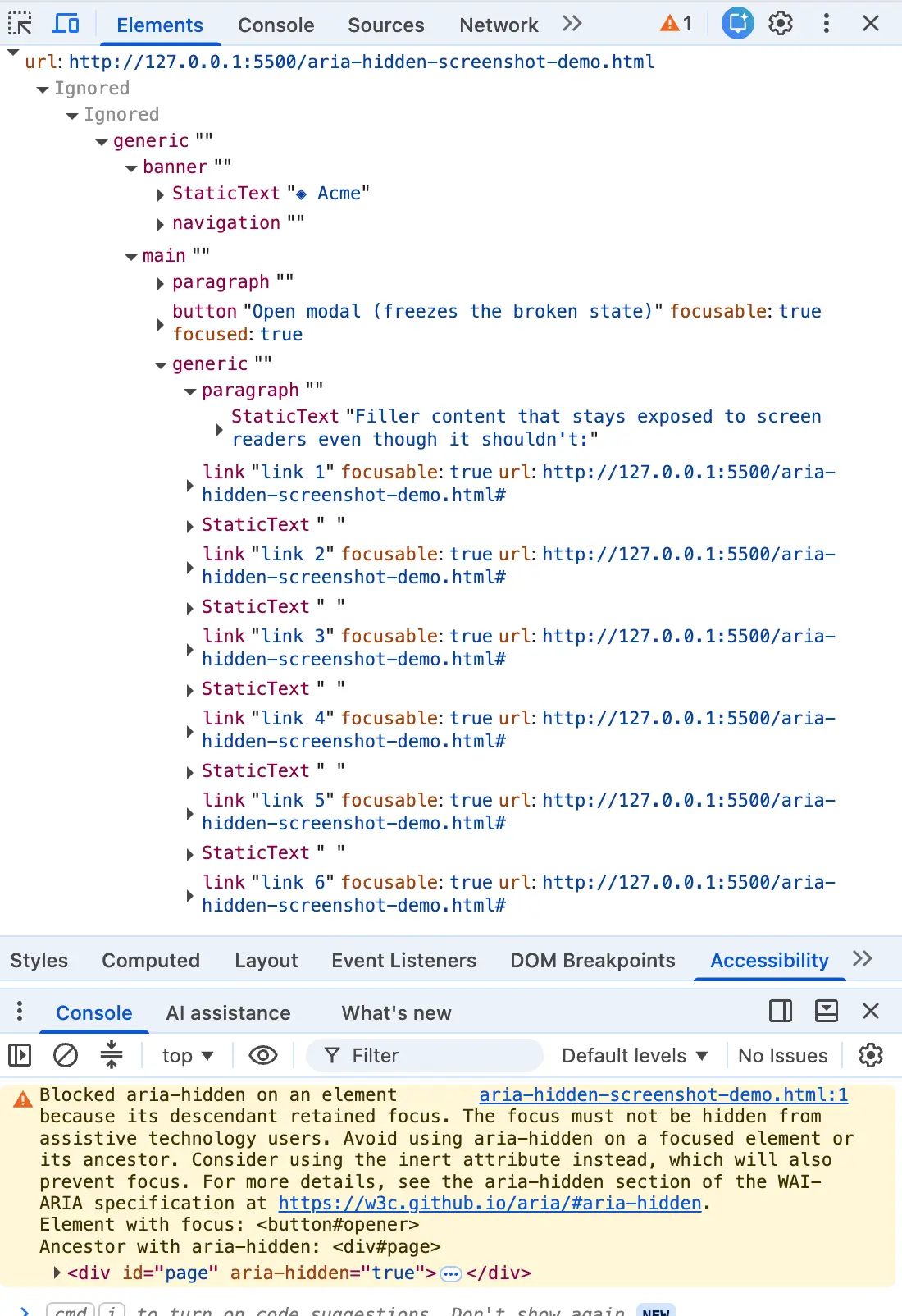
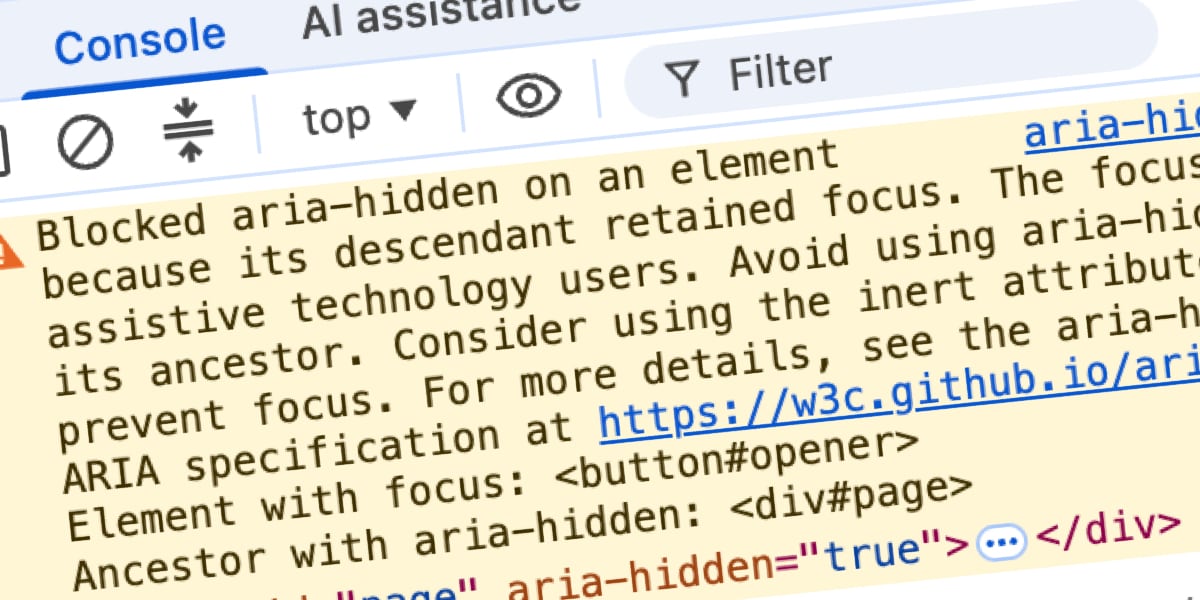
You close a dialog box in your web application, and the developer console suddenly erupts in a shade of angry mustard. Highlighting the error message, you drop it into a search engine, only to find yourself joined by half the front-end internet. Whether your stack is built on Angular, Bootstrap, Ionic, or managing data via phpMyAdmin, this exact string of text turns up identically.
Here is the crucial detail that top search results invariably bury: the browser’s warning is correct. There is a real person on the other side of that warning—someone navigating the web with a screen reader whose focus is about to plunge into a hole in your page.
The quick-fix solutions ranking at the top of Google all commit the same fundamental error under different names: the blur() one-liner, the setTimeout wrapper, or the trick where you yank the aria-hidden attribute off the markup. Each one quiets the console while quietly harming the user the browser was trying to protect. If you have already shipped one of these band-aids to production, you are in enormous company. You were failed by your search results, not by your own carelessness.
Detailed Chronology: How the "Ghost Focus" Crisis Evolved
To understand how the web development community arrived at this impasse, we have to look at the intersection of WAI-ARIA standards, browser engine updates, and modern component lifecycle management.
The Anatomy of the Warning
Chromium-based browsers have been quietly patching accessibility flaws for years, but the warnings reached a critical mass in two distinct waves throughout late 2024.
- The Open-Time Variant: Emerging around Chrome 127 in summer 2024, this warning scolds developers about an element that "just received focus" while trapped inside a freshly hidden or inert subtree. Bug reports clustered across major repositories like MUI (
#43106), Ant Design (#50170), and Flowbite (#943). - The Close-Time Variant: Arriving with Chrome 131 in late 2024, the "retained focus" warning caught developers mid-fade. Bootstrap issue
#41005and Angular issue#30187documented developers watching their Nightly and Beta builds flag code that had passed silently for years.
The Paradox of aria-hidden
The core of the defect stems from a structural paradox baked into aria-hidden. The attribute pulls content out of the accessibility tree, but it does not pull that content out of the keyboard focus order. Two different systems run parallel in the browser, with nothing keeping them synchronized.
Consequently, an element can be fully focusable and completely imperceptible to assistive technology at the same time. The instant the Tab key lands on it, you create what engineers now call ghost focus: the screen reader fires a focus event for a node it has been told doesn’t exist, looks it up, finds nothing it is allowed to describe, and stays entirely silent.
From the user’s perspective, they pressed a key, the machine acknowledged nothing, and they are left stranded in a room the digital map insists isn’t there. Chrome’s warning isn’t a style-guide nicety; it is the browser overruling your architecture because your markup violates basic accessibility invariants.
Supporting Context & Metrics: The False Comfort of Popular Fixes
When faced with a sudden flood of console warnings during a release crunch, developers routinely reach for fixes that silence the error while degrading user experience.
The blur() Trap
// The internet's favorite one-liner
element.addEventListener('hide.bs.modal', () =>
  // "Fixes" the warning
  document.activeElement.blur();
);
When you call blur() without specifying a new target, focus doesn’t go somewhere sensible—it goes to body. The warning clears because there is no longer a focused element inside your hidden subtree, but the keyboard user is dumped at the top of a long document, forced to tab all the way back to their previous position. This is a direct violation of WCAG 2.4.3 (Focus Order).
Timing Hacks and Attribute Stripping
- The
setTimeoutShim: Relying on render timers to defer focus restoration introduces race conditions. On a fast machine, it mostly works; under heavy CPU load or concurrent rendering, it fails intermittently, producing flaky bugs that are nearly impossible to reproduce locally. - Stripping
aria-hidden: Deleting the attribute entirely makes the warning go away because nothing is hidden. However, this allows users to tab out of an active modal and interact with background controls, breaking the core modal contract.
Official Statements and Architectural Standards
Addressing this challenge requires shifting our perspective from "how do I make the message go away?" to "at what exact instant does my code produce a focused node inside a hidden region?"
Industry standards groups have increasingly aligned around the use of the native inert attribute and HTML5 <dialog> elements rather than custom ARIA workarounds.
According to the HTML5 specification, the inert attribute removes elements from the accessibility tree, sequential focus navigation, and pointer events simultaneously. This makes it the ideal instrument for managing modals, whereas aria-hidden was always an incomplete substitute.
Furthermore, framework maintainers are adjusting their core primitives. For instance, Bootstrap 6 has transitioned toward native showModal(), placing dialogs in the browser’s top layer and rendering manual background management obsolete.
The Four-Step Teardown Contract
To resolve the issue permanently in custom design systems or component libraries that cannot be torn out this quarter, developers must enforce a strict order of operations on modal teardown:
- Un-inert the Background:
inertblocks focus. If your trigger button lives inside the background container, you must lift the background’sinertstate first. - Move Focus Synchronously: Return focus to the trigger element before any hide-states or CSS transition classes are applied.
- Inert the Closing Shell: Apply
inertto the dying modal shell rather than relying solely onaria-hidden. This ensures the fading element remains unreachable by keyboard navigation and invisible to screen readers during its exit animation. - Unmount After Transition: Safely remove the element from the DOM only after the CSS transition finishes, guarding against bubbled events and reduced-motion edge cases.
Future Outlook
The friction between browser engineering teams and application developers highlights a maturing web ecosystem. While the rollout of aggressive console warnings caught many teams off guard, it forced an industry-wide reckoning with invisible accessibility failures.
Standardization bodies continue to refine how browsers handle conflicting accessibility trees, and framework authors are hard at work baking correct focus management directly into primitive components.
The ultimate goal is clear: a clean developer console should never come at the cost of excluding users with disabilities. As native platform features like <dialog> and the inert attribute become ubiquitous, the complex dance of manual focus trapping will eventually fade into history—leaving us with a web that is both quieter in the console and genuinely accessible to everyone.