Executive Overview
For the past eighteen months, Silicon Valley and Wall Street have been inundated with sweeping, hyperbolic declarations that "SaaS is dead." While those soundbites made for engaging social media discourse, they fundamentally misunderstood the mechanics of enterprise software. Software is not dying; it is migrating.
A seismic collision within a single 24-hour window dramatically illustrated this profound shift. On Thursday, enterprise software giant ServiceNow suffered a catastrophic market sell-off, plunging nearly 27% in its worst single-day performance since its 2012 IPO, despite posting solid top-line growth. Just hours later, on Friday morning, AI-native pioneer Sierra—co-founded by Bret Taylor and Clay Bavor—revealed its third-quarter performance metrics: the young company added over $150 million in Annual Recurring Revenue (ARR) in a single quarter, blasting past $400 million in total ARR. Crucially, that single quarter brought in more new revenue than Sierra generated in the entirety of its preceding year.
To read these headlines as a simple binary—that AI agents have slain traditional software—is to miss the nuance of a much larger economic realignment. ServiceNow remains a formidable, highly profitable enterprise titan. However, the foundational architecture of Business-to-Business (B2B) software is undergoing a radical structural evolution. Enterprise IT budgets are not expanding infinitely; instead, capital is aggressively rotating away from legacy, seat-licensed productivity tools and flowing directly into outcome-driven agentic architectures.
SaaS is not dead. Rather, the era of SaaS as we knew it—built on human seat counts and passive workflow automation—has reached its evolutionary ceiling.
Detailed Chronology: A Tale of Two Dispatches
The events of late October 2026 will likely be studied by financial historians as the inflection point where agentic artificial intelligence officially displaced legacy software as the primary engine of enterprise value creation.
Thursday: ServiceNow’s Day of Reckoning
On Thursday, following the release of its Q3 financial report, ServiceNow shares nosedived 26.9%. While the broader S&P 500 slipped a modest 0.3%, the market reaction to ServiceNow was swift, merciless, and historic. The stock now trades more than 41% below its 52-week high, vaporizing billions in market capitalization in a single trading session.
At first glance, the underlying numbers did not justify the panic. ServiceNow reported a staggering $4.11 billion in revenue, narrowly beating analyst forecasts of $4.09 billion. Adjusted earnings per share (EPS) came in at $1.00, missing consensus estimates by a mere two cents. For any standard enterprise software firm, a minor two-cent EPS miss would be easily absorbed.
Instead, the market’s punitive reaction was catalyzed by forward-looking indicators: a compression in operating margins, a deceleration in remaining performance obligations (RPO), and mounting evidence that the infrastructure costs required to deliver cutting-edge AI features are eroding profitability faster than they are accelerating top-line expansion. The market delivered a definitive verdict: ServiceNow is locked into a predictable 20% growth trajectory, and the heavy capital expenditure of the AI transition is currently acting as a drag on shareholder value.
Friday: Sierra’s Warp-Speed Scale
Less than 24 hours after ServiceNow’s historic drawdown, Bret Taylor and Clay Bavor published Sierra’s Q3 performance figures, offering a stark contrast in enterprise velocity.
Just five months prior, Sierra crossed the $200 million ARR threshold. By the close of Q3, that figure had doubled to $400 million. To contextualize this growth, consider the velocity of compounding: while a mature incumbent growing at 20% year-over-year requires approximately 3.7 years to double its business, Sierra accomplished the feat in 150 days.
Furthermore, Sierra’s net new ARR generation demands attention. The company added $150 million in a single quarter—representing roughly 22% of ServiceNow’s total quarterly net new recurring revenue, despite Sierra being a mere 30 months old with zero enterprise customers at its inception. While ServiceNow targets $1.7 billion in total cumulative AI Annual Contract Value (ACV) across all of 2026 from an elite base of 680 enterprise clients spending over $5 million each, Sierra captured an astounding $150 million in new scale within a single three-month window.
Supporting Context & Metrics: Re-Splitting the Enterprise Pie
To understand why Wall Street punished ServiceNow while rewarding agentic pure-plays, one must analyze where enterprise dollars originate. Sierra is not being funded by newly minted, discretionary innovation budgets. It is drawing directly from the exact same pool of capital that enterprises allocate annually to customer experience (CX), IT service management, operational workflows, and back-office administration.
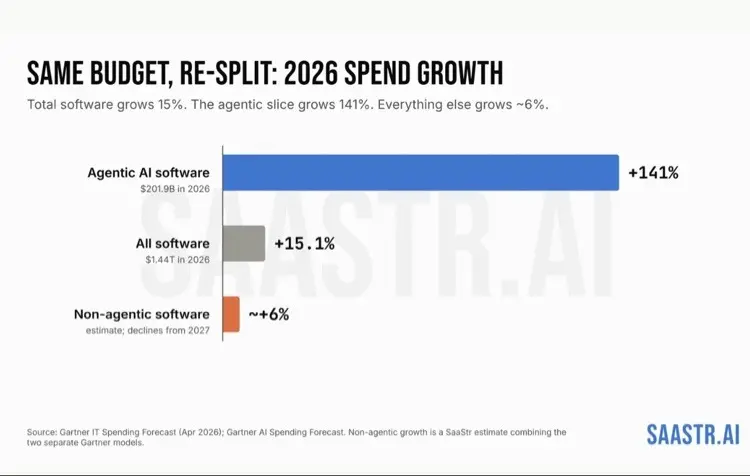
The chief information officers (CIOs) and customer experience leaders who sign enterprise checks are simply reallocating line items. According to macroeconomic and technology spending models from Gartner and IDC, enterprise software budgets are projected to grow by roughly 15% overall. However, dissecting that growth reveals a profound divergence: traditional software categories are beginning to plateau, while "agentic spend"—capital deployed toward autonomous AI agents that execute multi-step business processes—is projected to skyrocket by an astonishing 141% year-over-year.
+-------------------------------------------------------------------+
|               THE 2026 ENTERPRISE BUDGET RE-SPLIT                 |
+-------------------------------------------------------------------+
|                                                                   |
|   [ Traditional Software Spend ]  -->  Growing at ~6% (Plateauing)|
|                                                                   |
|   [ Agentic AI Spend (Sierra, etc.)] -> Growing at 141% (Surging)|
|                                                                   |
+-------------------------------------------------------------------+
As legacy software growth cools—with traditional categories expected to face outright contractions by 2027—the overall software pie is expanding only marginally. The game is no longer about market expansion; it is a zero-sum battle for budget reallocation. Incumbents like ServiceNow can capture portions of this agentic spend, but their success depends entirely on market share capture versus nimble, native challengers that do not have legacy business models to cannibalize.
Official Statements and Pricing Paradigms: Seats vs. Outcomes
The philosophical war between legacy SaaS and agentic AI ultimately boils down to a fundamental disagreement over pricing architecture. How software vendors monetize their value dictates how enterprise budgets migrate.
The Seat-Based Defense
During ServiceNow’s earnings call, CEO Bill McDermott defended the company’s traditional pricing philosophy, emphasizing that enterprise buyers deeply value the predictability of seat-based licensing, layered with consumption metrics for advanced features. Chief Financial Officer Gina Mastantuono reinforced this stance, asserting that clients are "very, very happy with the hybrid model" and are not actively demanding outcome-based pricing structures.
While ServiceNow has adapted—noting that roughly 50% of its net new business is now sourced from non-seat-based modalities such as tokens and workflow connectors—these mechanisms remain fundamentally tethered to legacy software metrics. They are, at their core, traditional software licenses with usage meters attached. ServiceNow charges organizations for the tools it provides to human workers.
The Outcome-Based Revolution
In stark contrast, Sierra has built its commercial foundation entirely around economic outcomes. In their Q3 public dispatch, the founders emphasized that enterprise clients do not pay for compute tokens or software seats; they pay for verified business results.
In Sierra’s ecosystem, an enterprise customer does not purchase software licenses for human customer service agents to use. Instead, they buy the successful completion of a business process: a home loan successfully refinanced, an insurance claim accurately adjudicated, a complex customer dispute resolved, or a high-value sale closed.
This creates a radically different value proposition for enterprise budget owners. If an AI agent successfully resolves 10,000 customer service inquiries without human intervention, the enterprise happily pays for those resolved outcomes because the cost per successful resolution is a fraction of human labor overhead. Conversely, seat-based software charges the enterprise regardless of whether the human employee is actively utilizing the tool or driving revenue.
+---------------------------+---------------------------------------+
| FEATURE                   | LEGACY SEAT-BASED SaaS                | OUTCOME-BASED AGENTIC AI              |
+---------------------------+---------------------------------------+---------------------------------------+
| Primary Metric            | Human User Count (Seats)              | Business Outcomes (Transactions/Wins) |
| Value Driver              | Assisting human productivity          | Executing end-to-end work autonomously|
| Budget Origin             | IT / Productivity Software Budgets    | Operational / Labor Cost Centers      |
| Incumbent Vulnerability   | High exposure to headcount reductions | Aligned directly with enterprise ROI  |
+---------------------------+---------------------------------------+---------------------------------------+
Future Outlook: Strategic Imperatives for the Next Era of B2B
The divergence between ServiceNow and Sierra offers vital lessons for founders, venture capitalists, and enterprise technology leaders navigating the latter half of the 2020s.
1. Deal Sizes Must Reflect Real Labor Replacement
For emerging B2B startups, building an agentic product that matches the pricing and deal size of legacy SaaS competitors is a strategic failure. If an AI agent replaces a complex operational workflow, its contract value must reflect the economic weight of the labor it displaces. Startups failing to command deal sizes at least double those of pre-AI competitors are merely splitting the legacy software budget rather than capturing core operational expenditure.
2. The Incumbent’s Dilemma
Platform giants like ServiceNow possess massive distribution, deep enterprise relationships, and formidable engineering budgets. McDermott accurately positions ServiceNow as an indispensable "execution layer" within the enterprise. However, incumbents face a structural innovator’s dilemma: they must vigorously protect a multi-billion-dollar, seat-based revenue baseline while simultaneously engineering the very products that render seat-based licensing obsolete. Pure-play agentic challengers operate without legacy baggage.
3. SaaS Architecture Survives; SaaS Business Models Do Not
It is vital to recognize that Sierra is, at its technical core, a SaaS company. It relies on multi-tenant architecture, recurring subscription economics, secure enterprise deployment models, and sophisticated application suites (spanning Agent Studio, analytics insights, and multi-channel orchestration). Furthermore, Sierra is actively building open ecosystem protocols—such as Poppy, designed in partnership with global giants like Meta, Shopify, Stripe, and Walmart. The delivery mechanism of software has not changed; the economic purpose of software has.
Conclusion
The market events of late October 2026 marked the definitive passing of an era. ServiceNow remains an elite, highly lucrative enterprise institution with nearly $30 billion in remaining performance obligations and exceptional cash flow margins. It will continue to compound value for its shareholders.
However, the capital that historically built and sustained legacy B2B software is undergoing an irreversible migration. Software that merely helps people do work, billed on a per-person basis, has hit a valuation ceiling dictated by modest, predictable growth. Meanwhile, autonomous agents that do the work directly, priced against verified economic outcomes, are scaling at speeds previously unseen in enterprise technology history.
SaaS is far from dead. But the era of passive, seat-licensed software before it is gone for good. The future belongs entirely to the execution layer.