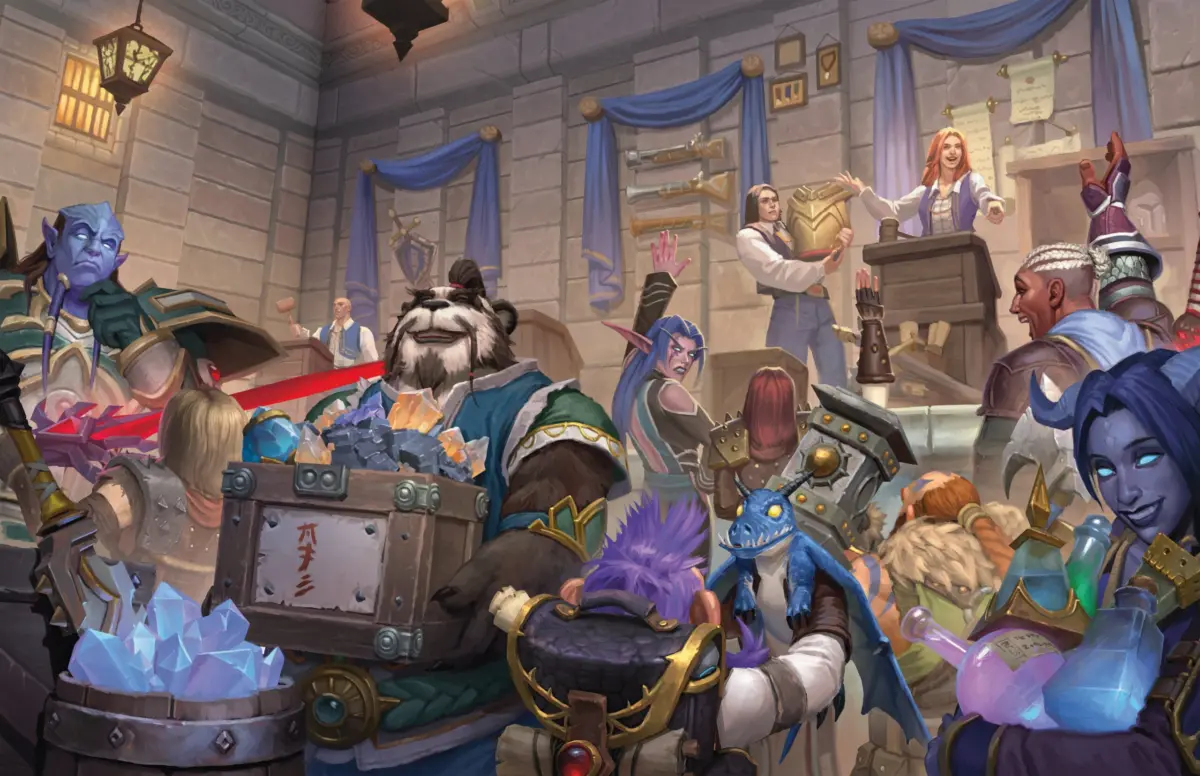
With the release of Dungeons & Dragons: World of Warcraft sitting less than a month away, the tabletop community stands on the precipice of one of the most significant crossover events in modern gaming history. Serving as D&D’s premier Universes Beyond expansion, the upcoming sourcebook bridges two titans of the fantasy genre: Wizards of the Coast’s ubiquitous tabletop roleplaying system and Blizzard Entertainment’s monumental massively multiplayer online roleplaying game (MMORPG).
For months, the tabletop community has buzzed with speculation regarding how Wizards of the Coast would handle this complex marriage of franchises. Would the expansion attempt to translate the hyper-mechanized, high-octane combat loops and rigid class roles of the MMO directly into a system defined by theater-of-the-mind improvisation? Or would it use Azeroth merely as a fresh coat of paint for traditional, narrative-driven Dungeons & Dragons?
To untangle these questions, Wizards of the Coast Principal Game Designer James Wyatt sat down for an exclusive interview during New York Comic Con. Wyatt offered deep insight into the design philosophy powering the expansion, highlighting a development cycle that favored "paraphrase" over direct translation. Rather than bogging down the nimble mechanics of fifth-edition D&D with the exhausting mathematical granularity of Azeroth’s talent trees, the design team focused on capturing the iconic flavor, thematic conflicts, and emotional resonance of the Warcraft universe.
Complete with a clever framing device courtesy of the bronze dragon Chromie—giving players explicit permission to bend or break rigid canon—the new sourcebook operates less like a restrictive rulebook and more like a sprawling toolkit. Whether players are charging headfirst into adapted classic dungeons, managing streamlined faction renown without the dreaded MMO grind, or inventing entirely new ways to hurl dismembered body parts at unsuspecting raid bosses, Dungeons & Dragons: World of Warcraft is poised to redefine how players experience Azeroth.
Detailed Chronology: From Concept to Tabletop
The genesis of Dungeons & Dragons: World of Warcraft began long before its upcoming public launch, rooted in early-stage playtests and rigorous behind-the-scenes cross-company collaboration.
The Blizzard Playtest Phase
In the fall preceding the book’s announcement, Wizards of the Coast took an early alpha build of the expansion straight to Blizzard Entertainment’s campus for a blind playtest. Blizzard employees—some seasoned veterans of tabletop roleplaying and others absolute novices who signed up with zero knowledge of what they were testing—gathered around the table to put the system through its paces.
According to Wyatt, watching greenhorn players experience D&D for the first time remains one of the highlights of the development process. Unburdened by preconceived notions of "how the game is supposed to be played," these novices leaned entirely into creative improvisation. In one standout anecdote, a Blizzard employee playing a Forsaken Warlock decided that because his character lacked a lower jaw, spellcasting was physically impossible. When his first spell inevitably backfired and sent him tumbling down a flight of stairs, the player bypassed traditional combat loops entirely: he tore off his own reanimated arm and hurled it directly at the approaching monster.
This moment encapsulated the core philosophy of the expansion. While World of Warcraft relies heavily on fixed button rotations, threat tables, and programmed encounters, the tabletop adaptation prioritizes player agency, spatial interaction, and unbounded imagination.
Structuring the Conflicts of Azeroth
When building out the framework of the sourcebook, Wyatt and his team faced a daunting structural challenge: how to distill decades of lore, expansions, and cosmic warfare into a digestible tabletop format.
The team began by establishing six foundational conflicts that have historically driven the narrative arcs of World of Warcraft. Every piece of content included in the book—from regional lore hooks to the curated selection of classic dungeons—was filtered through the lens of these overarching conflicts.
Dungeons were chosen based on a combination of community popularity rankings culled from community wikis, their resonance with the core thematic conflicts, and practical page-count constraints. While the core book features a balanced spread of dungeons tailored to various character level ranges, supplementary digital distributions were planned to handle massive set-pieces like Icecrown Citadel. Rather than leaving fans stranded without high-end raid content, Wizards of the Coast packaged Icecrown Citadel as a dedicated digital download adventure accompanied by a physical map pack featuring five double-sided poster maps of iconic boss arenas.
Supporting Context & Metrics: Translating Mechanics Without Breaking the Game
One of the most delicate challenges faced by the design team was adapting World of Warcraft’s distinct class mechanics, specializations, and progression loops into fifth-edition Dungeons & Dragons without breaking the balance of the tabletop system.
Paraphrase vs. Translation
In the interview, Wyatt emphasized that the development team deliberately avoided a one-to-one mathematical translation of WoW’s complex mechanics. World of Warcraft relies on granular talent trees, cooldown rotations, and strict role specialization (Tank, Healer, Damage Dealer). D&D, by contrast, operates on a much broader mechanical scale.
+-----------------------------------+-----------------------------------+
| World of Warcraft (MMO)           | D&D: World of Warcraft (Tabletop) |
+-----------------------------------+-----------------------------------+
| Granular, math-heavy talent trees | Thematic feats & battle maneuvers |
| Rigid roles (Pure Tanks/Healers)  | Flexible hybrid archetypes        |
| Millisecond-timed raid rotations  | Improvised 3-to-4 round combats   |
| Endless, compulsive reputation    | Streamlined Renown tracking       |
    grinds                              (maxed out by level 17)         |
+-----------------------------------+-----------------------------------+
Rather than engineering convoluted rules to force a Paladin into a pure healing pigeonhole, the design team utilized a philosophy of paraphrase. They analyzed iconic class fantasies—such as the Devourer Demon Hunter specialization introduced via the Midnight beta—and crafted custom spells, feats, and battle master maneuvers that evoke the flavor of those abilities without bogging down the table with excessive math.

Even class armor restrictions received a thoughtful pass to reflect the realities of Warcraft lore. For instance, World of Warcraft Priests frequently blur the lines of traditional cloth wearers—a prime example being Anduin Wrynn, who famously strides into battle clad in plate armor brandishing a sword. To accommodate this, the tabletop sourcebook grants Priests a broader range of protective options, ensuring the gameplay reflects the narrative reality of Azeroth’s most prominent heroes.
Taming the Reputation Grind
For veteran MMO players, the word "reputation" invokes memories of grueling, multi-week grinds spent killing identical mobs for fractional faction gains. Wizards of the Coast recognized that this mechanic would cause immediate friction if imported directly into a tabletop setting.
To solve this, the sourcebook repurposes the optional Renown system from the Dungeon Master’s Guide, integrating it cleanly into the Alliance, the Horde, and localized factions.
- Pacing: Renown in the Warcraft expansion scales naturally with gameplay progression. In structured adventures like Icecrown Citadel, player renown increases by one or two points with nearly every encounter, ensuring characters reach maximum standing with factions like the Ashen Verdict right around the time they face the Lich King.
- Automation: For groups uninterested in tracking granular renown points, the sourcebook provides a direct conversion rule linking faction standing to character level—automatically designating a hero as "Exalted" with their home faction by the time they hit 17th level.
Official Statements & Design Insights
James Wyatt’s commentary during the New York Comic Con interview sheds light on the creative freedom afforded to Dungeon Masters running campaigns within this new setting.
When asked about player anxiety regarding prescriptive, combat-heavy dungeon design, Wyatt was quick to reassure the community:
"The beauty of D&D is that when you walk into Shadowfang Keep, you can talk to anybody you meet, you can interact with anything you see… The possibilities open up tremendously over what a developer can program into any game, because you have a DM at the table who can improvise."
Addressing how the expansion handles high-end bosses like the Lich King Arthas—whose video game encounter featured notoriously punishing mechanics like Defile—Wyatt noted that the tabletop adaptation scales threats safely while maintaining emotional weight:
"He’s challenge rating 25, where D&D characters go up to level 20… We’re trying to evoke the feeling of that fight without reproducing it exactly. But there’s a lot going on here that will feel very familiar."
Furthermore, the expansion introduces the bronze dragon Chromie not merely as a lore fixture, but as a narrative framing device. Chromie writes the book’s introductory notes, granting Dungeon Masters explicit permission to discard rigid canon, leap across timelines, and construct bespoke campaigns that blend classic lore eras with modern expansions.
Future Outlook & Supplemental Potential
As World of Warcraft continues to evolve with upcoming narrative milestones like The Last Titan, the natural question facing Wizards of the Coast is whether this sourcebook is a one-off experiment or the foundation of an ongoing publishing line.
Wyatt expressed profound enthusiasm for future contributions, noting half-jokingly that working on the project was so rewarding it made him reconsider his retirement timeline. While the current book focuses heavily on foundational conflicts and sweeps up to the dawn of the Midnight expansion, notable contemporary figures like the void entity Xal’atath narrowly missed receiving a full stat block due to spatial constraints.
Should the partnership between Wizards of the Coast and Blizzard Entertainment continue to bear fruit, the framework established in this sourcebook leaves ample room for future supplements, digital drops via D&D Beyond, and expanded rulesets covering emerging races, dynamic zones, and shifting cosmic pantheons.
For now, Dungeons & Dragons: World of Warcraft stands ready to open its doors. Whether drawing veteran MMO players into their first tabletop roleplaying experience or offering seasoned D&D groups a massive, lore-rich sandbox to tear apart with unbridled creativity, the expansion successfully translates the spirit of Azeroth into the ultimate game of imagination.