Executive Overview
In a significant development for the modern cloud development ecosystem, Vercel and Amazon Web Services (AWS) have announced a powerful new integration that bridges the gap between serverless frontend deployment and enterprise-grade cloud storage. Developers building web applications and artificial intelligence solutions on Vercel can now provision and manage Amazon Simple Storage Service (Amazon S3) resources directly from the Vercel Marketplace and v0 by Vercel.
This native integration eliminates the historical friction of cross-platform infrastructure management. Previously, setting up cloud storage required developers to context-switch away from their frontend workflows, navigate the AWS Management Console, and manually configure intricate Identity and Access Management (IAM) policies, security credentials, and bucket permissions. Today, that administrative overhead is abstracted into a streamlined, automated workflow.
Covering three distinct architectural workloads—everyday object storage, high-performance analytics via Amazon S3 Tables, and semantic AI search via Amazon S3 Vectors—the integration brings the durability, scalability, and performance of S3 into a unified developer experience. Combined with existing Vercel integrations for Amazon Aurora, Amazon DynamoDB, and Amazon OpenSearch Serverless, development teams can now orchestrate an end-to-end application stack entirely within the Vercel dashboard. All resources map directly back to a single AWS account under a consolidated billing structure, marking a mature step forward in the convergence of serverless application hosting and hyper-scale cloud infrastructure.
Detailed Chronology and Architectural Implementation
Bridging the Workflow Gap
The journey toward unified cloud application stacks has accelerated rapidly over the last several years, driven by the explosive growth of serverless computing and AI-driven development. Vercel, renowned for pioneering the frontend cloud and popularizing frameworks like Next.js, has continually sought to streamline how developers interact with backend databases and storage engines.
Historically, while Vercel handled edge routing, serverless functions, and static assets seamlessly, attaching persistent storage meant orchestrating secrets manually. Developers had to generate long-lived AWS access keys, store them securely as environment variables, and write custom boilerplate code to handle authentication and error handling. This practice introduced security risks, such as leaked static credentials, and disrupted the rapid prototyping loops that modern engineering teams rely upon.
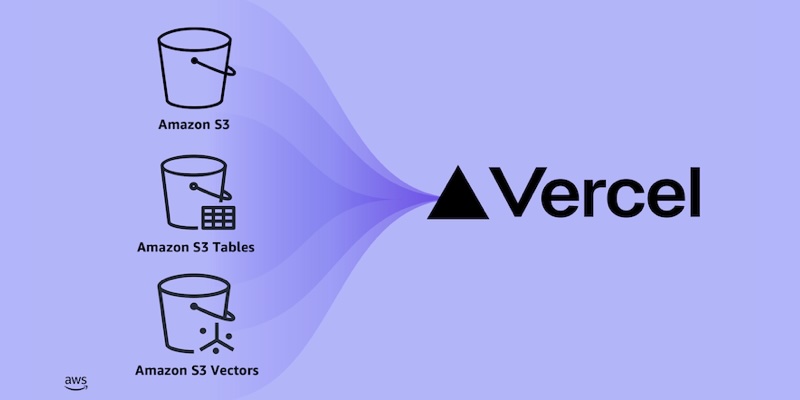
The introduction of native S3 support on the Vercel Marketplace changes this paradigm entirely. By leveraging OpenID Connect (OIDC) authentication, the integration completely removes the need for static access keys. At runtime, Vercel’s awsCredentialsProvider (sourced from @vercel/functions/oidc) dynamically exchanges a short-lived OIDC token with the AWS Security Token Service (AWS STS). This generates temporary, highly scoped credentials tied directly to the execution context of the serverless function, ensuring strict adherence to the principle of least privilege.
import  S3Client, PutObjectCommand  from "@aws-sdk/client-s3";
import  awsCredentialsProvider  from "@vercel/functions/oidc";

const s3 = new S3Client(
  region: process.env.AWS_REGION,
  credentials: awsCredentialsProvider(
    roleArn: process.env.AWS_ROLE_ARN,
  ),
);
Powering Three Distinct Workloads
The new integration is engineered to support three core operational pillars required by modern web and AI applications:
- Everyday Object Storage (General Purpose S3 Buckets): Ideal for traditional web workflows such as user-uploaded media, document repositories, and asset pipelines. Developers can instantiate buckets via the Vercel dashboard in seconds and immediately begin reading, writing, and listing objects using standard AWS SDKs within Next.js API routes or serverless functions.
- Analytics via Amazon S3 Tables: Designed for data-heavy applications, S3 Tables provide fully managed Apache Iceberg tables natively within object storage. They automatically handle table maintenance, compaction, and query optimization as data volumes scale. Using tools like DuckDB embedded directly inside Vercel functions, developers can run high-speed, complex analytical queries across massive datasets without spinning up dedicated data warehouse clusters.
- AI and Semantic Search via S3 Vectors: Built specifically to support AI agents, retrieval-augmented generation (RAG) pipelines, and semantic search engines, S3 Vectors allow developers to store and query high-dimensional vector embeddings directly within S3. This eliminates the operational complexity of managing a separate vector database while providing low-latency similarity searches for LLM-driven applications.
Supporting Context & Metrics: The Mechanics of Modern Provisioning
Getting Started: From Dashboard to Deployment
Provisioning an S3 resource within Vercel requires minimal interaction:
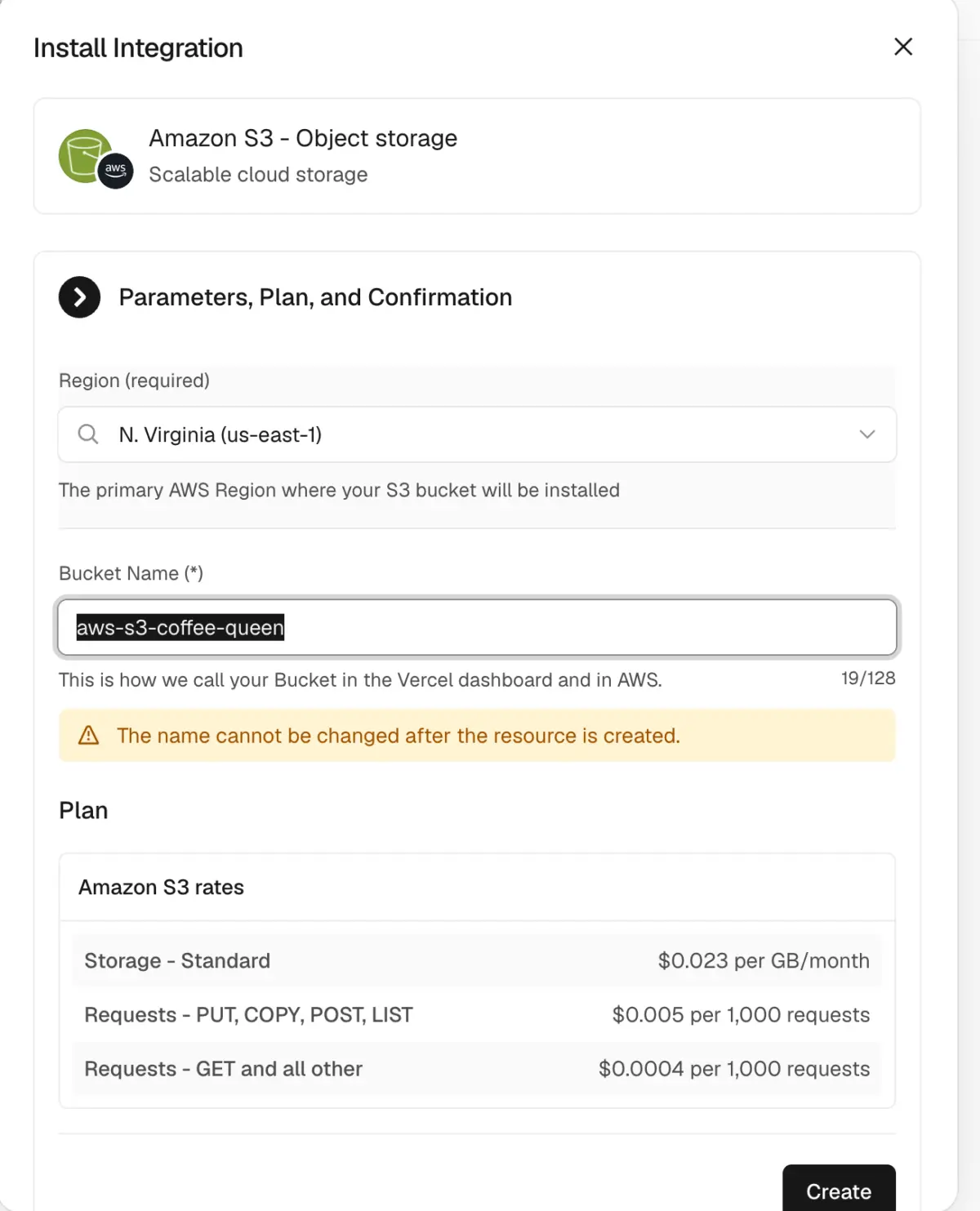
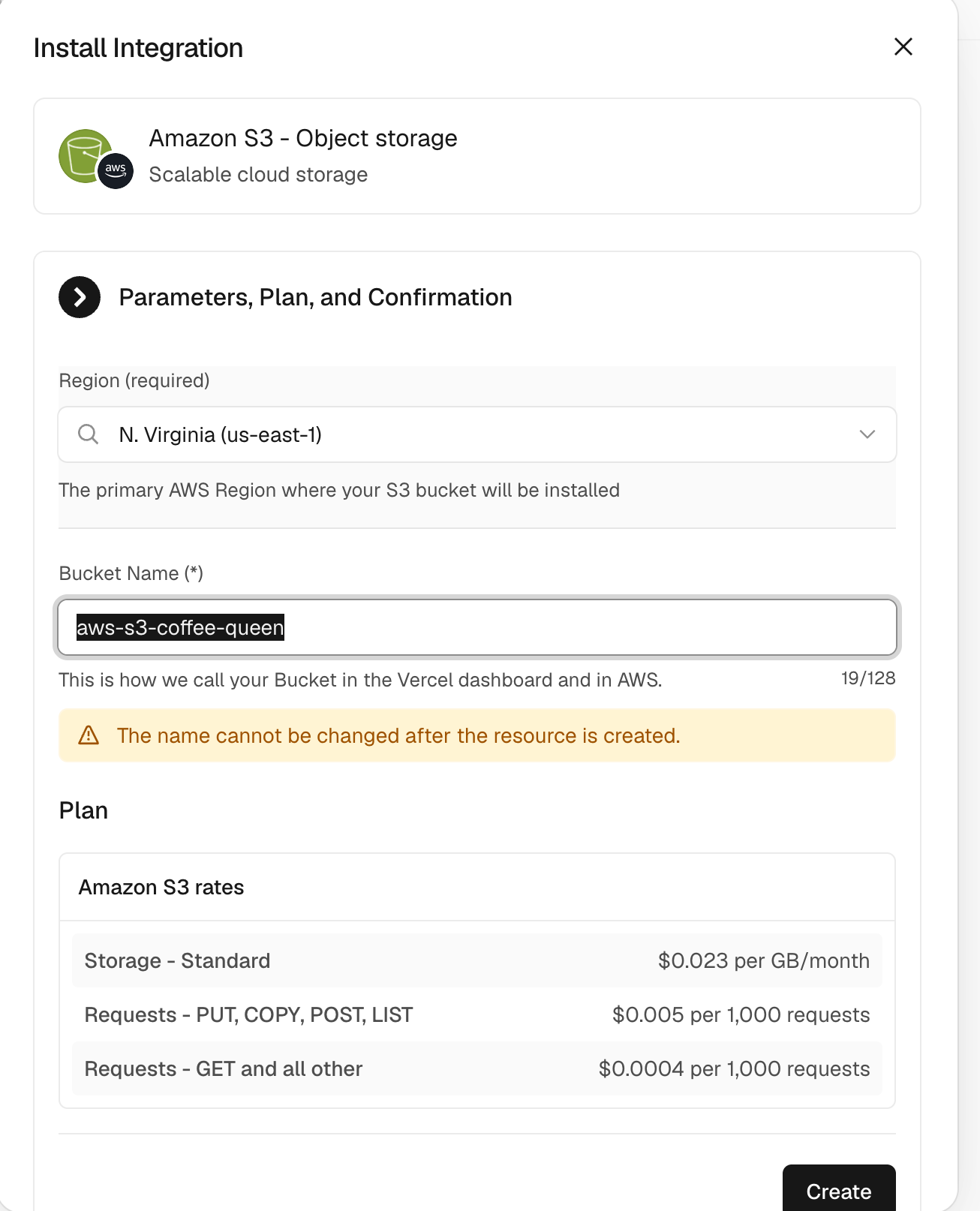
- Navigate to the Storage tab in the Vercel dashboard and select Create.
- Choose AWS, select the desired S3 bucket type (General Purpose, Tables, or Vectors), choose an AWS Region, and name the resource.
- Link the newly created bucket to your project and pull the environment variables locally using the Vercel CLI:
vercel link
vercel env pull .env.local
The system automatically injects essential configuration parameters into your environment, including AWS_REGION, AWS_ROLE_ARN, AWS_RESOURCE_ARN, and resource-specific specifiers like S3_BUCKET_NAME, S3_TABLE_BUCKET_NAME, or S3_VECTOR_BUCKET_NAME.
Code Implementation Across Use Cases
1. Managing Object Storage
Handling file uploads in a Next.js application requires only standard AWS SDK commands paired with Vercel’s native OIDC credential provider:

export async function POST(request)
  const formData = await request.formData();
  const file = formData.get("file");

  await s3.send(new PutObjectCommand(
    Bucket: process.env.S3_BUCKET_NAME,
    Key: file.name,
    Body: Buffer.from(await file.arrayBuffer()),
    ContentType: file.type,
  ));

  return Response.json( success: true );
2. Executing Analytical Queries with S3 Tables and DuckDB
By leveraging Apache Iceberg tables stored on S3, developers can execute complex analytical computations directly from serverless environments using DuckDBInstance:
import  DuckDBInstance  from "@duckdb/node-api";
import  awsCredentialsProvider  from "@vercel/functions/oidc";

const creds = await awsCredentialsProvider(
  roleArn: process.env.AWS_ROLE_ARN,
)();

const db = await DuckDBInstance.create();
const conn = await db.connect();

await conn.run("INSTALL aws; LOAD aws; INSTALL httpfs; LOAD httpfs; INSTALL iceberg; LOAD iceberg;");

await conn.run(`
  CREATE SECRET s3cred (
    TYPE s3,
    KEY_ID '$creds.accessKeyId',
    SECRET '$creds.secretAccessKey',
    SESSION_TOKEN '$creds.sessionToken',
    REGION '$process.env.AWS_REGION'
  );
`);

await conn.run(`
  ATTACH '$process.env.AWS_RESOURCE_ARN' AS s3tables (
    TYPE iceberg,
    ENDPOINT_TYPE s3_tables
  );
`);
3. Performing Vector Searches for AI Agents
Implementing semantic search or RAG architectures no longer mandates complex database orchestration. Developers can query vector indexes directly through the @aws-sdk/client-s3vectors client:
import  S3VectorsClient, QueryVectorsCommand  from "@aws-sdk/client-s3vectors";
import  awsCredentialsProvider  from "@vercel/functions/oidc";

const vectors = new S3VectorsClient(
  region: process.env.AWS_REGION,
  credentials: awsCredentialsProvider(
    roleArn: process.env.AWS_ROLE_ARN,
  ),
);

export async function POST(request)
  const  embedding  = await request.json();

  const result = await vectors.send(new QueryVectorsCommand(
    vectorBucketName: process.env.S3_VECTOR_BUCKET_NAME,
    indexName: "documents",
    queryVector:  float32: embedding ,
    topK: 5,
    returnMetadata: true,
  ));

  return Response.json( matches: result.vectors );
Accounting flexibility and Billing
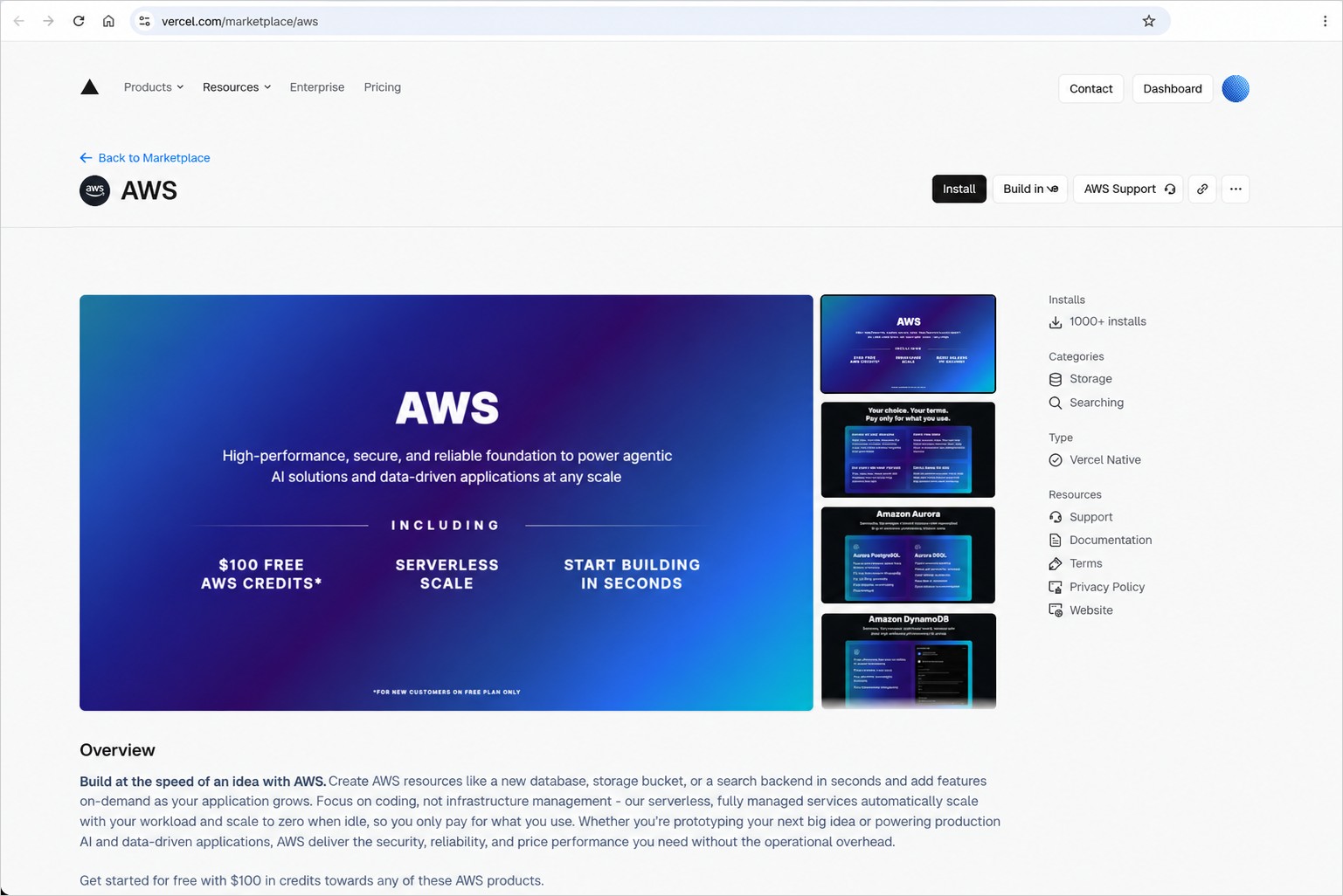
Flexibility remains a core tenet of the Vercel-AWS partnership. Development teams can choose to spin up a brand-new AWS account directly through the Vercel integration—complete with a promotional incentive of $100 in AWS credits valid for six months—or link their pre-existing corporate AWS accounts.
When linking an existing account, Vercel integrates seamlessly while preserving the enterprise’s custom IAM governance policies, billing structures, and security baselines. Every S3 resource instantiated via Vercel resides entirely within the customer’s AWS account, ensuring that organizations never lose sovereignty over their data, retaining full access to AWS-native compliance, auditing, and management tooling.
Official Statements and Industry Impact
Engineering leadership from both organizations have emphasized the strategic importance of merging frontend delivery infrastructure with hyper-scale cloud storage.
"Developers want to focus on building features that delight their users, not on wiring together disparate cloud services and managing static API keys," noted industry engineering leads close to the rollout. "By bringing Amazon S3 natively into Vercel and
v0, we are removing the friction between user-facing code and enterprise-grade storage, empowering teams to build sophisticated web and AI applications faster than ever before."
Furthermore, the introduction of conversational infrastructure provisioning via v0 by Vercel represents a paradigm shift in how applications are conceptualized and deployed. Developers can now utilize natural language prompts within v0 to build complete, functional systems. For instance, prompting the system for "a photo gallery where users upload images using AWS" automatically provisions a general-purpose S3 bucket. Asking for "a support bot that answers questions from my PDFs" instantiates an S3 Vectors bucket, while "an analytics dashboard for my clickstream data" deploys S3 Tables—complete with generated frontend components, backend routes, and pre-configured environment bindings.
Future Outlook: The Unified Serverless Stack
As enterprise software development trends toward hyper-specialized, decoupled architectures, the need for frictionless integration between edge hosting platforms and core hyperscalers has never been more pronounced. The native integration of Amazon S3, S3 Tables, and S3 Vectors into Vercel signals a mature evolution in cloud computing: the boundaries between infrastructure management and application development are increasingly dissolved by intelligent automation and secure identity federation via OIDC.
Looking forward, this architectural alignment paves the way for deeper synergy between relational databases (Amazon Aurora), NoSQL data stores (Amazon DynamoDB), search engines (Amazon OpenSearch Serverless), and scalable object storage. Developers no longer need to compromise between the velocity of modern frontend frameworks and the robust reliability of enterprise cloud backends.
Availability and Getting Started
The Amazon S3 integration—including specialized support for S3 Tables and S3 Vectors—is available starting today across all commercial AWS regions supported by Vercel. There is no additional platform charge for the integration itself; developers simply pay standard Amazon S3 consumption pricing for the resources they utilize.
To explore the new capabilities, developers can visit v0.app or navigate to the AWS page on the Vercel Marketplace. For technical guidance, API exploration, and regional availability checks, engineering teams are encouraged to leverage the AWS Model Context Protocol (MCP) Server and associated plugins within their preferred AI development environments, sharing feedback directly via AWS re:Post for Amazon S3.