Executive Overview
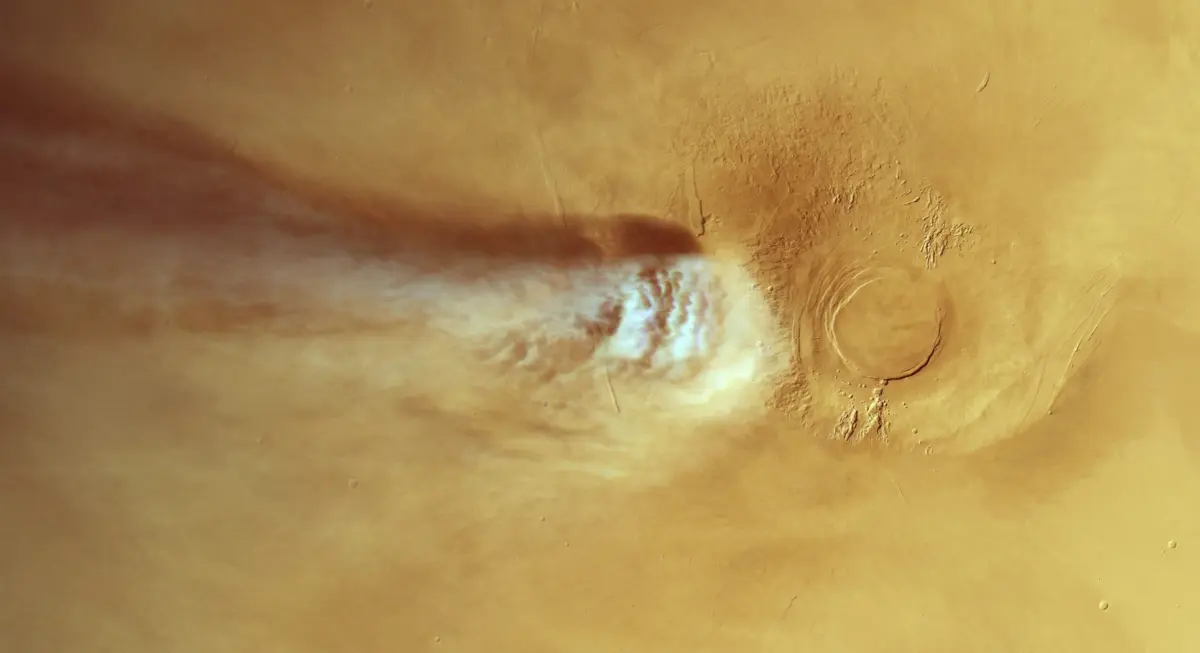
Every Martian spring and summer, a ghostly, elongated cloud materializes in the thin Martian atmosphere, stretches across an astonishing 1,000 miles—roughly the distance from New York City to Kansas City—and then abruptly evaporates into the thin air. For years, this ephemeral atmospheric spectacle, known officially as the Arsia Mons Elongated Cloud (AMEC), has baffled planetary scientists since its formal documentation by space probes in 2018. Repeating its daily cycle for months on end, the AMEC defied standard meteorological models, leaving researchers searching for a plausible physical driver.
Now, an international team of researchers has cracked the case, successfully modeling the formation of the AMEC for the first time. The breakthrough, recently published in the journal Nature Geoscience, reveals a startling truth: the cloud’s genesis is driven by an exotic, textbook-only physical process that has never been directly observed in the atmosphere of any planet in our solar system.
According to lead author Jorge Hernández-Bernal, a planetary scientist at Paris’ Sorbonne Université, solving the mystery required the integration of theoretical physics long thought too extreme to manifest in nature. By factoring these rare dynamics into advanced atmospheric simulations, the research team finally watched the AMEC emerge on their screens just as it does in the Martian skies. This revelation not only demystifies one of the Red Planet’s most striking visual anomalies but also opens an entirely new chapter in comparative planetology, forcing scientists to rethink the thermodynamic limits of planetary atmospheres across the cosmos.
Detailed Chronology: From Discovery to Breakthrough
The 2018 Discovery and Early Confusion
The story of the Arsia Mons Elongated Cloud began capturing the global scientific imagination in 2018, though amateur and professional astronomers had caught glimpses of recurring hazes near Mars’ colossal volcanoes for years. When modern orbiters, such as the European Space Agency’s (ESA) Mars Express, began capturing systematic, high-resolution imagery of the phenomenon, the sheer scale of the AMEC became undeniable.
Forming rapidly every morning on the leeward side of Arsia Mons—a massive shield volcano standing roughly 65,000 feet tall—the cloud stretches westward at astonishing speeds. By mid-morning, it reaches its full, staggering length of over 1,000 miles before solar heating causes it to sublimate and completely vanish by midday.
Initially, planetary scientists hypothesized that the cloud was simply a standard topographic wave cloud, similar to the lenticular clouds that form downwind of mountain peaks on Earth. However, standard meteorological equations failed to account for the AMEC’s rapid elongation, extraordinary length, and strict seasonal timing. The cloud stubbornly refused to fit into existing atmospheric paradigms, leaving researchers with a frustrating interplanetary puzzle.
The Modeling Breakthrough
The turning point came when Hernández-Bernal and his colleagues decided to push their atmospheric models past conventional boundaries. Recognizing that standard cloud formation theories fell short, the team began incorporating complex, theoretical equations that are traditionally relegated to the theoretical margins of physics textbooks.
By integrating these "exotic" parameters into their simulations, the researchers achieved what had eluded the scientific community for half a decade. The digital model successfully generated an elongated cloud that mirrored the exact timing, scale, and lifecycle of the AMEC.
The secret lay in a rare thermodynamic mechanism known as homogeneous nucleation. On Earth, cloud formation is a collaborative process: water vapor requires microscopic impurities—such as dust, pollen, or sea salt particles—to act as "cloud condensation nuclei" upon which vapor can condense into liquid droplets or freeze into ice crystals.
The Martian model, however, demonstrated that the AMEC forms entirely without the aid of atmospheric debris. Instead, water vapor undergoes homogeneous nucleation, transforming directly and spontaneously into ice crystals on its own.
“It’s akin to droplets of condensation appearing in the middle of a room, rather than on a window,” Hernández-Bernal explained. “It’s wholly unexpected.”
Supporting Context & Metrics: The Anatomy of an Extreme Phenomenon
To understand why the AMEC’s formation mechanism is considered groundbreaking, one must examine the extreme meteorological conditions required to spark homogeneous nucleation on such a massive scale.
Extreme Thermodynamic Triggers
For spontaneous ice nucleation to occur in the Martian atmosphere, nature must orchestrate a violent meteorological shift within minutes. The computer models revealed that the AMEC requires:
- A Thermal Plunge: A drastic temperature drop of 30 degrees Celsius (86 degrees Fahrenheit) within a mere 10-minute window.
- Hyper-Saturation: Relative humidity levels more than 100,000 times greater than any atmospheric moisture values ever reliably recorded in Earth’s skies.
The Role of Arsia Mons
None of this would be possible without the unique topography of the Red Planet. Arsia Mons is a colossal geological titan, rising approximately 12.4 miles (20 kilometers) above the surrounding Martian plains. When prevailing regional wind currents slam into the towering flanks of the 65,000-foot volcano, they are forced violently upward.
This mechanical lifting generates a powerful atmospheric wave that lofts moist air high into the frigid upper reaches of the Martian atmosphere in a matter of minutes. As the air ascends, it undergoes adiabatic cooling, plunging in temperature and crossing the precise thermodynamic threshold required to trigger massive, spontaneous homogeneous nucleation. The result is the rapid condensation of billions of ice crystals, stretching across the horizon in a linear formation that defies terrestrial intuition.
Planetary Implications
The confirmation of these extreme humidity levels and physical processes on Mars has sent ripples through the planetary science community. Previously, scientists speculated that homogeneous nucleation on this scale might theoretically occur in the upper atmospheres of gas giants or sister rocky worlds like Venus, but empirical proof remained entirely elusive.
Because Earth’s atmosphere is comparatively warm, densely populated with airborne particulates, and rarely reaches such astronomical supersaturation levels, humans have never witnessed this phenomenon in our home world’s skies. The AMEC thus serves as a unique natural laboratory, offering the first empirical window into a universal physical process operating under conditions impossible to replicate in terrestrial laboratories.
Official Statements and Expert Analysis
The publication of the study in Nature Geoscience has drawn widespread acclaim from the international space research community, cementing the discovery as a milestone in our understanding of planetary climates.
"We found that we needed to include some exotic physics—physics that, while included in textbooks, is treated as theoretical and usually thought not to happen in nature," lead author Jorge Hernández-Bernal emphasized in an ESA press release. "It certainly hasn’t been seen in action before. Once we included this physics in our simulations, the AMEC emerged just as we hoped."
The success of the modeling effort is particularly poignant given the historical paucity of detailed meteorological data from Mars compared to Earth. While terrestrial meteorologists benefit from dense networks of weather stations, constant satellite monitoring, and radiosonde weather balloons, Martian meteorologists must piece together planetary weather patterns using a sparse array of orbiters and surface rovers.
"We don’t have nearly as much information about Mars’ atmosphere as we do about Earth’s, so reproducing the AMEC to this degree is a big success," Hernández-Bernal noted, characterizing the final simulation results as "remarkable."
Independent atmospheric physicists have similarly praised the study for bridging the gap between theoretical thermodynamics and observational planetary science. By demonstrating that textbooks models of homogeneous nucleation can actually manifest in a natural planetary setting, the research provides a robust framework for decoding complex weather systems on alien worlds.
Future Outlook: The Next Wave of Martian Exploration
As planetary scientists celebrate this modeling triumph, the discovery immediately opens up new avenues for ongoing and future Martian exploration missions.
Re-evaluating Planetary Weather Archives
With the AMEC mystery largely resolved through the lens of homogeneous nucleation, researchers are now reviewing archival data from other spacecraft—including NASA’s Mars Reconnaissance Orbiter and various surface missions—to search for similar, previously misunderstood cloud formations. It is entirely possible that smaller or less persistent versions of this phenomenon occur near other massive Martian volcanoes, such as Olympus Mons or Ascraeus Mons, during specific seasonal windows.
Informing Future Human and Robotic Missions
Understanding the extreme moisture dynamics and wind patterns surrounding Arsia Mons is not merely an academic exercise. As space agencies and private aerospace ventures look toward eventual human exploration of Mars, comprehensive atmospheric modeling is critical for mission safety. High-altitude wind shears, rapid temperature fluctuations, and localized cloud dynamics can impact everything from orbital insertion trajectories to entry, descent, and landing (EDL) sequences for future robotic and crewed spacecraft.
Broadening Comparative Planetology
Beyond Mars, the confirmation that textbook-level "exotic physics" actively shapes planetary weather provides a powerful predictive tool for studying exoplanets. As James Webb Space Telescope (JWST) observations yield increasingly detailed data on the atmospheres of distant exoplanets, astrophysicists will need versatile, robust models capable of simulating extreme thermodynamic states far beyond Earth’s comfortable parameters.
Ultimately, the ghostly morning cloud of Arsia Mons has transformed from an baffling meteorological anomaly into a cornerstone of modern planetary physics. By looking to the skies above a dead Martian volcano, humanity has caught its first glimpse of an invisible, fundamental physical law at play—proving that even after decades of exploration, our solar system still holds the power to surprise us.