Executive Overview
Meta’s ongoing experiments with monetizing basic platform features have once again placed the tech giant at the center of a public relations and operational firestorm. For nearly a year, the company has quietly tested restricting organic link-sharing on Facebook pages, tying the fundamental capability to its new AI-centric subscription tiers, known as Meta One.
While Meta has explicitly maintained that its controversial link restrictions are designed exclusively for commercial creators and businesses—and are explicitly structured not to impact government entities or registered nonprofits—evidence from the field reveals a starkly different reality. Across the United States, municipal departments, public libraries, and charitable organizations have found themselves suddenly restricted to a paltry two free links per month. To bypass this barrier, these cash-strapped entities are being prodded to subscribe to monthly plans ranging from $50 to upwards of $500.
This investigative report examines the fallout of Meta’s testing phase, detailing how civic infrastructure and charitable organizations are grappling with paywalled communication channels. Through firsthand accounts from municipal communication managers, nonprofit co-founders, and marketing professionals, we explore the immense friction these sudden rollouts cause, the operational pivots organizations are scrambling to adopt, and the glaring disconnect between Meta’s stated policies and its automated enforcement systems.
Detailed Chronology: How the Rollout Stifled Public Services
The friction began unfolding quietly as Meta integrated link-sharing caps into its broader push for recurring revenue streams. Originally tethered to Meta Verified subscriptions, the capability has more recently been repurposed as a centerpiece of the company’s new AI-driven Meta One plans. While the overarching policy aims to extract revenue from commercial enterprises, the automated rollout has failed to respect the boundaries Meta itself established.
The Municipal Impact: Greenville, Texas
Daniel Starks serves as the communications manager for Greenville, Texas, overseeing a vital digital ecosystem of nearly a dozen Facebook pages for the municipality of 35,000 residents. Recently, the digital doors slammed shut on the public library’s Facebook page when Starks attempted to share routine community updates.
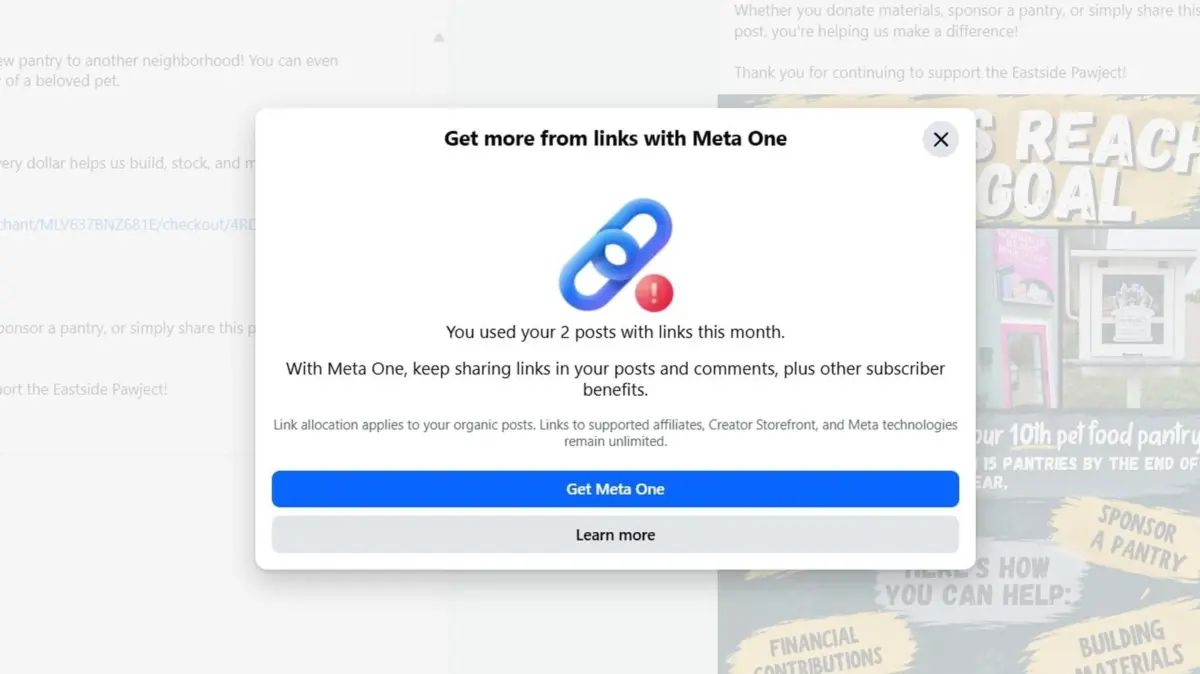
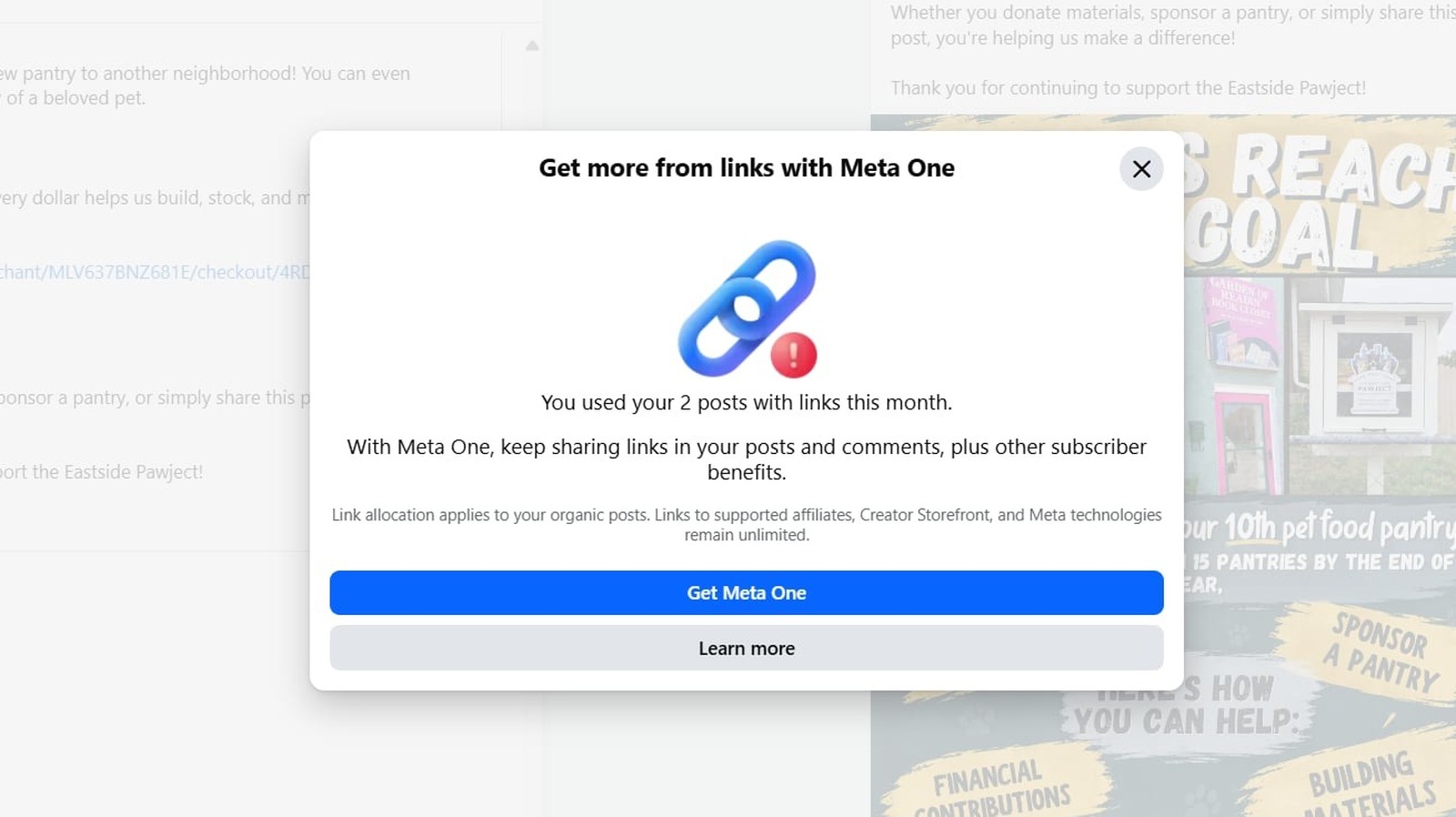
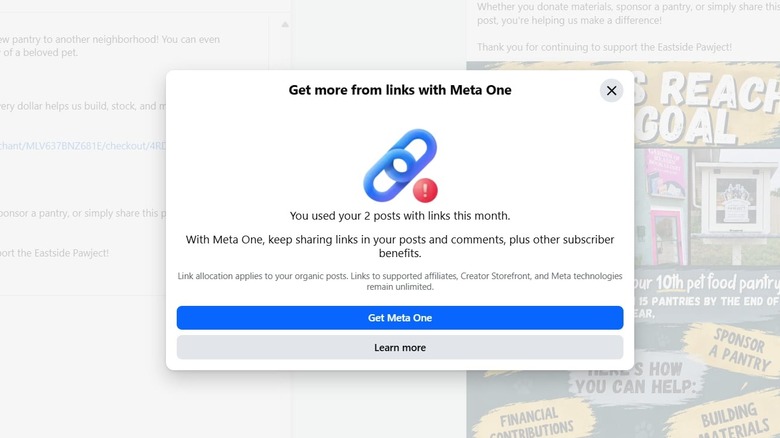
A notification abruptly halted the process: "You can add links to 2 posts per month, and you’ve used them all."
To share any additional URLs pointing residents to critical local resources, municipal weather updates, or city council agendas, Starks was instructed to subscribe to a Meta One tier starting at $50 per month.
For Greenville, the restriction threatens the core of its digital public outreach. "More than half of what we do as a city is linking back to information on our website," Starks explained. Fearing that the city’s other vital pages—including emergency services and municipal announcements—would soon be hit with similar blocks, Starks took preemptive action. He ordered his staff to cease posting direct links in Facebook posts entirely. Instead, they have had to resort to workaround strategies, such as hiding URLs within the comments section and publishing graphics to inform followers of the workaround.
The absurdity of paywalling a governmental body that was not only officially identified as such, but had also been previously verified by Meta, is not lost on local leadership. "When you have an official governmental entity that is trying to get out, in some instances, very, very important information, and we’re being paywalled by Facebook all because we’re trying to post a link, that’s a problem," Starks asserted.
The Nonprofit Struggle: Indianapolis and Beyond
The municipal crisis is mirrored in the nonprofit sector, where organizations operate on razor-thin margins. Bethany English, co-president of East Side Pawject—a small Indianapolis-based nonprofit that organizes pet food pantries—encountered the exact same algorithmic wall. While preparing a post to promote an upcoming community event, English was barred from linking her organization’s website because her meager two-link monthly quota had been exhausted.
To secure an "expert" level plan allowing up to 20 links monthly, English was quoted a price of $150 per month. For a grassroots initiative founded just last year with a follower count hovering under 1,000, absorbing a recurring $150 software expense for the simple privilege of sharing URLs is fiscally unviable.
"We’re a very small nonprofit, and we want to do big things, but that makes it very hard when something just like having social media is going to cost that much," English lamented.
Faced with a digital roadblock, English has had to brainstorm counter-intuitive workarounds, such as creating dedicated Facebook events for every announcement or asking board members to manually drop links from their personal profiles—which remain exempt from the current restrictions.
Similar frustrations echo in North Carolina. Jeff Bannister, marketing manager for SparkPoint—a small nonprofit dedicated to public health and social connection in Transylvania County—was hit with the exact same restriction. Confronted with pricing structures that demand $50 for a mere eight links, Bannister labeled the proposition absurd. "That’d be crazy for a corporation or a small business," he noted. "The ROI seems almost negative."
A Glimmer of Inconsistent Execution
The chaotic nature of the test is further highlighted by the experience of David Diskin, president of California Freethought Day, an organization hosting annual civic events in Sacramento. Diskin was hit with the link-sharing limitation just days ahead of a major annual event. He was quoted varying regional rates: $40 per month for eight links, $119 for 20, or nearly $400 for unlimited access.
Crucially, after weathering the critical lead-up to their annual fundraiser without the ability to distribute links properly, the restrictions on the California Freethought Day page were abruptly—and silently—reversed. Diskin regained full link-sharing privileges without explanation. While relieved, the timing of the fix rendered it largely useless for their most critical operational window of the year.
Supporting Context & Metrics: The Financials of Meta One
To understand why so many organizations are caught in the crosshairs, one must examine the architecture of Meta’s subscription models. Meta has increasingly pivoted toward recurring monthly revenue models under the banner of AI integration and specialized capabilities.
The tiered pricing structure for Meta One deployment maps out as follows:
- Entry-Level Plan ($14.99/month): Grants no additional link-sharing privileges on Facebook feeds, though subscribers are permitted to add a dedicated link page to their Instagram bio.
- Intermediate Plan ($49.99/month): Unlocks a modest allotment of eight links per month on Facebook. For small-scale entities, this amounts to roughly $6.25 per individual link.
- Advanced Plan ($149.99/month): Bumps the allowance to 20 Facebook links per month, bringing the marginal cost of a single outbound link to $7.50.
- Enterprise/Unlimited Plan ($499.99/month): The sole tier providing truly "unlimited" link-sharing capabilities on the platform.
+--------------------+---------------------+-----------------------------------+
| Subscription Tier  | Monthly Cost (USD)  | Facebook Link Allowance           |
+--------------------+---------------------+-----------------------------------+
| Entry              | $14.99              | 0 (Instagram bio link only)       |
| Intermediate       | $49.99              | 8 links/month                     |
| Advanced           | $149.99             | 20 links/month                    |
| Enterprise         | $499.99             | Unlimited links                   |
+--------------------+---------------------+-----------------------------------+
The Logic vs. The Reality
Critics and digital marketing professionals argue that tying outbound links—a foundational web feature dating back to the inception of the internet—to advanced artificial intelligence features is a thinly veiled cash grab. Links do not consume compute-heavy AI tokens or require specialized machine-learning infrastructure. Consequently, charging for them under the guise of an AI upgrade has alienated organizations that rely on organic reach to fulfill public safety mandates or charitable missions.
Furthermore, the implementation relies heavily on automated detection systems that appear incapable of accurately filtering out exempt entities. Even organizations that have completed Meta’s rigorous verification processes for fundraising tools find their automated categorization failing at the point of publishing.
Official Statements and Meta’s Evolving Defense
When pressed for comment on why verified nonprofits and government agencies were falling victim to a test explicitly designed to exclude them, Meta’s corporate communications offered brief, generalized explanations.
A Meta spokesperson stated: "We’ve been testing whether sharing links on Facebook should be part of the Meta One subscription. We will continue to evolve the experience based on the feedback we receive and what we learn."
The statement notably sidestepped the core grievance: why non-commercial entities performing civic duties were being hit by automated paywalls in direct contradiction to company policy.
Following initial public reporting, Meta issued a subsequent clarification on October 23, noting that pages must explicitly list "Nonprofit" within the specific category section of their Facebook page settings for Meta’s automated systems to recognize their exemption status. However, this clarification failed to address a glaring engineering oversight: why Meta’s systems cannot automatically cross-reference organizational status using existing verification markers, such as approved access to Meta’s own internal fundraising and donation tools.
Future Outlook: Navigating a Post-Organic Landscape
As Meta continues to iterate on its subscription models, the long-term implications for civic engagement and grassroots organizing on social media are profound. Platforms that once served as open, democratized public squares are increasingly transforming into gated communities where basic informational reach requires a corporate-level advertising budget.
Strategic Pivots for Impacted Entities
- Decentralized Audience Migration: Organizations like SparkPoint and Greenville are examining ways to diversify their communication portfolios, investing more heavily in direct-to-consumer channels such as SMS text alerts, proprietary email newsletters, and independent web portals.
- Community-Powered Distribution: Nonprofits are increasingly relying on decentralized sharing networks, leveraging personal profiles of staff, volunteers, and board members to bypass institutional publishing restrictions.
- Algorithmic Adaptation: Content strategies are shifting away from direct link posts toward native media—such as infographics, text-heavy graphics, and video content—with URLs relegated to the comments section or profile bios.
The Broader Regulatory and Industry Horizon
The friction experienced by municipal libraries and pet food pantries highlights a growing vulnerability in modern digital infrastructure: public utilities and social services are entirely dependent on private commercial platforms over which they hold no regulatory sway. As social media enterprises aggressively monetize every touchpoint to appease shareholders, the collateral damage inflicted on public service communications may ultimately invite renewed antitrust scrutiny, legislative pushback, and a permanent flight of users toward alternative platforms.
For now, organizations caught in the test are left walking a digital tightrope—balancing the vital necessity of reaching local audiences on Facebook against the untenable prospect of financial extortion for simply sharing a link.