Executive Overview
The technology sector has officially crossed a psychological and economic Rubicon. For the past two years, the prevailing wisdom among legacy software executives, incumbent tech giants, and traditional venture capitalists was a comforting refrain: Artificial intelligence is merely another feature to add to the roadmap.
That argument has quietly, definitively stopped working.
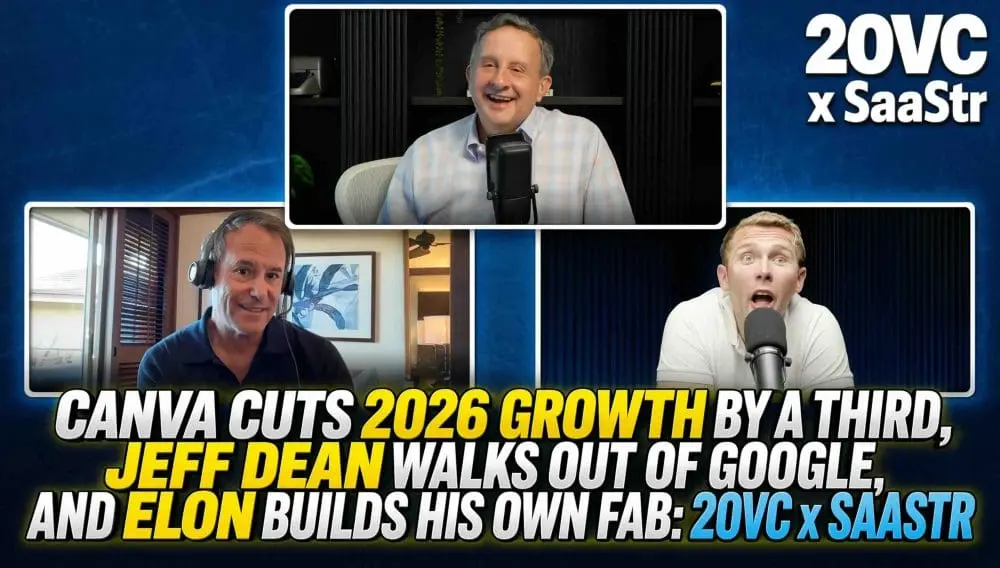
In a landmark episode of the 20VC x SaaStr collaboration, host Harry Stebbings sat down with industry veterans Jason Lemkin and Rory O’Driscoll to dissect a series of tectonic shifts vibrating through the global tech ecosystem. The conversation bypassed the usual platitudes about OpenAI and Anthropic to focus on the tangible casualties of the agentic era. From Canva slashing its 2026 growth forecast by a staggering third due to soaring AI serving costs, to massive brain drains at Google, record-breaking executive compensation packages at Revolut, and the silent death of the traditional no-code category, the message is unmistakable.
The software market is splitting into two entirely different realities. On one side are infrastructure providers and agile, founder-led disruptors capturing unprecedented economic value. On the other are legacy applications, prosumer tools, and non-founder-led SaaS companies facing an existential crisis. As autonomous agents bypass traditional user interfaces entirely, software companies are discovering that being omitted from an AI agent’s consideration set is a fatal blow.
This deep-dive investigative report examines the structural market changes, financial realignments, and strategic pivots dominating the tech landscape as the industry hurtles toward 2027.
Detailed Chronology: The Anatomy of a Market Shift
The fractures appearing across the software and AI landscapes did not happen overnight; they are the cumulative result of hesitation, skyrocketing compute costs, and the sudden maturation of agentic workflows.
1. The Canva Growth Slump and the End of Prosumer Subsidies
Canva entered 2026 riding high on a 30% GAAP revenue growth rate, tracking comfortably off roughly $3 billion in revenue from the previous year. However, mid-year disclosures revealed a stark reality check: the company is on track to finish the year closer to 20% growth.
The root cause is not a simple gross margin compression—it is an existential question of unit economics. Canva’s aggressive rollout of generative AI features requires subsidizing frontier model calls across a massive prosumer base. When millions of users generate images, designs, and copy simultaneously, the inference costs scale linearly while monetization lags behind.
+--------------------------------------------------------------------------+
|                     CANVA GROWTH TRAJECTORY (2026)                       |
|                                                                          |
|   Original Projection:  [██████████████████████████████] 30%             |
|   Revised Reality:      [██████████████████                  ] 20%             |
|                                                                          |
|   * Driven by exploding inference and frontier model serving costs.      |
+--------------------------------------------------------------------------+
During the 20VC discussion, Rory O’Driscoll framed the core issue: the margin math is merely a second-order business model symptom. The real question is whether a drop from 30% to 20% growth is a transitional speed bump or a highway heading toward 10%. With public giants like Adobe trading at 3 to 4 times revenue while growing at 12%, and newer entrants like Figma growing at 40%, the entire creative software stack is being forced to justify its existence in an AI-native world.
2. The Rise of Agentic Workflows and UI Disintegration
Perhaps the most alarming development for legacy application builders is how autonomous agents interact with software. Jason Lemkin shared that when SaaStr built its internal ad server and creative generation network entirely on agents, it never once occurred to the agent to use Canva.
This introduces a terrifying paradigm for software executives. User churn—where a customer leaves your product for a competitor—is a fixable problem with product-market fit and better features. But when an autonomous agent makes the functional decision to omit your product from its consideration set entirely, the marketing funnel collapses at the root.
Harry Stebbings connected this phenomenon to warnings from the President of Uber, whose single biggest fear is the complete disaggregation of the user interface. When a consumer tells ChatGPT, "I want a car," and the AI seamlessly routes them to the cheapest or most efficient provider, brand loyalty built over decades evaporates in milliseconds. Canva, Notion, and a host of other productivity tools are discovering that agents do not care about sleek landing pages or brand affinity; they care about direct, programmatic utility.
3. The Quiet Demise of the No-Code Era
For over a decade, the "no-code" movement promised to democratize software creation, allowing non-engineers to build databases, design workflows, and launch websites without writing a single line of HTML. Airtable was a no-code database disguised as a spreadsheet; Notion was a no-code database disguised as a word processor; Canva was no-code design.
That entire category is now winding down. As Jason Lemkin noted, if a job can be accomplished natively inside ChatGPT, Claude, or a custom agentic wrapper—even accidentally as a byproduct of a broader workflow—the standalone prosumer tool faces terminal decline. The era of building a venture-backed business purely on the premise that humans need an intermediary tool to avoid writing code is drawing to a close.
Supporting Context & Metrics: Valuations, Compensation, and Infrastructure
As business models shift, the financial mechanics of Silicon Valley and global venture capital are undergoing a violent realignment. Private market marks, executive compensation bands, and capital allocation strategies are all reflecting this new reality.
The Myth of Legacy Private Valuations
For years, private companies hid behind inflated, outdated funding rounds, maintaining high valuations long after their fundamental growth rates had slowed. Airtable and Canva’s recent valuation adjustments signal the end of this defensive posture.
Jason Lemkin issued a stern warning to venture capitalists and Limited Partners (LPs): holding an asset at its peak 2021 or 2022 valuation simply because "that’s what we raised at" is no longer defensible. Based on public market comps and a decelerating 20% growth rate, Canva’s realistic valuation today lands closer to $12 billion—a stark reality check for investors holding paper marks.
The Three Compensation Tiers of the AI Era
The talent war has permanently restructured corporate compensation. When the AI boom began, tech companies generally split employees into two bands: normal operational employees and high-priced AI researchers.
Today, that model has fractured into three distinct tiers:
- Regular Employees: Standard market-rate compensation and equity.
- AI & Engineering Teams: Elevated salary and equity bands established over the last three years to secure machine learning talent.
- The "God-Tier" Superstars: A tiny, highly coveted cohort of 1 to 5 elite individuals who command multi-million-dollar cash packages and equity stakes up to 10 times traditional levels.
Companies scaling past $200 million in revenue find themselves forced to absorb these astronomical packages for exceptional talent, recognizing that pulling off a category-defining leap—like Palantir or Intercom—is impossible without top-tier visionaries.
Infrastructure and Energy: The Terrafab Bet and NIMBYism
While software applications grapple with agentic displacement, the hardware and infrastructure layers are locked in a historic arms race. Elon Musk’s monumental $16.8 billion first installment on Terrafab, backed by a consortium that includes a rare equity raise from Intel, represents the ultimate all-in bet on physical infrastructure.
+--------------------------------------------------------------------------+
|                       INFRASTRUCTURE VS. APPS                            |
|                                                                          |
|  [Infrastructure / Hardware]  --> Booming demand, physical supply chains,|
|                                    energy investments, and vertical      |
|                                    integration (e.g., Terrafab, Intel).   |
|                                                                          |
|  [Legacy Apps / No-Code]      --> Facing existential threats from AI     |
|                                    agents, margin compression, and       |
|                                    forced price hikes.                   |
+--------------------------------------------------------------------------+
However, this massive physical expansion faces fierce headwinds from local communities. Proposals like the data center bill of rights introduced by Rep. Ro Khanna highlight rising data center NIMBYism (Not In My Back Yard). As Rory O’Driscoll pointed out, local resistance is rarely born out of an ideological hatred of AI; rather, it stems from opacity and infrastructure strain. If a local community faces a 25% spike in residential electricity bills alongside a data center development, no amount of pitch decks will secure local approval. True social license requires tangible local benefits, such as zero impact on household power rates and direct economic distribution.
Official Statements & Industry Insights
The 20VC discussion produced some of the most quotable, uncompromising perspectives on the current tech landscape:
-
On the Death of Non-Founder Leadership:
"Any investment I’ve made that is not run by a founder is going to be a zero in this age. Whether they’re at $20 million or $200 million, they’re all going to be zeros. If the price of me not having a zero is getting Nik [Storonsky] to 40% [ownership at Revolut], I wish I was a shareholder. That’s the price I’m gonna pay in a heartbeat." — Jason Lemkin
-
On UI Disaggregation:
"What is the President of Uber’s single biggest fear? The disaggregation of UI, where you say ‘I want a car’ and ChatGPT routes you to Lyft or Uber based on price." — Harry Stebbings
-
On Trimming vs. Holding Winning Assets:
"Most of the time you won’t regret trimming. But on the few that you regret trimming, it turns out to be most of the value." — Rory O’Driscoll
-
On the Cost of Hesitancy:
"There’s going to be a lot of people paying the bill in ’26 and ’27 for a certain amount of hesitancy in ’23 and ’24." — Rory O’Driscoll
Future Outlook: Two Different Movies, One Market
As the technology sector looks past 2026 and toward the end of the decade, the market is playing out two entirely different movies simultaneously.
On one hand, infrastructure giants and companies deeply embedded in the hardware boom—such as Datadog, Cloudflare, and Palo Alto Networks—are reaping the rewards of an unprecedented demand cycle. They are selling picks and shovels to the largest infrastructure gold rush in human history.
On the other hand, application software companies face a stark ultimatum: adapt or obsolesce. Companies like Palantir, Intercom, and Replit survived and thrived because they aggressively restructured their operations, deployed outcome-based pricing models, and embraced the chaos of 2023 and 2024. Meanwhile, companies that rested on their laurels, relied on free-tier collaborative loops, or treated AI as a superficial feature addition are now facing an aggressive reckoning.
Growth remains the ultimate antidote to the existential narrative. As demonstrated by Atlassian’s recent quarterly beat—achieved in part by aggressively rationalizing free Loom seats and tightening pricing levers—solidifying business fundamentals is critical. Yet, for application startups and private giants like Canva, proving long-term relevance without a public safety net, while autonomous agents actively route around their products, will be the definitive defining challenge of the next five years.
The era of easy software growth is officially over. Welcome to the age of the agentic economy.