Executive Overview
In tattoo studios from Sheffield to Atlanta, a jarring new visual motif is taking root: firearms. But this is not the traditional, hyper-masculine Americana of eagles, flags, and patriotic revolvers. Instead, a plaid-patterned M4 carbine stretches across a client’s thigh; a delicate handgun is tucked enticingly into a lace garter; an AR-15 is framed by vibrant anime graphics and sparkling system messages.
These striking visuals are gaining significant traction across Instagram, Pinterest, and TikTok, marking a fascinating cultural shift. At a time when firearms remain one of the most volatile and heavily contested subjects in contemporary sociopolitical discourse, the emergence of gun tattoos is not a straightforward manifestation of right-wing gun advocacy. Rather, it is a nuanced symptom of a generation whose relationship with weaponry is profoundly complex, mediated by the digital landscape, video game graphics, and hyper-accelerated internet aesthetics.
To understand why young adults are permanently etching lethal weaponry onto their bodies, one must look beyond standard political binaries. This is a story about a generation raised on the bleeding edge of online gaming, where guns were first introduced not as instruments of real-world terror, but as customizable digital accessories splashed in neon camos and cartoonish prints. As these digital natives come of age, they are bleeding the aesthetics of online gaming, fashion, music, and counter-culture into the physical world.
In doing so, they are stripping firearms of their traditional geopolitical contexts—or subverting them entirely—transforming instruments of death into complex badges of irony, rebellion, fashion, and aesthetic self-expression.
Detailed Chronology: The Evolution of the Digital Weapon
To trace the trajectory of the modern gun tattoo, one must travel backward through the digital ecosystem that shaped today’s youth. The journey of the firearm from a practical tool of violence to an artistic, highly customizable lifestyle accessory follows a distinct evolutionary path mapped out over the last two decades.
Phase 1: The Virtual Armory (Late 2000s – Early 2010s)
For Millennials and older Gen Z individuals raised during the golden era of online multiplayer gaming, firearms were first encountered in pixelated virtual spaces. Titles like Call of Duty: Modern Warfare, Halo, and later, battle royale monoliths like Fortnite and Overwatch, fundamentally re-engineered how young people interact with weaponry. In these digital arenas, guns were not merely functional tools; they were blank canvases.
Gamers spent hours unlocking custom weapon skins, painting assault rifles in hot pink, gold plating, digital camouflage, and anime decals. This gamification taught a generation to view lethal weapons through the dual lens of utilitarian killing machines and deeply customizable fashion accessories. The weapon became an avatar of personal style within a virtual ecosystem.
Phase 2: The Convergence of Offline and Online Worlds (Mid-to-Late 2010s)
As the boundary between internet subcultures and physical reality dissolved, the aesthetic markers of gaming began spilling over into tangible creative industries. Music, underground streetwear, and digital art scenes adopted the hyper-saturated, ironic, and often nihilistic iconography of internet gaming culture. Concurrently, curation platforms like Pinterest and Instagram began democratizing tattoo flash, allowing niche micro-trends to spread globally at unprecedented speeds.
Phase 3: The Neo-Weaponry Tattoo Boom (2023 – Present)
In the post-pandemic tattoo landscape, traditional motifs like daggers, panthers, and tribal bands have been joined—and sometimes eclipsed—by an influx of hyper-stylized weaponry. Following a broader cultural embrace of neo-medievalism (which saw swords, maces, and gothic armor saturate alternative fashion), modern tattoo artists began experimenting with contemporary armaments. Today, platforms like Instagram are flooded with custom flash sheets featuring Uzis wrapped in barbed wire, revolvers intertwined with lace, and assault rifles framed by cyber-sigilism and anime graphics.
Supporting Context & Metrics: The Cultural and Political Paradox
The mainstreaming of gun imagery does not exist in a political vacuum. To evaluate the phenomenon objectively, one must examine the stark paradox of modern firearm perception, particularly in the United States, where gun violence remains a pervasive public health crisis.
The Problem of Historical Distance
In tattooing, weapons are hardly a novelty. Daggers, swords, and medieval blades have cycled through tattoo history for decades without causing widespread societal friction. Cultural analysts point out that this acceptance is largely due to "historical distance."
Centuries removed from the battlefield, a medieval broadsword or a Renaissance mace can be easily abstracted, stripped of its original bloodshed, and appreciated purely for its form, symmetry, and romanticized fantasy associations.
With firearms, however, that historical distance does not exist. The daily reality of mass shootings, active conflict zones broadcasting live to social media feeds, and ongoing legislative battles over the Second Amendment ensure that guns remain hyper-charged, bleeding-edge symbols of contemporary trauma. Consequently, public reception of gun tattoos is deeply polarized. Industry insiders report that reactions typically fall into one of two extremes: peers who view the designs as "sick" (in the positive, aesthetic sense) and critics who express profound confusion and dismay as to why anyone would voluntarily tattoo an instrument of mass murder onto their skin.
Political Fragmentation: MAGA vs. The Leftist Resistance
While traditional gun culture in the US has long been dominated by conservative, Republican-leaning demographics aligned with the MAGA movement and absolute interpretations of gun rights, the political landscape surrounding firearms is fracturing.
In recent years, an unexpected counter-trend has emerged: engagement with firearm culture among left-wing, anti-fascist, and marginalized communities. Faced with rising civil unrest, institutional violence, and a perceived resurgence of far-right extremism, groups like the Arm the Dolls movement and various progressive shooting clubs have reframed gun ownership through the lenses of community self-defense, mutual aid, and armed resistance.
At the same time, decades of aggressive foreign policy and imperialist conflict have generated deep-seated anti-war sentiments among younger generations, while simultaneously spawning a subculture that aggressively embraces the aesthetics of armed struggle and insurgency.
Perspectives from the Front Lines: Tattoo Artists Speak
To understand the motivations driving this trend, one must look directly to the artists currently inking these designs onto a new generation of clients. Their insights reveal a complex mosaic of irony, politics, and pure aesthetic appreciation.
Liv (@polka.pokes): The Playful Subversion of Idioms
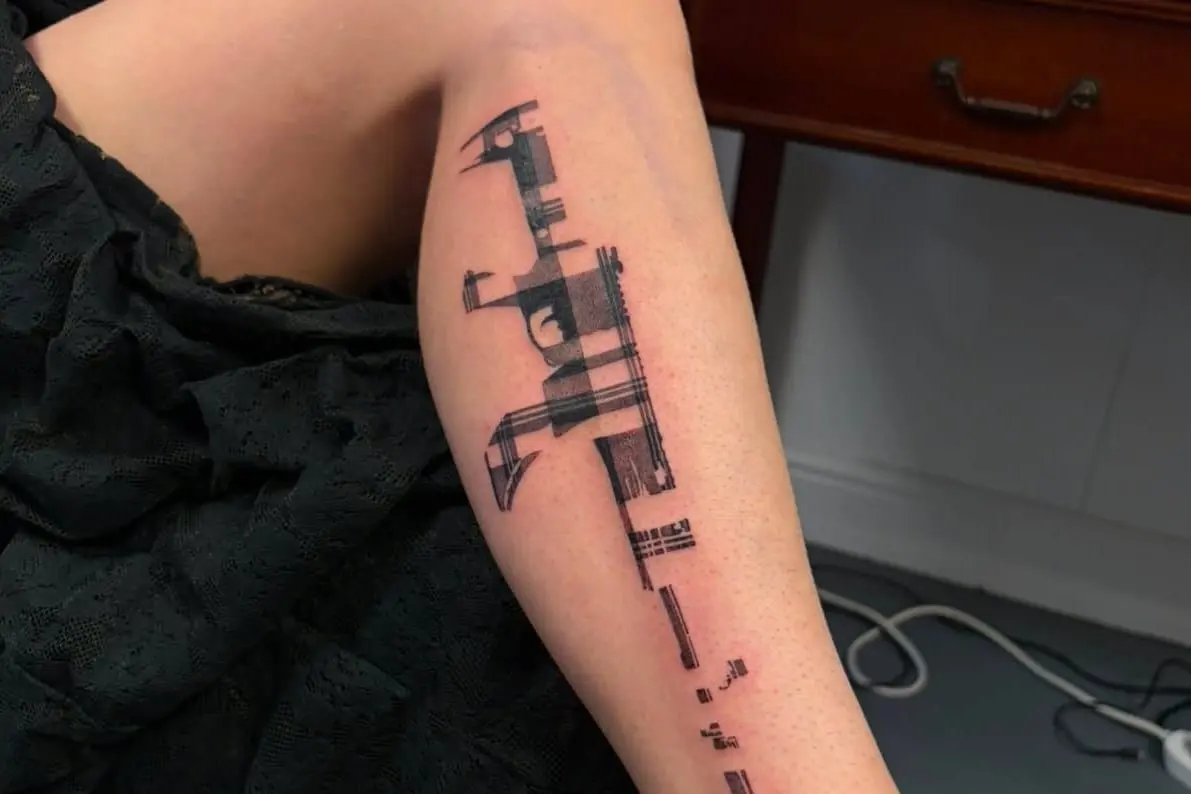
Operating out of Sheffield, 23-year-old tattoo artist Liv has become a notable figure in this niche, having inked roughly half a dozen weapon designs so far, with many more requested. One of her standout pieces features an M4 carbine rendered entirely in a cozy plaid pattern, stretched across a client’s leg.
"It was a custom design inspired by the quote ‘shot yourself in the foot,’ mixed with inspiration from my original plaid style tattoos," Liv explains. By merging a lethal military weapon with domestic, harmless textile patterns like plaid, Liv subverts the inherent menace of the firearm, turning a symbol of destruction into a piece of whimsical, tongue-in-cheek body art.
Gianna (@meiintattoo): The Power of Digital Curation
In Atlanta, Georgia, 22-year-old tattoo artist Gianna has observed a notable surge in firearm requests, which she attributes heavily to the algorithmic curation of platforms like Pinterest and Instagram.
"I’ve seen lots of gun tattoos recently," Gianna notes. While she has previously inked cybersigilism swords and other bladed weapons, she acknowledges the unique psychological weight that firearms carry compared to historical blades. The juxtaposition of modern trauma and digital aestheticization creates a jarring tension that many clients are actively seeking to explore.
Adam (@ineedarocketlauncher): Anti-War Politics Meets Aesthetic Appreciation
Perhaps no artist encapsulates the ideological contradictions of the trend better than Adam, a 26-year-old tattooist based in Atlanta. Adam describes his personal worldview as "staunchly anti-war and anti-fascist," yet his flash portfolio reads like a military surplus catalog: Uzis, shotguns, revolvers, Glocks, AK-47s, RPG-7s, grenades, miniguns, and tanks.
His personal favorite is an AK-47 he tattooed on his own leg while learning the craft. "It looks quite shit, but I like it for that reason too," he laughs.
Adam recalls showing the tattoo to his father, whose critique was not centered on the fact that his son had permanently inked a weapon onto his body, but rather on the type of weapon chosen. "Why did you choose the terrorist gun [when] you could do something American like an M16 or AR-15?" his father asked.
For Adam, however, that subversive choice is precisely the point. "The AK-47 is the most commonly used weapon for revolutions, insurgencies, civil wars, and whatever else," he notes. "I think a lot of people view it as a symbol of rebellion and returning power to the people."
Yet, when pressed on whether every client has a deeply articulated political manifesto backing their ink, Adam admits to a simpler, more universal truth: "I also just like guns because they’re cool."
Future Outlook: Where is the Trend Heading?
As firearms continue to occupy an increasingly multifaceted and contradictory space in the global cultural imagination, the motivations driving people to get gun tattoos will likely remain wonderfully diverse and deeply decentralized.
On one end of the spectrum, individuals will continue to secure firearm tattoos as a nod to traditional, patriotic, or conservative-coded gun culture. On the other, progressive and marginalized groups will utilize the imagery as a reclaimed symbol of community self-defense, revolutionary heritage, and resistance.
However, for the vast majority of Gen Z and Millennial clients, the primary driving force remains aesthetic. As guns continue to cycle aggressively through the visual bloodstream of modern fashion, music videos, underground streetwear lines, and digital curation sites, they are undergoing a process of cultural normalization.
Looking ahead, it is entirely plausible that gun tattoos will eventually shed their transgressive edge. Much like the ubiquitous sword-wielding elves and medieval daggers of past generations, firearms may eventually cease to provoke visceral shock, blending seamlessly into the broader, eclectic tapestry of modern body art—a permanent monument to a generation raised between the digital crosshairs of virtual worlds and the harsh realities of physical space.