Executive Overview
The B2B software industry is undergoing a structural paradigm shift. Driven by rapid advancements in agentic artificial intelligence, shifting macroeconomic pressures, and a renewed prioritization of efficiency over pure top-line growth, executive leadership teams and boards of directors are aggressively re-evaluating corporate headcount. The governing question for modern tech leadership has fundamentally changed: How lean can an organization become while maintaining—or even accelerating—its performance metrics?
Recent industry developments underscore this transformation. Bending Spoons recently announced widespread layoffs across the Airtable team, echoing a growing consensus that smaller, highly focused teams routinely outperform bloated legacy organizations. This move follows a wave of aggressive structural transformations across major technology companies throughout the year, including Cloudflare, Atlassian, and specialized operators like Bending Spoons itself.
By strategically deploying agentic AI systems, streamlining back-office operations, and rethinking traditional product development hierarchies, these companies are rewriting the rules of corporate leverage. This report investigates the operational blueprints of these industry leaders, analyzes public financial outcomes following deep structural cuts, and provides a framework for evaluating departmental efficiency and revenue-per-employee benchmarks in the modern era.
Detailed Chronology: The 2026 Wave of Strategic Restructuring
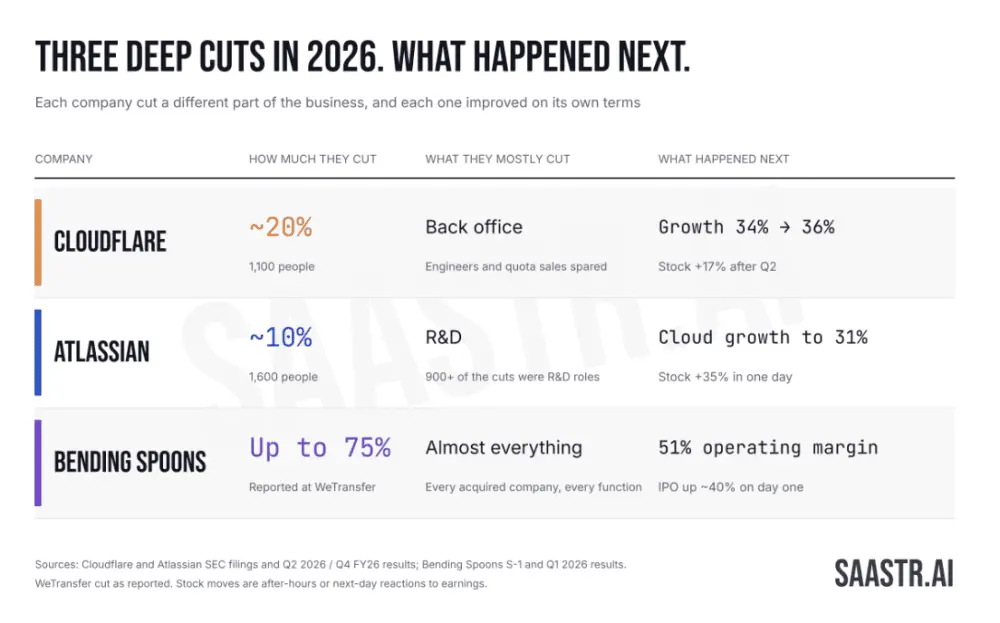
The movement toward hyper-lean operational models is not merely a theoretical exercise; it has manifested in high-stakes structural overhauls across the software landscape. Three distinct case studies illustrate how varying strategies—applied at different company stages and targeting distinct operational functions—yield profound financial and operational shifts.
1. Cloudflare: Streamlining G&A for an Agentic AI-First Model
On May 7, Cloudflare announced a comprehensive operational restructuring designed to pivot the company toward an agentic AI-first operating model. The plan involved reducing its workforce by approximately 20%, resulting in anticipated restructuring charges between $140 million and $150 million. At the close of 2025, Cloudflare maintained 5,156 full-time employees.
Crucially, Cloudflare executed these cuts from a position of relative financial strength. In the quarter leading up to the restructuring, the company posted record-breaking results, generating $639.8 million in revenue—a 34% year-over-year increase. Despite this revenue beat, the market initially reacted with caution, sending the stock down more than 20% in after-hours trading.
However, the subsequent quarterly results validated executive strategy. Q2 revenue rose to $696.1 million, accelerating to 36% year-over-year growth, prompting a 17% surge in after-hours stock value. Management subsequently raised full-year guidance to a range of $2.86 billion to $2.87 billion, surpassing consensus estimates of $2.81 billion, while net dollar retention held firm at 120%.
Strategic Execution: Cloudflare’s restructuring focused squarely on back-office operations while intentionally preserving its engineering core and customer-facing sales apparatus. Executive leadership noted that quota-carrying sales representatives were protected across every region and department, ensuring that market-facing execution remained uninterrupted.
The accelerated growth was largely driven by organic market demand, particularly workloads associated with Cloudflare Workers and machine-to-machine traffic. By streamlining general and administrative (G&A) functions through AI automation, the company maintained its capacity to service surging demand at a significantly reduced operating cost.
2. Atlassian: Reallocating R&D Capital Toward Enterprise Scale
In March, Atlassian initiated a workforce reduction affecting approximately 10% of its personnel—roughly 1,600 roles—with a heavy concentration within software research and development (R&D), where over 900 positions were eliminated.
The market sentiment surrounding Atlassian prior to the announcement was heavily burdened by investor anxieties regarding the emergence of AI-native enterprise competitors, leading to a loss of more than half the company’s market value since the start of the year. The initial layoff announcement was met with a modest 2% rise in after-hours trading.
Despite shedding a significant portion of its engineering headcount, Atlassian’s operational velocity appeared to increase rather than stall. In the subsequent June quarter:
- Cloud revenue demonstrated robust resilience.
- Product development output accelerated, evidenced by usage metrics for MCP servers and the Teamwork Graph CLI surpassing one million monthly active users, doubling within a single quarter.
- Concurrently, Atlassian restructured its engineering leadership by splitting the Chief Technology Officer role into two distinct AI-focused positions, modernizing its internal software delivery pipelines.
3. Bending Spoons: Maximizing Operating Margin Through Extreme Consolidation
Bending Spoons represents the outer boundary of the hyper-lean operational philosophy. Known for deep operational interventions following corporate acquisitions—such as significant staff reductions following the acquisition of WeTransfer and successive rounds of restructuring at Vimeo—Bending Spoons treats mature software products as high-margin cash generators.

The financial profile of the Bending Spoons model is characterized by:
- Exceptional revenue-per-employee metrics, scaling up to $2.57 million per worker.
- Industry-leading operating margins reaching approximately 51%.
While this model successfully optimizes profitability and operational efficiency for mature, slower-growing software assets, it comes with clear strategic trade-offs. For instance, prior to its acquisition and subsequent restructuring, Vimeo featured an ambitious roadmap centered on native integrations and natural-language search capabilities. Under Bending Spoons’ stewardship, product development priorities are sharply aligned with margin preservation and cost discipline rather than expansive, high-risk feature exploration.
Supporting Context & Metrics: The Financial Impact of Lean Operations
To understand the macro-level impact of these corporate realignments, one must examine the fundamental unit economic shifts within enterprise software.
The Revenue-Per-Employee Transformation
Evaluating financial performance through the lens of revenue generated per employee highlights the compounding leverage delivered by automation and streamlined organizational design.
- Cloudflare’s Efficiency Leap: Prior to its restructuring, Cloudflare’s annualized Q1 revenue divided across 5,156 employees yielded approximately $496,000 per worker. Following the reduction to roughly 4,050 full-time employees, annualized Q2 revenue scaled this metric to approximately $690,000 per employee—representing an approximate 40% increase in workforce productivity within a single quarter.
- The Market Benchmark: According to industry data, the median revenue per employee for traditional B2B software companies historically hovered near $237,000. However, top-tier performers documented in indices such as ICONIQ’s Pacesetter Index reveal that fastest-growing companies exceeding $100 million ARR achieve a median benchmark of $655,000 in revenue per employee.
Departmental Vulnerability Matrix
Different corporate functions exhibit varying degrees of elasticity when subjected to AI-driven automation and structural trimming:
- Back Office, G&A, and Operations (50%+ Reduction Potential): This category absorbs the vast majority of initial cuts. Administrative workflows, procurement tracking, and compliance reporting are increasingly handled via autonomous agents.
- Marketing Operations and Demand Generation (30% to 50% Reduction Potential): Campaign orchestration, data list hygiene, variant creation, and initial reporting metrics are heavily optimized by artificial intelligence, allowing smaller human teams to focus purely on core brand strategy and messaging.
- Engineering in Mature Organizations (10% to 20% Reduction Potential): Supported by AI-assisted code generation (such as automated pull requests and test coverage), legacy engineering organizations frequently maintain high output with leaner teams.
- Engineering in Hyper-Growth Startups (Protected): For early-stage companies scaling rapidly, engineering talent acts as the primary driver of product differentiation. Rather than trimming, maintaining or expanding technical headcount allows high-growth firms to maximize developer leverage.
- Quota-Carrying Sales (Protected in Growing Pipelines): When enterprise demand is verified and sales pipelines remain active, customer-facing revenue generators are routinely shielded from restructuring initiatives.
Official Statements and Industry Commentary
The strategic rationale behind these industry-wide adjustments points to a fundamental evolution in management philosophy.
Announcing the restructuring of the Airtable team, Bending Spoons leadership emphasized that corporate agility is inversely proportional to team size:
"Today we’re laying off a large part of the Airtable team. This is not a reflection of their work but a reflection of our deep belief that small teams ship more and better. For Airtable, better is about to look like a new Core team shipping your top requests monthly…"
Similarly, operators operating at the bleeding edge of agentic integration are redefining the relationship between human oversight and automated execution. Organizations such as SaaStr have demonstrated that running a multi-million-dollar digital operation with a micro-team of humans—supported by dozens of specialized AI agents—is no longer speculative.
However, industry leaders emphasize that automation does not eliminate the need for human accountability. While autonomous systems can draft, execute, and monitor routine tasks, human capital remains essential for strategic judgment, relationship management, and the rigorous auditing of automated outputs. As organizational structures compress, the burden of review shifts directly to senior operators and technical leads.
Future Outlook: The Autonomous Enterprise Horizon
As the technology sector moves further into the era of agentic artificial intelligence, the traditional playbook of scaling headcount linearly with revenue growth is obsolete. The companies that successfully navigate the coming years will be those that treat organizational design as a dynamic, software-defined architecture.
Key indicators for boardrooms and executive teams entering the next fiscal cycle include:
- Prudent Headcount Ratios: Falling below contemporary benchmarks (such as $500,000+ in revenue per employee for scaled B2B SaaS firms) will increasingly draw scrutiny from institutional investors and boards.
- Agentic Integration as Baseline Infrastructure: AI agents will transition from experimental tooling to core enterprise infrastructure, fundamentally altering the execution costs associated with customer success, marketing logistics, and software engineering support.
- Strategic Specialization: Executive teams will continue to decouple back-office execution from core market-facing differentiation, deploying aggressive automation where possible while preserving high-touch human engagement for enterprise-grade sales and complex relationship management.
Ultimately, the lesson of the current restructuring wave is clear: efficiency is no longer merely a defensive mechanism deployed during economic downturns. It is an offensive capability that enables agile, high-performing teams to ship faster, operate with greater margins, and scale sustainably in an increasingly competitive global software market.