Executive Overview
In a decisive move aimed at dismantling the infrastructure supporting Russia’s wartime economy, the United Kingdom has levied sweeping economic sanctions against Cryptomus, a notoriously elusive cryptocurrency payment processor. Long flagged by blockchain intelligence firms and cybersecurity researchers, Cryptomus has served as a principal financial conduit for ransomware syndicates, narcotics networks, darknet marketplaces, high-yield fraud schemes, and illicit cybercrime services designed to help the Russian state circumvent international financial restrictions.
Announced on October 8, the U.K. Treasury’s sanctions freeze any assets held by Cryptomus within British financial institutions and legally bar UK-based companies, individuals, and entities from entering into business, virtual, or commercial relations with the platform. Alongside Cryptomus—which has operated under various aliases including Certa Payments, Xeltox Enterprises, and more recently, Heleket—the UK government targeted several allied virtual payment platforms, specifically VexPay, TokenSpot, and the Tsunami Payments service.
This regulatory crackdown marks a critical escalation in the global fight against crypto-enabled financial crime. While Canada previously slapped the platform with a historic CAD $176 million fine for anti-money laundering (AML) violations, enforcement mechanisms reliant solely on monetary fines have historically proven toothless against cross-border digital entities. By applying hard economic sanctions, the UK has shifted from penalization to operational neutralization. Furthermore, international legal experts note that this enforcement action represents a historic milestone: the first known instance of a "Five Eyes" nation (comprising Australia, Canada, New Zealand, the United Kingdom, and the United States) officially sanctioning a cryptocurrency operation originally incorporated within another Five Eyes jurisdiction.
Detailed Chronology: From Certa Payments to Heleket
The operational lifespan of Cryptomus reads like a masterclass in corporate shell-game tactics and regulatory evasion. Emerging on the digital landscape in 2022, the enterprise quickly embedded itself within the dark corners of the global digital economy, serving as an indispensable backend payment processor for dozens of Russian cryptocurrency exchanges and underground websites hawking specialized cybercrime services.
The Foundation and Early Growth (2022–2024)
Initially operating under corporate banners such as Certa Payments and Xeltox Enterprises, Cryptomus positioned itself as an eager, compliance-lite gateway for merchants seeking to skirt traditional banking oversight. Investigators later traced its physical registration to a shared, nondescript Vancouver address—a location simultaneously claimed by dozens of other foreign currency dealers and money transfer businesses, none of which maintained a physical presence at the site.
Despite operating with minimal regulatory friction during its formative years, the platform’s illicit transaction volumes swelled exponentially. By the close of 2024, investigations led by security journalist Brian Krebs and prominent blockchain intelligence firms revealed that Cryptomus had anchored itself as the premier cash-out bridge for illicit funds moving directly into Russian banking networks.
The Canadian Fine and the Birth of "Heleket" (2025)
As scrutiny mounted, regulatory authorities began closing in. In late 2025, Canadian financial regulators issued a record-shattering CAD $176 million fine against Cryptomus for severe violations of the country’s anti-money laundering and terrorist financing regulations.
However, rather than complying or shuttering operations, the platform demonstrated its chameleonic nature. Cryptomus formally appealed the multi-million-dollar penalty while simultaneously launching a parallel, no-KYC (Know Your Customer) payment processing service dubbed Heleket. While public-facing chat support agents on Telegram adamantly denied any structural affiliation between Heleket and Cryptomus, blockchain forensic tracing quickly exposed Heleket as a direct continuation of the original infrastructure, ensuring that high-risk transactions continued uninterrupted.
The UK Sanctions and Immediate Aftermath (October 2026)
The turning point arrived on October 8, 2026, when the UK government formally designated Cryptomus under its Russia-related sanctions regime. The impact was swift and disruptive. Within hours of the announcement, user-support bots for the platform on Telegram began issuing automated notices to merchants and customers, stating that the platform was suddenly unable to process standard fiat and cryptocurrency transactions. The abrupt service interruption underscored the fragility of illicit payment processors once they are cut off from legitimate Western liquidity and banking rails.
Supporting Context & Metrics: The Scale of Illicit Activity
The sheer volume of illicit capital channeled through Cryptomus and its spin-offs has staggered financial crime investigators. According to comprehensive data released by prominent blockchain analytics firms, the platform functioned on a multi-billion-dollar scale, actively laundering funds for some of the world’s most dangerous criminal syndicates.

Transaction Volumes and Illicit Diversification
In an April 2026 intelligence report, blockchain analytics giant TRM Labs disclosed that Cryptomus had processed in excess of $7 billion in transactions since its inception in 2022. TRM’s granular analysis revealed that this staggering sum was not restricted to general e-commerce; a significant percentage of the processed capital was tied directly to abhorrent criminal enterprises, including vendors of child sexual abuse material (CSAM), international terrorist financing networks, and cross-border human trafficking operations.
Chainalysis Insights on Wartime Evasion
In response to the UK sanctions, blockchain data-crunching firm Chainalysis published an extensive evaluation emphasizing that Cryptomus was not merely an isolated criminal tool, but a foundational pillar of Russia’s wartime economic survival strategy.
"Cryptomus and Heleket have emerged as major payment hubs for illicit activity," Chainalysis wrote in its October 8 advisory. "Together, these services received more illicit funds across tracked categories than the mixers in our dataset, and the number of illicit counterparties surged to more than 900 in a single month in late 2025."
Chainalysis further noted that while Cryptomus experienced temporary volume dips whenever it experimented with rudimentary KYC frameworks, it systematically routed unverified traffic through its newer infrastructure (such as Heleket), rendering regulatory compliance little more than an illusory facade.
Official Statements and Industry Analysis
The international cybersecurity community has universally praised the UK’s intervention, contrasting the efficacy of economic sanctions with the inherent limitations of standard monetary fines against decentralized digital entities.
Richard Sanders on the Limits of Fines vs. Sanctions
Richard Sanders, a veteran blockchain analyst and investigator who spent months mapping out Cryptomus’s intricate payment infrastructure and directly interacting with its customer base, highlighted the profound regulatory distinction between a civil penalty and a formal government sanction.
Writing on professional networks following the announcement, Sanders pulled no punches regarding the failure of Canada’s prior enforcement action:
"A fine doesn’t stop a cryptocurrency payment processor from processing payments," Sanders observed. "Sanctions kill the operation. The distinction matters."
Sanders explained that while the Canadian CAD $176 million fine made headlines, it was ultimately uncollectible and unenforceable against an entity structured around shell corporations and pseudonymous leadership. By contrast, asset freezes and statutory prohibitions implemented by the UK effectively sever the platform’s access to international financial partners, liquidity pools, and technical service providers.
The "Five Eyes" Precedent
Furthermore, Sanders emphasized the geopolitical significance of the UK’s action. Because Cryptomus possessed historical and corporate roots stretching into Western allied nations (specifically Canada), the decision by the UK to sanction a platform connected to a fellow "Five Eyes" partner jurisdiction signals a new era of cross-border regulatory intolerance for permissive crypto hubs.

The Phantom Regulator: Tracing the Corporate Roots
Perhaps the most bizarre and illuminating aspect of the Cryptomus investigation is the labyrinthine network of shell entities, fake financial institutions, and fictitious regulatory bodies that provided the platform with its legalistic veneer.
The Western Sahara Connection
During their landmark December 2024 investigation, researchers uncovered the structural blueprint underpinning Certa Payments (Cryptomus’s parent company). The sole shareholder and director of Certa Payments was identified as a 25-year-old Ukrainian national. Alongside her role at Certa Payments, she simultaneously headed several other corporate entities, most notably the WS Management and Advisory Corporation.
This corporation marketed itself aggressively as an exclusive, authoritative regulatory body responsible for issuing licenses to cryptocurrency exchanges, foreign exchange brokers, and online gaming operators. However, the catch was jurisdiction: WS Management and Advisory claimed to operate out of the Western Sahara—a disputed territory in northwest Africa that is not widely recognized as an independent sovereign nation by the United Nations or the international community.
Digital Fingerprints and Phony Oversight
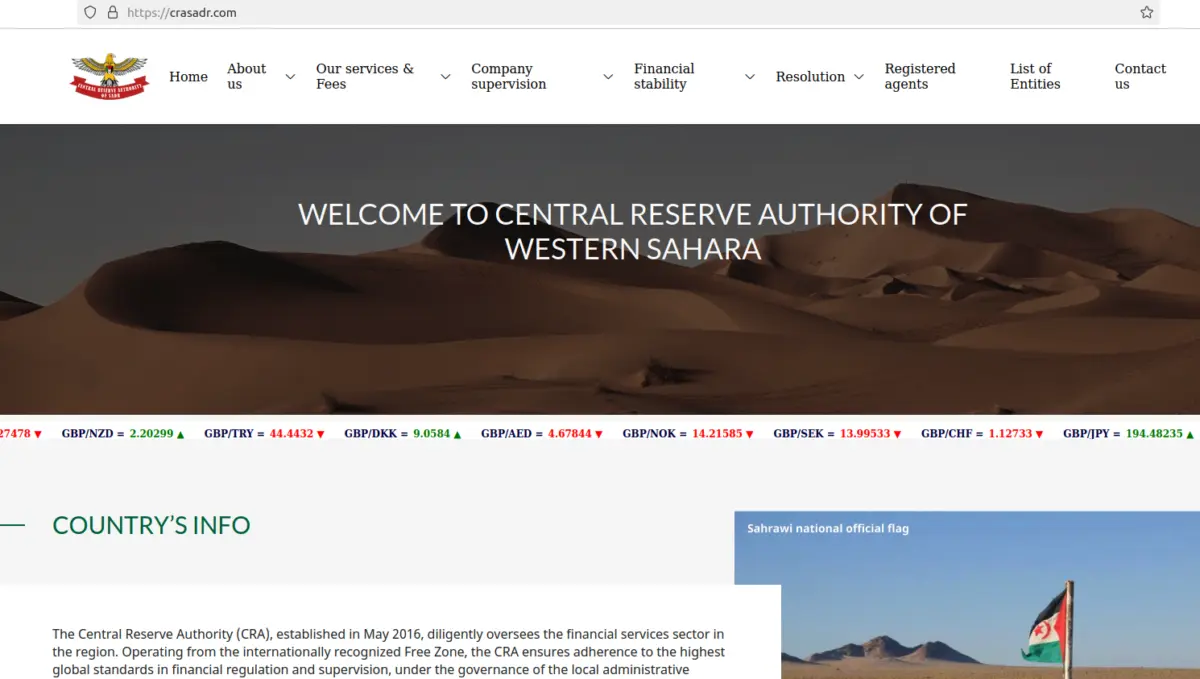
Investigators uncovered that the primary web portal for this supposed regulatory body—crasadr.com, belonging to the Central Reserve Authority of the Western Sahara—served as the official issuer of licenses for entities like Cryptomus.
Digital infrastructure analysis revealed smoking-gun overlaps: one of Certa Payments’ former corporate domains (certa.website) shared a physical server hosting twelve other suspicious domains, including rasd-state.ws, the web property utilized by the phony Central Reserve Authority. By establishing a circular ecosystem of self-certifying, fake regulatory authorities located in geopolitical black holes, the operators of Cryptomus manufactured a counterfeit aura of legitimacy that successfully duped initial compliance checks before independent blockchain sleuths exposed the fraud.
Future Outlook: The Death Knell for Shell Processors?
The coordinated pressure from international watchdogs, analytical firms, and now British economic sanctions signals a perilous future for high-risk cryptocurrency processors operating on the fringes of the global financial system.
As blockchain analytics become increasingly sophisticated, the ability of chameleonic platforms to indefinitely reinvent themselves under new monikers—shifting from Certa Payments to Cryptomus, and subsequently to Heleket—is meeting institutional resistance. While illicit networks will undoubtedly attempt to pivot toward decentralized mixers or harder-to-trace privacy coins, the decisive action taken by the UK demonstrates that governments are increasingly willing to target the institutional infrastructure, corporate officers, and supporting shell networks that enable state-sponsored sanctions evasion and transnational cybercrime.
For Cryptomus and its parallel incarnations, the music has finally stopped. With their assets frozen in the UK, their web infrastructure increasingly isolated, and global intelligence agencies sharing real-time telemetry, the era of unpunished, state-adjacent crypto laundering is drawing to a definitive close.