Executive Overview
The modern software development lifecycle is an exercise in scale, complexity, and—frequently—frustration. When an enterprise application crashes unexpectedly, a Docker container fails to spin up, or a Kubernetes pod enters an unyielding CrashLoopBackOff state, engineering teams are instantly thrust into a high-pressure diagnostic loop. For decades, the ritual remedy has remained stubbornly archaic: manual inspection. Engineers spend countless hours combing through thousands of lines of dense log files, hunting for elusive stack traces, cross-referencing timestamps, and deciphering cryptic error codes.
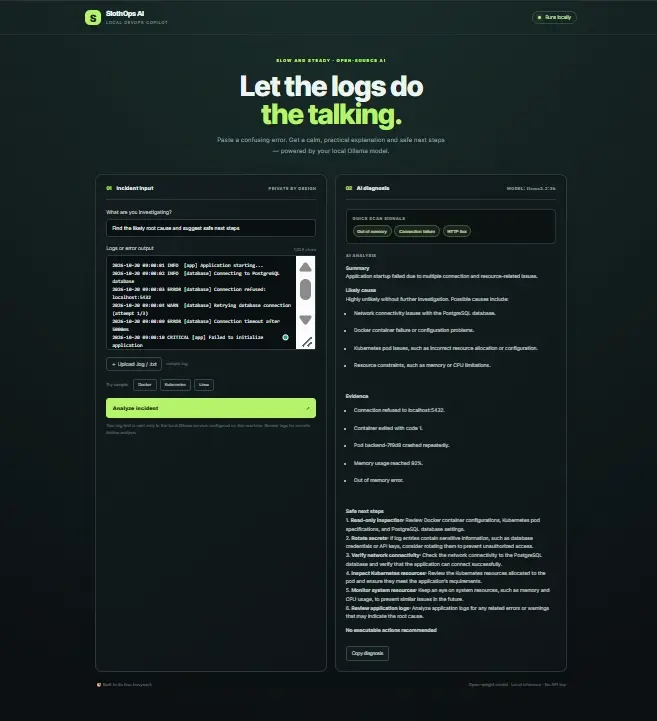
Enter SlothOps AI, an open-source, AI-powered DevOps log analyzer engineered to fundamentally disrupt this tedious workflow. Developed as a submission for the Hacktoberfest Open-Source AI Challenge Week 3: Slow and Steady, SlothOps AI introduces an intuitive, web-based dashboard that shoulders the heavy lifting of log interrogation. By harnessing the power of local-first artificial intelligence—specifically utilizing open-weight models via Ollama—the platform ingests raw application logs, parses complex system errors, and instantly delivers AI-generated root-cause analyses, contextual explanations, and actionable troubleshooting suggestions.
By championing a local-first architecture, SlothOps AI bridges the gap between cutting-edge artificial intelligence and enterprise data privacy. Developers no longer need to transmit sensitive production logs to third-party proprietary APIs to gain intelligent insights. Instead, they can run advanced language models locally, ensuring absolute data sovereignty while drastically reducing the time spent on repetitive firefighting. This comprehensive report explores the genesis of SlothOps AI, its underlying technology stack, the broader philosophy of open innovation, and the future outlook for AI-augmented DevOps tooling.
Detailed Chronology: From Concept to Community-Driven Code
The journey of SlothOps AI began with a universally recognized pain point in software engineering: the sheer inefficiency of manual log parsing. While the DevOps landscape has seen exponential advancements in orchestration, continuous integration, and infrastructure-as-code, the foundational act of reading logs when things break has evolved very little.
Phase 1: Identifying the Bottleneck
During the preliminary conceptualization phase of the Hacktoberfest AI Challenge, the project’s creator, Abhimanyu, analyzed the daily friction points faced by developers and system administrators. The diagnosis was clear: while cloud-native applications scale effortlessly, human engineers do not. When a microservice fails in a distributed environment, the cascading logs generated across multiple containers create an overwhelming noise floor. Separating the critical signal from ambient noise consumes valuable engineering bandwidth—bandwidth that would be far better spent building features and shipping products.
Phase 2: Architecting a Local-First Solution
Recognizing that sending production logs containing sensitive data, internal IP addresses, and proprietary code architecture to external cloud APIs was a non-starter for many organizations, the decision was made to build a strictly local-first solution. The architecture needed to be lightweight, developer-friendly, and capable of running on standard consumer or development hardware without requiring expensive GPU clusters.
Python was chosen as the backbone of the backend due to its ubiquity in data processing and AI orchestration, paired with Flask to deliver a responsive, lightweight web dashboard. For the artificial intelligence layer, Ollama was integrated to manage and execute open-weight large language models locally, ensuring that the entire diagnostic pipeline—from log upload to root-cause synthesis—occurs securely on the developer’s machine.
Phase 3: Assembly and Open-Source Deployment
The final assembly phase focused on creating a seamless user experience. The application was structured to allow users to clone a single repository, pull a designated AI model, install Python dependencies, and launch a fully functional local dashboard within minutes. Published openly on GitHub under the moniker SlothOps AI – Your Local AI Automation Assistant, the project immediately welcomed community engagement, inviting developers worldwide to test, critique, and contribute to its codebase.
Supporting Context & Metrics: The Cost of Manual Troubleshooting
To truly appreciate the value proposition of SlothOps AI, one must examine the hidden economic and productivity costs of traditional debugging methodologies. In modern software engineering teams, debugging is rarely a linear process.
The Anatomy of a Log Investigation
When an infrastructure failure occurs, the traditional resolution path typically involves:
- Identification: Discovering that an anomaly has occurred via alerting systems or user reports.
- Retrieval: Navigating to log aggregation platforms, downloading raw text files, or SSHing into remote servers to tail log streams.
- Filtering: Manually writing complex regular expressions or scanning line-by-line to locate warning and error flags (
[ERROR],FATAL,Exception). - Contextualization: Correlating asynchronous events across distributed services to determine why a failure triggered a downstream collapse.
- Remediation Research: Searching documentation, Stack Overflow, or internal wikis to map error signatures to potential fixes.
According to various industry productivity studies, developers spend anywhere from 20% to 50% of their working hours troubleshooting, debugging, and maintaining existing codebases rather than writing new features. When scaled across an enterprise engineering organization numbering in the hundreds, the cumulative hours lost to manual log searching represent a massive operational inefficiency.
The SlothOps AI Intervention
SlothOps AI alters this economic equation by shifting the burden of initial data synthesis from human cognition to machine automation. By uploading a raw log file directly to the web dashboard (http://127.0.0.1:5000), the developer initiates an automated pipeline:

- Pattern Recognition: The local LLM rapidly scans the unstructured text, filtering out boilerplate initialization logs to home in on anomalies, exceptions, and stack traces.
- Semantic Explanation: Instead of presenting a wall of cryptic Java, Python, or Node.js error codes, the AI generates a plain-language summary detailing what failed and why.
- Targeted Remediation: The system provides prioritized troubleshooting steps, guiding the developer directly toward configuration updates, dependency fixes, or code patches.
While specific time-saving metrics naturally fluctuate depending on log volume, model performance, and issue complexity, the qualitative shift is profound. The overarching philosophy—aptly dubbed the "Lazy Payoff"—embraces automation not out of idleness, but out of strategic prioritization: freeing human capital from repetitive digital excavation so they can focus on high-value innovation.
Official Architecture and Local Deployment Guide
SlothOps AI is built upon an accessible, open-source technology stack designed for rapid deployment and seamless local execution.
Technology Stack
- Backend Framework: Python / Flask
- AI Orchestration & Inference: Ollama (running open-weight models such as
llama3.2:3b) - Interface: Web-based dashboard utilizing standard HTML/CSS/JavaScript
- Containerization & Version Control: Docker, Git, and GitHub
Running SlothOps AI Locally
Developers wishing to experiment with, evaluate, or contribute to SlothOps AI can deploy the application locally by following these standardized steps:
-
Clone the Repository:
git clone https://github.com/360abhimanyu/Project-SlothOps-AI-Your-Local-AI-Automation-Assistant.git cd Project-SlothOps-AI-Your-Local-AI-Automation-Assistant -
Download the Required AI Model:
Ensure Ollama is installed on your system, then pull the lightweight, highly efficient Llama model optimized for local inference:ollama pull llama3.2:3b -
Install Python Dependencies:
Set up your environment and install the required packages:pip install -r requirements.txt -
Start the Application:
Launch the Flask backend server:python app.py -
Access the Dashboard:
Open your preferred web browser and navigate tohttp://127.0.0.1:5000. From there, you can upload sample log files and experience automated AI-driven troubleshooting firsthand.
Future Outlook: The Rise of Local-First Open Innovation
The emergence of projects like SlothOps AI highlights a broader, highly encouraging paradigm shift within the software engineering ecosystem: the democratization of artificial intelligence through open-source collaboration.
For years, advanced developer tooling was inextricably linked to proprietary, closed-source cloud ecosystems. Developers were forced to trust external vendors with sensitive internal telemetry, accepting black-box algorithms with little visibility into how data was processed or stored. The open-source AI movement—anchored by projects like Ollama, Hugging Face, and community-driven initiatives like Hacktoberfest—proves that powerful, privacy-compliant developer tools can be built, audited, and deployed locally.
What Open Innovation Makes Possible
- Absolute Data Privacy: By keeping log analysis strictly on-premise or on-device, organizations eliminate the compliance risks associated with transmitting proprietary production data to third-party cloud endpoints.
- Customizability and Transparency: Developers possess the complete freedom to inspect source code, modify prompt engineering logic, swap out underlying language models, and tailor the analyzer to specific enterprise logging formats.
- Community-Driven Evolution: Collective problem-solving accelerates feature delivery, bug fixes, and performance optimization far beyond the capacity of any single proprietary product team.
As artificial intelligence continues to mature, tools that respect developer autonomy, data security, and operational simplicity will undoubtedly define the next generation of DevOps engineering. SlothOps AI stands as a compelling proof-of-concept—demonstrating that by automating the tedious, repetitive elements of infrastructure maintenance, we can empower developers to do what they do best: build, innovate, and create.