Executive Overview
As artificial intelligence shifts from a theoretical productivity tool to the literal operating system of modern business, few organizations have leaned into autonomous agents as aggressively as Anthropic. In a landmark internal report, the artificial intelligence research company has laid bare the exact mechanics of what happens when a high-growth tech company radically restructures its day-to-day workflows around AI agents.
Utilizing an unprecedented dataset—spanning internal headcount metrics, agent session telemetry, calendar analytics, Slack interaction patterns, hiring scorecards, and qualitative deep dives with employees—the report serves as the most granular case study available on the enterprise-level impacts of hyper-automation.
The findings are both staggering and sobering. Anthropic’s workforce has tripled over the past year, yet its revenue-per-employee metrics tower at two to four times the historical figures posted by tech behemoths like Google and Meta at identical stages of maturity. At the same time, the fundamental architecture of its labor force has transformed. Junior technical hiring has plunged, administrative roles have stagnated as clerical tasks are absorbed by agents, and the primary bottleneck in the corporate ecosystem is no longer generation speed, but human review capacity.
For founders, executives, and enterprise leaders charting their own organizational roadmaps, Anthropic’s data offers a glaring preview of the structural shifts heading toward the broader B2B economy. This deep dive unpacks the five critical operational shifts identified in the report, exploring their profound implications for hiring, productivity, management, and corporate strategy.
Detailed Chronology: The Evolution of an AI-Native Workforce
The transition documented by Anthropic did not happen overnight; it followed a distinct, accelerated trajectory driven by rapid model iteration and aggressive internal deployment.
Phase 1: The Code-Level Shift (Late 2024 – Early 2025)
The initial wave of automation targeted predictable, highly structured software engineering tasks. By early 2025, teams heavily reliant on Claude began shifting routine code generation, test writing, and bug hunting directly to automated agents. Internal telemetry indicates that performance engineers saw immediate performance lifts, fundamentally altering what managers sought when opening technical requisitions.
Phase 2: The Junior Squeeze (January – December 2025)
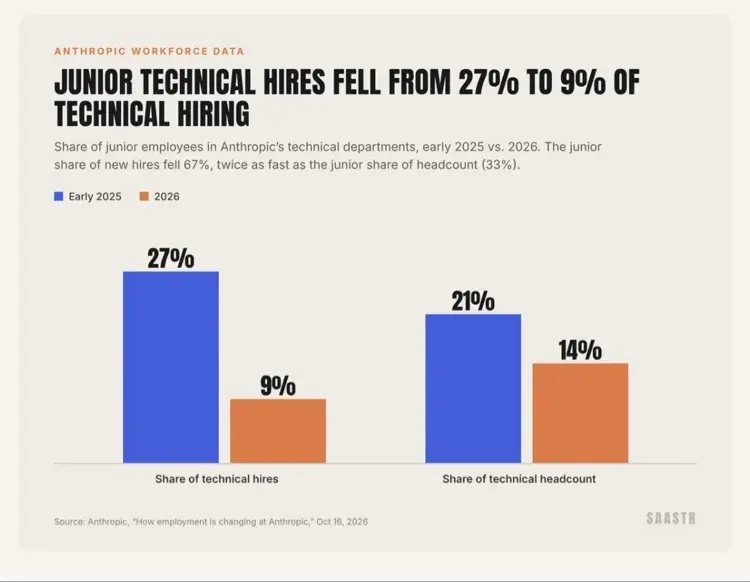
By the start of 2025, the downstream effects on hiring patterns became statistically undeniable. The share of junior employees within Anthropic’s technical departments experienced a sharp contraction, dropping from 21% to 14%. More tellingly, the proportion of new technical hires classified as junior plummeted from 27% to 9%. Job postings targeting early-career engineers fell off a cliff, particularly after December 2025. Engineering and research leadership deliberately de-emphasized lower-band technical hiring, with approximately one-third of machine learning managers and one-fifth of software engineering managers explicitly citing AI capabilities as the primary reason for curbing entry-level headcount growth.
Phase 3: Total Agent Supremacy (March – August 2026)
A profound tipping point occurred in March 2026, when aggregate agent work hours officially surpassed human work hours at Anthropic for the first time. By August 2026, when measuring exclusively the agents directed independently by employees, non-human entities were logging six times as many operational hours as their biological counterparts. Code commits per engineer skyrocketed to five times their levels from just six months prior, while parallel velocity surges were recorded in legal contract processing, accounts payable invoice clearance, and enterprise sales pipeline progression.
Supporting Context & Metrics: Five Core Learnings for Executives
The report’s data yields crucial lessons for business leaders attempting to navigate the integration of generative AI and autonomous workflows.
1. The Collapse of Junior Technical Hiring
The most contentious finding in the report revolves around the displacement of early-career talent. As code writing, test suites, and routine debugging became frictionless via Claude, the traditional "apprentice" model of software engineering—where junior engineers cut their teeth on menial coding tasks—began to dissolve.
Anthropic’s data reveals a direct inverse correlation between complex Claude usage and junior hiring velocities between January and July 2026. While the company maintains robust internal redeployment programs for existing personnel whose roles shift, the report openly acknowledges that these worker protections offer zero utility for the junior engineer who fails to secure an initial entry-level offer. This signals a looming structural crisis for the broader tech labor market: if enterprises stop hiring juniors, the industry risks choking off the pipeline that produces senior, system-architect-level talent down the line.
2. Hyper-Growth Without Traditional Headcount Expansion
Despite automation pressures, Anthropic’s overall headcount tripled over the past year. However, the internal distribution of that headcount shifted dramatically. Technical departments shrank from 61% to 56% of total employees, not because technical teams contracted in absolute terms, but because go-to-market functions—specifically sales, finance, and recruiting—expanded at an even faster clip.
Remarkably, administrative and clerical roles remained virtually flat. Through a combination of custom agent assistants, automated document reviews, and outsourced ticketing handles, Anthropic managed to triple in size while keeping clerical bloat at absolute zero. One executive assistant noted that entry-level scheduling and email triage were entirely automated, elevating her day-to-day responsibilities into high-level chief-of-staff duties.
3. The Bottleneck Paradox: 80% Idle Time
One of the most counterintuitive metrics unearthed in the telemetry data is that interactive Claude sessions spend approximately 80% of their time idle, waiting for human intervention.
Even though agents are working at machine speeds, human review capacity has become the ultimate corporate speed bump. Code commits have surged 5x, but the volume of reading material generated by agents across technical and non-technical teams has escalated to such a degree that fully reviewing agent output would consume more than 50% of an average employee’s work week. Engineers frequently describe feeling like they are actively "bottlenecking the agents." Productivity gains, therefore, are artificially throttled by human cognitive bandwidth.
4. The Rise of "Meta-Work" and Standing Instructions
To govern this army of digital workers, employees have had to master a new discipline: meta-work. Written standing instructions for agents surged from a few hundred in July 2025 to a staggering 8,500 a year later.
Meta-work—defined as agent management, multi-agent run specifications, pipeline monitoring, and cross-agent code reviews—climbed from 10% of an average employee’s interactive session time in late 2025 to 22% by spring 2026. This administrative oversight layer has paradoxically driven an increase in corporate meetings; the median employee now spends 20% more time in meetings than a year prior, as high-level architectural decisions and cross-team alignments still require humans talking in a room. Crucially, these decisions must be meticulously documented in open Slack threads or public documents; if a decision remains trapped in an unrecorded conversation, agents immediately operate on stale context.
5. Hiring for Autonomy, Judgment, and Mission
An automated analysis of Anthropic’s hiring manager scorecards between 2024 and 2026 reveals a dramatic pivot in what interviewers value. Mentions of a candidate’s proven track record with AI tooling tripled for technical roles and quadrupled for non-technical roles.
For technical candidates, comments centered on autonomy and raw judgment surged, while domain expertise diminished as a percentage of overall evaluation criteria. For non-functional and business roles, customer alignment and mission orientation trumped isolated execution skills. Because base models remain inherently uneven across various domains, Anthropic prioritizes generalists who excel at directing autonomous workflows over narrow, single-stack specialists whose specific skill sets run the risk of swift automation.
Official Perspectives and Industry Validation
The data points published in the report mirror real-world scaling challenges observed across the broader B2B ecosystem. Speaking at SaaStr AI 2026, Anthropic sales leaders provided vital context regarding how go-to-market teams adapted to hyper-growth without linear hiring.
Kelly Loftus detailed how she scaled startup sales from under 10 people to over 150 in just 18 months while overall company headcount expanded from 250 to 1,300. Remarkably, Loftus’s team operates without traditional quotas, relying instead on dynamic "shadow targets."
Meanwhile, Eleanor Dorfman explained that the company simply could not absorb three to five times the number of human sales reps fast enough to keep pace with hyper-demand. By completely rearchitecting the sales organization around digital workflows in January 2026, Anthropic achieved a milestone where 54% of new enterprise logos were acquired through self-serve channels within four months—an extreme outlier driven by unprecedented market demand that standard B2B companies should view as a high-water mark rather than a baseline expectation.
Future Outlook: Equity, Early Warnings, and the Road Ahead
As organizations race to replicate Anthropic’s operational velocity, the report concludes with crucial frameworks designed to mitigate the human cost of mass automation.
First, Anthropic ties heavy agent adoption directly to broad-based employee stock ownership. Recognizing that workers are effectively functioning at a VP level of operational oversight while automating their own daily tasks, the company ensures they hold a substantial financial stake in the enterprise’s upside. The authors draw explicit parallels to mid-century labor agreements, where industrial workforces accepted sweeping organizational restructuring in exchange for productivity-linked financial rewards.
Second, Anthropic has instituted an internal early warning system. By continuously tracking shifting demand and role-specific productivity against current AI capabilities, the company identifies when a specific job function is undergoing structural transformation. This proactive monitoring allows management to pivot employees into new, high-fit internal roles long before their legacy positions are phased out—a key driver behind a 50% year-over-year increase in internal employee mobility.
Strategic Takeaways for Enterprise Leaders
While few B2B organizations possess the luxury of Anthropic’s equity upside or brand gravity, the structural lessons of the report are universally applicable.
- Audit Your Review Bottlenecks: Generating output is no longer a competitive advantage; your ability to rapidly review, validate, and integrate agentic work is.
- Reskill for Orchestration: Shift your hiring frameworks away from routine execution and domain-specific rote skills toward autonomous problem-solving, prompt architecture, and agent management.
- Implement Early Warning Systems: Do not wait for automation to hollow out your workforce. Track task-level shifts internally and build transparent internal mobility pipelines to redeploy human capital proactively.
Anthropic’s bold transparency provides a sobering blueprint for the corporate landscape of tomorrow. The AI-first enterprise is no longer a futuristic hypothesis—it is a functioning reality, and adapting to its operational gravity is the defining mandate for modern executive leadership.