Executive Overview
It is difficult to imagine a more unforgiving cosmic address than a celestial body named after the Greek god of fear. Phobos, the larger and more ominous of the two Martian moons, orbits a mere 3,700 miles above the rusty surface of the Red Planet. For decades, it has stood as a graveyard for interplanetary ambition. Since the 1980s, the Russian space program has launched three separate probes targeting this enigmatic satellite; all three met with catastrophic failure, leaving the true origins of Phobos—and its smaller sibling, Deimos (dread)—shrouded in the deep-freeze vacuum of space.
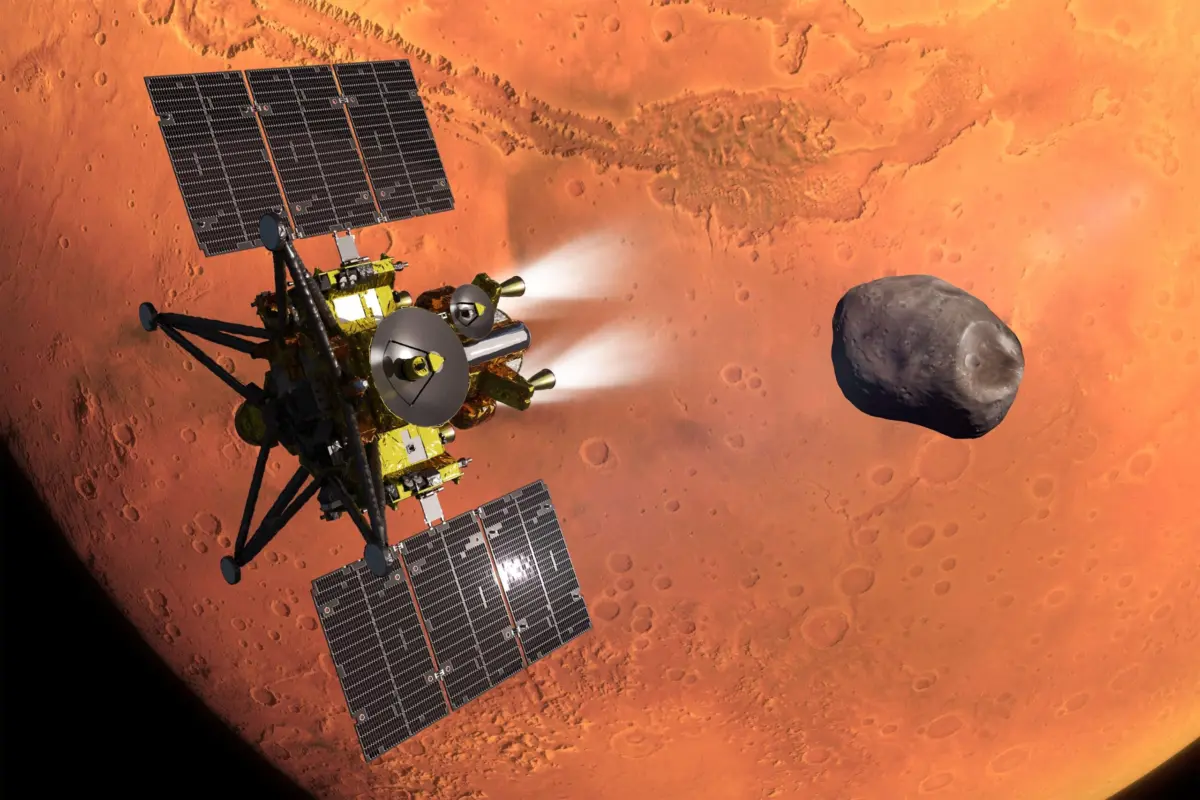
Yet, planetary science stands on the precipice of a historic breakthrough. Led by the Japan Aerospace Exploration Agency (JAXA), an unprecedented global coalition of space agencies is preparing to launch the Martian Moons eXploration (MMX) mission. Blasting off from the Tanegashima Space Center during a tense window in the early hours of Tuesday (Monday afternoon in the United States), the MMX spacecraft will embark on an arduous, year-long journey across the inner solar system.
The stakes could not be higher. If successful, MMX will spend years studying Mars and its moons from orbit, deploy a specialized surface rover, scoop up at least 10 grams of pristine regolith from Phobos using two distinct sampling mechanisms, and deliver the cargo safely back to Earth by 2031. This would mark the first time in human history that scientists have successfully returned samples from a moon other than our own.
Beneath the daunting engineering hurdles and the shadow of past failures lies a palpable sense of historic optimism. "All the members are filled with a quiet sense of excitement," says Kiyoshi Kuramoto, who leads the mission’s extensive international science team. By unlocking the secrets locked away inside Phobos, MMX aims not only to solve a decades-old planetary debate about how the Martian moons formed, but also to yield invaluable clues regarding the evolution of the early solar system and the origins of life itself.
Detailed Chronology: The Road to the Launchpad and Beyond
The realization of the MMX mission is the culmination of decades of conceptualizing, technological iteration, and international diplomacy.
The Historical Context: A Legacy of Russian Setbacks
To understand the gravity of the MMX endeavor, one must look back at the history of Martian moon exploration. Phobos has long been a siren song for planetary scientists. Its unique position—sandwiched deep within Mars’ gravitational well—makes it uniquely difficult to reach and even harder to orbit stably.
Beginning in the late 20th century, the Soviet Union and its successor state, Russia, launched a trio of missions targeting the moon: Phobos 1 and Phobos 2 in 1988, followed by the ill-fated Phobos-Grunt spacecraft in 2011. Phobos 1 was lost en route due to an erroneous command sent from Earth. Phobos 2 successfully entered Martian orbit and beamed back fascinating data before its onboard computer failed prematurely. Phobos-Grunt suffered a fatal propulsion failure in Earth orbit shortly after launch, burning up in the atmosphere. These repeated heartbreaks underscored the treacherous nature of Phobos missions, cementing its reputation as a cosmic graveyard.
The MMX Timeline: From Concept to Deep Space
- Early Planning and Design (Mid-2010s): Building upon the successes of its Hayabusa asteroid-sampling missions, JAXA began conceptualizing a dedicated Martian moon return mission. Collaborators from NASA, the European Space Agency (ESA), and national space agencies in France and Germany joined forces to pool resources, scientific instruments, and expertise.
- Launch Window (Current): The spacecraft lifts off from the Tanegashima Space Center in Japan.
- Interplanetary Transit (Late 2024 – Late 2025): MMX will spend roughly 11 months cruising through deep space, calibrating its instruments, and executing trajectory corrections to match Mars’ orbital path.
- Martian Arrival and Orbital Insertion (Late 2025): Upon reaching the Martian system, the probe will fire its thrusters to enter a stable orbit around Mars, subsequently transitioning to a quasi-satellite orbit around Phobos.
- Remote Sensing and Rover Deployment (2026–2028): MMX will thoroughly map both Phobos and Deimos, utilizing its robust suite of scientific payloads to study their mineralogy, surface morphology, and thermal properties. A specialized rover, developed jointly by French and German space agencies (CNES and DLR), will be deployed to touch down on the surface of Phobos, capturing unprecedented ground-level imagery and physical data.
- The Sampling Phase (2028–2029): The main spacecraft will perform a delicate touchdown on the moon’s cratered surface, executing a dual-method sampling strategy designed to scoop and core at least 10 grams of regolith.
- Return Journey and Earth Entry (2029–2031): Leaving Martian orbit behind, the sample-return capsule will embark on its high-speed return trajectory toward Earth, culminating in a parachute-assisted landing in the Australian outback (or a similar designated recovery zone) in 2031.
Supporting Context & Metrics: The Science of Phobos and Deimos
At the heart of the MMX mission is a fundamental scientific mystery: Where did Phobos and Deimos come from? For generations, astronomers have fiercely debated two primary hypotheses regarding the genesis of Mars’ diminutive companions.
Hypothesis One: The Captured Asteroid Scenario
The first theory suggests that Phobos and Deimos are ancient bodies born in the outer asteroid belt. According to this model, billions of years ago, these rocky wanderers drifted too close to the burgeoning Red Planet, allowing Mars’ gravity to capture them into permanent orbits.
Support for this hypothesis stems from spectral observations showing that the reflectance and visible light patterns of Phobos and Deimos bear a strong resemblance to D-type asteroids—primitive, carbon-rich bodies rich in organic compounds and volatile elements.
Hypothesis Two: The Giant Impact Scenario
Conversely, a rival camp of planetary scientists argues that the moons are native to the Martian system. This model proposes that during the chaotic early solar system, a colossal asteroid—or perhaps a proto-planet—slammed into a nascent Mars. The catastrophic impact would have blasted a colossal ring of molten debris into orbit around the planet. Over millions of years, this ring of dust and rock accreted, coalescing into the twin moons we see today.
The strongest evidence for the impact scenario is orbital mechanics. Unlike true captured asteroids—which often occupy eccentric, inclined orbits—both Phobos and Deimos travel in nearly circular orbits that align closely with the Martian equator. Such tidy orbits are notoriously difficult to explain via random gravitational capture alone.
The Instruments Deciding the Debate
To settle this cosmic whodunit once and for all, MMX is equipped with an extraordinary array of scientific payloads designed to read the chemical fingerprint of Phobos.
- MEGANE (Mars-moon Exploration with GAmma rays and NEutrons): Developed by Johns Hopkins University’s Applied Physics Laboratory with funding from NASA, MEGANE is a remote-sensing instrument that will measure the elemental composition of Phobos. By detecting gamma rays and neutrons naturally emitted when cosmic rays strike the moon’s surface, MEGANE can identify specific elements.
- The Chemical Clue: If MEGANE detects a high abundance of volatile elements (such as hydrogen, carbon, and potassium), it will heavily support the captured-asteroid theory. Conversely, a bone-dry composition lacking volatile elements would point toward the high-temperature debris disk generated by a giant impact.
- Optical Cameras and Spectrometers: High-resolution cameras will map the moon’s topography down to the centimeter scale, allowing researchers to study impact craters, fracturing patterns, and regolith depth.
- The Surface Rover: The joint CNES/DLR rover will navigate the low-gravity terrain of Phobos, probing physical properties like soil cohesion, electrical conductivity, and thermal inertia.
Official Statements: Perspectives from the Frontlines
The sheer complexity of the MMX mission has necessitated an unprecedented level of international cooperation. Leaders from across the global space community have emphasized both the immense risks and the staggering scientific rewards awaiting the mission.
Kiyoshi Kuramoto, leader of the MMX science team, reflects on the emotional undercurrent of the launch:
"All the members are filled with a quiet sense of excitement. Returning samples from a Martian moon is a world-first challenge that is not easy. Because we currently know so little of Phobos’ surface, we can’t pick a final landing spot until taking up-close observations of the moon. That is why we are utilizing two different sampling methods as a safeguard in case one fails."
Tom Statler, MMX program executive at NASA, highlights the broader implications of the mission for our understanding of planetary evolution:
"Laboratory analysis of the samples will help determine the origin of leftover material from the early solar system and how it was transported. Whether these moons are captured asteroids or the offspring of a colossal impact with ancient Mars, the data we return will fundamentally rewrite our models of planetary formation."
David Lawrence of Johns Hopkins University, who leads the development of the groundbreaking MEGANE instrument, expresses the thrill of scientific exploration:
"We know nothing about Phobos’ elemental composition. For me, that’s what’s exciting—making a measurement nobody’s done before. These observations are going to give us a hint at some of the answers to the really big questions we have about Phobos, but really, the return samples are going to nail those questions."
Abigail Fraeman, an MMX team scientist at NASA’s Jet Propulsion Laboratory, emphasizes JAXA’s unique institutional readiness for this monumental task:
"JAXA’s learned and achieved so much with their sample-return missions that they are really well positioned to be able to do this. That kind of compounded set of expertise and contributions really helps make the mission objectives very achievable."
Elliot Sefton-Nash, MMX project scientist at the European Space Agency, echoes the value of cross-border synergy:
"Missions of this magnitude cannot be accomplished in isolation. The integration of scientific instruments, tracking networks, and analytical talent from NASA, ESA, JAXA, and European national agencies represents the pinnacle of modern space exploration."
Future Outlook: Beyond Phobos and into the 2030s
As the MMX spacecraft leaves Earth’s atmosphere and charts a course for the Red Planet, its implications extend far beyond the immediate debate over Phobos and Deimos. The mission serves as a critical stepping stone for humanity’s long-term aspirations in deep-space exploration.
Unlocking the Secrets of Mars’ Past
Beyond the moon itself, researchers strongly suspect that the dusty regolith blanketing Phobos acts as a cosmic sponge. Over millions of years, asteroid impacts on Mars have blasted millions of tons of Martian surface material into space. A fraction of this ejecta inevitably settled onto the surface of nearby Phobos.
By analyzing the returned samples in terrestrial laboratories equipped with state-of-the-art mass spectrometers and electron microscopes, scientists may inadvertently gain access to pristine fragments of ancient Mars. This "bonus" Martian material could reveal chemical signatures of a time when the Red Planet was warm, wet, and potentially hospitable to primordial life.
Proving Ground for Human Exploration
Phobos is frequently cited by space architects as an ideal staging ground for future human missions to Mars. Its negligible gravity well makes it an attractive anchor for fuel depots, communication relays, and deep-space habitation modules, shielding astronauts from the harsh radiation of interplanetary space while remaining close enough to remotely operate robotic assets on the Martian surface. The detailed geotechnical data collected by MMX—such as soil mechanics, thermal variations, and radiation profiles—will provide essential baseline data for future human explorers.
The Proven Track Record of JAXA
Skeptics may point to the graveyard of past Russian failures at Phobos, but JAXA enters the fray with an extraordinary pedigree in sample-return technology.
In 2010, JAXA’s Hayabusa spacecraft achieved the historic milestone of returning surface dust from the near-Earth asteroid Itokawa, overcoming severe mechanical failures along the way. Ten years later, its successor, Hayabusa2, successfully dropped a capsule containing pristine subsurface material from the primitive carbonaceous asteroid Ryugu into the Australian desert.
While the orbital dynamics, gravity profile, and thermal environment of Phobos present entirely unique engineering challenges, the institutional knowledge forged during the Hayabusa program gives the MMX team a distinct operational advantage.
Conclusion: A Defining Moment for Planetary Science
As the countdown clock ticks down at the Tanegashima Space Center, the global aerospace community holds its breath. The journey to the moon of fear is fraught with peril, demanding absolute precision from navigators, unfailing resilience from hardware, and unprecedented cooperation from international scientists.
If MMX succeeds, it will not merely resolve a decades-old scientific debate about two small rocks orbiting Mars. It will open a thrilling new chapter in our exploration of the cosmos—turning ancient dread into enduring discovery, and bringing a tiny piece of the Martian system home to Earth.