Executive Overview
Federal investigators in the United States have broadened their aggressive pursuit of the notorious ShinyHunters cybercrime syndicate, uncovering a deeply entrenched network of corruption inside the commercial cybersecurity and ransomware negotiation industry. According to sources close to the unfolding investigation, law enforcement agencies have identified high-ranking executives at two distinct ransomware negotiation and remediation firms who maintained unusually close, illicit relationships with the extortion collective. Most damningly, federal authorities believe a U.S.-based corporate executive actively helped operate a specialized website engineered to pressure breach victims into fulfilling ransom demands.
The ongoing crackdown comes on the heels of an audacious September cyberattack in which ShinyHunters infiltrated the FBI’s recruitment portal, fbijobs.gov. The breach exposed deeply sensitive personnel files, including medical records, Social Security numbers, home addresses, and specialized unit details. In response, federal law enforcement has mobilized with unprecedented speed, executing international arrests, seizing digital infrastructure, and dismantling the operational apparatus of a hacking collective that has reportedly extorted upwards of $70 million from global targets this year alone.
Detailed Chronology and the Fall of Key Operatives
The Takedown of Pepijn van der Stap
The unraveling of the modern ShinyHunters apparatus accelerated on the evening of September 15, 2026, when law enforcement officers in the Netherlands executed a high-stakes raid in pursuit of Pepijn van der Stap, a convicted hacker and suspected senior member of the syndicate. Dutch police reportedly deployed flash-bang grenades to stun Van der Stap while he remained actively logged into his digital accounts.
Crucially, investigators apprehended Van der Stap while he was using the encrypted messaging platform Signal. This tactical success allowed authorities to harvest real-time communications history, exposing an extensive network of regular contacts that included prominent ransomware negotiators based in Canada and the United States. Furthermore, sources close to the probe indicate that Van der Stap’s decrypted Signal chats provided the foundational evidence required to dismantle an unrelated murder-for-hire plot directed from abroad—though Dutch news outlet RTL reported that there is no indication the ordered hits were ultimately carried out.
The Rise (and Cooperation) of "Rey"
With Van der Stap neutralized, control over the fragmented ShinyHunters brand temporarily consolidated under a teenager known online as "Rey." Identified last year by cybersecurity researchers as a young resident of Amman, Jordan, Rey assumed administrative control over the collective’s sprawling extortion schemes.

However, Rey’s reign was short-lived. Following the breach of the FBI jobs portal, Jordanian authorities detained Rey in early October. According to sources cited by Reuters, the teenage administrator is currently cooperating extensively with federal investigators, providing law enforcement with critical insights into the internal hierarchy, financial laundering mechanisms, and external collaborators of the ShinyHunters operation.
Arrest of Canadian Executive Edward Dubrovsky
The decrypted communications seized from Van der Stap’s devices served as a roadmap to the broader professional services ecosystem supporting cybercrime. On October 9, the FBI arrested Edward Dubrovsky, a 54-year-old Canadian cybersecurity executive and the founder of a ransomware remediation firm. Dubrovsky had recently published a book on handling cyber extortion that advised companies to consistently engage with hackers.
According to federal court records, Dubrovsky has been charged with threatening to disclose stolen data and interfering with interstate commerce through extortion. Prosecutors have requested that he remain in custody pending trial, keeping court records under seal. Investigators allege that Dubrovsky’s Signal chats with Van der Stap revealed he possessed advanced knowledge of the catastrophic data theft targeting FBI servers—yet deliberately withheld this information from the bureau until ShinyHunters publicly weaponized the leak on social media.
Supporting Context, Infrastructure, and Corporate Feuds
The Mechanics of "Shinywire"
Perhaps the most explosive revelation emerging from the federal probe is the operational involvement of corporate executives in the syndicate’s public extortion infrastructure. Sources close to the investigation revealed that federal agents believe at least one executive at a prominent U.S.-based consulting firm played an active role in operating shinywire[.]com, a now-defunct shaming and extortion portal utilized by ShinyHunters.
Active from May 3 until October 16, the Shinywire website listed nearly 100 organizations compromised by the hacking group. Each entry featured samples of stolen data, explicit ultimatums urging engagement, and a countdown timer warning that non-compliance would result in public data dumps on Tor-based leak sites. High-profile victims, such as American medical technology firm Intuitive Surgical—breached in March 2026 via targeted credential-harvesting phishing—were routinely showcased on the platform to force rapid corporate payouts.

Corporate Infighting and the "Ghostbyte" Connection
Court filings and investigative reporting from outlets like The Globe and Mail have further exposed toxic power struggles within the upper echelons of the cybersecurity consulting sector. Months prior to his arrest, Edward Dubrovsky filed a lawsuit in Ontario against Daniel Tobok, the former chief executive of Cypfer, a major global cyber firm. Dubrovsky alleged he was being pushed out of the company by Tobok following a 2024 falling out. Tobok countered with allegations of unfair competition and unauthorized access to confidential information.
Adding a bizarre historical layer to the saga, interviews with former colleagues of Tobok indicate that years prior, he was known to ransomware purveyors by the alias "Ghostbyte." In a 2018 extortion incident involving the Russian-language Dharma ransomware affiliate program, a victim demanding payment guarantees was explicitly directed by hackers to contact an IT professional using the email address [email protected]. Intelligence tracking services later tied email accounts frequently used by Tobok to online user profiles registered under the handle "ghostbyte," though Cypfer has aggressively distanced itself from the allegations, stating that the firm has never facilitated ransomware payments and had no prior knowledge of Dubrovsky’s criminal entanglement.
Conflict of Interest in the Ransomware Economy
The Perverse Economics of Ransom Negotiation
The integration of cybersecurity executives into criminal extortion schemes highlights a systemic, structural conflict of interest within the broader incident response marketplace. While paying ransoms to non-sanctioned groups like ShinyHunters is not strictly illegal under U.S. law, the fee structures utilized by many negotiation firms create dangerous moral hazards.
Industry experts note that while some firms charge a flat retainer, many ransomware remediation outfits operate on a contingency model, taking a direct percentage of the final ransom payout. Consequently, negotiators are financially incentivized to encourage payouts and discourage aggressive downward bargaining, as a larger settlement yields a higher commission for the intermediary.
Mark Camillo, chief executive of cyber insurance consortium CyberAcuView, emphasized the urgent need for transparency:

"It has come to the industry’s attention that many of the ransomware payers charge a percentage of the final payment which may or may not be disclosed. This makes no sense if they are also the negotiator. There needs to be more transparency in the process as no one in the ecosystem should be profiting purely on the size of the ransomware transaction or payment itself."
The PowerSchool Fallout and Industry Division
The consequences of paying extortionists are vividly illustrated by the December 2024 breach of education technology giant PowerSchool, where ShinyHunters stole the private records of 62 million students and 9.5 million teachers. Despite PowerSchool reportedly paying a $2.85 million ransom via remediation partners, the stolen records subsequently surfaced in secondary extortion waves targeting individual school districts.
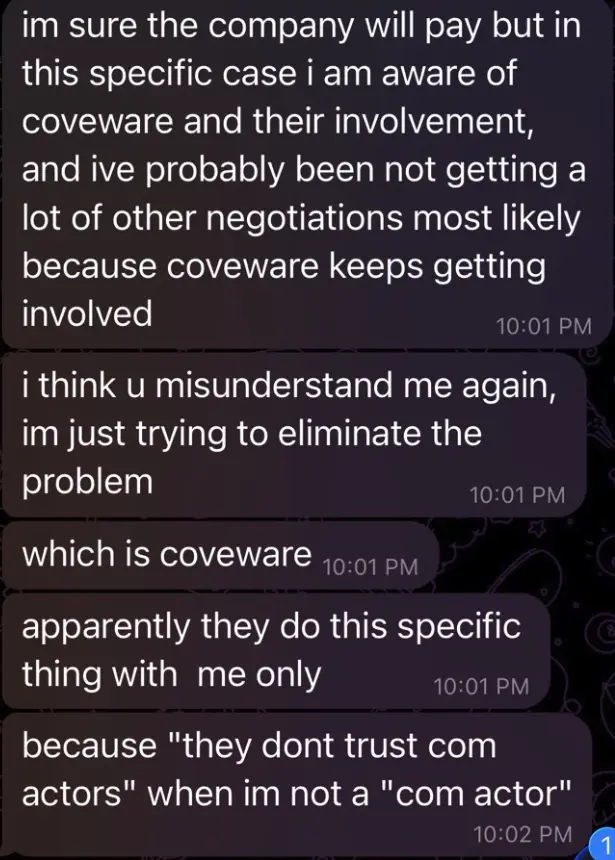
Leading cyber forensic firms such as Coveware and Unit 221B have consistently advised corporate victims against paying ShinyHunters, warning that cybercriminals routinely retain, resell, or re-extort compromised data regardless of agreements. This principled stance has drawn the violent ire of the hackers themselves. In intercepted Telegram chats from April and May 2026, ShinyHunters leaders openly bewailed that Coveware’s anti-ransom advisories were destroying their business model, explicitly discussing plans to "eliminate the problem."
Federal authorities are increasingly treating complicit negotiators as co-conspirators rather than neutral intermediaries. This shift is underscored by recent Department of Justice actions, including the October indictment of MonsterCloud CEO Zohar Pinhasi on wire fraud charges for secretly paying hackers behind his clients’ backs, and the July sentencing of Florida ransomware negotiator Angelo Martino to 70 months in prison for leaking client negotiation strategies directly to the BlackCat/ALPHV syndicate.
Future Outlook
The convergence of state-sponsored intelligence capabilities, international law enforcement cooperation, and aggressive federal prosecutions marks a watershed moment in the global fight against cyber extortion. The dismantling of the ShinyHunters administrative core—catalyzed by the dramatic arrest of Pepijn van der Stap, the compromise of administrative infrastructure like Shinywire, and the ongoing cooperation of detained administrator "Rey"—demonstrates that the digital walls are closing in on elite cybercrime syndicates.

More critically, the criminal charges brought against corporate executives like Edward Dubrovsky signal an aggressive expansion of prosecutorial scope. Federal investigators are no longer focusing solely on the teenage hackers and eastern European affiliates pressing computer keys; they are casting a wide net over the professional services sector, targeting the white-collar intermediaries, negotiators, and consultants who act as vital enablers in the global ransomware economy. As the Department of Justice continues to unseal indictments and scrutinize contingency-fee payment models, the cyber insurance and incident response industries face an existential reckoning over ethics, transparency, and accountability.