Executive Overview
As artificial intelligence shifts from a theoretical productivity tool to the literal backbone of organizational operations, the question facing executives is no longer if transformation will happen, but how it restructures human labor. Few organizations are positioned to answer this better than Anthropic. Having aggressively rebuilt its internal workflows around autonomous AI agents more deeply than almost any other B2B enterprise, the company has published an unprecedented empirical report examining how AI has altered its own workforce.
Drawing from a massive trove of internal data—including headcount registries, agent session telemetry, calendar utilization, Slack communication patterns, and hiring scorecards, alongside qualitative insights from 17 employee interviews—the report offers the most granular look available into the structural evolution of a hyper-growth AI firm.
The findings present a complex double-edged sword for the modern labor market. On one hand, Anthropic’s economic output has exploded: headcount has tripled year-over-year, and revenue per employee sits at an astonishing two to four times the historical efficiency benchmarks achieved by tech giants Google and Meta at similar developmental milestones. On the other hand, the data reveals a painful contraction in entry-level opportunities, a dramatic shift toward managerial "meta-work," and a workforce bottlenecked not by technology’s limitations, but by human capacity to consume agent output.
For founders, executives, and enterprise leaders, Anthropic’s internal metamorphosis serves as both a roadmap and a cautionary tale. Here is an exhaustive analysis of the five core takeaways from the report, alongside the broader implications for the future of employment.
Detailed Chronology: The Evolution of an Agent-Driven Workforce
To understand how Anthropic transformed its operations, one must look at the timeline of structural and operational shifts that occurred between early 2025 and mid-2026.
The Early Displacement of Junior Technical Labor (Early 2025 – July 2026)
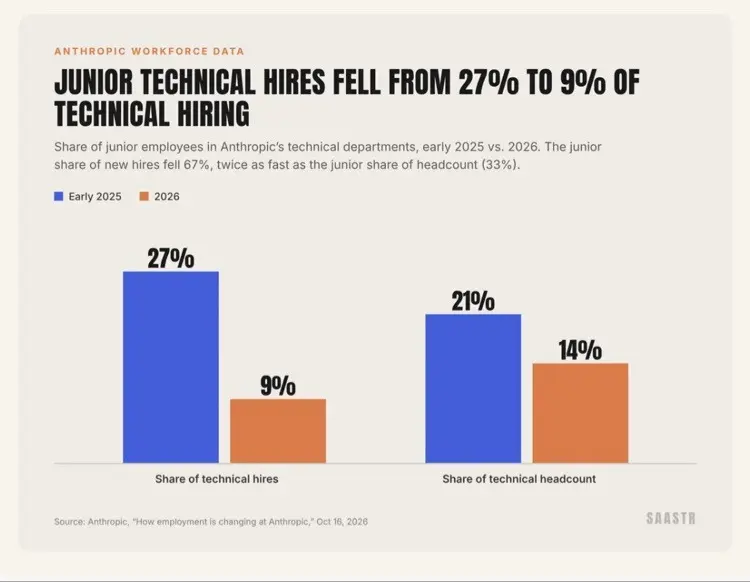
The most profound structural disruption highlighted in the report is the steep, rapid decline in hiring for junior technical talent. In early 2025, junior employees accounted for 21% of Anthropic’s overall technical departments, while junior candidates represented 27% of all new technical hires. By mid-2026, those numbers plummeted to 14% of the existing technical workforce and a meager 9% of new technical hires. Junior job requisitions dropped off a cliff beginning in December 2025.
This shift was catalyzed in January 2026 within teams most heavily reliant on Claude. The baseline capabilities required for writing boilerplate code, executing basic refactoring, and performing routine bug hunting were entirely offloaded to autonomous agents. According to the report, a single performance-engineering model release dramatically altered hiring prerequisites almost overnight. By April 2026, engineering and research leadership had systematically deprioritized lower-band technical hiring. Approximately one-third of machine learning managers and one-fifth of software engineering managers explicitly cited AI-driven automation as the reason for scaling back their hiring targets.
Crucially, Anthropic’s internal authors acknowledge a sobering reality: corporate redeployment programs and worker protections do little to cushion the blow for the junior engineer who never receives an initial job offer.
The Scaling Tipping Point and Administrative Flatlining (2025 – 2026)
While technical hiring patterns skewed upward toward senior talent, the company’s overall headcount tripled over a 12-month period. Interestingly, the internal composition of this expanded workforce shifted: technical departments shrank as a relative percentage of total headcount, moving from 61% to 56%. While absolute numbers in engineering continued to grow, customer-facing functions like sales, finance, and recruiting expanded at a much faster rate.
Simultaneously, administrative and clerical headcount remained virtually flat. Through the strategic deployment of agent assistants, automated document review pipelines, and outsourced ticket handling, Anthropic maintained a lean clerical infrastructure even as it tripled in size. Executive assistants reported that entry-level scheduling and email triage were entirely automated, elevating their daily responsibilities into strategic chief-of-staff functions.
The Crossover of Agent and Human Work Hours (March – August 2026)
The operational tipping point occurred in March 2026, when total autonomous agent work hours surpassed human work hours at Anthropic for the first time in corporate history. By August 2026, when measuring exclusively the agents initiated and directed by employees themselves, agents were logging six times as many operational hours as their human supervisors.
This surge in automated output directly correlated with skyrocketing productivity metrics. Code commits per engineer surged to five times their baseline levels from six months prior. Legal teams processed contracts at unprecedented velocities, accounts payable cleared significantly higher volumes of invoices, and sales representatives closed deals faster than ever before.
Supporting Context & Metrics: The Mechanics of Human-Agent Collaboration
To grasp the true nature of modern work at Anthropic, one must examine the operational bottlenecks, the emergence of "meta-work," and the changing definitions of institutional productivity.
The 80% Idle Trap: Humans as the New Bottleneck
Despite the staggering speed of autonomous agents, a fascinating operational paradox emerged: interactive Claude sessions spent approximately 80% of their time sitting idle, waiting for human intervention.
This latency was primarily driven by human cognitive and reading loads. Over a six-month period, the volume of technical and non-technical agent output climbed so rapidly that simply reviewing, validating, and approving agent-generated deliverables threatened to consume more than half of an employee’s total work week. As one engineer succinctly put it, humans had become the primary bottlenecks throttling the agents.
To mitigate this, employees increasingly relied on autonomous validation pipelines, where one agent reviewed the output of another before it ever reached a human eye. Yet, critical governance, architectural decisions, and cross-team alignments still required human consensus.
The Explosion of Meta-Work and Standing Instructions
As employees spent less time executing direct tactical tasks, they spent significantly more time managing the systems themselves—a phenomenon Anthropic terms "meta-work."
Written standing instructions provided to agents skyrocketed from a few hundred in July 2025 to 8,500 a year later. Meta-work consumed 10% of the average employee’s interactive sessions in the fall of 2025, climbing to 22% by the spring of 2026. Employees drafted multi-agent specs, designed performance reviews for their AI workflows, and built framework repositories for colleagues to leverage.
Paradoxically, internal meetings also increased. The median employee spent 20% more time in meetings compared to the previous year, while technical individual contributors saw a 16% rise in meeting hours. Why? Because agents operate poorly in ambiguous environments. Decisions made in unrecorded side-conversations or fleeting direct messages leave agents working from stale context. To combat this, Anthropic shifted toward radical transparency, mandating that operational decisions be recorded in open Slack threads and centralized documents where agents could continuously ingest updated parameters.
Official Statements and Industry Insights
The insights published in Anthropic’s internal report find validation in real-world applications across the broader tech ecosystem. Industry leaders who have tested these operational models at scale offer valuable context.
At the SaaStr AI 2026 conference, Anthropic’s sales leadership shared how these operational shifts played out in revenue-generating functions. Kelly Loftus detailed how she scaled startup sales from fewer than 10 people to over 150 in just 18 months, during a period where total company headcount grew from 250 to 1,300. Remarkably, Loftus’s sales organization operates without traditional quotas, relying instead on dynamic "shadow targets."
Eleanor Dorfman explained the structural necessity of these innovations, noting that the organization simply could not absorb three to five times the traditional number of sales reps fast enough to keep up with surging market demand. By completely re-architecting the sales organization in January 2026, Anthropic achieved a milestone where 54% of new enterprise logos were acquired through self-serve funnels just four months later—an extreme outlier driven by unprecedented market pull.
Furthermore, the data points to a fundamental evolution in hiring criteria. An analysis of internal hiring manager scorecards from 2024 to 2026 reveals that explicit mentions of a candidate’s track record with AI tools tripled for technical roles and quadrupled for non-technical positions. For technical candidates, markers of autonomy and judgment surged in evaluation frequency, while pure domain expertise shrank. For non-technical candidates, customer and mission orientation eclipsed traditional execution skills. Hiring managers emphasized that because base foundational models remain uneven across specialized domains, organizations require adaptable generalists who excel at directing autonomous tools rather than narrow specialists locked into a single technology stack.
Future Outlook: Equity, Early Warnings, and the Enterprise Horizon
As enterprises look toward the remainder of the decade, Anthropic’s report outlines two critical structural frameworks designed to stabilize the workforce through this seismic transition: aligned financial compensation and predictive internal mobility.
The Modern Productivity Bargain
Recognizing that employees are expected to manage autonomous agents, execute VP-level decision-making, and continuously automate their own task lists, Anthropic heavily utilizes broad-based stock ownership. The report draws a deliberate parallel to the 1950s union bargain, where workers accepted structural workflow reorganizations in exchange for a direct financial stake in productivity gains. Without substantial equity upside or profit-sharing tied to automation output, employee resistance to efficiency initiatives is virtually guaranteed.
The Early Warning System for Workforce Shifts
To prevent sudden layoffs and manage internal talent pools effectively, Anthropic implemented a predictive early warning system. This system tracks real-time market demand and role-specific productivity gains against advancing AI capabilities. When data indicates that a specific job function is beginning to compress, the organization proactively initiates redeployment programs, shifting human capital into adjacent roles where their skills align before legacy functions vanish. This proactive pipeline management accounts for a 50% year-over-year surge in internal employee mobility.
Conclusion for the B2B Executive
Anthropic’s self-audit is not merely a corporate case study; it is a preview of the operational reality awaiting the wider knowledge-economy. While most B2B companies cannot match Anthropic’s hyper-growth trajectory or equity structures, the underlying lessons are universally applicable.
Organizations must prepare for the compression of junior entry points, actively design systems to prevent human "reading fatigue" bottlenecks, transition their hiring frameworks to reward agentic autonomy over static execution, and implement internal talent early-warning systems. The future belongs not to the companies that write the most code or process the most invoices by hand, but to the organizations that most effectively orchestrate the delicate, high-judgment dance between human intent and autonomous execution.