Executive Overview
In modern cloud-native software engineering, platform engineering teams face a persistent operational friction point: configuring and maintaining ingress networking for containerized applications running at scale. For every microservice or containerized workload deployed on the Amazon Elastic Container Service (Amazon ECS), infrastructure teams traditionally have had to manually provision, wire together, and continuously manage a web of supporting components. These include Application Load Balancers (ALBs), AWS Certificate Manager (ACM) SSL/TLS certificates, AWS WAF web access control lists (web ACLs), and complex security groups.
As organizations scale to hundreds or thousands of microservices, this per-service provisioning model introduces critical bottlenecks. Deployment velocity drops, configuration drift creeps across environments, and infrastructure management overhead balloons.
To solve these architectural challenges, Amazon Web Services (AWS) has announced the general availability of Amazon ECS Gateway. This powerful new account-level resource radically simplifies ingress networking for containerized workloads. By shifting the burden of infrastructure provisioning and lifecycle management to ECS itself—while retaining full resource creation inside the customer’s AWS account—ECS Gateway establishes a clean separation of duties between platform operators and application developers.
With support for host-based routing, automatic load balancer scaling (allowing up to 25 services to share a single ALB for maximized cost-efficiency), automated DNS generation, and a flexible many-to-many relationship mapping between gateways and clusters, ECS Gateway represents a paradigm shift in how container networking is handled on AWS. Available today across all commercial AWS regions at no additional software charge, this capability promises to eliminate manual toil, reduce cloud spend, and accelerate time-to-market for enterprise engineering organizations.
Detailed Chronology: The Evolution of ECS Ingress and the Birth of the Gateway
The Traditional Burden of Container Networking
To understand the significance of Amazon ECS Gateway, one must look at how ingress networking has historically operated within container orchestration platforms. When ECS was first introduced, and even as it matured into a preferred engine for high-scale microservices, it treated application networking largely as an exercise for the user or the platform team.

Whenever an application team built a new service, they required a public or internal entry point. Platform engineers had to write automation scripts—often embedded in Terraform, AWS CloudFormation, or bespoke CI/CD pipelines—to instantiate an ALB listener, generate or fetch a domain certificate via ACM, create target groups, map health checks, establish strict security group rules restricting traffic exclusively from the load balancer to the container instances, and register DNS records in Amazon Route 53.
Over time, this architecture created severe maintenance overhead:
- Configuration Drift: As security patches were applied or requirements changed, load balancer configurations and security groups frequently drifted out of compliance.
- Resource Exhaustion and Cost Inefficiencies: Developers often spun up dedicated ALBs for minor services, driving up infrastructure costs unnecessarily.
- Operational Bottlenecks: Every single deployment request required platform team intervention or complex internal self-service portals to wire up networking, stalling the velocity of application teams.
The Engineering Breakthrough: Designing ECS Gateway
Recognizing these friction points, AWS engineers set out to build an abstraction layer that would automate the tedious mechanics of ingress configuration without taking away underlying control or security compliance.
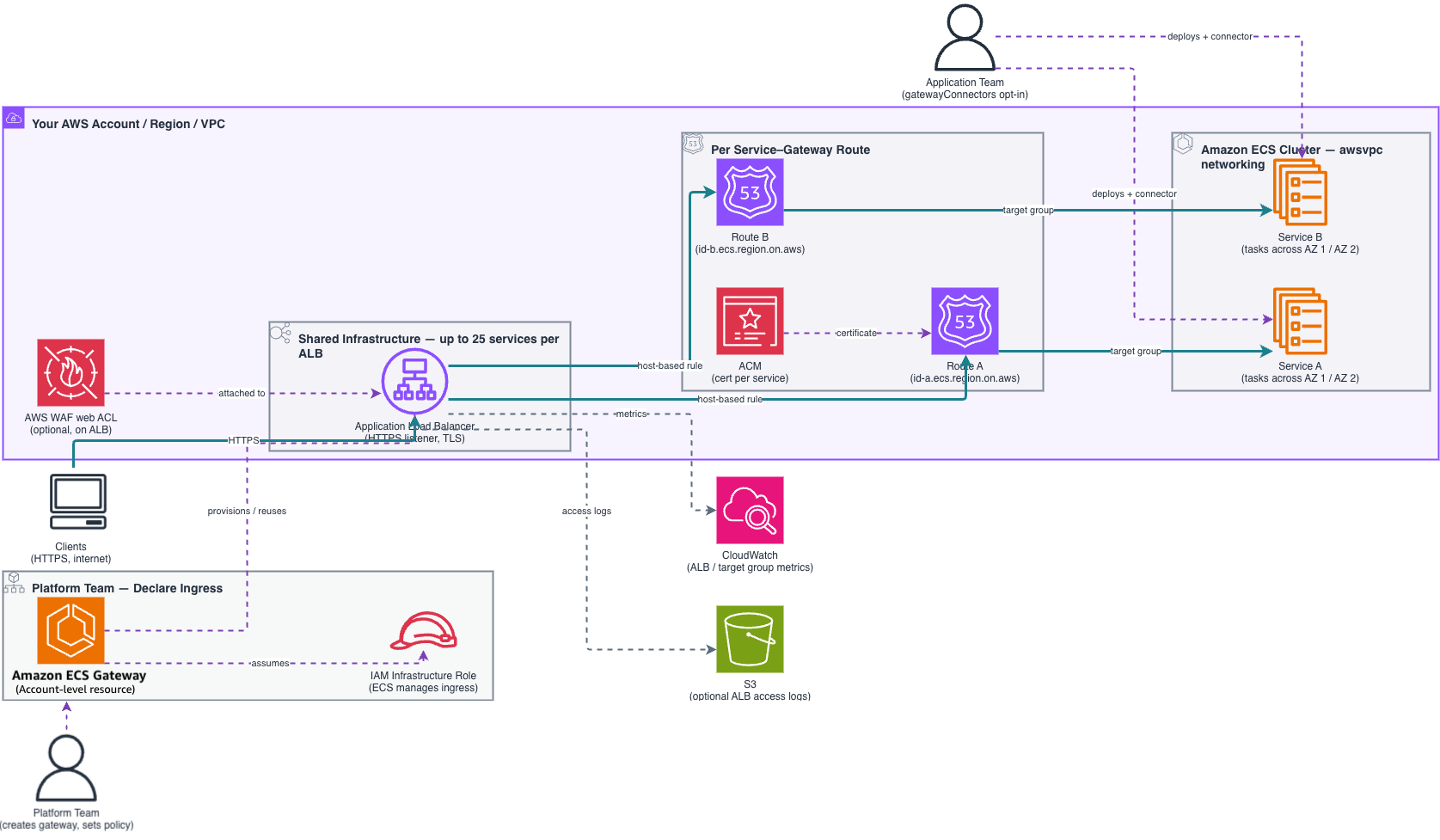
The core design philosophy of ECS Gateway centers on an account-level resource model. Instead of configuring networking service-by-service, platform teams now create a centralized gateway entity once per account or environment. This gateway acts as a smart traffic router and orchestrator.
When an application team deploys or updates a service and attaches a "gateway connector," ECS steps in behind the scenes. It evaluates cluster compatibility, checks VPC and Availability Zone (AZ) alignment, provisions the required per-service resources (such as ACM certificates and unique DNS hostnames), assigns the service to an ALB with available capacity, and automatically updates listener rules.

If an existing ALB reaches its capacity limit (such as max target group or listener rule thresholds), ECS automatically provisions a new ALB up to a pre-configured maximum count (maxAlbCount). Conversely, when services are decommissioned, ECS cleans up the associated infrastructure. This automated lifecycle management transforms container networking from a manual, error-prone chore into a fully managed, declarative experience.
Supporting Context & Metrics: Architecture, Configuration, and Mechanics
Architectural Paradigm: Separation of Responsibilities
Amazon ECS Gateway enforces a clean boundary between the two primary personas in a cloud-native organization:
- Platform Teams: Responsible for the overarching governance, security guardrails, and networking foundations. They create the gateway, define IAM infrastructure roles, select VPC subnets, apply AWS WAF web ACLs for security, and associate gateways with relevant ECS clusters.
- Application Teams: Focused entirely on business logic. Instead of worrying about load balancers or certificates, application developers simply add a lightweight gateway connector to their service definitions (
CreateServiceorUpdateService), declaring their intent to expose the service publicly or internally.
Deep Dive into Gateway Mechanics
A single ECS Gateway can be associated with up to 10,000 ECS clusters, while an individual cluster can support up to five distinct gateway associations. This robust many-to-many relationship matrix gives platform architects immense flexibility. For example, an organization can maintain distinct "Public-Facing" and "VPC-Internal" gateways, attaching both to specific clusters to handle varied traffic profiles seamlessly.
Cost Optimization via Host-Based Routing
To prevent wasteful cloud spending, ECS Gateway leverages host-based routing via Application Load Balancers. Up to 25 individual services can safely share a single ALB. ECS intelligently manages this density, packing services onto shared load balancers until capacity limits are met, at which point it provisions a fresh ALB. This architectural choice dramatically cuts down on idle load balancer hourly fees, making microservices architectures far more cost-effective at scale.
Step-by-Step Configuration & Implementation
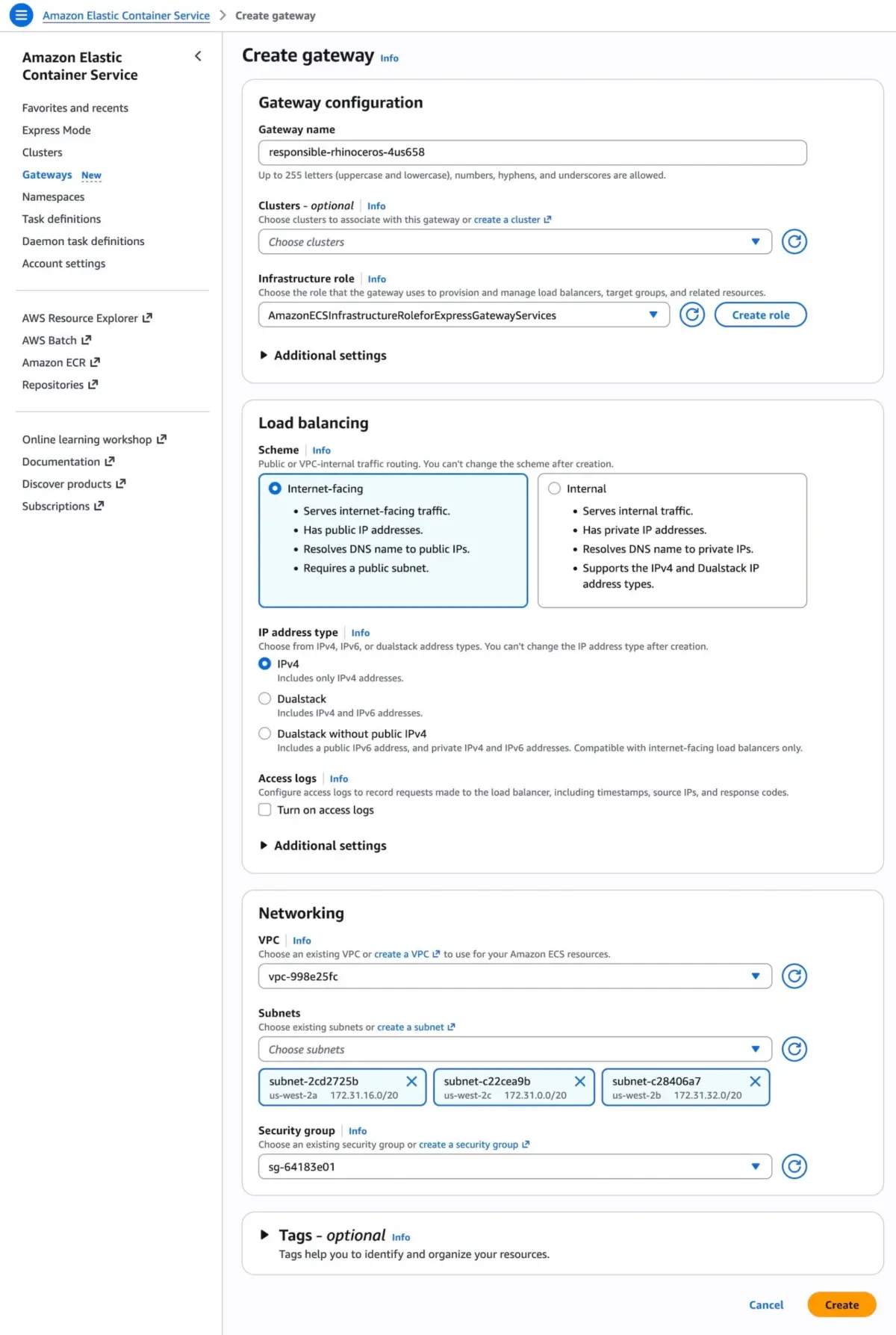
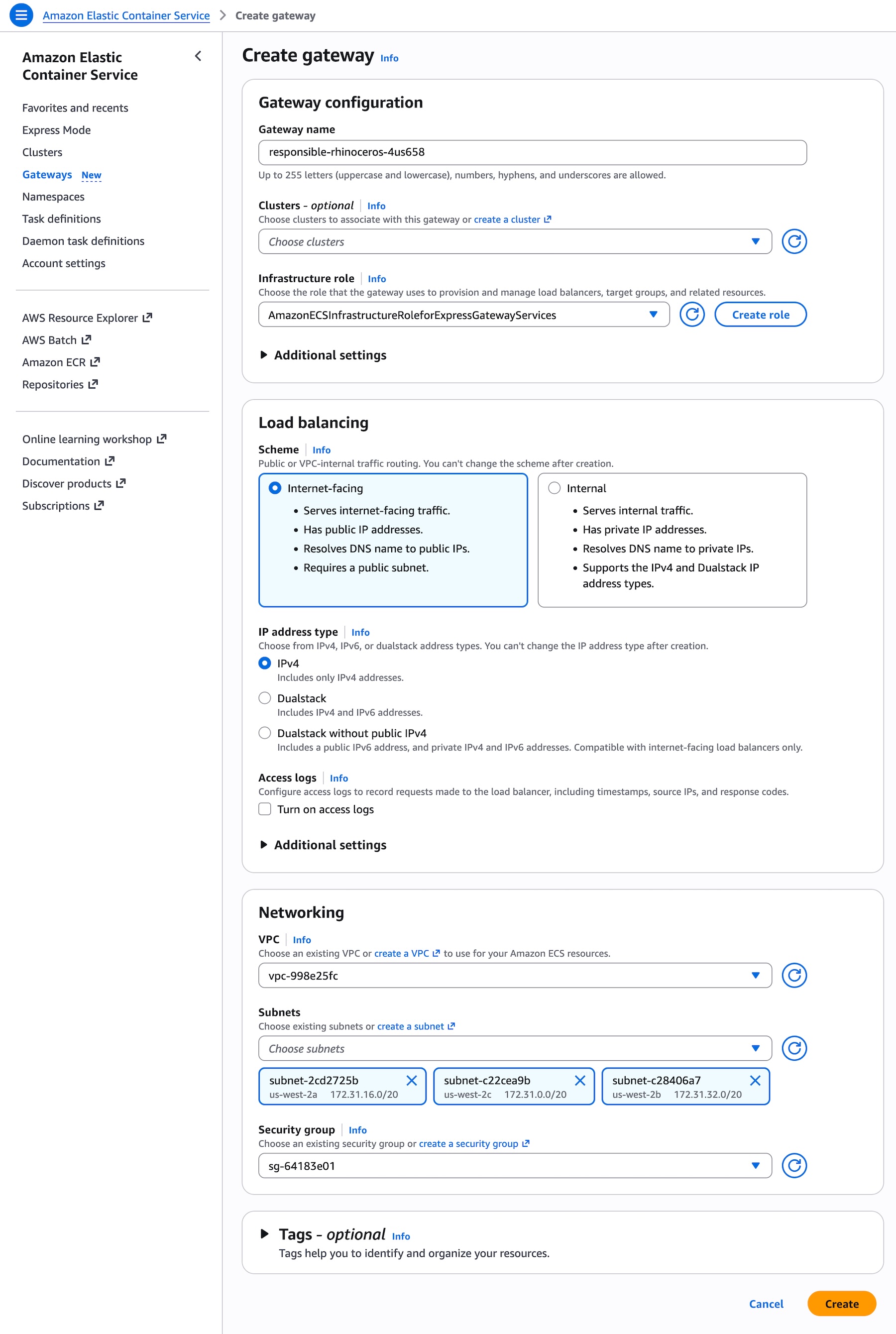
Platform teams can set up ECS Gateway using either the AWS Management Console or the AWS Command Line Interface (CLI).
To instantiate a gateway via the AWS CLI, an administrator invokes the CreateGateway API, supplying a unique name, an IAM infrastructure role (which ECS assumes to provision ALBs, security groups, and certificates), and a configuration payload:
aws ecs create-gateway
  --name my-team-gateway
  --infrastructure-role-arn arn:aws:iam::123456789012:role/ECSGatewayRole
  --configuration '
    "HostSharedAlb":
      "networkConfiguration":
        "subnets": [
          "subnet-080779f9bd887757a",
          "subnet-03d5b2fead6bc6258",
          "subnet-0861210a397d31252",
          "subnet-06539e194023cb77a"
        ],
        "ipAddressType": "ipv4"
      ,
      "scheme": "internet-facing"

  '
Once the gateway is established, it must be linked to target ECS clusters using the AssociateGatewayWithCluster command:
aws ecs associate-gateway-with-cluster
  --gateway my-team-gateway
  --cluster arn:aws:ecs:us-east-1:123456789012:cluster/my-cluster
Incremental Adoption for Existing Services
Organizations do not need to perform a disruptive "big bang" migration to adopt ECS Gateway. For legacy or existing ECS services already tied to standalone load balancers, teams can adopt ECS Gateway incrementally. By calling UpdateService to inject a gateway connector, both ingress pathways remain active concurrently. This allows engineering teams to thoroughly validate the new gateway routing and DNS endpoints before safely deprecating and removing the legacy load balancer configuration.
Here is an example of updating or creating a service with a gateway connector:
aws ecs create-service
  --cluster my-cluster
  --service my-api-service
  --task-definition my-api-service:1
  --gateway-connectors '[ "portName": "api", "filters": "accessTypes": ["PUBLIC"], "healthCheck": ... ]'
Official Statements and Industry Perspective
The release of Amazon ECS Gateway addresses a long-standing pain point voiced by cloud architects across enterprises utilizing container technologies. While serverless platforms like AWS Fargate abstracted away underlying virtual machines, ingress networking remained stubbornly complex.
Industry analysts and early preview participants have lauded the feature for its balance of automation and absolute user-account ownership. Because all underlying infrastructure—including ALBs, target groups, and ACM certificates—is provisioned directly inside the customer’s AWS account, security and compliance teams retain full visibility, auditability, and control over every physical asset. There are no opaque managed proxies hiding traffic flows; standard AWS monitoring tools, metrics, and logs apply natively.
Furthermore, AWS has integrated modern developer workflows into the rollout. Developers and platform engineers can build, manage, and query ECS Gateway APIs programmatically using AI-assisted coding tools equipped with the AWS MCP Server and associated plugins, bridging the gap between advanced automation and natural language infrastructure management.
Future Outlook: The Next Wave of Container Operations
As container densities increase and microservices architectures continue to fragment into hyper-granular distributed systems, the tooling supporting them must evolve from reactive scripts to proactive, intelligent controllers. Amazon ECS Gateway is a foundational step in this evolution.
Looking ahead, we can anticipate deeper integrations between ECS Gateway and broader AWS security and mesh services, further shrinking the administrative footprint required to run mission-critical container estates. By removing the undifferentiated heavy lifting of ingress configuration, AWS is empowering engineering organizations to redirect their intellectual capital away from plumbing and toward building high-value, customer-facing applications.
Getting Started Today
Amazon ECS Gateway is available immediately across all commercial AWS regions where Amazon ECS is supported. There is no additional software charge for using the gateway itself; customers simply pay for the underlying AWS resources provisioned within their accounts (such as Application Load Balancer hourly rates, data transfer fees, ACM certificates, and CloudWatch logs/metrics).
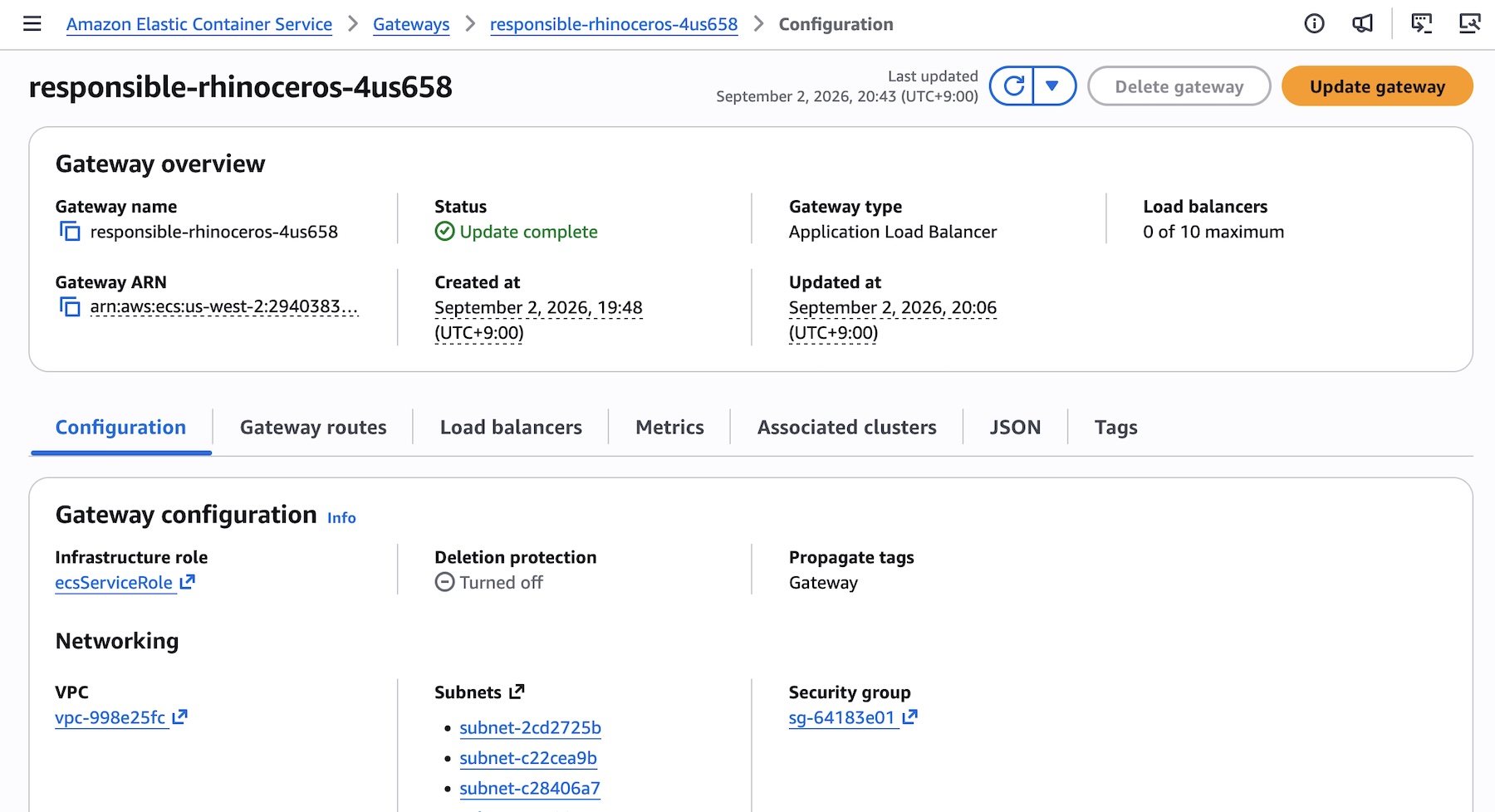
Platform teams can provision their first gateway via the Amazon ECS Console, explore comprehensive guidance in the Amazon ECS Gateway Documentation, and join the community conversation via AWS re:Post for ECS.