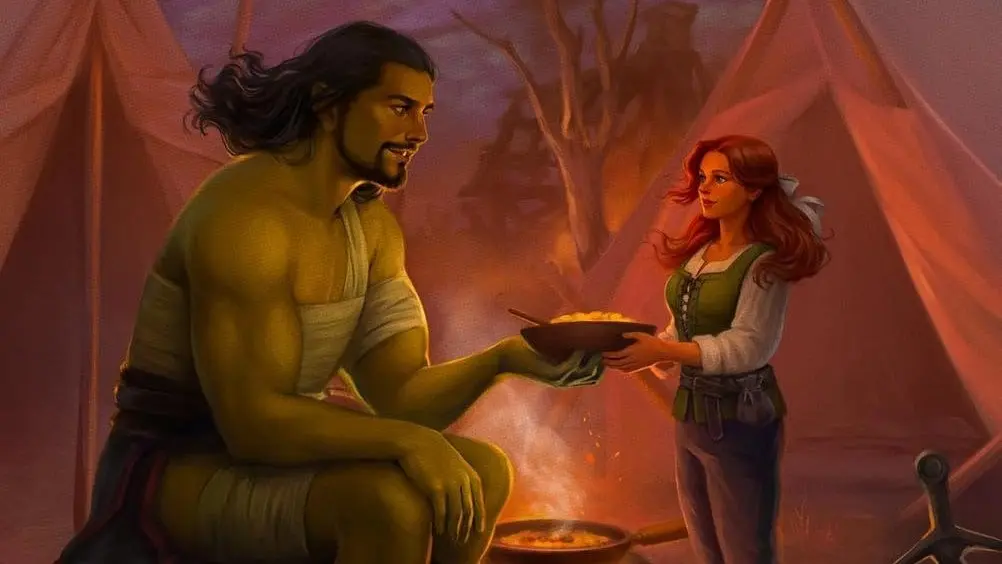
In the ever-expanding landscape of contemporary fantasy literature, authors constantly seek innovative ways to blend comforting tropes with high-stakes adventure. Enter Cooking Up Magick, the inaugural installment of The Dell Chronicles by HL Bernabe. Billed as a cozier, more approachable version of J.R.R. Tolkien’s legendary The Lord of the Rings, the novel sets out to combine the rustic charm of culinary exploration with the sweeping gravitas of epic fantasy. At its core, the narrative follows Paisley, a cheerful halfling who leaves the comfort of her family’s inn to gather new recipes, only to find herself thrust into an ancient struggle against a resurrected dark lord.
While the premise promises a delightful mashup of mouth-watering culinary arts and magical adventure, the execution reveals a tug-of-war between two distinct subgenres. On one hand, Bernabe succeeds in crafting an endearing, tightly knit core cast whose dynamics exemplify the comforting tropes of the "found family" subgenre. On the other hand, the book struggles to fully flesh out its alternate version of Middle-earth, occasionally sacrificing its unique culinary identity to chase the sprawling, war-torn conventions of traditional high fantasy.
This comprehensive review explores how Cooking Up Magick navigates its identity crisis, examining its character development, the friction between its magical and culinary elements, its antagonist’s construction, and what this debut means for the future of The Dell Chronicles.
Detailed Chronology: The Journey of Cooking Up Magick
To understand the narrative trajectory of Cooking Up Magick, one must trace Paisley’s physical and emotional migration from a quiet, provincial life to the center of a geopolitical crisis.
Act I: The Culinary Quest Begins
The novel opens in the safety and warmth of a family-run inn, establishing Paisley’s primary motivation: an insatiable wanderlust driven by food. Unlike classic heroes who yearn for glory or are driven by prophecy, Paisley’s initial impetus for leaving home is remarkably grounded. She wants to taste the world, master regional flavors, and return home with a ledger full of new recipes. This opening act establishes a charming, slow-paced rhythm that echoes the pastoral comfort of the Shire.
Soon, however, Paisley’s solitary culinary tour is interrupted by fate. She crosses paths with a pair of steadfast dwarves, anchoring the narrative firmly in classic fantasy archetypes. The early chapters rely heavily on these character introductions, showcasing Paisley’s infectious optimism as she binds the disparate group together with her vibrant personality and hospitality.
Act II: The Awakening of Latent Powers
As the party ventures further into the wider world, the stakes quietly shift. Unbeknownst to Paisley and her companions, a dark entity long thought vanquished—an evil overlord named Verzod—has returned after centuries of dormancy. The narrative occasionally pivots away from the heroes to give readers a glimpse into Verzod’s perspective, establishing his campaign to ignite war across an otherwise peaceful land.
Concurrently, Paisley begins to manifest magical abilities. Rather than conforming to traditional spellcasting rooted in arcane studies or inherited bloodlines, her magic stems directly from her deep-seated compassion and emotional connection to her companions. As she learns to channel this power to heal, protect, and bond with her friends—including a budding romance with a Half-Orc companion—the book enters its strongest character-building phase. Through shared discovery, both the reader and Paisley unlock the true depths of her sorcery.
Act III: The Eclipse of the Kitchen
However, as Verzod’s threat looms larger and Paisley’s magical aptitude takes center stage, the novel’s foundational premise begins to fracture. The culinary aspirations that initially launched Paisley out of her front door are systematically sidelined. What was once introduced as a story deeply infused with the love of food devolves into a more conventional quest narrative. While the core party remains engaging, the urgency of an impending global war eclipses the pots, pans, and recipe books that made the protagonist’s journey uniquely charming.
Supporting Context & Metrics: Tropes, Expectations, and Comparisons
To properly contextualize Cooking Up Magick, it is helpful to examine how it measures up against existing literary trends, specifically the boom of "cozy fantasy" and "romantasy," as well as comparisons to juggernauts of the genre.
The "Cozy Fantasy" and "Romantasy" Intersection
In recent years, readers have gravitated toward low-stakes, high-comfort narratives—often referred to as cozy fantasy—as well as romantic fantasy ("romantasy") blends. Cooking Up Magick attempts to straddle these movements by offering:

- The Found Family Dynamic: A central pillar of cozy fantasy, wonderfully executed through Paisley’s magnetic warmth and her interactions with her companions.
- Romantic Subplots: The inclusion of a Half-Orc love interest nods directly to contemporary romantasy cravings, adding emotional stakes to the journey.
- The Culinary Hook: Fans of anime and manga like Delicious in Dungeon (Dungeon Meshi) have come to expect a granular, enthusiastic celebration of food preparation within fantastical settings.
The Expectations vs. Reality Matrix
| Element | Promised / Expected | Delivered in Cooking Up Magick |
|---|---|---|
| Epic Scope | Lord of the Rings-level world-building and lore. | Surface-level alternate Middle-earth tropes lacking deep historical detail. |
| Culinary Focus | Delicious in Dungeon-levels of gastronomic passion. | Food acts primarily as an initial plot device rather than a persistent theme. |
| Magic System | Unique, flavor-infused sorcery tied to the protagonist’s craft. | Compassion-based magic that quickly overtakes and erases the culinary element. |
| Antagonist | A looming, mysterious ancient evil driving global conflict. | Verzod, an overtly "pure evil" antagonist whose motivations feel thinly sketched. |
The disconnect between the book’s marketing as an epic fantasy and its cozy roots creates a minor identity crisis. By attempting to scale up to the geopolitical dimensions of Tolkien’s works, the novel inadvertently dilutes the unique, intimate flavor that made its protagonist stand out.
Official Analysis and Critical Perspective
Literary critics evaluating modern fantasy debuts often look at how an author balances homage with originality. In the case of Cooking Up Magick, the critical consensus centers on a paradox: the book succeeds marvelously in its micro-moments while stumbling in its macro-structure.
Character Dynamics as the Saving Grace
The undisputed highlight of HL Bernabe’s debut is its character work, particularly concerning Paisley. As noted in critical evaluations of the text:
"As she learns about her new powers, so do we, and it’s some of the best Paisley character building we get in the entire story."
Paisley acts as the narrative’s sun, radiating a bubbly, compassionate energy that draws out the hidden depths of her dwarven companions and her Half-Orc romantic interest. These interpersonal exchanges validate the core theme of the "found family." When the characters are simply talking, resting by a campfire, or navigating small-scale interpersonal conflicts, the novel sings.
The Antagonist Problem: Verzod and Whipclaw
On the opposing end of the narrative spectrum lies Verzod, the dark sorcerer responsible for inciting the regional war. Bernabe dedicates multiple chapters to Verzod’s perspective, an ambitious narrative choice designed to give the antagonist dimension. However, these interludes yield mixed results.
Instead of cultivating a complex, morally grey villain, the perspective chapters frequently reaffirm that Verzod is a straightforward embodiment of pure evil. The sole humanizing element—his soft spot for his lost talking cat, Whipclaw—is undercut by the fact that Whipclaw spends the vast majority of the narrative traveling with Paisley. Consequently, readers are left with an antagonist whose primary function is to push the plot forward rather than challenge the reader’s philosophical boundaries. Critics argue that leaving Verzod as an obscured, mysterious shadow in the first book might have preserved a sense of dread, rather than exposing his simplistic motivations too early.
The Culinary Disconnect
Perhaps the most notable critique of Cooking Up Magick is its treatment of cooking. An author who writes a character obsessed with culinary discovery opens a tacit contract with the reader: food will matter. Unfortunately, the narrative relies too heavily on telling readers that Paisley loves cooking rather than showing it through rich descriptions of ingredients, local culinary customs, or the sensory joy of a well-prepared meal. Once her magic awakens, cooking vanishes into the literary ether, leaving behind a missed opportunity to carve out a genuinely unique subgenre niche.
Future Outlook: Where The Dell Chronicles Go From Here
Despite its structural growing pains, Cooking Up Magick establishes a sturdy sandbox for HL Bernabe to play in. A debut novel often bears the heavy burden of world-building, exposition, and character introduction all at once. Now that the expositional heavy lifting is largely out of the way, future installments in The Dell Chronicles possess significant room for refinement and growth.
Areas for Improvement in Subsequent Volumes
- Deepening the Lore: To truly rival the immersive quality of epic fantasy, Bernabe must expand the historical and cultural architecture of this alternate world, giving nations, factions, and magic systems more granular texture.
- Reintegrating the Kitchen: The author can easily course-correct by weaving Paisley’s culinary passions back into her magical development. Imagining combat or spellcasting through the metaphorical and literal lens of cooking could yield a uniquely flavorful magic system.
- Nuance for the Opposition: With Verzod established as the primary threat, future books would benefit from expanding upon his internal contradictions—perhaps by exploring the fate of Whipclaw or the political fallout of his war on the common folk.
The Verdict
Cooking Up Magick is a decent, highly readable debut that stumbles slightly under the weight of its own epic ambitions. By attempting to wear the heavy armor of The Lord of the Rings, it occasionally misplaces the cozy, culinary-focused apron that made its protagonist so charming in the first place.
Nevertheless, a strong, endearing core cast anchors the experience, keeping the pages turning even when the broader plot feels sluggish. For fans of cozy fantasy, found-family tropes, and light romantasy, HL Bernabe’s premiere offers plenty of charm and leaves ample room for the series to mature, blossom, and truly find its own magical recipe in the books to come.