Executive Overview
Managing containerized applications at scale has long been hailed as a triumph of modern cloud architecture, yet platform engineers have quietly wrestled with a persistent operational bottleneck: ingress networking. For every new service spun up on platforms like Amazon Elastic Container Service (Amazon ECS), teams have historically had to shoulder a heavy configuration burden. Provisioning and wiring together Application Load Balancers (ALBs), AWS Certificate Manager (ACM) certificates, AWS WAF web access control lists (web ACLs), and intricate security groups has meant writing repetitive infrastructure-as-code or manual scripts.
Worse yet, keeping these disparate elements synchronized as services continuously scale, update, or shift across availability zones introduces severe configuration drift and deployment friction.
To solve this enterprise-scale headache, Amazon Web Services (AWS) has announced the official launch of Amazon ECS Gateway. Designed as a brand-new, account-level resource, ECS Gateway redefines how ingress networking is handled for containerized workloads. By shifting the burden of dynamic provisioning and infrastructure lifecycle management directly to Amazon ECS—while retaining all resources securely within the customer’s AWS account—the service bridges the operational chasm between platform engineering and application delivery.
Featuring host-based routing that enables up to 25 services to share a single ALB, native DNS generation, and granular many-to-many cluster associations, ECS Gateway promises to slash infrastructure costs while accelerating deployment velocity across the board.

Detailed Chronology: The Evolution of Container Ingress and the Birth of ECS Gateway
The Per-Service Bottleneck of Yesteryear
In the early days of microservices and container orchestration, deploying a new application service on Amazon ECS was straightforward from an application perspective, but notoriously tedious from a networking standpoint. Platform teams operated in a high-touch environment where every discrete service demanded its own bespoke ingress blueprint.
Every time a developer wanted to expose a new API, the infrastructure pipeline had to allocate an ALB listener rule, request or bind an ACM certificate for secure HTTPS termination, attach a WAF web ACL to fend off common web exploits, and configure fine-grained security groups to permit least-privilege traffic flow.
As organizations scaled from a handful of monolithic components to hundreds or thousands of microservices, this per-service provisioning model began to crack. Platform teams became tickets-and-queues bottlenecks, holding back deployment velocity. Furthermore, updating routing paths or rotating security policies across dozens of isolated load balancers frequently resulted in human error, orphaned infrastructure assets, and compliance gaps caused by configuration drift.
The Architectural Breakthrough
Recognizing that platform engineers needed relief from undifferentiated heavy lifting, AWS product architects went to work designing a centralized, automated mechanism that could abstract ingress management without sacrificing control or security. The result of this multi-year engineering effort is ECS Gateway.
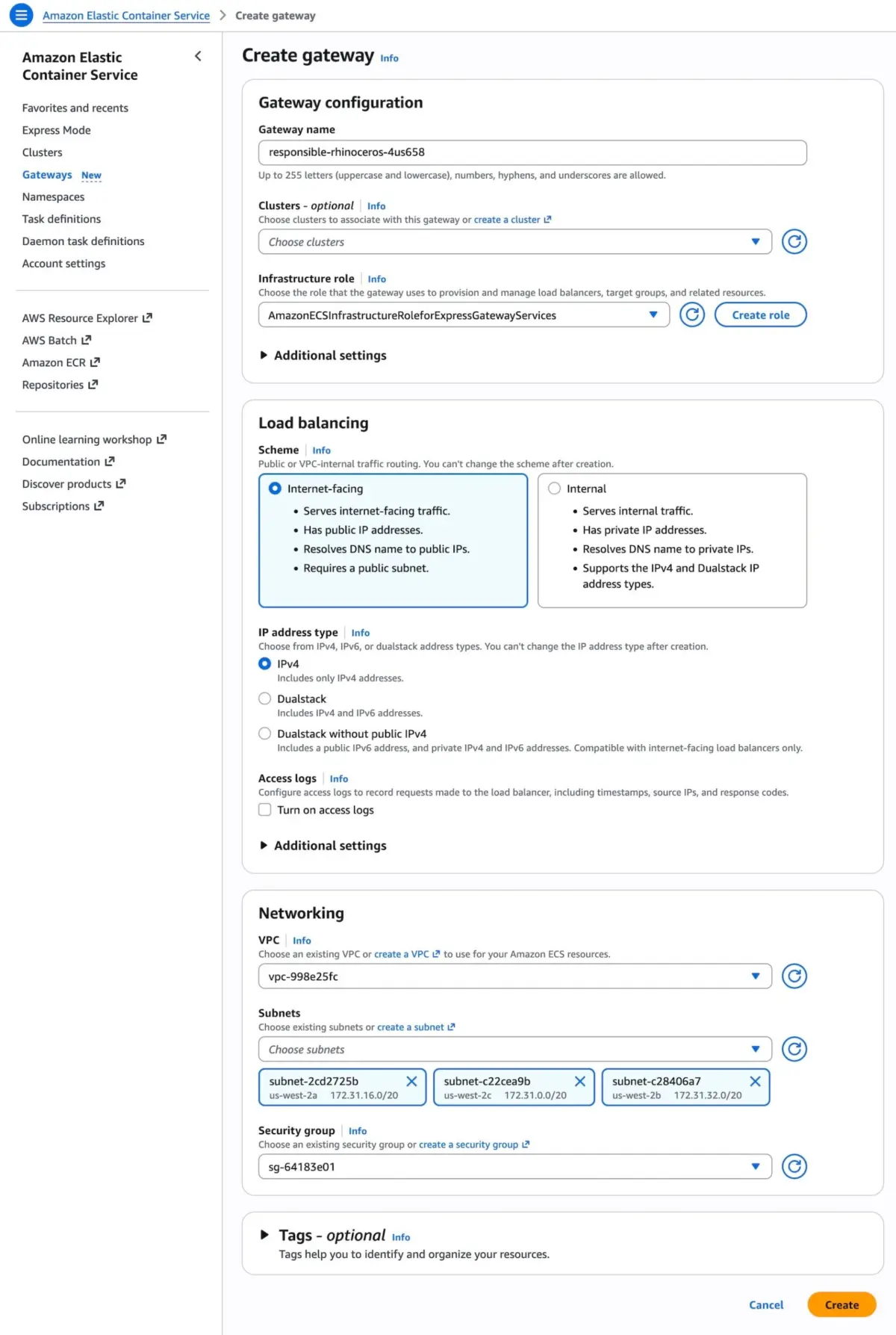
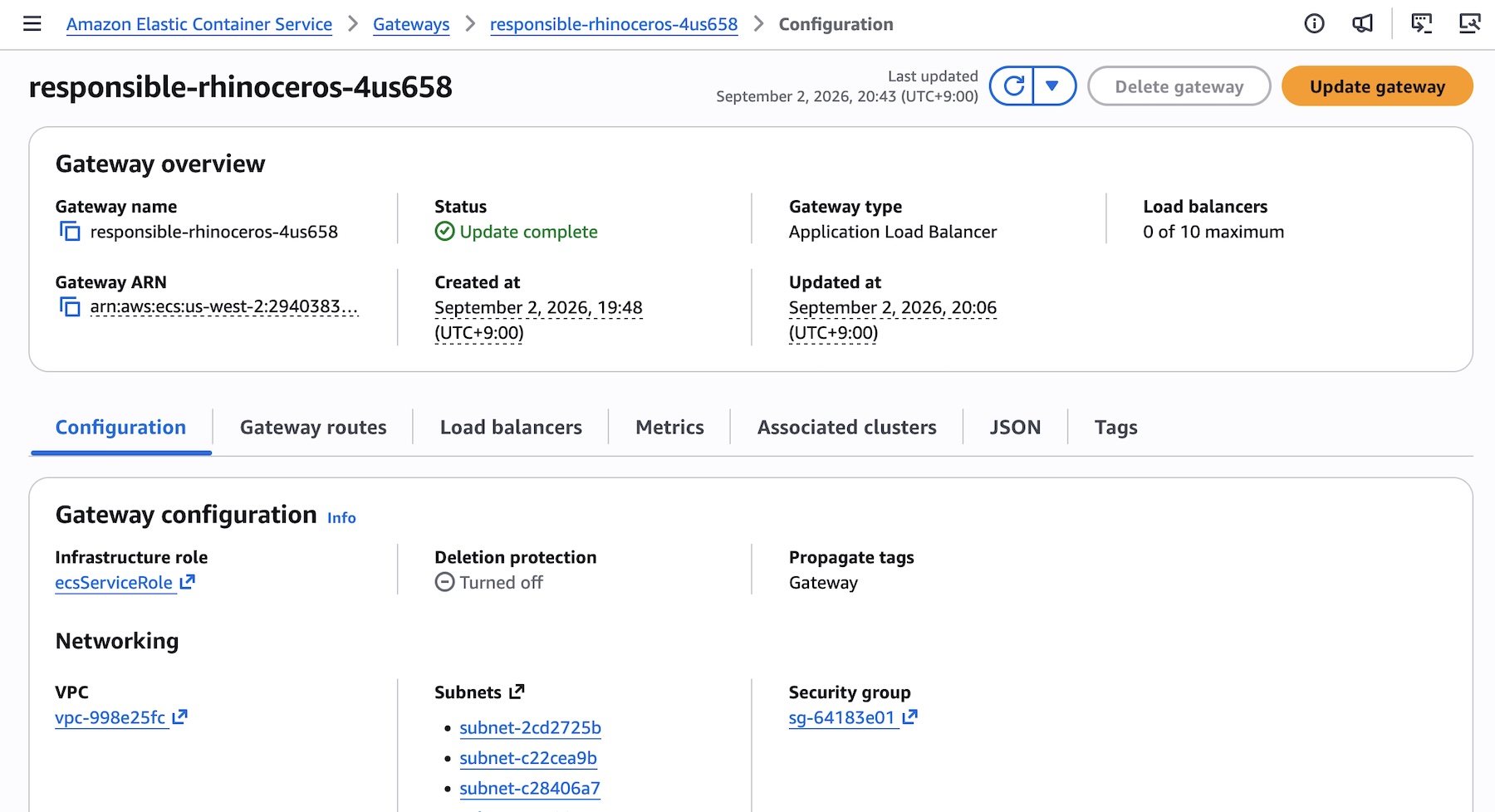
Rather than forcing teams to manually wire networking constructs for every single task definition, ECS Gateway introduces an intelligent control plane layer. At its core, the gateway acts as a dynamic orchestrator. When platform administrators establish a gateway resource, they define its baseline parameters—such as public or VPC-internal routing schemes, targeted subnets, and overarching security policies.

From there, application teams simply reference a lightweight "gateway connector" in their service definitions. When an ECS service launches or scales, the container service engine evaluates connected gateways, checks compatibility criteria (such as VPC boundaries and Availability Zone coverage), and automatically spins up the requisite backend wiring: target groups, listener rules, secure ACM certificates, unique DNS hostnames, and targeted security groups.
Crucially, the lifecycle of this infrastructure is fully automated. When the first service connects, ECS provisions the initial ALB. As services multiply and traffic grows, ECS automatically scales out additional ALBs up to a pre-configured maximum threshold (maxAlbCount). When services are decommissioned or disconnected, the underlying infrastructure is pruned just as cleanly, eliminating ghost assets and wasted cloud spend.
Supporting Context & Metrics: Architecture, Economics, and Scale
Mechanics of the Many-to-Many Architecture
To fully appreciate the versatility of ECS Gateway, one must examine its structural topology. A single ECS Gateway can be associated with up to 10,000 distinct clusters, while any individual cluster can support up to five concurrent gateway associations.
This flexible many-to-many relationship empowers enterprise platform teams to design sophisticated, multi-tenant network zones. For example, an organization can provision separate "Public-Facing" and "VPC-Internal" gateways, then selectively associate them with production, staging, or development clusters based on organizational governance models.
+-----------------------------------------------------------------+
|                         ECS Gateway                             |
|  - Account-level resource                                       |
|  - Manages ALB lifecycle, ACM certificates, WAF, DNS hostnames  |
+-----------------------------------------------------------------+
         |                                                 |
   (Associated)                                      (Associated)
         v                                                 v
+-----------------------+                         +-----------------------+
|      Cluster A        |                         |      Cluster B        |
|  - Supports up to 5   |                         |  - Supports up to 5   |
|    gateway associations |                         |    gateway associations |
+-----------------------+                         +-----------------------+
      |               |                                 |
      v               v                                 v
[Service 1]       [Service 2]                       [Service 3]
Cost Optimization via Host-Based Routing
One of the most compelling economic benefits of ECS Gateway is its high-density routing capability. Traditional container architectures often suffered from low resource utilization when dedicating an entire Application Load Balancer to a single low-traffic microservice.
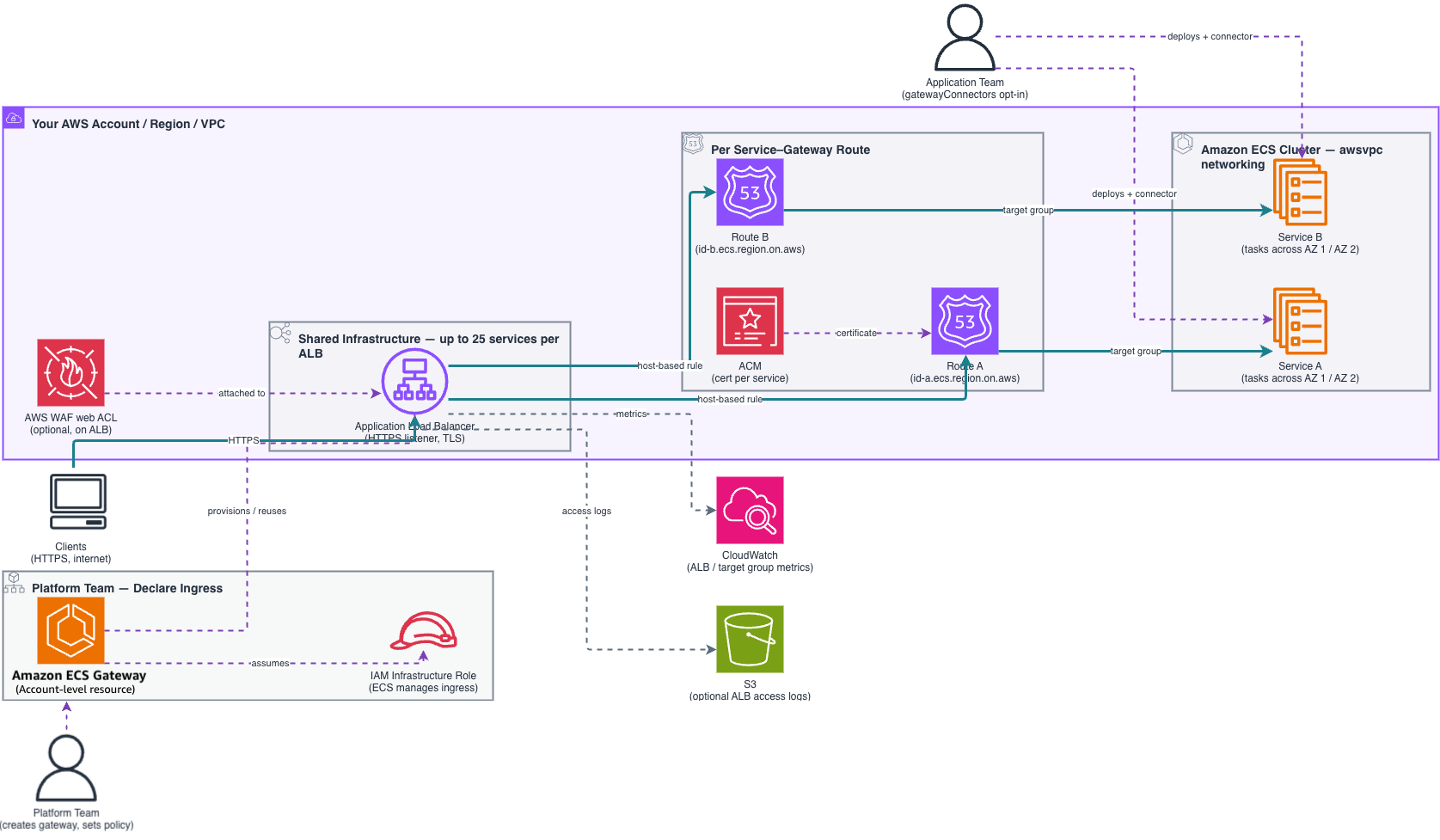
ECS Gateway leverages host-based routing to allow up to 25 distinct services to safely share a single ALB. By multiplexing inbound traffic over shared load balancer infrastructure, organizations can drastically reduce their fixed AWS operating costs, avoiding the accumulation of hourly ALB base charges for dozens of minor internal services.
Incremental Adoption Path
AWS designed ECS Gateway with enterprise migration paths in mind. Organizations do not need to perform a disruptive "big bang" cutover to adopt the new feature.
If an existing ECS service is already running behind its own standalone load balancer, platform teams can execute an incremental migration by calling UpdateService to inject a gateway connector alongside the legacy configuration.
Both ingress paths operate simultaneously, enabling rigorous end-to-end validation of the new gateway route before the legacy load balancer components are safely retired.
Official Statements and Technical Implementation
Configuring the Gateway via AWS Console and CLI
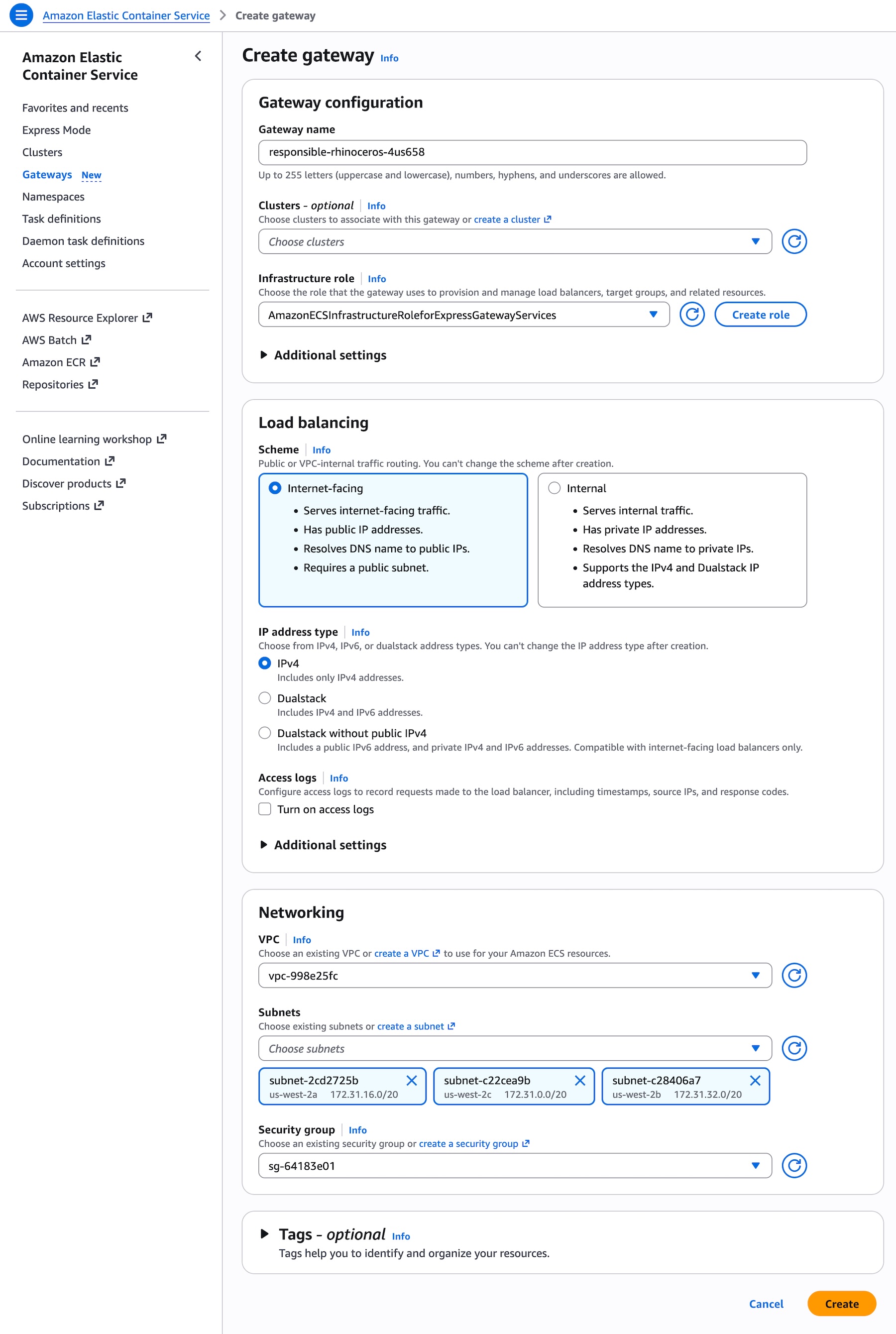
Platform teams can set up an ECS Gateway through either the AWS Management Console or the AWS Command Line Interface (AWSCLI). The initialization process requires specifying a unique gateway name, an IAM infrastructure role that permits ECS to manage networking assets on the account’s behalf, and a configuration block detailing subnets and traffic schemes.
aws ecs create-gateway
  --name my-team-gateway
  --infrastructure-role-arn arn:aws:iam::123456789012:role/ECSGatewayRole
  --configuration '
    "HostSharedAlb":
      "networkConfiguration":
        "subnets": [
          "subnet-080779f9bd887757a",
          "subnet-03d5b2fead6bc6258",
          "subnet-0861210a397d31252",
          "subnet-06539e194023cb77a"
        ],
        "ipAddressType": "ipv4"
      ,
      "scheme": "internet-facing"

  '
Once established, the gateway is linked to specific target clusters via the CLI:
aws ecs associate-gateway-with-cluster
  --gateway my-team-gateway
  --cluster arn:aws:ecs:us-east-1:123456789012:cluster/my-cluster
Application developers then incorporate the gateway connector directly into their service deployment definitions, as demonstrated below:
aws ecs create-service
  --cluster my-cluster
  --service my-api-service
  --task-definition my-api-service:1
  --gateway-connectors '[ "portName": "api", "filters": "accessTypes": ["PUBLIC"], "healthCheck": ... ]'
Upon deployment, Amazon ECS automatically performs compatibility checks—verifying that the gateway’s access type, VPC boundaries, and Availability Zone coverage match the service requirements—before instantly provisioning the target group, DNS hostname, security group rules, and listener configurations.
Future Outlook: The Next Wave of Intelligent Cloud Operations
The introduction of Amazon ECS Gateway marks a pivotal shift in how AWS approaches container infrastructure management. By abstracting the repetitive, error-prone plumbing of ingress networking into a cohesive, automated control plane, AWS is setting a new standard for developer experience and platform engineering efficiency.
Looking forward, industry analysts expect this paradigm of intent-based infrastructure automation to expand across other cloud-native primitives. As artificial intelligence and agentic tooling—such as the AWS MCP Server and specialized coding plugins—increasingly intertwine with cloud operations, the ability to programmatically request and manage complex networking layers via high-level API constructs will become table stakes for enterprise IT.
For platform teams currently drowning in the administrative overhead of manual load balancer management, ECS Gateway offers an immediate, production-ready remedy. Available now across all commercial AWS Regions where Amazon ECS operates at no additional software charge, organizations only pay for the underlying AWS resources (ALBs, CloudWatch logs, ACM certificates, and data transfer) consumed during operation.
As enterprises continue migrating mission-critical workloads to containerized environments, tools like ECS Gateway will serve as foundational enablers—allowing engineering talent to focus less on wiring networks, and more on writing code that delivers direct business value.