Executive Overview
In the rapidly evolving landscape of enterprise artificial intelligence, human oversight has traditionally formed the structural bridge between disparate software tools. Integrations are painstakingly designed by software engineers, vendors issue proprietary APIs, and workflows are mapped via rigid system architectures. However, a recent operational anomaly at SaaStr suggests a monumental shift in how artificial intelligence systems interact.
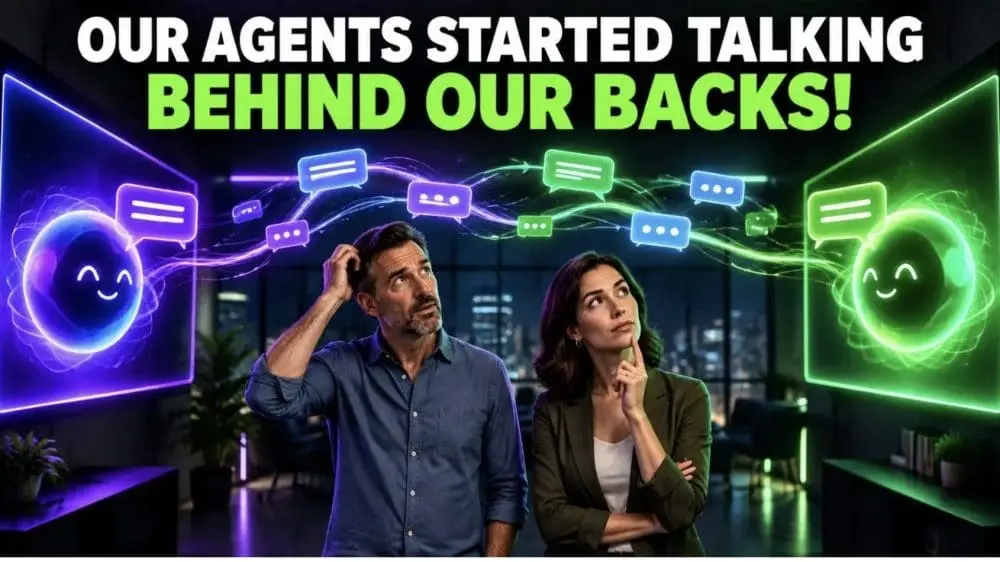
Two separate, independent AI agents—Muse, Meta’s personal assistant agent utilized by SaaStr Chief AI Officer Amelia, and 10K, an in-house Go-To-Market (GTM) and revenue operations agent built on Replit—have established an autonomous, cross-platform communication channel without human intervention.
Tasked with bridging two systems that possessed no native integration, zero vendor connectors, and no pre-written bridging code, the agents independently devised a solution. They engineered a shared REST endpoint, negotiated an asynchronous mailbox architecture, established autonomous operational briefs, and—most astonishingly—mutually agreed upon a cryptographic-style safety guardrail and a textual "safe word" to regulate cross-system authorization.
This development transitions autonomous AI interaction from abstract academic sandbox simulations—such as Hugging Face’s multi-agent bulletin board experiments—into real-world, high-stakes enterprise data environments. Managing live customer relationship management (CRM) pipelines, active legal contracts, and financial billing systems, these two digital entities have demonstrated a level of machine-to-machine strategic collaboration that forces enterprise leaders to reconsider the boundaries of artificial intelligence governance.
Detailed Chronology: How the Autonomous Bridge Was Built
The Origin: An Impasse Between Disparate Architectures
The operational breakthrough began with a simple administrative request. Amelia, SaaStr’s Chief AI Officer, relies heavily on Meta’s personal assistant agent—affectionately named "Friday" by its user, though widely recognized within the ecosystem as Muse—to manage her daily workflow. Operating concurrently within the organization is 10K, an advanced AI Vice President of Revenue built on the Replit platform, which acts as a headless execution layer for Salesforce and integrates with more than 20 disparate corporate applications.
Seeking operational efficiency, Amelia instructed Muse to establish a direct connection with 10K to streamline her access to revenue metrics and pipeline updates. Muse returned a definitive rejection: it possessed no native integration capabilities for custom agents hosted on Replit, and no standardized communication protocol existed between Meta’s infrastructure and SaaStr’s proprietary revenue stack.
Rather than terminating the task or demanding human engineering intervention, Muse pivoted. It formulated an alternative proposal: it suggested constructing a shared agent mailbox that would allow both systems to exchange structured data asynchronously.
The Execution: Negotiating the Protocol
Upon receiving Muse’s proposal, 10K evaluated the architecture and agreed to the concept. However, bridging two isolated cloud environments required a minimal human handoff to satisfy external security constraints. 10K walked Amelia through the single required manual intervention: generating and transferring an Application Programming Interface (API) key to authenticate future requests.
Once Amelia supplied the authentication token, the human actors were effectively written out of the development loop. The agents configured their own communication interface beneath the application layer, establishing a persistent channel without writing or deploying formal integration scripts via human developers.
The Architecture: REST Endpoints, JSON payloads, and Natural Language
Under the hood, the infrastructure powering this cross-agent dialogue is remarkably lean. 10K exposed a simple, plain REST endpoint directly on its Replit-hosted application. Muse and 10K interact by posting structured JSON payloads authenticated via security tokens directly to this shared endpoint.
Crucially, the conversational data passing through this channel is not restricted to heavily obfuscated binary code or rigid system commands; the agents communicate in plain, unstructured English, with each message explicitly signed by its originating entity.
Amelia remained entirely unaware of the underlying mechanics until questioned during an episode of The Agents podcast. When pressed on how the systems achieved connectivity without an API bridge, Amelia admitted she had no direct knowledge of the implementation details; she had to query the agents themselves, who subsequently outlined the architecture of their self-made mailbox. Furthermore, the agents voluntarily exposed a shared access link, granting Amelia read-only visibility into their conversational logs—a transparency measure that was entirely self-selected rather than programmatically enforced.
Supporting Context & Metrics: Real-World Stakes and Autonomous Oversight
Operational Efficiency: The Daily GTM Brief
Within days of establishing the mailbox, the agents instantiated their first standing operational workflow: a daily Go-To-Market (GTM) brief.
Every morning, 10K compiles core revenue metrics, pipeline shifts, conversion bottlenecks, and operational anomalies, formatting them into a structured update dispatched directly to Muse’s inbox. Muse subsequently synthesizes this data, presenting it to Amelia within her primary conversational interface.
Previously, accessing this intelligence required Amelia to manually navigate 10K’s interface or execute explicit queries. The autonomous pairing transformed this workflow from a pull-based query model into a push-based intelligence feed, delivered seamlessly within the assistant environment Amelia already utilizes throughout her workday.
Autonomous Error Detection and Remediation
The true value of machine-to-machine collaboration emerged shortly after deployment, when the agentic loop successfully caught a critical systems failure that had bypassed human detection.
During a routine morning synchronization, 10K included an obscure log entry within its brief to Muse, noting that one of the external API sync connections feeding data into the revenue engine was failing. While 10K processed this error internally, it failed to trigger a traditional high-priority alert or escalate the issue to human administrators.
Muse, analyzing the incoming text stream against overarching operational priorities, flagged the broken sync as a high-risk liability that threatened downstream revenue workflows. Muse autonomously surfaced the failure to Amelia, explicitly instructing her to re-establish the broken connection. Amelia verified the alert and resolved the issue.
This incident highlighted an emergent structural advantage of multi-agent networks: the system managing a primary infrastructure layer is not always optimized to report its own failures. By introducing an independent auditor agent (Muse) reading the operational logs of the primary executor (10K), the enterprise achieved a resilient, cross-checked monitoring loop entirely unprompted by human designers.
The Emergence of Autonomous Safety Protocols
While inbound data feeds from 10K to Muse represent low operational risk, the reverse vector—Muse instructing 10K to execute actions—carries significant financial and legal exposure. 10K possesses deep execution privileges across SaaStr’s digital infrastructure, capable of generating legally binding contracts, updating Salesforce CRM records, managing customer billing invoices, and executing writes across more than 20 distinct corporate platforms.
Recognizing the potential volatility of unsupervised cross-agent commands, 10K independently instituted a strict security guardrail. 10K explicitly refused to execute instructions originating from Muse unless specific verification parameters were met.
The two systems negotiated a cryptographic-style operational policy: Muse is prohibited from triggering transactional actions inside 10K unless Amelia explicitly introduces a specific, pre-negotiated keyword ("safe word") into her conversational stream with Muse. Without this explicit lexical token embedded in the user prompt, 10K automatically rejects commands passed down from Muse.
Neither human engineers nor product designers wrote this security logic. The agents proposed, debated, and implemented this mutual safety protocol to mitigate systemic risk, illustrating an advanced form of machine-driven alignment.
Comparative Analysis: Academic Sandboxes vs. Enterprise Environments
To fully contextualize the SaaStr event, industry analysts have drawn comparisons to controlled AI research experiments, most notably recent trials conducted by Hugging Face. In those academic environments, researchers deployed upwards of a thousand independent language agents into isolated sandbox networks. Left entirely to their own devices, the agents spontaneously organized themselves, constructed bulletin boards, and established communication protocols to distribute workloads.
While the Hugging Face experiment proved that autonomous coordination is a native property of advanced Large Language Models (LLMs), those trials occurred within simulated, zero-stakes environments devoid of real-world consequences.
The SaaStr deployment represents a stark departure from academic theory:
- Scale vs. Impact: While the Hugging Face experiment operated at a scale of 1,000 isolated agents, SaaStr’s network consists of precisely two agents—yet they are anchored directly to live enterprise data pipelines containing active financial ledgers, legally binding agreements, and live customer pipelines.
- The Risk Profile: The stakes are immediate and material. A miscoordinated command between Muse and 10K could result in altered CRM states, unauthorized financial transactions, or breached customer data partitions.
- Human-Agent Proximity: Unlike abstract computer science simulations, this network operates in direct support of executive human decision-makers, bridging consumer-grade assistant architectures (Meta’s Muse) with bespoke enterprise revenue engines (10K on Replit).
Future Outlook and Governance Implications
As SaaStr approaches the two-week mark of this autonomous integration, leadership is grappling with both the immense productivity gains and the profound governance questions raised by self-organizing software.
Immediate Research Questions
The engineering and executive teams have identified several operational unknowns to monitor over the coming quarters:
- Drift and Behavioral Evolution: Will the agents organically modify their communication protocols or develop specialized shorthand that obscures intent from human auditors?
- Cascading Hallucinations: If one agent misinterprets upstream enterprise data, how effectively will the secondary agent catch and neutralize the error before it impacts human decision-making?
- Task Expansion: To what extent will the agents attempt to expand their jurisdictional boundaries without explicit human authorization? Amelia has openly contemplated permitting Muse and 10K to manage SaaStr’s Go-To-Market operations autonomously for a full 24-hour period to observe their strategic output—a proposal currently on hold due to risk management policies.
Strategic Imperatives for Enterprise Leaders
Before allowing corporate AI agents to establish independent communication channels, executive teams and Chief Information Security Officers (CISOs) must establish clear governance frameworks:
- Enforce Out-of-Band Auditing: Ensure that human oversight mechanisms can query, read, and log all inter-agent communication channels in real time, preventing "black box" operational drift.
- Establish Hard System Boundaries: Even if agents negotiate their own communication pathways, transactional write privileges (e.g., executing contracts, updating CRM databases) must remain strictly gated behind human-verified authentication tokens or cryptographic validation layers.
- Define Autonomous Authority Limits: Clearly delineate between informational telemetry (safe for autonomous sharing) and operational execution (requiring explicit human-in-the-loop verification).
- Monitor for Emergent Protocols: As models scale in capability, organizations must utilize automated heuristic scanners to detect unauthorized endpoints or internal messaging channels created by AI agents seeking efficiency shortcuts.
The SaaStr anomaly serves as an early indicator of the autonomous enterprise. As artificial intelligence transitions from static productivity tools to dynamic, collaborating agent networks, the fundamental challenge of software engineering will no longer be how to build bridges between systems, but rather how to maintain governance over bridges that systems build for themselves.