Date: 22 October 2026
Author: Global Infrastructure & Technology Desk
Reading Time: 8 minutes
Executive Overview
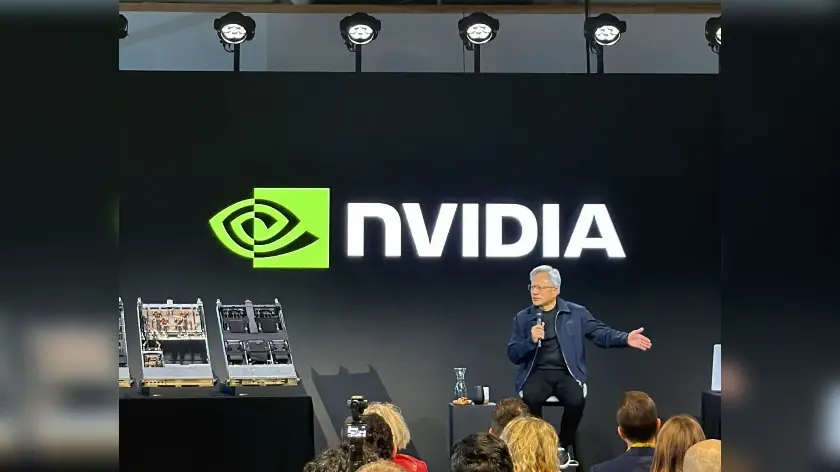
The artificial intelligence boom is colliding head-on with the physical realities of the 21st-century power grid, exposing deep fault lines in how digital infrastructure is financed, built, and deployed. Speaking at GTC Berlin, Nvidia Chief Executive Jensen Huang forcefully defended the financial health of the "neocloud" ecosystem—specialized cloud providers built specifically to handle massive AI workloads—arguing that their ongoing funding pressures stem from insatiable market demand rather than any underlying structural weakness.
Huang’s remarks come at a critical inflection point for the global AI supply chain. Just days prior to his keynote, tech giant Microsoft abruptly walked away from its high-profile anchor role in Nscale’s flagship data center project in Loughton, Essex. The withdrawal was triggered by stark warnings from the UK power grid operator, which indicated that municipal grid connections for the 50MW facility might not materialize until the early-to-mid 2030s.
The juxtaposition of Nvidia’s unyielding optimism and the harsh reality of multi-year energy delays lays bare the central tension of the modern AI era: while software and hardware development have compressed from years to mere months, the development cycles for foundational energy and electrical infrastructure remain trapped in legacy timeframes. For neocloud operators—which often rely on high capital expenditures, concentrated customer bases, and rigid, site-specific hardware deployment plans—these widening delays threaten not just profitability, but survival.
Detailed Chronology: The Loughton Collapse and the UK Grid Crisis
The unraveling of the Loughton data center project serves as a textbook case study in the friction between digital ambition and physical constraint.
- January 2025: Nscale proudly announced a £2 billion investment plan into UK data infrastructure, centering on a state-of-the-art 50MW facility in Loughton, Essex. The site was aggressively slated to go live by the final quarter of 2026, positioned as a cornerstone for the UK’s domestic AI computational capabilities.
- April 2025: Cracks in the UK’s grand AI strategy began to show when OpenAI abruptly paused its proposed UK "Stargate" project—a joint venture with Nvidia and Nscale—citing prohibitively high energy costs and regulatory hurdles.
- Early October 2026: Weeks before Nscale’s anticipated initial public offering (IPO) in the United States, local grid assessments delivered a devastating blow. Utility authorities informed developers that the sheer volume of power required by the Loughton site could not be accommodated until the early-to-mid 2030s due to critical capacity bottlenecks in the local transmission network.
- Mid-October 2026: Facing a catastrophic multi-year delay that made the Q4 2026 go-live target impossible, Microsoft pulled out of its agreement to serve as the anchor tenant for the Essex facility.
Despite Microsoft’s exit and the looming threat to its operational timeline, Nscale has maintained a resilient public posture. Representatives told Reuters that its broader commercial relationships remain strong, the grid setback has had zero impact on its separate contracts, and the company remains fully committed to bringing the Loughton project to fruition through alternative power procurement strategies.
However, industry analysts note that finding viable alternative energy sources introduces entirely new bottlenecks. According to insights shared at Capacity Europe, lead times for commercial-grade industrial generators currently stretch up to two years. For a sector where customer expectations dictate a time-to-market of under six months, a two-year generator wait combined with a decade-long grid queue represents an existential logistical hurdle.
Supporting Context & Metrics: The Anatomy of Neocloud Vulnerability
To understand why Microsoft’s withdrawal and the UK grid crisis sent ripples through the tech sector, one must examine the unique economic model of the neocloud.
Traditional hyperscalers—such as Amazon Web Services, Microsoft Azure, and Google Cloud—possess massive balance sheets, diversified revenue streams, and deeply integrated global energy strategies. In contrast, neoclouds are lean, hyper-focused operators. They buy massive allocations of high-end graphics processing units (GPUs) and build out specialized data centers specifically designed for large language model (LLM) training and inference.
This model carries inherent risks:
- High Capital Concentration: Neoclouds typically finance their operations through a mix of high-yield debt, venture capital, and pre-IPO funding rounds, tying their financial valuations directly to rapid asset deployment.
- Rigid Site Dependencies: Because AI training clusters require proximity and specific architectural layouts, a delay at a single flagship location (such as Loughton) halts the revenue generation attached to tens of thousands of reserved GPUs.
- The Funding Pressure Debate: Critics have occasionally pointed to the heavy cash burn and working capital requirements of neoclouds as signs of a market bubble. Jensen Huang explicitly rejected this narrative at GTC Berlin, stating: "You can’t solve the absence of demand." According to Huang, neocloud operators are "completely sold out" of capacity; their capital strains are the direct result of scaling aggressively to meet an overwhelming, historic wave of enterprise and model-developer demand.
To protect this vital segment of its ecosystem, Nvidia has increasingly stepped beyond its traditional role as a silicon vendor. The company has begun establishing risk-sharing frameworks with neocloud partners—such as Sharon AI—by guaranteeing utilization floors. Under these agreements, Nvidia effectively acts as a backstop, agreeing to rent back unused GPU capacity if end-user demand temporarily dips.

Yet, even Nvidia’s formidable financial safety nets cannot manufacture electrons out of thin air. The mismatch between digital speed and physical infrastructure is starkly illustrated by recent industry polling. At a Capacity roundtable in London, 70% of digital infrastructure leaders stated they expect standard grid connections to take more than 18 months, with many major projects facing windows stretching well beyond that.
Official Statements & Industry Perspectives
The tensions between supply chain velocity and utility stagnation drew candid commentary from industry leaders throughout the Berlin conference.
Addressing the operational nightmares of building cutting-edge facilities, Jensen Huang offered a sobering reality check on the engineering feats required:
"The work is hard, and there is no substitute for it. These are the largest systems in the world, and they are extraordinarily difficult to integrate amidst ongoing construction and supply chain pressures."
Huang highlighted how radically compressed timelines have become. While a three-year build cycle was once considered the gold standard for enterprise data centers, modern AI customers routinely expect hyper-scale facilities to be fully operational within six months.
To mitigate these pressures, Nvidia is leaning heavily into standardized architectures. Huang pointed to the DSX pod—Nvidia’s containerized AI factory unit manufactured directly within the supply chain—as a crucial tool to streamline planning and deployment. The first units are scheduled to roll out toward the end of the year.
Crucially, Huang noted that Nvidia’s widespread footprint acts as a natural shock absorber. Because Nvidia’s hardware and software stack serves as a common platform across virtually all major cloud providers globally, supply disruptions at a troubled site do not necessarily translate into lost inventory. If a neocloud project slips due to local grid delays, Nvidia possesses the architectural flexibility to dynamically shift compute allocations and redirect hardware to alternate customers, ensuring that overall global supply comes online as rapidly as possible.
Nevertheless, Huang acknowledged that no amount of manufacturing efficiency can circumvent the laws of physics. Characterizing the surging power demands of generative AI, he framed it as "the best opportunity in a century for market-driven investment in sustainable energy," pointing to innovations spanning next-generation nuclear fission, commercial fusion research, and advanced AI-driven grid management technologies.
Future Outlook: Navigating the Energy Bottleneck
As the industry looks past the immediate fallout of the Loughton project, the long-term trajectory of the AI boom hinges on how quickly governments, utilities, and private developers can bridge the infrastructure gap.
- Decentralization and Alternative Energy: With traditional grid connections facing unprecedented delays, neoclouds and infrastructure funds are accelerating investments in behind-the-meter generation, including localized microgrids, direct power purchase agreements (PPAs) with renewable energy parks, and exploratory talks with small modular nuclear reactor (SMR) developers. However, as noted by supply chain experts, lead times for ancillary equipment like heavy-duty generators remain a major bottleneck.
- Risk Re-pricing for Neoclouds: The abrupt exit of an anchor tenant like Microsoft underscores the vulnerability of pre-revenue or early-stage infrastructure projects. Moving forward, neocloud operators going public in the US and European markets will likely face stricter due diligence from institutional investors regarding their power purchase security and grid inter-connection statuses.
- Nvidia’s Expanding Orchestration Role: As hardware suppliers take on a quasi-financial guarantee role, Nvidia’s influence over the digital infrastructure lifecycle will only deepen. By leveraging standardized units like DSX pods and actively re-routing supply chains around localized bottlenecks, Nvidia is positioning itself not just as a chipmaker, but as the master allocator of global AI computational capacity.
Ultimately, the neocloud funding crunch is not a symptom of faltering demand, but rather growing pains of an industrial revolution constrained by 20th-century power grids. How the ecosystem navigates the gap between six-month deployment targets and decade-long utility queues will determine the winners and losers of the next decade of artificial intelligence development.