Executive Overview
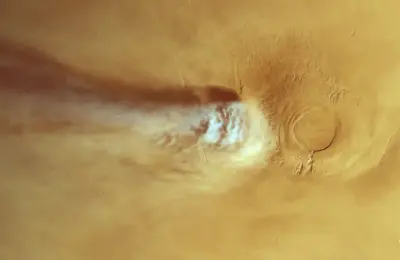
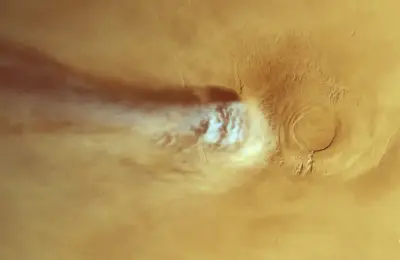
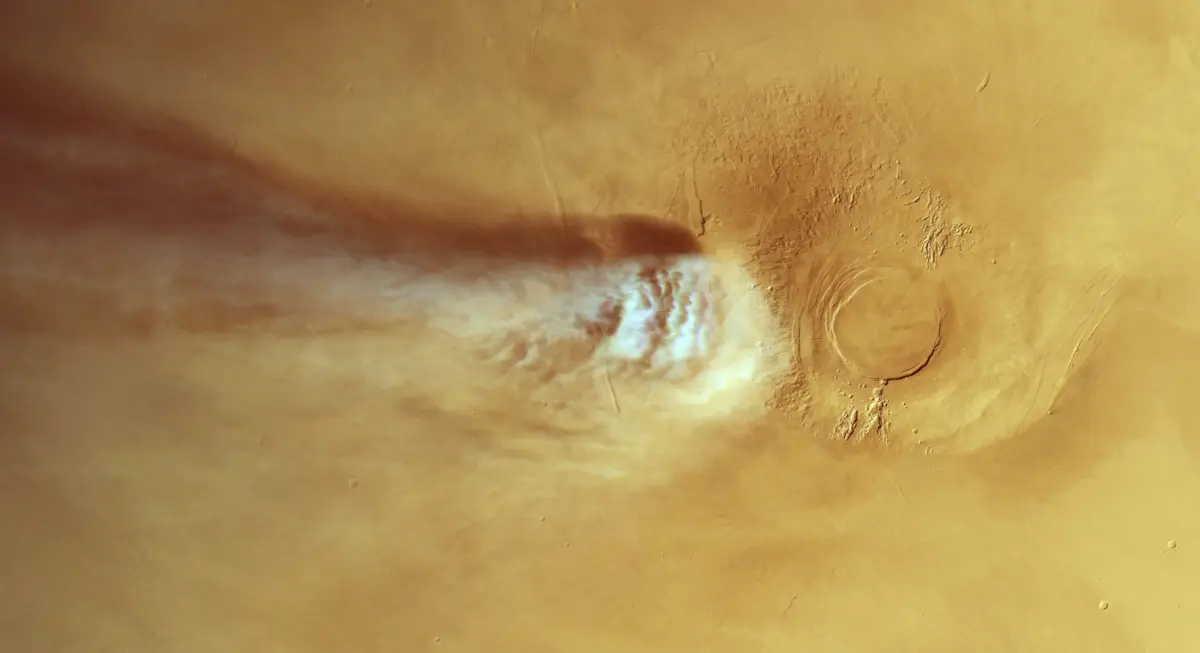
Every Martian spring and summer, a ghostly, colossal phenomenon unfurls across the Red Planet’s skies. Emerging in the shadow of the colossal volcano Arsia Mons, a thin, intensely elongated cloud stretches across the Martian landscape with clockwork regularity. Growing to an astonishing length of over 1,000 miles—roughly equivalent to the distance from New York City to Kansas City—the Arsia Mons Elongated Cloud (AMEC) dominates the morning horizon before completely evaporating under the midday sun. For years, this ephemeral titan baffled planetary scientists who detected it via orbital probes, leaving them without a mechanism to explain how such a massive structure could repeatedly form and dissolve in the thin Martian air.
Now, a breakthrough study published in Nature Geoscience has finally solved the mystery. By successfully modeling the cloud’s formation for the first time, an international team of researchers has revealed that the AMEC is driven by a physical process long relegated to theoretical textbooks: homogeneous nucleation. This exotic atmospheric mechanics, where water vapor condenses directly into ice crystals without the aid of aerosol particles like dust or salt, has never been directly observed in active planetary atmospheres.
The findings not only demystify one of Mars’ most captivating meteorological oddities but also force planetary scientists to reevaluate the extreme physical thresholds achievable in planetary atmospheres. Requiring a staggering flash-freeze of 30 degrees Celsius within 10 minutes and localized humidity levels more than 100,000 times greater than anything ever recorded on Earth, the AMEC stands as proof that nature can—and does—manifest the most extreme theoretical physics under the right cosmic conditions.
Detailed Chronology: From First Sighting to Breakthrough Modeling
2018: The Discovery of an Atmospheric Anomaly
The story of the Arsia Mons Elongated Cloud began in earnest when it was systematically captured and recorded by space probes orbiting Mars in 2018. While amateur astronomers and orbital cameras had occasionally glimpsed hints of anomalous atmospheric activity near Mars’ monumental shield volcanoes in the past, the 2018 apparition provided the scientific community with comprehensive, high-resolution data sets.
Researchers quickly realized this was not a routine weather cloud. Unlike typical orographic clouds that form stationary caps over mountain peaks, the AMEC behaved like an immense, fast-growing plume. Every single Martian morning during specific seasonal windows, the cloud would materialize on the western flank of Arsia Mons, rapidly stream westward, and stretch out over a thousand miles before vanishing entirely by midday.
The Years of Frustration (2018–2024)
For nearly half a decade, planetary scientists struggled to construct computer models that could replicate the AMEC. Traditional atmospheric circulation models failed repeatedly. Standard meteorological equations used to simulate weather on Earth and Mars predicted that moisture would disperse or fail to accumulate in the required geometries.
Scientists knew that Arsia Mons—standing at a staggering 65,000 feet (nearly 20 kilometers) high—was acting as a massive topographic trigger, forcing winds to rise and cool. However, standard condensation physics dictated that water vapor requires "cloud condensation nuclei" (tiny airborne particles like dust or salt) to anchor onto in order to form ice crystals or droplets. Standard models incorporating these known parameters could not account for the sheer scale, speed, and clean dissipation of the AMEC. The scientific community hit a brick wall, labeling the structure an enduring enigma of Martian meteorology.
The Breakthrough: Simulating the Impossible
The tide turned when a research team led by Jorge Hernández-Bernal, a planetary scientist at Paris’ Sorbonne Université, decided to push the boundaries of atmospheric simulation software. Rather than relying solely on tried-and-true terrestrial meteorological baselines, the team decided to integrate equations for physical processes usually dismissed as too extreme or purely theoretical for natural environments.
By integrating these "exotic physics" parameters into their high-resolution models, Hernández-Bernal and his colleagues achieved what no one else could. For the first time, their digital simulations spontaneously generated an AMEC-like cloud that matched the exact temporal cycles, dimensions, and behaviors observed by Mars orbiters. The mystery was cracked, opening a new chapter in our understanding of planetary physics.
Supporting Context & Metrics: The Mechanics of the Martian Monster
To truly comprehend the scale and peculiarity of the Arsia Mons Elongated Cloud, one must examine the extreme environmental metrics governing its existence. Mars is a cold, arid world with an atmosphere roughly 1% as dense as Earth’s. Yet, within this thin envelope, hyper-extreme meteorological events can take place.
The Anatomy of the Phenomenon
- Geographic Origin: The western flank of Arsia Mons, a massive shield volcano located near Mars’ equator.
- Maximum Length: Exceeds 1,000 miles (approx. 1,600 to 1,800 kilometers)—stretching far enough to cross multiple Martian topographical zones.
- Lifespan: Forms exclusively during the Martian spring and summer mornings, repeating its cycle daily for several months before evaporating completely by midday.
- Temperature Drop Threshold: Requires an astonishing, hyper-rapid thermal crash of 30 degrees Celsius within just 10 minutes.
- Humidity Extremes: Demands atmospheric vapor concentrations more than 100,000 times greater than the highest relative humidity values ever reliably measured in Earth’s atmosphere.
Standard Condensation vs. Homogeneous Nucleation
On Earth, the creation of clouds is a collaborative process between water vapor and atmospheric impurities. Whether it is sea salt aerosol blown off an ocean, soot from a wildfire, or mineral dust swept up from a desert, water vapor requires a microscopic solid surface—a condensation nucleus—to transition from a gas into liquid droplets or ice crystals.
The newly published study in Nature Geoscience upends this conventional framework for the Martian AMEC, pointing instead toward homogeneous nucleation. In this theoretical process, water vapor molecules spontaneously bond together to form ice crystals entirely on their own, completely devoid of any particulate scaffolding.
"It’s akin to droplets of condensation appearing in the middle of a room, rather than on a window," explains lead author Jorge Hernández-Bernal. "It’s wholly unexpected."
This spontaneous phase change requires conditions so violent and pristine that they push the limits of thermodynamic equations. When prevailing wind currents slam into the titanic 65,000-foot-tall mass of Arsia Mons, they are forced upward into the stratosphere with incredible velocity. This mechanical lifting generates an atmospheric wave that lofts moist air high above the volcano in a matter of minutes, triggering the hyper-rapid 30-degree temperature drop and establishing localized humidity levels previously thought impossible on the Red Planet.
Official Statements & Expert Analysis
The publication of the Nature Geoscience findings has sent ripples through the international planetary science community. Because this marks the first time that homogeneous nucleation has been implicated as the driving engine of a planetary-scale cloud, researchers are treating the discovery as a landmark milestone.
In an official press release detailing the study, lead author Jorge Hernández-Bernal emphasized the paradigm-shifting nature of their work:
"We found that we needed to include some exotic physics—physics that, while included in textbooks, is treated as theoretical and usually thought not to happen in nature. It certainly hasn’t been seen in action before," Hernández-Bernal stated. "Once we included this physics in our simulations, the AMEC emerged just as we hoped."
Highlighting the historic scarcity of deep atmospheric data for Mars compared to our extensively monitored home planet, Hernández-Bernal underscored the significance of closing the knowledge gap:
"We don’t have nearly as much information about Mars’ atmosphere as we do about Earth’s, so reproducing the AMEC to this degree is a big success. The result is remarkable."
Independent atmospheric physicists not directly involved in the study have echoed these sentiments, noting that while theorists have long debated whether homogeneous nucleation could occur in planetary upper atmospheres—such as those found on Venus, Mars, or the outer gas giants—hard observational or modeled proof has remained elusive until now.
Future Outlook: What the AMEC Teaches Us About the Cosmos
The decoding of the Arsia Mons Elongated Cloud extends far beyond a localized Martian weather report. It provides scientists with a vital calibration tool for understanding atmospheric stability, thermodynamic thresholds, and volatile transport on rocky planets across the solar system.
Implications for Comparative Planetology
With the AMEC model now successfully verified, planetary scientists are turning their analytical lenses toward other worlds. Venus, with its hyper-dense, searingly hot atmosphere laced with sulfuric acid clouds, and Earth’s own upper mesosphere, feature extreme thermal gradients and wind dynamics where similar spontaneous phase changes might occur.
By proving that homogeneous nucleation can drive macroscopic weather features on Mars, researchers now have a validated theoretical framework to search for similar ghost-like cloud structures on Venus and potentially on exoplanets orbiting distant stars.
The Next Frontier in Martian Exploration
As upcoming orbital missions and surface rovers continue to monitor Mars’ complex meteorological cycles, scientists will look for further validation of the micro-meteorological triggers that feed the Arsia Mons cloud. Future high-altitude atmospheric probes may even be designed to fly through or directly sample the regions surrounding Mars’ massive shield volcanoes during the spring and summer seasons.
Ultimately, the 1,000-mile-long Martian cloud serves as a humbling reminder of nature’s capacity for complexity. What once appeared to be an inexplicable atmospheric glitch has turned out to be a masterclass in exotic physics—proving that even on a barren, rust-colored world, the skies still hold secrets capable of rewriting our science textbooks.