Executive Overview
Thirteen years. Three console generations. Over 230 million copies sold. Generating upwards of $10 billion in cumulative revenue, Grand Theft Auto V occupies a stratospheric tier of commercial success and cultural endurance matched by virtually nothing else in modern entertainment history. In the pantheon of interactive media, only Minecraft and the staggering, perpetual iterations of Tetris sit comfortably in the same conversation regarding sheer, unadulterated volume of distribution.
Yet, cold sales metrics fail to encapsulate the underlying mechanics of its longevity. Raw numbers quantify distribution, but they do not explain why a game launched in the twilight of 2013 continues to routinely outperform contemporary releases on monthly sales charts. They do not articulate why millions of players remain entrenched in its sandbox, nor do they define what makes the sprawling geography of Southern California so enduringly magnetic.
As part of a retrospective journey revisiting the core entries of Rockstar Games’ flagship franchise in anticipation of Grand Theft Auto VI, evaluating GTA V requires looking past its financial footprint. It demands an examination of structural innovations, engineering marvels, and design paradigms that fundamentally reshaped the open-world genre. While personal nostalgia for the neon-soaked alleys of Vice City or the golden-age grime of San Andreas might keep older entries close to the heart, Grand Theft Auto V represents a technical and mechanical watershed moment for the medium—a title so profoundly future-proofed that its subsequent cross-generation ports became the baseline standard against which all open-world action games are measured.
Detailed Chronology: From Seventh-Generation Pioneer to Cross-Platform Juggernaut
To fully comprehend the gravity of GTA V, one must contextualize the era of its birth. Released on September 17, 2013, the game arrived on the PlayStation 3 and Xbox 360 at a time when both consoles were visibly gasping at the absolute limits of their aging, 2005-era hardware architectures.
Just two months prior to its launch, early hands-on impressions captured a prevailing industry sentiment: this was not merely a swan song for a fading hardware generation; it was a preemptive strike from the next era of gaming. Equipped with a daring vision, Rockstar North defied the hardware limitations of the time, engineering an experience that felt leagues ahead of its contemporaries.
- September 2013: Initial release on PlayStation 3 and Xbox 360, shattering global entertainment records by clearing $1 billion in its first three days.
- November 2014: The launch of the eighth-generation ports for PlayStation 4 and Xbox One, introducing an unprecedented first-person perspective mode, vastly improved draw distances, denser traffic, and a suite of visual enhancements.
- April 2015: The long-awaited arrival of the PC version, offering uncapped frame rates, 4K resolution support, and the robust Director Mode, which cemented the game’s popularity within machinima and content-creation communities.
- November 2021 / March 2022: The transition into the ninth generation with enhanced editions for PlayStation 5 and Xbox Series X/S, featuring ray-tracing capabilities, performance modes targeting 60 frames per second, and faster load times.
Through each iterative hardware leap, Rockstar avoided the trap of simple, asset-flipping remasters. Instead, they consistently tuned the engine to exploit new processing power, ensuring the world of Los Santos never truly felt archaic.
Supporting Context & Metrics: World-Building, Mechanics, and the Triple Threat
The Architecture of Los Santos
Where its immediate predecessor, Grand Theft Auto IV, offered a dense, hyper-detailed, yet claustrophobic urban grid in Liberty City, GTA V pivoted toward expansive topography. Los Santos and its surrounding Blaine County combined urban sprawl, sun-bleached suburbs, industrial sectors, dense pine forests, arid deserts, and the looming bulk of Mount Chiliad into a seamless landmass.
Though it omitted full iterations of San Fierro and Las Venturas found in the 2004 classic San Andreas, the map of GTA V was more than double the physical size of its PS2-era predecessor. More impressive than raw square mileage, however, was the meticulous environmental storytelling. Rockstar mastered the art of accumulation: thousands of subtle details—faded storefront signs, rusting industrial equipment, distinct architectural quirks across socioeconomic districts, and dynamic lighting reacting to the harsh southern sunshine—converged to make the world feel authentic rather than artificial. It is a testament to this design that after over a decade of continuous exploration, players still stumble upon unnoticed graffiti, storefronts, and environmental minutiae.
The Innovation of the Trio
The most radical structural departure for the franchise was the abandonment of the solitary protagonist model in favor of a synchronized trio:
- Michael De Santa: A wealthy, cynical, retired bank robber trapped in witness protection, wrestling with a suffocating suburban mid-life crisis and a dysfunctional family.
- Franklin Clinton: A sharp, ambitious repo man from South Los Santos looking for a legitimate upward trajectory, who stumbles into the criminal underworld through Michael.
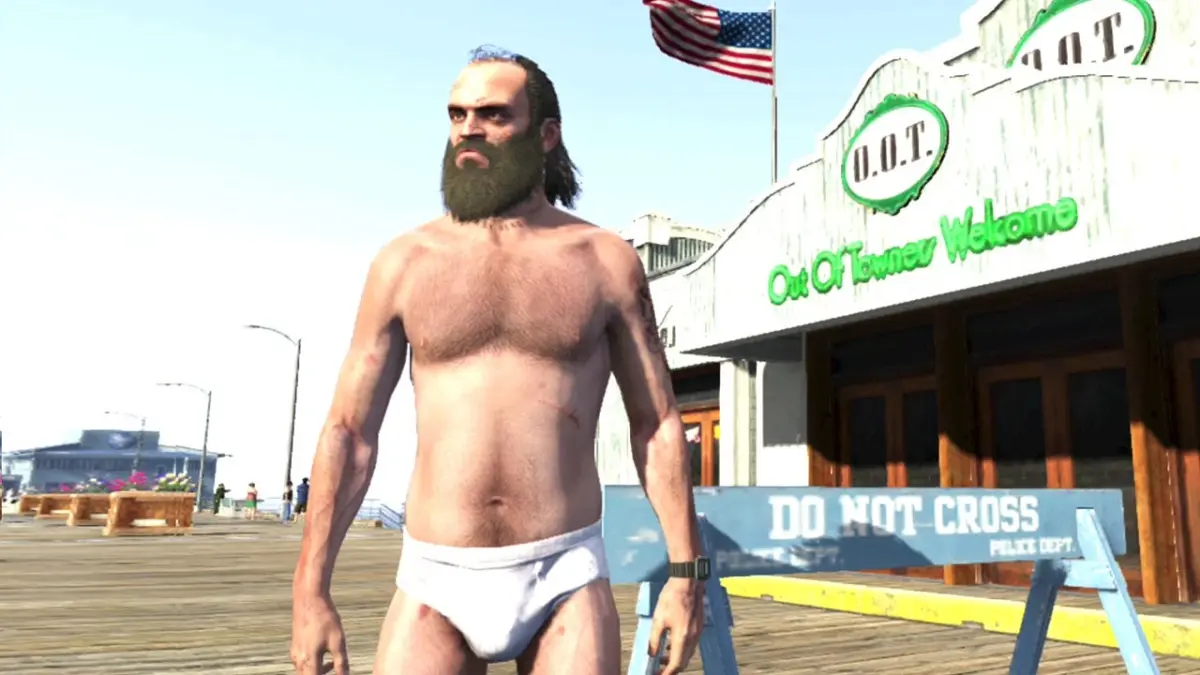
- Trevor Philips: A volatile, unpredictable, career criminal and former military pilot whose unhinged psychopathy injects a chaotic, pitch-black comedic energy into the narrative.
This mechanical pivot was far more than a narrative gimmick. By allowing players to switch characters in real time—instigated by a dynamic camera zoom that dropped the player straight into whatever mundane or violent scenario that protagonist happened to be navigating—Rockstar created the illusion of an autonomous world. These characters lived, breathed, and caused trouble even when the player wasn’t actively controlling them. Furthermore, the multi-protagonist structure allowed the narrative to effortlessly pivot across vastly different socio-economic strata and geographic regions of San Andreas without narrative fatigue.

Refining the Core Loop: Missions, Heists, and Combat
GTA V also overhauled the moment-to-moment gameplay loop. Recognizing the deep frustrations caused by the rigid mission-failure penalties of past titles—where dying near the end of a grueling 20-minute sequence forced complete restarts—Rockstar integrated comprehensive checkpointing, a philosophy introduced in The Ballad of Gay Tony.
This safety net liberated the design team to craft grander, more cinematic set-pieces. This evolution culminated in the game’s signature feature: multi-layered heists. Drawing spiritual inspiration from GTA IV’s iconic "Three Leaf Clover" mission, these sprawling operations required players to plan approaches, hire specialized crew members, acquire gear through discrete setup missions, and execute synchronized strategies by swapping between Michael, Franklin, and Trevor on the fly.
On the mechanical front, vehicle handling was overhauled to strike a balance between arcade accessibility and satisfying weight, favoring responsive steering and hard braking that complemented the massive variety of transport options. Fighter jets, commercial airliners, heavy freight trucks, and sports cars could all be commandeered with equal ease. Concurrently, combat fluidity received a major upgrade with a responsive weapon wheel, tighter cover mechanics, and punchy audio design that made every firefight visceral.
Official Statements and Industry Impact
Reflecting on the title’s foundational engineering, lead developers at Rockstar North emphasized that the core objective for GTA V was to break down the invisible walls separating open-world exploration from tight, cinematic narrative pacing.
"When we looked at the scale of what we wanted to achieve with San Andreas—incorporating urban sprawl, rural expanses, and the contrasting lives of three distinct individuals—we knew the traditional single-hero structure would strain under the weight," notes documentation from the game’s development cycle. "The real-time character-switching technology wasn’t just a technical achievement; it was the key to making a massive world feel intimate and continuously alive."
Industry analysts frequently cite GTA V as the definitive textbook case study for games-as-a-platform. Its single-player campaign established a gold standard for production values, while its concurrent online ecosystem (Grand Theft Auto Online) established a persistent economic model that fundamentally transformed how publishers conceptualize post-launch monetization and community retention over multiple console generations.
Future Outlook
As the industry stands on the precipice of the next major epoch in interactive entertainment with the impending arrival of Grand Theft Auto VI, the shadow cast by GTA V remains immense. Re-evaluating the 2013 masterpiece highlights the staggering baseline Rockstar has set for itself.
While purists may forever argue the stylistic supremacy of Vice City’s neon atmosphere or San Andreas’ cultural zeitgeist, Grand Theft Auto V stands tall as the most mechanically complete, structurally ambitious, and comprehensively optimized single-player sandbox the studio has ever produced. It defined an entire decade of gaming, bridging the gap between seventh and ninth-generation hardware with supreme confidence.
Los Santos may soon share the spotlight with new horizons, but the engineering triumph of Rockstar’s 2013 epic ensures it will remain a permanent benchmark for what an open-world action game can achieve.