Executive Overview
It feels like only yesterday that the mere mention of Victoria’s Secret and its iconic, feather-plumed annual fashion show was synonymous with systemic sexism, exclusionary marketing, and punishingly narrow beauty standards. For decades, the brand sat comfortably—and controversially—at the apex of 1990s and 2000s male-gaze consumerism. It sold a rigid, uniform fantasy of physical perfection that left millions of women feeling alienated, inadequate, and fundamentally unrepresented.
Yet, in a bizarre and ironic twist of contemporary cultural history, the brand’s multi-year strategic rehabilitation has positioned it, somewhat counterintuitively, as a comparative beacon of progressivism. As the wider fashion industry regresses into a renewed obsession with hyper-thinness—spurred by the widespread cultural adoption of GLP-1 weight-loss medications and a general resurgence of exclusionary aesthetics—Victoria’s Secret has managed to reframe itself.
By cautiously opening its runway to a more diverse spectrum of sizes, racial backgrounds, and gender identities, the brand has executed a brilliant public relations pivot. While high-fashion houses retreat into restrictive gatekeeping, Victoria’s Secret’s modern incarnation presents a softer, more approachable fantasy. It is an industry-shifting paradox: a corporate giant once pilloried for its cruelty now looks, by comparison to the austere runways of Milan and Paris, almost progressive.
Detailed Chronology: From PR Nightmare to the 2026 Runway
To understand how Victoria’s Secret arrived at its current cultural standing, one must examine the cascading crises that forced the brand into self-preservation mode between 2018 and 2024.
2018–2019: The Breaking Point and the Hiatus
The rot at the core of the brand’s public image became too systemic to ignore toward the end of the 2010s. In late 2018, then-Chief Marketing Officer Ed Razek gave a notorious interview to Vogue, during which he flatly stated that the brand’s fashion show should not cast plus-size or transgender models because the show was "a fantasy."
Combined with mounting revelations regarding former CEO Les Wexner’s deep, long-standing financial and personal ties to convicted sex offender Jeffrey Epstein, the brand faced an unprecedented consumer revolt. Cultural irrelevance loomed, amplified by the reckoning of the post-MeToo era. Recognizing that the old playbook was dead, executives pulled the plug on the iconic fashion show entirely, sending the brand into a five-year hiatus (2019–2024) dedicated entirely to intensive damage control and strategic reconstruction.
2019–2024: The Quiet Pivot
During its time away from the televised runway, Victoria’s Secret began replacing its infamous "Angels" with the "VS Collective"—a roster of accomplished women chosen for their achievements rather than purely their measurements. This period also saw the first cracks in the brand’s historical exclusivity. In 2019, Valentina Sampaio was hired as the brand’s first openly transgender campaign model. The corporate machinery was slowly rewriting its own narrative, transitioning from an unapologetic purveyor of male-centric desire to a self-proclaimed champion of female empowerment.
2025–2026: The Return and the Inverted Industry
When the Victoria’s Secret Fashion Show officially returned to the cultural calendar, it stepped into a drastically altered landscape. High fashion, which had spent a few brief years nodding toward body positivity and size diversity, had executed a sharp about-face. Amid the cultural mania of injectable weight-loss treatments, the luxury runways had returned to an uncompromising, unyielding fetishization of rail-thin frames.
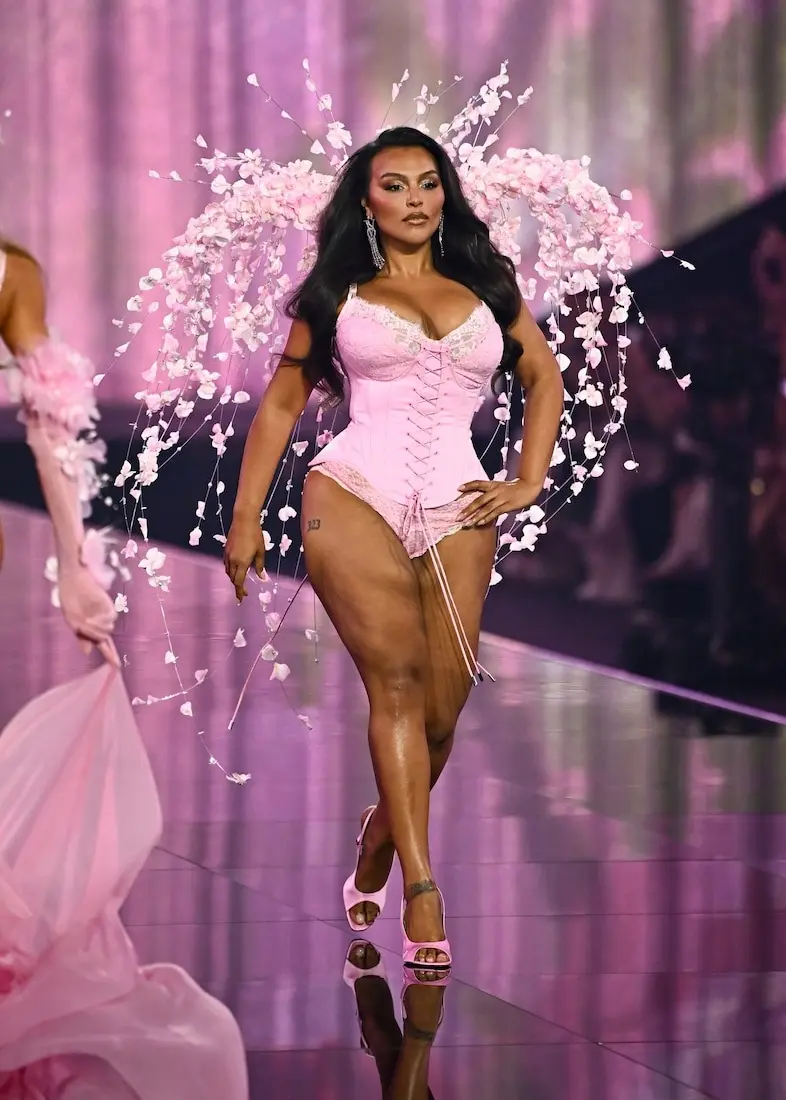
Suddenly, Victoria’s Secret—historically the ultimate villain of body standards—found itself looking remarkably moderate by comparison. By casting visible icons of modern diversity like Alex Consani, Anok Yai, and Paloma Elsesser, and maintaining a token, albeit small, representation of plus-size trailblazers, the brand successfully cloaked itself in the armor of modern inclusivity.
Supporting Context & Metrics: The Shrinking Runways of High Fashion
The perception that high fashion has abandoned inclusivity is not merely anecdotal; it is backed by empirical data. Vogue Business, which has tracked size representation across international fashion weeks since 2023, released alarming metrics confirming that the most recent fashion seasons featured the thinnest runways on record since data collection began.
| Metric / Indicator | High-Fashion Runways (2025–2026) | Victoria’s Secret Fashion Show (2026) |
|---|---|---|
| Plus-Size Representation | Sub-1% (Statistically negligible) | Approx. 8%–10% (Ashley Graham, Precious Lee, Devyn Garcia) |
| Transgender Visibility | Highly inconsistent / Tokenistic | Mainstream integration (Alex Consani, 3 consecutive appearances) |
| Aesthetic Direction | Rigid austerity, GLP-1 thinness worship | Softened fantasy, plush comfort, escapism |
| Cultural Positioning | Unapologetic elitism and exclusivity | Attempted "kinder" corporate redemption |
When placed side-by-side with the high-fashion sector, Victoria’s Secret’s numbers—while still modest—stand out. Plus-size representation at the brand’s revived show does not crack the 10% threshold, featuring a handful of prominent figures like Ashley Graham, Precious Lee, and Devyn Garcia. Yet, in an era where elite fashion weeks have virtually purged non-standard bodies from the catwalk, even this limited inclusion feels starkly different.
Furthermore, the casting choices signal a wider cultural awareness. Seeing models like Alex Consani—arguably the world’s most high-profile trans model, making her third consecutive appearance for the brand—share the stage with Anok Yai and Paloma Elsesser reads less like a desperate corporate checklist and more like an intentional curation. In today’s regressive climate, it provides the brand with an unexpected glow of moral health.
Official Statements & Industry Perspectives
The internal pivot at Victoria’s Secret has been mirrored by carefully orchestrated public relations messaging, though critical reception remains fiercely divided.
In corporate press releases and interviews accompanying the brand’s relaunch, leadership has heavily leaned into the language of transformation. Executives have repeatedly emphasized that Victoria’s Secret is no longer about selling an unattainable standard dictated by men, but rather about celebrating individual journeys, comfort, and self-expression.
However, cultural critics and consumer advocates remain deeply skeptical, viewing the rebrand through a more cynical lens. Commentators frequently point out the glaring contradictions of the modern spectacle. For instance, the high-profile return of the multi-million-dollar diamond-encrusted "Fantasy Bra"—worn in a splashy debut by Kylie Jenner—underscores that the brand remains fundamentally tethered to hyper-capitalism, extreme wealth, and traditional markers of elite glamour.
As one industry observer noted:
“The VS show’s strategic rebrand has, perhaps, stumbled on something important. Many women have grown tired of watching women suffer, and of attaching themselves to brands that are bywords for that suffering. Even weak gestures towards inclusivity from within a highly exclusive structure admit to a wider hunger for the real thing.”
This sentiment captures the core tension of the modern consumer relationship with the brand. Is a corporation allowed to reform, or is an inherently exploitative institution merely changing its packaging to survive the shifting tides of public morality?
Future Outlook: Can a Fairy Tale Survive Reality?
As we look toward the future of retail and fashion culture, the trajectory of Victoria’s Secret offers a fascinating case study in corporate reinvention.
On one hand, it is easy to dismiss the entire enterprise. For many, Victoria’s Secret remains a relic of suburban mall culture—a place where teenagers purchase ill-fitting undergarments under the guise of an artificial sexual awakening. Devoting intellectual energy to its rebranding strategy can feel like an exercise in futility.
On the other hand, the cultural climate for women—and anyone who does not conform to the newly resurgent standards of rail-thin perfection—is undeniably harsh. In an era marked by casual cruelty and aesthetic fascism, the fact that inclusivity can still be utilized as a profitable marketing tool offers a glimmer of hope. It proves that public pressure works, even if corporations only adopt inclusive practices as a defensive shield.
The underlying appeal of the modern Victoria’s Secret show may lie not in its sex appeal, but in its promise of rest. The wings, the feathers, the cloud-like beds, and the theatrical vulnerability tap into a collective feminine exhaustion. Women are tired—tired of working, tired of maintaining impossible standards, and tired of the physical and psychological punishment required to fit into the old molds of beauty.
For this fantasy to truly work in the years ahead, it must expand further. It must prove that the delicate, fairy-tale world of intimacy and comfort is accessible to all bodies—across every size, race, and identity. Meanness has historically served the fashion industry well by manufacturing an intoxicating sense of exclusivity, but meanness has its limits. If Victoria’s Secret can maintain its softer, more inclusive edge—and if it forces the broader luxury fashion market to reckon with its own cruelties—then this unlikely corporate comeback might just leave a permanent, positive mark on the cultural landscape.