Executive Overview
In the modern digital landscape, the demand for consistent, high-converting, and SEO-optimized content has never been higher. Content creators, digital marketers, entrepreneurs, and enterprises face an unrelenting pressure to scale their publishing velocity across blogs, social media channels, email campaigns, and e-commerce platforms. However, human bandwidth remains finite, and traditional content creation is often plagued by bottlenecks, burnout, and escalating labor costs.
Enter the era of Generative Artificial Intelligence. Over the past few years, AI content generators have evolved from experimental text-prediction novelties into sophisticated, enterprise-grade writing assistants. By leveraging advanced Large Language Models (LLMs), these software applications can analyze user intent, structure comprehensive narratives, optimize keywords for search engines, and replicate specific brand voices in a fraction of the time required by human writers.

Choosing the right platform can be an intimidating undertaking for businesses trying to navigate the shifting digital ecosystem. To help organizations and independent creators navigate this crowded marketplace, this report provides an in-depth analysis of the top 10 AI content generator tools available today. We evaluate their core functionalities, pricing structures, distinct use cases, and strategic advantages to help you determine the optimal solution for your content pipeline.
Detailed Chronology and Technological Evolution of AI Writing Assistants
The journey toward automated content generation began decades ago with rudimentary rule-based systems and basic predictive text algorithms. However, the true inflection point for AI writing assistants arrived with the development of transformer-based neural network architectures. These models allowed software to understand context, nuance, and semantic relationships across vast datasets of human-written text.
- Phase 1: Rule-Based and Template Generation (Pre-2018): Early attempts at automated content relied heavily on rigid templates and spinning software. These tools swapped out synonyms in pre-written paragraphs, frequently resulting in unreadable, grammatically flawed text that failed to satisfy search engine algorithms or human readers.
- Phase 2: The Arrival of Transformer Models (2018–2020): With the introduction of advanced foundational models, AI tools gained the ability to generate coherent paragraphs based on simple prompts. Early pioneers began releasing commercial applications designed to assist copywriters with short-form social media ads and product descriptions.
- Phase 3: Specialized Long-Form Content and SEO Integration (2020–Present): Today’s AI content generators have evolved far beyond simple sentence completion engines. Modern platforms feature integrated SEO research tools, automated outline generators, plagiarism checkers, tone customization, and multi-lingual translation capabilities. They no longer just "write"—they strategize, research, and optimize.
Supporting Context & Metrics: The Modern Content Bottleneck
Recent industry surveys indicate that over 70% of digital marketers struggle to produce enough content to keep pace with audience demand. Content creation cycles that historically took days—such as writing an exhaustive 2,000-word SEO-optimized blog post—can now be executed in minutes.
Furthermore, the economic implications are profound. While human freelance copywriters often charge substantial per-word rates, AI content generation platforms operate on predictable subscription models that drastically lower the marginal cost per article. For small businesses and solopreneurs, this democratization of content creation levels the playing field, allowing lean teams to compete with enterprise-level publishing operations.

Comprehensive Evaluation: The Top 10 AI Content Generators
1. Jasper AI (Formerly Jarvis)
Jasper has established itself as one of the premier content writing and generation platforms on the market. By utilizing advanced AI algorithms, Jasper identifies the most effective phrasing, vocabulary, and sentence structures tailored to your specific writing style and target audience.
- Core Strengths: Exceptional long-form content generation, brand voice customization, and advanced workflow templates.
- Standout Feature: "Boss Mode," designed for power users who require high-speed, long-form document creation.
- Pricing Structure: Tiered plans scaling up to the Boss Mode package at approximately $99 per month, with specialized trial incentives available through partner networks.
2. Copy.ai
Copy.ai is a versatile marketing copy platform equipped with over 90 specialized templates ranging from bullet-to-blog converters to high-converting Facebook Ad hooks. It is specifically engineered to streamline short-term and transactional business writing needs, including product descriptions, website landing page copy, and sales reports.
- Core Strengths: Intuitive user interface, extensive template library, and rapid short-form copy generation.
- Pricing Structure: Offers a robust 7-day free trial with daily run limits, transitioning into Pro tiers priced at $49 monthly (or $35 monthly when billed annually).
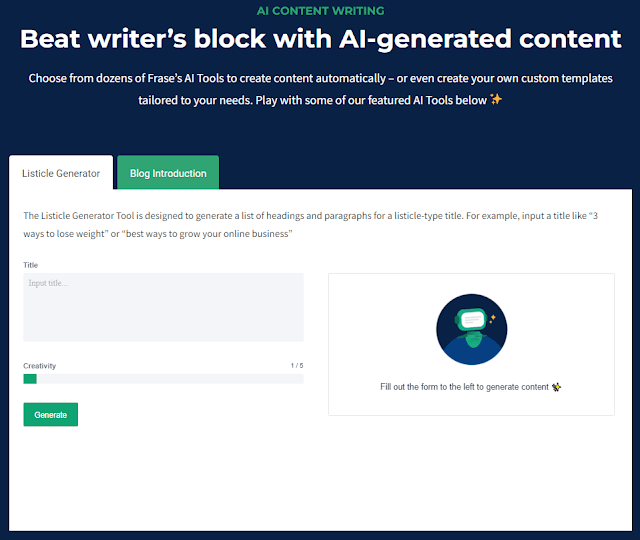
3. Frase AI
Frase operates at the intersection of AI generation and search engine optimization. Rather than simply generating text in a vacuum, Frase assists users through the entire content lifecycle: research, outlining, creation, and optimization. It analyzes top-ranking search results to ensure your content meets the semantic expectations of major search engines.
- Core Strengths: Superior SEO research, automated content briefs, and topic modeling.
- Pricing Structure: Features multiple tiers including the Solo Plan ($14.99/mo), Basic Plan ($44.99/mo), and Team Plan ($114.99/mo), with customizable add-ons for enterprise users.
4. Article Forge
Article Forge takes a uniquely streamlined approach to automated blogging. Unlike systems that require detailed briefs or multi-step prompting, Article Forge requires little more than a target keyword. From that single input, the software autonomously researches and generates a complete, structured article.

- Core Strengths: Total automation, hands-off blog generation, and a built-in guarantee that generated text passes Copyscape plagiarism checks.
- Pricing Structure: Ranging from the Basic Plan at $27/month (up to 25k words) to the Standard ($57/mo) and Unlimited ($117/mo) tiers, backed by a 30-day money-back guarantee.
5. Rytr
Rytr.me is an exceptionally user-friendly, budget-conscious AI assistant popular among students, bloggers, and small business owners. It provides a streamlined workspace to generate SEO-optimized blog posts, essays, and marketing copy within minutes.
- Core Strengths: Affordability, ease of use, and a built-in plagiarism checker.
- Pricing Structure: Features a limited free plan (up to 5,000 characters per month) and affordable paid upgrades like the Saver Plan starting at $9 per month ($90 annually).
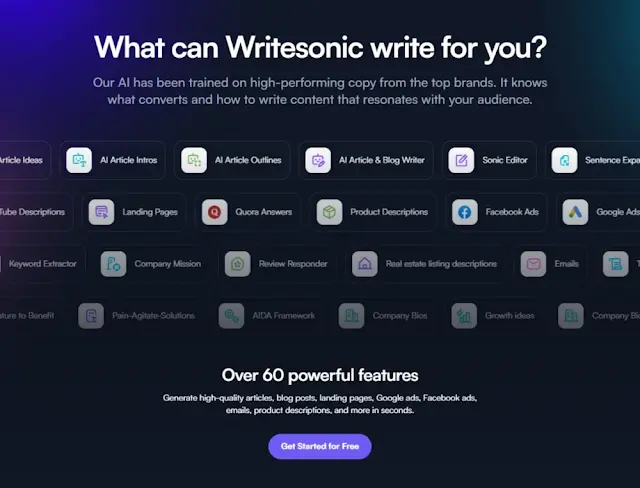
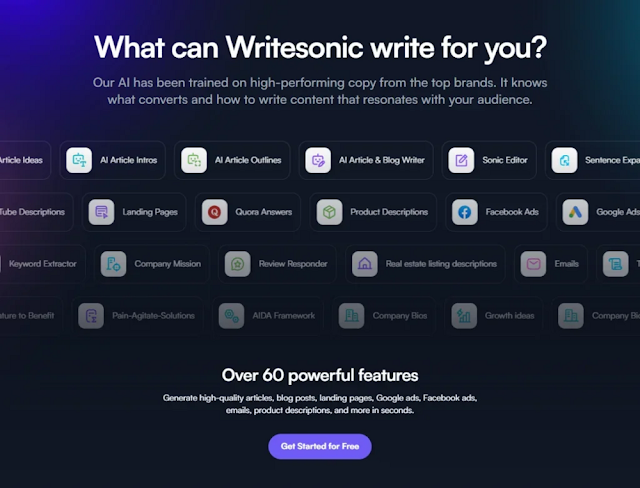
6. Writesonic
Writesonic is celebrated as a robust article-writing software that bridges the gap between creative AI generation and rigorous quality control. It integrates grammar checking and plagiarism detection directly into its writing environment, making it ideal for budget-conscious solopreneurs.

- Core Strengths: Integrated quality assurance tools, dedicated long-form assistant, and multi-purpose marketing templates.
- Pricing Structure: Operates on a credit-based trial model, with paid tiers starting around $15/month for short-form content and $19/month for long-form capabilities.
7. CopySmith
CopySmith is an enterprise-ready AI content generator engineered to produce professional documents, blog posts, and marketing presentations at scale. It offers collaborative team features and a diverse array of rapid-deployment templates.
- Core Strengths: Team collaboration tools, bulk content generation, and seamless integrations.
- Pricing Structure: Offers a credit card-free trial, followed by the Starter Plan at $19 per month and customizable Enterprise solutions.
8. Hypotenuse.ai
Hypotenuse.ai is purpose-built for the e-commerce sector. It excels at generating high-volume product descriptions, category text, and visual marketing assets, making it an indispensable tool for online retailers and digital storefront managers.
- Core Strengths: E-commerce optimization, bulk product description generation, and simplified user onboarding.
- Pricing Structure: Free trial period followed by tiered subscriptions including the Starter Plan ($29/mo) and Growth Plan ($59/mo).
9. Kafkai
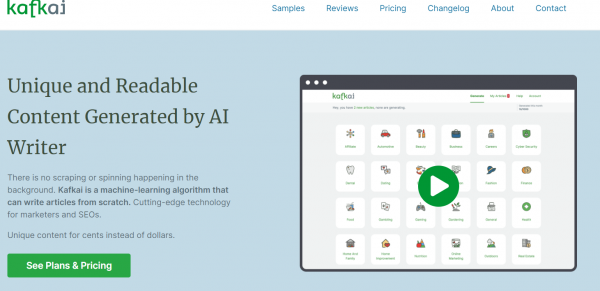
Kafkai is a specialized writing tool designed specifically for SEO professionals and affiliate marketers who require niche-specific content at scale. It utilizes unsupervised machine learning models to generate articles across a wide spectrum of specialized industries.
- Core Strengths: Niche content generation and high-volume output capability.
- Pricing Structure: Tiered volume-based subscriptions starting with the Writer Plan ($29/mo for 100 articles) up to the Industrial Printer Plan ($199/mo for 2,500 articles).
10. Peppertype.ai
Peppertype.ai functions as a virtual content marketing team, helping business owners and creators rapidly ideate, draft, and polish copy across various digital formats. Its clean interface and specialized writing modules make blogging effortless.

- Core Strengths: Rapid ideation, clean user experience, and diverse blogging formats.
- Pricing Structure: Trial options available, with the Personal Plan starting at $35 per month and Team Plans scaling to $199 per month.
Official Statements and Industry Insights
Industry analysts note that the integration of artificial intelligence into content workflows is no longer a futuristic concept—it is an operational necessity. According to leading digital publishing consultants, "The future of content creation does not belong to AI alone, nor does it belong exclusively to humans. It belongs to human creators who know how to leverage AI tools to amplify their creativity, efficiency, and reach."
While concerns regarding search engine penalties for AI-generated content once dominated industry discussions, search engine guidelines have increasingly clarified that quality, helpfulness, and user intent matter far more than the underlying mechanism of production. Content that provides genuine value—regardless of whether it was assisted by an AI model—ranks effectively when curated by human editorial oversight.

Future Outlook: What Lies Ahead for AI Content Generation?
Looking forward, the trajectory of AI content generation points toward deeper multimodal integration. We can anticipate tools that seamlessly combine text generation with real-time data fetching, automated graphic design, programmatic video editing, and advanced personalized email distribution.
As Large Language Models become more refined, the friction between human intent and machine execution will continue to diminish. Creators who adopt these technologies early will establish a formidable competitive advantage, freeing up valuable cognitive bandwidth to focus on high-level strategy, creative direction, and audience engagement.
Ultimately, choosing the right AI writing assistant depends entirely on your specific organizational requirements, budgetary constraints, and publishing volume. Whether you choose an all-encompassing powerhouse like Jasper, an SEO-focused strategist like Frase, or an e-commerce specialist like Hypotenuse.ai, incorporating artificial intelligence into your content workflow is the definitive path forward in the digital age.