Executive Overview
In the theater of modern corporate technology, few spectacles match the grandiose showmanship of an Elon Musk product unveiling. Standing beneath the Texas night sky, the billionaire entrepreneur leaned into a microphone to deliver a classic piece of techno-prophecy: "What you see with your eyes, you will not believe!"
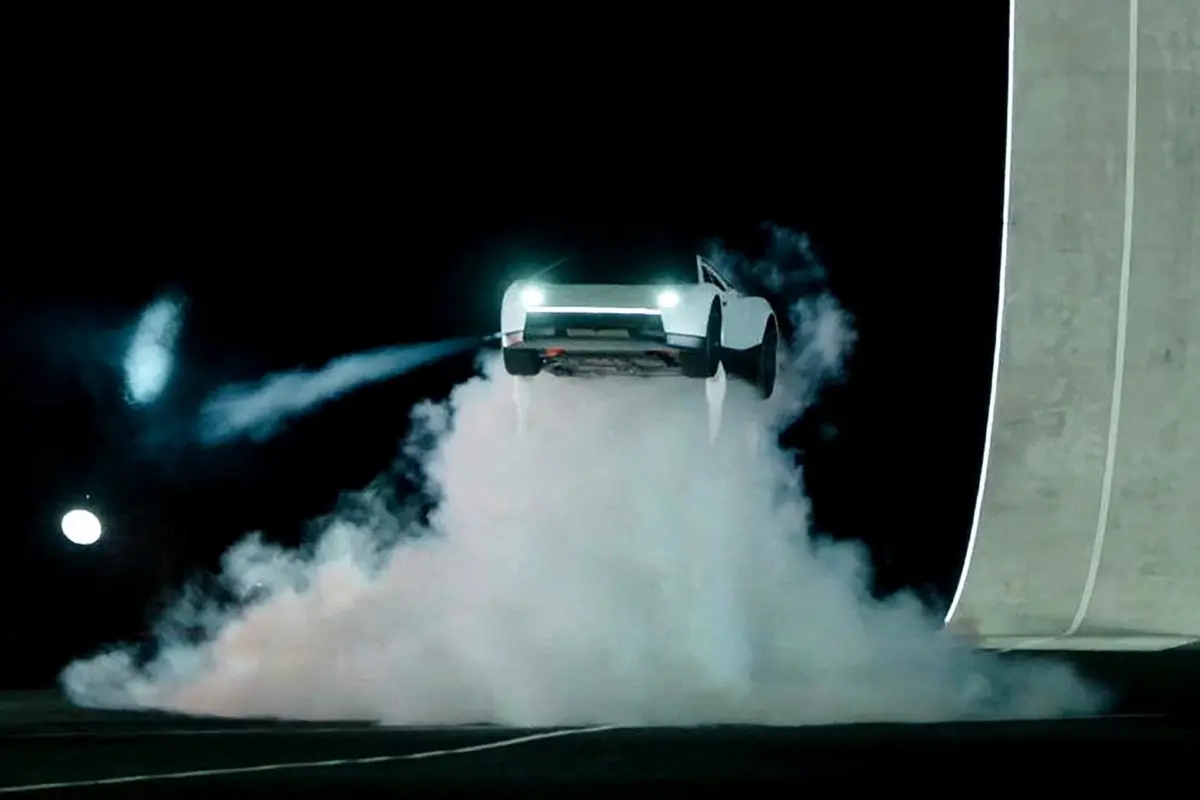
The occasion was the long-overdue, highly anticipated unveiling of the next-generation Tesla Roadster—a vehicle Musk promised would not merely drive, but briefly fly. Touted as a mechanical hybrid of a 1970s Lotus Esprit and an SR-71 Blackbird spy plane, the prototype boasted an electric drivetrain capable of launching from 0 to 60 mph in a blistering 0.8 seconds. Yet, the real headline-grabber was its integration of SpaceX-designed gas thrusters, engineered to provide explosive bursts of acceleration and, yes, short arcs of airborne elevation.
Beneath the flashing lights, roaring crowds, and pyrotechnics, however, lay a far more profound subtext. This was not merely the debut of an eccentric hyper-car destined for the ultra-wealthy. Rather, the event served as a calculated smoke screen—a brilliant, high-octane distraction signaling the twilight of Tesla as a traditional automotive manufacturer.
Industry analysts, financial insiders, and tech watchers are increasingly recognizing the Roadster reveal for what it truly was: a carefully orchestrated runway toward a historic corporate restructuring. Prepare for the sunsetting of Tesla as we know it, as Elon Musk clears the financial and structural runway for a mother-of-all-mergers uniting Tesla and SpaceX into a single, multi-trillion-dollar galactic conglomerate.
Detailed Chronology: From the Texas Ramp to the Horizon of a Megamerger
To understand how Tesla arrived at this existential crossroads, one must trace the timeline of Musk’s grand vision, the mounting pressures facing the electric vehicle (EV) pioneer, and the strategic deployment of the new Roadster.
The Spectacle in Texas
At the live-streamed event in Texas, Tesla engineered a massive, C-shaped ramp designed to test the limits of physics and public credulity. The new Roadster ascended the curve, using a sophisticated, downforce-generating fan system to remain miraculously stuck upside down. From there, it blasted free, executed a brief, controlled flip—the literal "flying" component of the evening—and touched down amid a dramatic cloud of compressed air. To cap off the demonstration, it leaped over a lineup of parked Tesla vehicles with another theatrical roll.
While jaw-dropping, the stunt was reminiscent of Musk’s most audacious public relations maneuvers, most notably the 2018 launch of his personal red Roadster into deep space atop a SpaceX Falcon Heavy rocket—a cherry-red artifact that remains in solar orbit to this day.
Yet, beneath the amusement park theatrics, Musk dropped a monumental strategic admission: this Roadster will be the last manually drivable vehicle Tesla ever builds.
The Strategic Pivot: Cybercabs and Humanoids
With that single declaration, the future trajectory of Tesla snapped into sharp focus. The era of selling consumer-driven EVs is bowing out, making way for an ecosystem dominated by the Cybercab—an autonomous robotaxi devoid of steering wheels and pedals—and Optimus, a fleet of humanoid robots.
Musk has unabashedly claimed that Optimus will eventually push Tesla’s market capitalization to an astronomical $25 trillion, a staggering leap from its current $1.4 trillion valuation. Priced around $30,000 apiece, these robots are ostensibly designed to eradicate human drudgery, spanning everything from assembling Cybercabs and mowing lawns to bartending, elder care, and assisting in the eventual colonization of the moon and Mars.
The Mechanics of the Merger
As Tesla funnels staggering sums into artificial intelligence and next-generation robotics, its core automotive business is facing severe margin compression. The Roadster showcase was not merely a love letter to automotive speed enthusiasts; it was an explicit telegraphing of Tesla’s ultimate corporate destiny: absorption into SpaceX.
By merging the two entities, Musk can creatively rescue Tesla’s tightening balance sheet by leveraging SpaceX’s unmatched capacity to raise colossal amounts of capital from public markets. Why else make SpaceX propulsion technology the central selling point of a long-delayed Tesla automotive showcase?
Supporting Context & Metrics: The Shifting Sands of the EV Market
To appreciate why a Tesla-SpaceX merger is transitioning from a speculative theory to an operational necessity, one must examine the hard economic realities currently confronting the world’s most famous EV maker.
Financial Health and Production Realities
On paper, Tesla remains a corporate titan. In 2025, the company delivered more than 1.6 million manually drivable vehicles, generating approximately $95 billion in revenue, primarily from automotive sales alongside its growing solar and energy storage sectors.
Yet, beneath these headline figures lie warning signs:
- Stagnant Lineup: Tesla has not introduced a truly new, non-flying consumer vehicle since the Cybertruck debuted in 2019. Furthermore, it has quietly ended production of its high-priced Model S sedan and Model X SUV, leaving the aging Model 3 sedan and Model Y crossover to shoulder the entire volume of the business.
- Shrinking Margins: The explosive influx of low-cost competition from Chinese automakers has eaten aggressively into global market share—particularly in Europe, where Musk’s political alignments and public controversies have inflicted collateral damage on regional sales.
- The Regulatory Credit Cliff: For years, Tesla survived and thrived financially by capitalizing on billions of dollars in regulatory credits sold to legacy automakers. As traditional manufacturers ramp up their own compliant fleets, this lucrative revenue stream has steadily dried up.
- A Cooling U.S. Market: The phased elimination and restriction of federal EV tax credits have visibly weakened domestic consumer demand.
The Anatomy of the Roadster Presales
If history serves as a reliable guide, prospective buyers should not hold their breath for mass production of the flying Roadster. When the original Roadster was announced back in 2017, eager enthusiasts rushed to secure reservation slots with $50,000 deposits (and up to $250,000 for the limited Founder Series).
Tesla’s modern pricing strategy for the new iteration is similarly stratified:
- "Performance" Trim: $50,000 reservation entry point.
- "Thrust" Trim: $250,000.
- "Rocket" Trim (The Flying Version): An undisclosed, invite-only sum.
With deliveries optimistically slated for 2028, consumers are once again reminded of the golden rule of Musk-era enterprises: caveat emptor (let the buyer beware).
The Wall Street Consensus
The prospect of a formal Tesla-SpaceX consolidation is no longer confined to Reddit forums and tech blogs. Wall Street analysts have begun treating the idea with grave seriousness. Notably, Barclays analyst Dan Levy recently suggested that a merger between the two corporate giants is nearing inevitability, projecting that it could materialize before the close of 2026.
Under this anticipated structure, SpaceX would act as the acquiring entity, with Tesla investors swapping their shares for SpaceX stock. The resulting monolith would command a staggering valuation hovering around $3.5 trillion.
Crucially, this financial union would empower Musk to draw upon SpaceX’s formidable fundraising prowess to shoulder the astronomical capital expenditures required to retool Tesla’s factories for Cybercab mass production, scale Optimus manufacturing, construct massive AI data centers to rival OpenAI and Anthropic, and pursue the wild ambition of launching solar-powered orbital data centers.
Official Statements and Industry Perspectives
The convergence of automotive manufacturing and aerospace engineering has triggered intense debate across financial markets and technology sectors.
Elon Musk’s official narrative frames the entire evolution of Tesla not as an end in itself, but as a multi-decade bootstrap operation. According to Musk, manufacturing millions of moderately priced consumer EVs was never the final destination; it was simply a necessary mechanism to fund global manufacturing expertise, build supply chains, and develop the automated infrastructure required to churn out a Cybercab every ten seconds while marching legions of humanoid robots down assembly lines.
"The vehicles we built were always a means to an end," insiders close to the executive circle suggest. "You cannot build an interplanetary supply chain or a fully automated robotic workforce without first mastering terrestrial mass production at a planetary scale."
Industry skeptics, however, view the narrative through a more pragmatic, financial lens. For years, seasoned automotive executives questioned the long-term viability of Tesla’s hyper-focused product roadmap, wondering why the company repeatedly abandoned lucrative luxury segments and delayed expansion into profitable categories like large-scale family SUVs and traditional utility trucks.
Financial analysts argue that the sudden pivot toward artificial intelligence, autonomous robotaxis, and humanoid labor is a direct defense mechanism against the commoditization of electric vehicles. As profit margins compress under the weight of global competition, Musk is effectively pivoting the company out of the crowded, low-margin automotive sector and into the high-margin realms of autonomy, robotics, and aerospace infrastructure.
Future Outlook: The Dawn of the Galactic Mega-Entity
As the dust settles on the Texas spectacle, the writing on the wall is exceptionally clear. The traditional era of Tesla as a pure-play automotive manufacturer is drawing to a close.
The unveiling of the thruster-equipped Roadster was never truly about delivering a flying car to the consumer driveway. It was a masterclass in narrative redirection—a signal flare announcing that Tesla is shedding its automotive skin to merge with SpaceX, birthing an unprecedented corporate leviathan.
For investors who weathered the volatility, the journey from the original 2008 Roadster to the precipice of a multi-trillion-dollar galactic enterprise has been nothing short of a roller coaster ride. Whether this bold integration of autonomous robotaxis, orbital rocketry, and artificial intelligence ultimately fulfills Musk’s utopian—or dystopian—visions remains to be seen.
One thing, however, is indisputable: the corporate entity rising from the ashes of this impending megamerger will make classic science-fiction monopolies like the Weyland-Yutani Corporation look tame by comparison. The future of transportation is no longer grounded on asphalt, nor is it confined to Earth. It has been cleared for launch.