Executive Overview
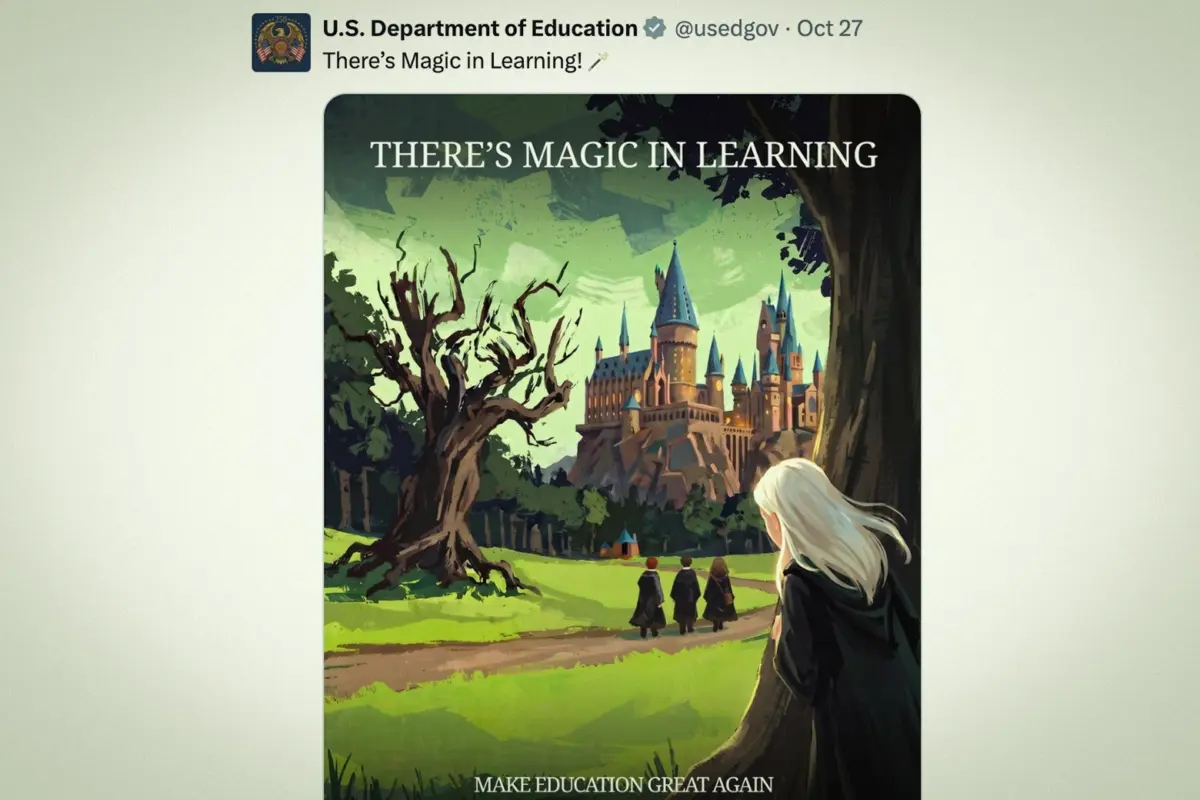
In the sprawling, hyper-accelerated ecosystem of modern internet culture, the boundaries between fringe subcultures, AI-generated content, and official government communications have officially collapsed. This week, the United States Department of Education shocked digital culture observers by posting an AI-generated image to X (formerly Twitter) featuring a caption that directly nodded to a viral, right-wing Harry Potter meme. The image, accompanied by the text "There’s Magic in Learning—Make Education Great Again," depicted a scene reminiscent of J.K. Rowling’s wizarding world, but anchored by a digital specter known intimately by internet historians and the "manosphere" as "Draco Malfoid."
This seemingly harmless—if deeply bizarre—social media misstep is far more than a quirky government intern gaffe. It marks a watershed moment in digital sociology: the mainstreaming and sanitization of an explicitly misogynistic internet subculture by the federal apparatus. The "Draco Malfoid" phenomenon began as a gender-swapped fan-fiction meme born out of AI art generators and amplified by incel-adjacent online spaces. Yet, its rapid trajectory from the depths of platformed irony to official government channels illustrates a profound shift in how internet slang, generative content, and political messaging intersect.
This deep-dive investigation examines the anatomy of the Malfoid meme, the ironic embrace of traditional fan fiction by right-wing digital spaces, the dark etymology of incel terminology, and the alarming implications of institutional participation in algorithmic slop.
Detailed Chronology: The Birth and Ascent of "Draco Malfoid"
To understand how a federal agency came to reference an AI-generated incel meme, one must retrace the bizarre digital lineage of the character.
Phase 1: The Original Conception
Roughly a month prior to the Department of Education’s post, a digital artist operating under the handle @redteneri published an original illustration on X. The drawing reimagined classic Harry Potter antagonist Draco Malfoy as a young woman with cascading blond hair, striking green irises, and large hoop earrings. Dubbed "Dracaena Malfoy" by the artist, the character initially existed within the conventional, albeit niche, boundaries of traditional fan art. Human artists produced several hand-drawn variations of the character, playing on familiar tropes of gender-swapped literary figures.
Phase 2: The Algorithmic Hijacking and the Birth of "Malfoid"
However, the character’s trajectory shifted violently once it entered the automated content mills of generative artificial intelligence. A tidal wave of synthetic, AI-generated videos, images, and text prompts flooded social media platforms. In this transition, "Dracaena" was stripped of her original human artistry and rebranded by the alt-right and incel communities as "Draco Malfoid."
The suffix -foid is not accidental; it is a calculated, misogynistic portmanteau derived from "female" and "android" or "humanoid organism" (frequently shortened to femoid). Originating on unmoderated image boards like 4chan, the term is deployed to dehumanize women, reducing them to subhuman computational objects.
Despite this grim etymological root, Malfoid quickly transcended her origins through sheer volume. AI-generated narratives depicting a tortured, enemies-to-lovers romance between Harry Potter and Malfoid flooded TikTok. Fans engineered a dark academia dating simulator titled Pureblood & Prejudice on itch.io. Comment sections across J.K. Rowling’s social media feeds were inundated with references to the synthetic character.
Phase 3: Institutional Capture
The final, surreal frontier of this digital pathogen was crossed when the U.S. Department of Education’s digital media team published their branded iteration. Utilizing what digital forensic tools indicate is a 99 percent probability AI-generated image, the agency deployed the "Magic in Learning" campaign. The online reaction from the meme’s proponents was immediate and euphoric. "MALFOID OCCUPIED GOVERNMENT," cheered one user on X, capturing the surreal triumph of fringe internet culture colonizing official state communication channels.
Supporting Context & Metrics: The Gender Dynamics of Fandom and the Right
The embrace of the Malfoid phenomenon by right-wing internet spaces represents a profound cultural irony. Historically, the infrastructure of internet fan fiction has been overwhelmingly female, queer, and marginalized.
The Demographics of Fandom
Platforms like Wattpad and Archive of Our Own (AO3) have long served as creative sanctuaries for women and Gen Z/Millennial creators. According to platform data, more than 70 percent of Wattpad’s reader demographic as of 2021 consisted of women, with over 80 percent belonging to Gen Z and millennial cohorts. Major internet fandoms have traditionally been built around fictional queer romances—colloquially known as "ships"—such as:
- Supernatural’s "Destiel" (Dean Winchester and Castiel)
- The "Drarry" pairing (Harry Potter and Draco Malfoy) within the Harry Potter universe itself
- Real-person shipping communities like "DreamNotFound"
For decades, these spaces were routinely dismissed, mocked, or pathologized by mainstream male-dominated internet subcultures as "cringe" or "worthless." Derogatory terms like foidslop were routinely weaponized by the manosphere to demean creative output authored by women—ranging from get-ready-with-me beauty tutorials to romantic fiction.
The Great Inversion
The sudden adoption of Harry Potter fan fiction by right-wing "military bros" and internet political commentators represents a fascinating inversion. By slapping a hyper-sexualized, AI-generated, gender-swapped face onto Draco Malfoy and labeling her "Malfoid," the manosphere managed to launder the traditionally female-dominated medium of fan fiction into acceptable, digestible content for male audiences.
As digital culture critic and tech observers note, these men are now consuming complex, multi-chapter fan-fiction narratives—complete with trope-heavy enemies-to-lovers arcs—while swearing unironically that the storytelling is superior, completely blind to the fact that they have simply rediscovered a genre built by young women over the past twenty-five years.
Official Statements and Institutional Silence
The fallout from the Department of Education’s post has cast a harsh spotlight on the vetting processes governing federal social media accounts. As of press time, the Department of Education has issued no official clarification, apology, or technical breakdown regarding how an AI-generated image carrying an alt-right incel meme reference was approved for public dissemination.
The Transparency Void
Independent analysis utilizing advanced image detection frameworks—such as SightEngine—indicates that the visual asset posted by the federal agency bears all the classic hallmarks of generative AI, scoring a 99 percent probability of synthetic origin. When government communications rely on synthetic media, questions of accountability immediately arise:
- Editorial Oversight: Were content creators within the federal agency consciously aware of the "Malfoid" etymology, or were they merely chasing algorithmic engagement metrics?
- Resource Allocation: Does the reliance on AI-generated imagery reflect a broader systemic shift within government agencies toward automated, low-cost content production at the expense of human graphic designers and copywriters?
- Cultural Co-optation: To what extent are federal channels intentionally adopting subversive internet vernacular to appeal to younger, chronically online demographics, and where is the ethical red line drawn regarding hate-group lexicon?
Future Outlook: The Age of Synthetic Fandom and Government "Slop"
The convergence of the Department of Education and an AI-generated incel meme is a diagnostic symptom of a wider cultural malaise: the triumph of "slop" over substance.
For decades, the architects of internet culture were human beings. Fan-fiction writers spent countless hours painstakingly drafting hundreds of thousands of words, agonizing over plot holes, and inserting humble disclaimers ("Sorry for the errors, my English isn’t too good"). They built communities brick by digital brick in an era when the internet still felt like an expansive, hopeful frontier of human creativity.
Today, that infrastructure has been hollowed out by generative artificial intelligence. The "Malfoid" phenomenon demonstrates that future cultural touchstones will not even require human imagination; they will be synthesized via machine-learning algorithms that scrape decades of unpaid labor by young women, repackaged through the cynical lens of manosphere irony, and ultimately regurgitated by federal agencies eager for viral engagement.
As we look toward the future, the integration of fringe internet memes into state communications signals a chilling normalization of digital nihilism. If the U.S. Department of Education can unwittingly—or wittingly—celebrate "Malfoid," we have officially entered an era where institutional authority and digital shitposting are indistinguishable. The classroom of tomorrow may well be run by algorithms, captioned by incels, and sponsored by a federal government that has traded governance for engagement metrics.